2024 is my year of short stories. In this weekly series, I talk about the stories I’m working on, from idea and draft to submission.
Stories in Progress – 1
Submissions This Week – 1
Submissions Currently Out – 2
Rejections – 1
The First Rejection of the Year
“Tom, Dick, and Derek” garnered my first rejection of the year. This was a turnaround of only a few days, but it’s not too surprising since it’s a drabble and the magazine was only accepting flash fiction. I’m still not entirely sure of the viability of 100-word stories, but I’ll continue submitting to flash fiction publications and see how it goes.
Revisions for Pleasant Hills
This week, I re-read all the feedback I had received for “The Incident at Pleasant Hills” and condensed it into a page of bullet points of things to address, and several more pages of small line edits and suggestions for wording improvements. Most of these are straightforward fixes. A few are things that the story needs, and I just need to figure out where to put them. But there are a couple problems that I don’t have a solution for yet.
One of the things I need to improve about my writing process is handling revisions. I was hoping to be done or close to done with this story last week, but now that I’m in the middle of it, I’ll be happy if I can get it all done in the next week. I’m quickly realizing that writing short stories is a juggling act between keeping finished stories out on submission, and writing and editing new stories.
Themed Submissions
I mentioned last time that I was thinking about trying some themed submissions.
This week, I trolled the Duotrope listings, looking for themed submissions in speculative fiction genres that pay pro and semi-pro rates. I started with the basic search, and was annoyed to find no good search options to filter down to these. So I searched the listings and read the submissions pages. It was only after I had gone through twenty or thirty publications that I discovered Duotrope’s entirely separate page, the Theme and Deadline Calendar, which is designed for exactly this.
Having gone on my own search before discovering these listings, I know it’s not showing everything that’s out there. For example, Apex Magazine’s monthly flash fiction contest doesn’t show up. This probably comes down to how the listings are categorized.
If you’ve got the time and the inclination to write for these themed submissions, it might be worth doing your own research to track them down. However, the Duotrope listing is pretty good, and won’t suck up a whole afternoon.
With a few options in hand, I spent time brainstorming for the Parsec short story contest’s “AI Mythology” theme. I filled a couple pages with Story Engine ideas, but nothing that particularly excited me. I find Story Engine useful because it creates interesting constraints, but in this case, where the theme is already a significant constraint, I think it might be too much.
I plan to come back to these themed submissions every week or two and try other methods of brainstorming. It’s a good exercise to stay productive when I don’t feel like working on the stories in progress.
Fun Find – Plotopolis
Plotopolis is a new site for interactive fiction. It’s launching this winter, but open for submissions and proposals now. If you’re not familiar with interactive fiction, I wrote a post about it. It can be as simple as Choose Your Own Adventure-style branching narrative, or as complex and gamified as Fallen London, with character attributes and an inventory of items.
Interactive fiction has gained some acceptance as gaming in general has entered the cultural mainstream, but it remains a fairly small niche, so it’s nice to see something like this popping up. Hopefully they find their feet and are able to stick around.
Goals for Next Week
Only one goal this week: revise Pleasant Hills! I want to get this one done and out for submission.
2024 is my year of short stories. In this weekly series, I talk about the stories I’m working on, from idea and draft to submission.
Stories in progress – 1
Submissions this week – 1 (1 currently out)
Reviewing the Backlog
This first week, I spent some time reviewing short stories that I already have finished and edited.
“Dr. Clipboard’s Miracle Wonder-Drug” is a 1400-word modern fantasy story about a man in a drug trial who experiences an unexpected transformation. It has already been through critique and polishing, and is ready to send out.
In general, there tend to be more venues for shorter stories than longer ones. This is a nice length because most publications will accept it. It’s right on the edge of flash fiction territory (depending on your exact definition).
I recently gave a Critters critique that got me thinking about story titles and the ways they can add to the story itself. I spent some time rethinking this title, and while I didn’t end up finding one I liked better, it was still time well-spent. One of the most valuable things I get out of critiquing others’ work is new insights that I can apply to my own work.
I also have four finished drabbles that I’m fairly satisfied with. One is new, but the other three are already posted here on Words Deferred, so they could only be submitted to publications that accept reprints.
I don’t really know how easy it is to sell drabbles, since they’re so short. I’ve only seen them in a couple of publications that specialize in them, so my guess is that they are harder to place than flash fiction in the 500-1000 word range.
Submitting Stories
Duotrope is a great tool for narrowing down possible places to submit stories. I start by narrowing my search to the appropriate genre(s) and length. I also limit my search to professional pay rates. Well-paying publications are going to be more competitive, but you might as well try. If the story gets rejected, you can always submit to the semi-pros markets next.
However, that filtered list of publications is just the start of the process. The bulk of the effort is in reviewing those publications to find a good fit. After all, it’s a waste of time to submit a story to a place that doesn’t publish what you’re writing.
Duotrope has interviews with the editors of some publications, and these (usually) provide some insight into what they’re looking for. Ultimately, though, the best way to get to know a publication is to read it.
So, I read a few of their stories, if possible, and try to get a feel for what the editors like. Conveniently, a lot of publications these days are online, and it’s common for at least some stories to be available for free.
This all has the added benefits of immersing my brain in good short fiction and giving me a better understanding of what the current market is like in my chosen genres. It feels like a lot of effort now, especially if I decide that a publication isn’t a good fit for the story I’m sending out, but I hope that over time I’ll develop a good feeling for many of these markets, and I won’t have to do quite so much research.
This week, I only submitted one story, “Dr. Clipboard,” and that’s at least partly because I spent a few days deciding where to submit.
Work In Progress
I have one story in progress, a 2000-word sci-fi story called “The Incident at Pleasant Hills,” about the detonation of an architecture bomb with the power to reshape a city. It has been through critique and needs some revisions before it’ll be ready to go out the door.
The final story I’ll talk about this week is one that I’m just starting, tentatively titled “Portrait of the Artist in Wartime.” It’s a science fiction story about a performance artist who uses time travel to create his magnum opus. I’m going to try to write this in the form of an interview with the artist’s former assistant.
It’s interesting to note that the core ideas of both of these stories came from my brainstorming sessions with Story Engine cards.
Goals for Next Week
Revise “Pleasant Hills”
Research more publications and submit at least one drabble
If you’ve been around here for a while, you might remember my review of The Story Engine. The Story Engine is part card game, part tool for generating semi-randomized writing prompts. I’ve used it as a fun way to brainstorm ideas for short stories, and I’ve found that it works well for me. As someone who enjoys card and board games, it’s just a much more fun and tactile way to generate ideas than sitting in front of the notebook with pen in hand.
Recently, the folks behind the original Story Engine kickstarted a new product in the same vein. It’s called the Story Engine: Deck of Worlds. Deck of Worlds is another card-based brainstorming game, but this time it’s focused on settings instead of plots. It’s billed as a tool for storytellers and TTRPG game masters to easily generate interesting and deep settings.
I received my order right before the holidays, and I was able to take Deck of Worlds for a test drive.
What’s In the Box?
The base set of cards for Deck of Worlds comes in a flat box with a plastic insert, magnetic latch, and a heavy tagboard sleeve that guarantees it will stay closed. This is nearly identical to the box that the original Story Engine came in, and the build quality is good. It’s the sort of box you’d expect from a premium board game.
However, the original Story Engine had many expansion packs that added more cards, and Deck of Worlds is the same. If you add extra cards to your set, you’ll quickly fill up the small amount of extra space in the box. Luckily, the creators of the Story Engine are well aware of this problem, and they’ve created a new card box with dividers that is capable of holding all the cards, even if you’ve got every single expansion. They’re inexpensive, so I got one for my original Story Engine set as well as my Deck of Worlds.
I also received three expansion packs for Deck of Worlds. “Worlds of Chrome and Starlight” is the science fiction expansion, “Worlds of Myth and Magic” is the fantasy expansion, and “Worlds of Sand & Story” is the deserts expansion. I chose these because sci-fi and fantasy are my two favorite genres to write in, and I have a TTRPG project percolating with a strong desert component.
Much like the original product, the Deck of Worlds main box includes a slim “guidebook,” which describes the intended ways to use the Deck of Worlds—although the creators are clear that there is no wrong way to play.
The Card Types
There are six card types in the Deck of Worlds: Regions, Landmarks, Namesakes, Origins, Attributes, and Advents. According to the guidebook:
Regions establish a setting’s main terrain type and act as a hub for other cards
Landmarks add geographical sites and points of interest
Namesakes combine with Regions or Landmarks to create in-world nicknames
Origins record significant events of the area’s past
Attributes highlight present-day features of the area and its people
Advents introduce events that may change the area’s future
Regions are the only cards with a single prompt on them, and have a nice background that illustrates the geography of the setting. Landmarks have two prompts to choose between, and each one has a background illustration. The other four card types have a symbol and color to identify the card type, and four different prompts to choose from.
Building Basic Settings
The simplest way to play with Deck of Worlds is to create small settings, or “microsettings” as the guidebook calls them. These will typically be built around a single region (terrain type) and a single landmark, like a building.
For my test run, I built a few of these microsettings. First, I chose the prompts I liked best and combined the cards. Then I expanded or focused the results, writing a little blurb about each setting. I only spent a couple minutes on each of these examples.
The Grassland of Crowds
The museum’s founding piece is a huge fulgurite dug out of a sandy hill. The museum was built around this dug-out hill, and the piece is displayed, unmoved, where it was found.
The “lightning festival” grew in this area, and is held during the season of rainless storms. People display all kinds of art. One of these presentations is voted the winner of each festival and incorporated into the museum.
The Scree of Rivers
(Cyberpunk) The scree was mined for the long, winding veins of precious metals near the surface, leaving a maze of narrow, shallow canyons and piles of leavings. Rivers form when it rains. A grey market meets here periodically, protected from government scanners by the trace metals in the rock, with lots of escape routes and hidey-holes for quick getaways.
Not sure about the prophecy bit.
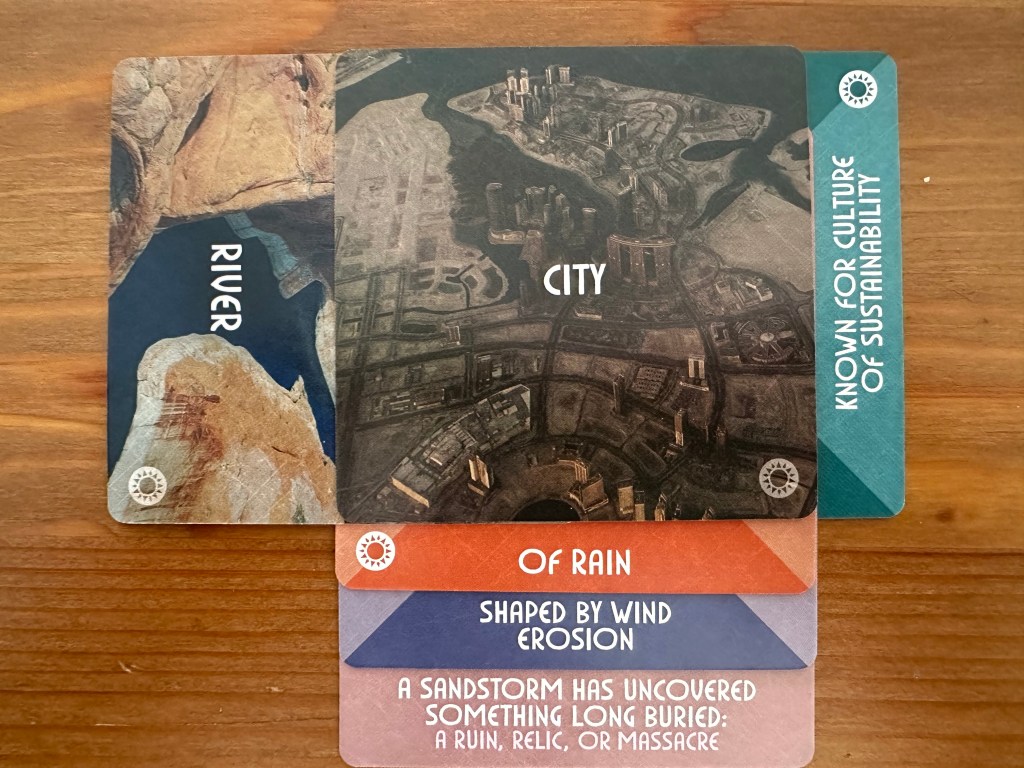
City of Sand and Story
The City of Rains is nestled in rocky mountains in a desert. During the wet season, the mountains funnel moisture and clouds and it rains on the city, creating a temporary river. All inhabitents capture as much water as possible, to live on and trade for the rest of the year. They plant crops along the river while it lasts.
A recent sandstorm uncovered caverns in the rock beneath the city, leading to underground ruins and vast cisterns. The discovery of so much water could upend the economy of the entire region
Complex Settings
The guidebook also includes some rules for building more complex settings out of multiple microsettings. There is really no limit to the number of smaller settings you could combine. There are optional rules, including a “meta-row” for attributes of the larger area as a whole, a “sideboard” of extra cards to give you more choices when selecting any given card type.
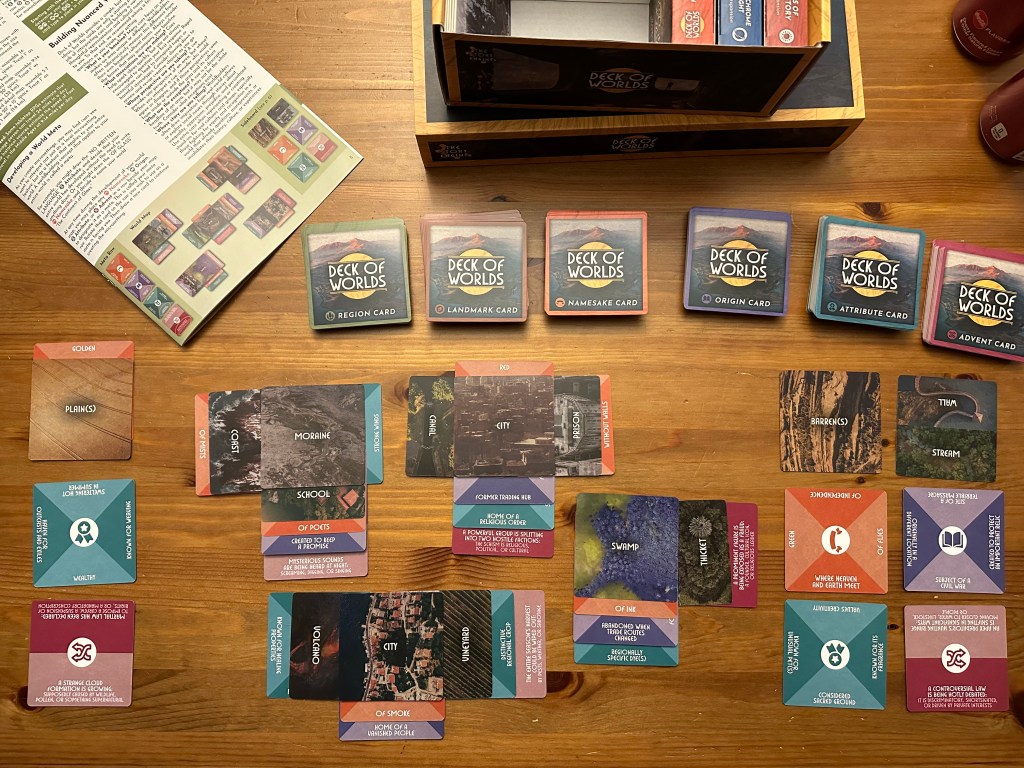
To test this out, I built a setting from four different microsettings, using the meta-row (on the left) and sideboard (on the right).
The Golden Plains
Once known as a wealthy region, but its reputation is fading. The area has been covered with strange dark clouds for weeks, but there is little rain.
In the North: The Red City
Home of a religious order, this city was built on a river and filled with canals. It was once a hub of commerce, but the river grew over the years and eventually overflowed its banks south of the city, disrupting the flow and creating a vast swamp.
Now, the priests of the Red City ply a darker trade: they’ve made the city into a prison for the worst criminals. The prison is the center of the old city, and is called “The Prison Without Walls.” It is surrounded by deep and fast-running canals, and is only accessible by a single, heavily-guarded bridge.
The priests have traditionally been led by a patriarchal lineage of high priests, but now a lowly priestess is gathering a following among priests and prisoners alike. She has radical ideas of rehabilitating prisoners instead of working them to death as penance for their crimes.
In the South-East: The Swamp of Ink
These thickets were once hunting grounds of the nobility, until the river overflowed and the land became swampy.
The few people who still live here are led by an excommunicated priest from the Red City. They harvest “swamp mites,” tiny, stinging crawfish that can be ground into fine black dyes. Travelers from the North recently called out the priest as an exile, and he imprisoned them, but there is unrest and talk of rebellion among the people.
In the West: The Moraine
The coast of mists is the western edge of the Golden Plains region.
The Moraine is the home of the School of Poets. It was created by a celebrated poet who was known as a cantankerous jerk. The only woman who ever loved him, muse of his thousand poems, made him promise to teach other poets his craft.
The school is rumored to be haunted. While most of its inhabitants don’t take this seriously, many students have recently complained of strange and disturbing noises coming through the stone walls.
In the Southwest: The City of Smoke
A city on the slopes of an inactive volcano, built atop the ruins of the “old city,” which was destroyed by the last eruption.
Hot springs in the city are warmed by the heart of the volcano. They supposedly have healing properties, and draw tourists who hope to have their injuries or sickness cured.
Vineyards planted in the fertile volcanic soil use a unique variety of small, golden grapes, harvested after the first frost to make sweet wine.
The dark clouds that have shrouded the region threaten the growth of the grapes and the year’s wine harvest.
Takeaways
Overall, I’m pretty happy with the Deck of Worlds so far. It has a very similar feel to the original Story Engine. The cards strike a nice balance by giving you a few options to pick from, but also limitations that force your brain to make interesting and occasionally surprising connections between seemingly unrelated things.
Like any sort of brainstorming, not every single idea will be a good one. The randomization means that sometimes you get combinations that just fall flat or fail to inspire. Some of this depends on your own creativity and willingness to explore.
Like the original Story Engine, the quality of the product is great. The new boxes are an improvement, allowing me to keep all my original and expansion cards together in a form factor that takes up less space than the original box.
I don’t necessarily like all the rules suggested by the guidebook, but it’s easy to tweak the process until it works for you. They’re just cards, and they can be arranged however you see fit. The extra rules for bigger settings are a little complicated for my tastes, but the end result in my experiment had some interesting ideas that I wouldn’t mind exploring further.
The guidebook also has more rules that I didn’t get into, for collaborative multiplayer and for combining Deck of Worlds with the original Story Engine. All of that feels like more complexity than I want when I’m brainstorming—I would much rather create smaller ideas and then mix and match myself. However, I’m sure this style of prescribed creation could work for others.
Finally, I think this could be a great tool for GMs/DMs who run custom table-top RPG campaigns. I’ve long believed that the best way to approach TTRPG worlds is the “billiards” style described by Chris Perkins, where you set up a number of interesting locations full of interesting characters, and then let the player characters bounce around between them, setting events in motion.
The Deck of Worlds is a great way to invent these little islands of content, and I think it would be pretty easy to create quick and dirty sessions with very little prep, especially if you’re using a lightweight rule set.
Where to Get It
The Deck of Worlds and its expansions are available directly from the Story Engine website. In addition to the Sci-fi, Fantasy and Desert expansions I chose, there are Horror, Coastline, and Arctic expansions. If you’re planning to use the deck for tabletop RPGs, they also have expansions for lore fragments, cultures, and adventure prompts.





 Words Deferred