March was my recovery month. I quit slacking off and got my writing mojo back, and I also read a few books. Some are oldies from the bookshelf, and one is a new library find.
As usual, I include Bookshop affiliate links instead of Amazon. If any of these books pique your interest, please use those links. I’ll get a tiny commission, and you’ll support real book stores instead of massive political spending by billionaires.
Hyperbole and a Half lives in an interesting space between web-comic and autobiographical blog. It began on Blogger at a time when blogs and web-comics were approaching their zenith of popularity, and was rocketed to fame by panels that became widespread memes, like this:
Brosh’s MSPaint-style art depicts every person and animal as wide-eyed and crazed, with mouths that span their faces. Every expression is extreme. It is as hyperbolic as the name suggests.
She mines her childhood, relationships, pets, and a wide variety of unusual life experiences for material, crafting stories in the vein of comedians like Mike Birbiglia or David Sedaris, but with a chronically online millennial perspective.
Several stories follow her family’s adventures living with a “simple” dog, and the adoption of a “helper” dog who turns out to be just as problematic. She describes her childhood determination to steal a birthday cake that belongs to someone else. And she recounts the experience of being attacked by an angry, wild goose in her own house.
Brosh also uses the same comic-story lens to examine her experiences with depression and becoming suicidal. These heavy topics are treated with vulnerable honesty while still managing to find the humor lurking in these dark corners (or under the fridge, in this case).
Solutions and Other Problems is the long-awaited sequel to Hyperbole and a Half. Seven years have passed between books. Brosh has gone through medical issues, mental health challenges, divorce and remarrying. The book still contains plenty of her trademark goofiness, but there is a notable shift in tone and perspective.
Brosh has also clearly leveled-up her art. It somehow manages to convey the same level of absurdity and retains the lo-fi MSPaint aesthetic while being far more detailed and varied.
Where many of the stories in the first book originally appeared on the Hyperbole and a Half blog, almost all of the content of this second book is new. Which probably explains the dearth of content on the blog in recent years.
If you enjoyed the blog and the first book, the second book provides more of the same, and does almost all of it even better.
This was an unexpected library find for me. The Last Hero is a lushly illustrated novella, written for the same adult audience as Pratchett’s other Discworld books. It occupies that sparse space between comics, children’s books, and novels. In fact, the only other illustrated story like this that I can think of is The Truth is a Cave in the Black Mountains. It’s too bad that experimentation in format like this is so rare.
Drawing from the usual massive cast of Discworld characters, this story stars Rincewind (the original inept wizard from Pratchett’s earliest books), the brilliant Da Vinci-esque inventor Leonard of Quirm, Cohen the Barbarian, and a supporting cast of wizards and barbarian heroes.
The barbarians are growing old, and they want to go out with a bang. They want to return fire to the gods. A whole lot of it. Unfortunately, exploding the magical mountain where the gods live will very likely destroy the entire Discworld, so the wizards and Leonard set out to stop them.
The storyline following Cohen and the barbarians parodies the classic D&D “murder-hobo” style of heroism, and the storyline of Leonard building a craft to fly to the highest mountain on the Disc parodies classic space-dramas and the Apollo program.
The illustrations are incredibly beautiful and detailed, in the mold of the best classic fantasy covers, so the absurdity of Discworld details (like “Wizzard” stitched onto Rincewind’s pointy hat) stand out all the more.
What I’m Reading in April
I’ve come to the realization that I often talk about reading books in this section, only for them to not appear in next month’s report.
I’m not messing with you. I promise. I just have a bad habit of reading too many things at once. And now I’ve found an exciting new way to increase my number of half-finished books, through the power of audio books!
That’s right, I’m currently listening to Fonda Lee’s Jade City on Libro.fm. And I’m still in the midst of American Gods and Ted Chiang’s short stories. And some day I’ll get beyond the first chapter of the final Witcher book. If we’re really being honest, I’ll probably pick up something else before the month is out.
What will I actually finish? Tune in next month to find out.
Alright, February was a train wreck for me, so I never managed to get January’s post out. But that’s fine. We’re all here now. We’ll do it live!
Where possible, I include Bookshop affiliate links instead of Amazon. If any of these books pique your interest, please use those links. I’ll get a tiny commission, and you’ll support real book stores instead of longevity injections for billionaires.
I’m still working through the Discworld series with my kids. Thankfully, Pritchett was a prolific author, and if I stretch them out I can continue reading his books for several more years before I’ve read them all. It’s nice to think that a favorite author can live on in this way, through his books.
Moving Pictures is an experiment in how many movie-related references and metaphors Pratchett can cram into a fantasy world. Alchemists have invented movies, their cameras powered by the dangerous combination of little imps and highly flammable cellulose film. Within weeks, the seaside shanty-town of Holy Wood springs up on an otherwise deserted stretch of beach, and people are drawn toward it by the chance for fame, and perhaps a more nefarious force.
One of the newly minted actors who found his big break at Holy Wood happens to be a student wizard from Anhk-Morpork’s Unseen University. He starts to see signs that there’s more than movie magic going on: in fact, there may be other realities (like our own) leaking into the Discworld from the void between universes. Where there are weak places in the fabric of the universe, there are Cthulhu-esque “Things” looking for a way in.
Much of the silliness of the book comes from twisted versions of familiar movie tropes: the Orangutan-transformed University Librarian picked up by a 50-foot woman climbing a tower in an inversion of King Kong; or the bald, golden, statuesque ancient protector against cosmic evil who just happens to look like everyone’s uncle Oscar.
Like the Simpsons, Discworld has a massive cast of characters that can be pulled into service for any given plotline. Detritus the troll and perpetual scammer “Cut-me-own-Throat” Dibbler get higher billing than usual, with the wizards of the University making a strong appearance toward the end.
Pratchett’s super-power, however, is the ability to write a silly story in a silly setting, packed with quips and jokes, and still build a real plot and characters with actual motivations that make you root for them.
Like many of the more unusual comics I pick up, this was a Half Price Books impulse buy. There is now a whole sub-genre of historical fiction and biography within indie comics (see Maus, Palestine, and Persepolis in my previous months’ reading), and while I don’t generally gravitate toward it, I’m glad I picked up Katusha.
Firstly, this thing is a tome, clocking in at almost 600 pages. Unlike many trade paperback comics, this has a strong binding that has held up well so far, despite that size.
When I started reading, I wasn’t especially excited by the art, which has a sketchy look that sometimes skimps on detail. However, it grew on me over time, and I came to understand that Vansant was picking and choosing important panels to fully flesh out. I could call the art “workmanlike,” but that is not an insult. It is straightforward, and there is never any confusion about what is happening. It is impactful at all the right moments, and really fits the documentarian feel of the story. I can hardly blame Vansant for lack of detail here or there. The fact that one person was able to write and illustrate this entire book is a small miracle.
The story follows the titular girl soldier from the early war, before the German expansion east into Russia, all the way through the messy German retreat to Berlin.
The first few chapters provide a day in the life before the war, introducing Katusha’s mother and father, her adopted sister, her best friend, and her mysterious troublemaker of an uncle.
Katusha and her family are Ukrainian, and their life under Soviet rule is already sometimes fraught. When the Germans invade, making promises to civilians of a better life under their rule, rural Ukranians have to wonder whether the occupation might improve their lives.
Unfortunately, those promises soon prove hollow, as the family witnesses brutal suppression and an immediate round-up of Ukrainian Jews and others the Germans consider undesirable. Katusha and her family are forced to flee their home town to stay with relatives, and then flee again and again. The family is separated, and Katusha and her sister become partisans under the leadership of their uncle, creating a rebel base in a well-hidden cave.
After a winter of successful operations against the Germans, the sisters are briefly reunited with their father, a tank factory supervisor, who helps them enroll in the Soviet tank school. They spend the remainder of the war manning, and eventually commanding their own tanks.
For a book that is concerned with brutal war, there is no excessive gore. When there is violence, it isn’t skimmed over, and it feels honest. Over the course of the war, Katusha loses many family members and friends. It is a sad coming-of-age story that must mirror what millions of teenagers went through in many countries over the course of the war.
Vansent is careful to show the complexity of wartime politics, with multiple factions of Ukrainian partisans. Some fight with the Soviets, while others fight with the Germans, and some fight against both in a bid for independence. Even after the Germans retreat, the fighting continues in what eventually proves to be a vain hope for Ukrainian independence. It is a particularly timely reminder that the Ukrainian people have spent so much of their history fighting for the right to choose their own destinies.
Katusha ultimately survives beyond the end of the war, but like any good war story it is a melancholy victory. She marries a fellow soldier who nearly died of his injuries. Most of her family is gone. And despite the best efforts of the partisans, Ukraine returns to the grip of the USSR. It’s a long and bittersweet journey.
Severance: The Lexington Letter
(Unattributed)
Like the rest of America, I’ve been watching Severance. The Lexington Letter is a little in-universe book (exclusive to Apple Books, of course) that includes a series of emails and a pamphlet titled “The Macrodata Refiner’s Handbook.”
The emails chronicle the brief story of a severed worker who finds clues that her “innie”—the separated personality that only activates at work—has found evidence of bad things happening at her employer, Lumon. After trying in various ways to sneak information out of the company, the woman quits and contacts a reporter at the Topeka Star with her information. The story, however, is ultimately suppressed. The editor killing the story has a name that will lead observant fans to realize he is likely in the company’s pocket, and the woman turns up dead soon thereafter.
The handbook in the second part features a cartoonized severance brain chip as a mascot that guides new workers through the mysterious job featured in the show: macrodata refinement. It is full of the tone-deaf and slightly sinister corporate propaganda-speak that the show is known for, and filled with a plethora of little details that seem like they might be clues, but probably don’t mean anything. In short, perfect fodder for the mega-fan conspiracy theorists.
Typical r/SeveranceAppleTVPlus Redditor
The entire book can be easily read in a sitting or two, and serves to add a little more content to the Severance universe, without really revealing anything new or exciting. It is definitely focused on existing fans, and newcomers to the series will likely not find much for them here. However, if you’re a hardcore fan of the show and desperately counting down the days until the next episode release, this might just tide you over for an evening.
I’ll also note that I hate it when big media tie-ins do this thing where they don’t credit the author(s) of the tie-in material. Yes, the book is effectively a stealth advertisement for the show, but there was clearly some effort put into the writing and illustration. Those people deserve credit.
What I’m Reading in March
I’m currently working my way through American Gods, a book that I loved when I first read it, years ago. It’s by Neil Gaiman, award-winning author and person recently outed as being somewhere on the spectrum between avid sex pest and serial abuser. Never have heroes, kids. You’ll be disappointed.
I’m also working through some excellent Ted Chiang stories, something I’ve wanted to do ever since I fell in love with the movie Arrival, based on his Story of Your Life. See you next month!
Since I took a month away from blogging in June (and I was so busy that I only read one book), this will include my June reading as well.
Where possible, I’ve included Bookshop affiliate links instead of Amazon. If any of these books pique your interest, please use those links. I’ll get a small commission, and you’ll support real book stores instead of a fifth vacation house for a billionaire.
This is my favorite Discworld book, and Pratchett is at the top of his game. There are a couple of additional books that came after this, but sadly he was likely fighting dementia at that point, and I think later books like Unseen Academicals suffered for it.
Moist von Lipwig is a confidence man who starts the book by getting hanged. He’s given a reprieve by Vetinari, ruler of the city, and given the job of postmaster. The Ankh-Morpork post office is a dilapidated disaster, but he’s aided by Mr. Pump, a golem bodyguard/probation officer, the elderly “junior” postman Groat (who attributes his health to horrifying homemade herbal remedies), and the young postman apprentice Stanley, a boy who isn’t quite all there and has an abiding obsession with collecting pins.
Moist spends the first half of the story looking for ways out of his forced government service. However, he’s a showman at heart, and he soon discovers that his brand of hype and hyperbole is well-suited to getting people excited about sending mail. Unfortunately, the post has largely been replaced by Clacks—a network of semaphore towers that act as a fantasy telegraph system.
The Clacks were built by high-minded engineers, but the original owners have all been ousted or murdered by clever corporate raiders, who are doing their best to extract as much value as possible while running the whole company into the ground. By delivering the mail once again, Moist finds himself in their crosshairs, and it doesn’t help that he’s falling in love with Adora Bell Dearheart, the disaffected, chain-smoking daughter of the Clacks’ dead founder.
Pratchett is a fantastic comedy writer, but he doesn’t get praised enough for his intricate plots or his characters that make you care, even if they’re all rather silly. This book is filled to the brim with all of that. If you’re only going to read one Discworld book, it should be Going Postal.
Another re-read with my kids. This was a formative sci-fi book for me when I was young, and it holds up fairly well.
This is one of those books with some content that some adults probably wouldn’t want their kids reading, like children murdering other children. And yet, my children really enjoyed it, and didn’t seem especially traumatized. I guess we’ll see how they turn out.
I appreciate that Ender’s Game is populated by many characters who do terrible things, but the narrative is not judgmental. As a reader, you’re free to form your own opinions about whether each character’s actions are justified or reasonable, without feeling like the book is trying to steer you to a particular conclusion.
It’s a book about growing up, and war, and the terrible things people do to one another, often for reasons that seem justifiable or even absolutely necessary at the time. It is also about the way that history often judges those actions in its own context, ignoring those justifications.
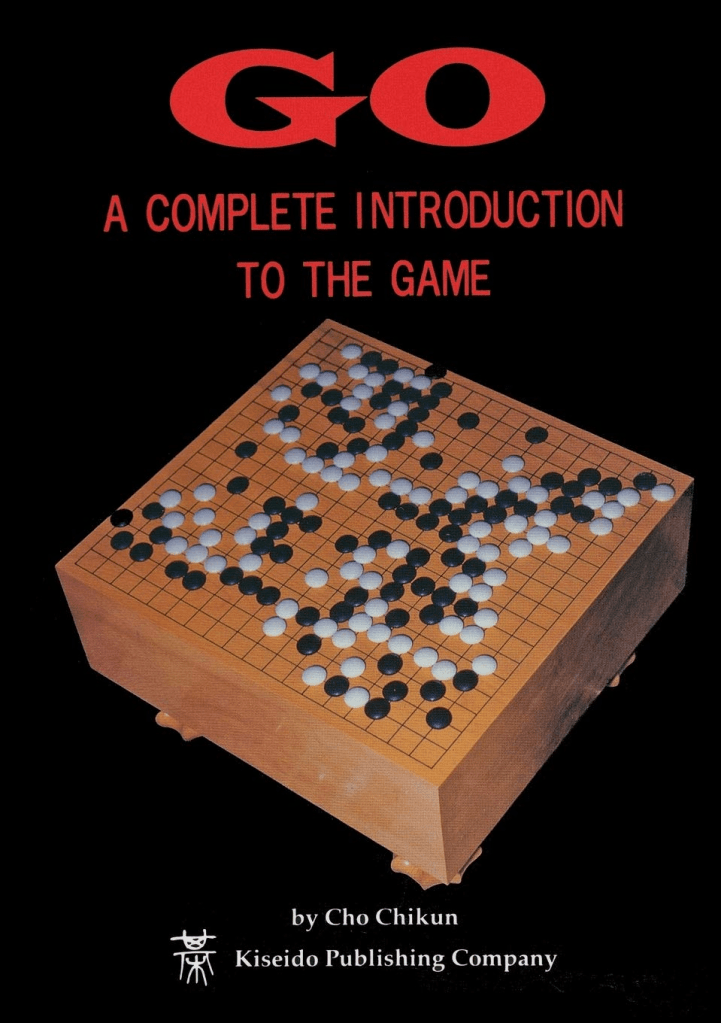
As I was getting back into Go, I re-read this excellent beginner’s guide in the SmartGo app. Cho Chikun is one of the most famous professional players in modern times, and the Japanese player with the most titles.
This book deftly introduces all the important aspects of Go rules and basic strategy, while alternating chapters about the history and cultural significance of Go. It’s a perfect introduction to the game (or re-introduction, in my case).
In amateur Go, players start at a rank of 30 kyu. As they improve, their rank decreases down to 1 kyu, then to 1 dan, and up to 7 dan. As you might expect, players with double digit kyu ranks are beginners and casual players.
While most books about Go are written by pro players for obvious reasons, Moffatt wrote this as a moderately high (1 kyu-ish) amateur. He’s close enough to still remember and understand why the players of these games make the mistakes they do.
Moffatt also goes into more detail than usual in explaining the merits and disadvantages of each move, often exploring various alternatives. They result is a set of thorough game deconstructions that are very useful aids for an amateur player to recognize their own shortcomings.
I bought this on a whim while on vacation, mostly on the authority of a positive blurb by Kieran Gillian (of Die and other comics), and a brief skimming of the art. Unfortunately, this book was not for me.
I don’t read a lot of romance, but I’m not strictly opposed to the genre. This, however, was just too much irritating teenage angst and not enough mythology for my tastes. When the romance hinges on everybody being afraid to voice how they feel, and the conflict stems from people hating each other for basically no reason, I get bored.
As far as the art goes, the character work is nice, but these characters live in a world composed of colored smears. This lack of any background detail is something that seems to be more and more common in indie comics, and while I understand it, I do miss the crispness that you see more in high budget superhero comics.
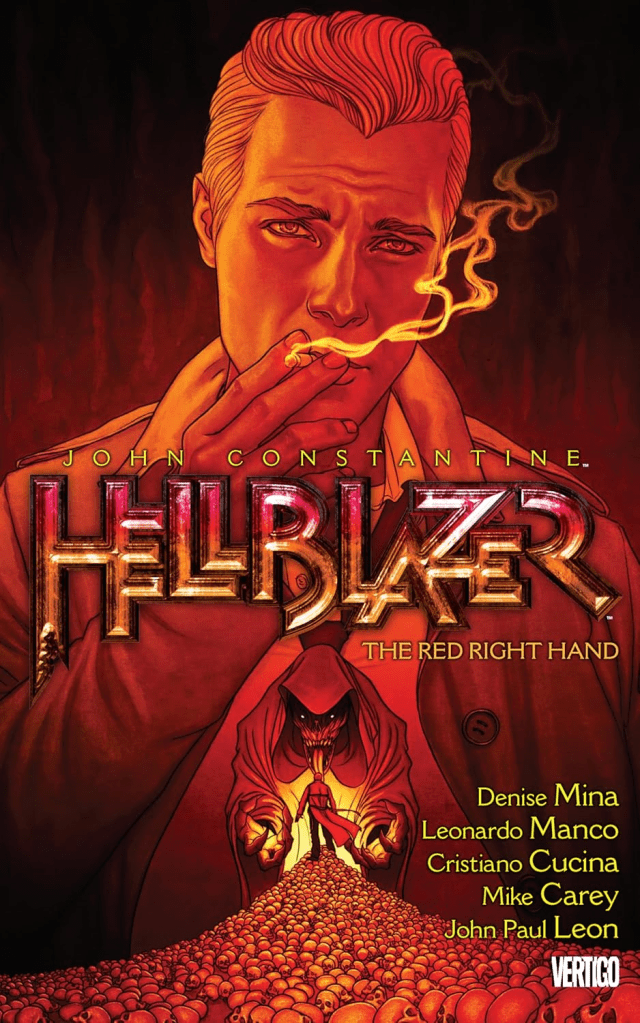
Hellblazer: The Red Right Hand
By Denise Mina and Mike Carey
Illustrated by Leonardo Manco, Cristiano Cucina, John Paul Leon
I do love me some John Constantine, but this collection wasn’t my favorite. There are two story arcs here: one where Constantine enters into a trap, and one where he gets out of it.
The typical Constantine story usually has a mystery twist, and this is no exception. Unfortunately, the twist didn’t shock me, it just made me shrug. Maybe if I were reading the series in sequence I would be better prepped as a reader.
It’s also not uncommon for Constantine to have some plan that only gets revealed when everything seems hopeless. Here, he doesn’t have much of a plan at all.
A collection of Constantine’s friends show up midway through, and it feels like deus ex machina, but even they don’t actually do very much. They muddle through, and the eventual resolution to the situation hardly feels like any of the characters had agency.
The last issue in this volume is a stand-alone one-off story, and it’s a classic, solid Hellblazer story. It made me a little sad that the rest of the book didn’t hold up as well.
Summer is here, and I’m currently in the process of packing to move. It turns out you can acquire a shocking amount of junk when you spend almost 15 years in a house, so I’m going through it and getting rid of everything I can.
This past month was light on reading, but I did manage to get through a couple of books.
Where possible, I’ve included Bookshop affiliate links instead of Amazon. If any of these books pique your interest, please use those links. I’ll get a small commission, and you’ll support real book stores instead of Armageddon bunkers for billionaires.
I’m still reading Discworld with the kids at bedtime. This title features some of my favorite recurring characters: Death (and the miniature rat version, the Death of Rats); Susan, his grand-daughter; the wizards of Unseen University; and the mysterious and villainous Auditors, who are not permitted to meddle in the affairs of mortals, but keep coming up with clever schemes to wipe them out so the universe can be neat and orderly.
The Discworld version of Death is, in some ways, the classic trope of the robot who wants to become human. He may be an anthropomorphic personification, but he has spent centuries around people, and he can’t help that they’ve rubbed off on him.
Thanks to the Auditors, the Hogfather (Discworld’s version of Santa Claus) is missing in action, and it’s up to Death to take his place and keep the world believing in him. It’s a Nightmare Before Christmas with ancient gods and extra-dimensional monsters.
Susan is pulled into Death’s schemes against her will, determined (but mostly failing) to live a “normal” life instead of the inevitably strange life of the woman whose grandfather is the personification of Death.
Hogfather is a meditation on the way people create the gods they need, while also being a completely silly story about bumbling wizards, a skeleton posing as a mall Santa with a strap-on beard, and a governess who actually finds the monsters under the children’s beds, and resolves the issue with the sharp end of the fire poker.
Novelty is a book of four stories, two longer, and two shorter. Its themes and some elements of its plots are very science-fictiony, but the style is literary. It feels like a 1980s precursor to the “new weird” of Jeff Vandermeer or China Miéville.
“The Nightingale Sings at Night” begins in classic myth-story fashion with an explanation of the nightingale’s unusual song. It’s a retelling of the fall of man from Genesis, but the structure feels like something straight out of Aesop’s Fables. It’s a great example of using a classic story structure as a jumping-off point.
“Great work of time” is the longest story of the bunch, and a fantastic time travel story. Like all time travel stories, it’s linear from one perspective and non-linear from another.
Caspar Last is an imminently reasonable man who invents a time machine and decides to use it only once, in order to make enough money to live out the rest of his days in moderate comfort. However, he is tricked into giving up his invention to a secretive group calling themselves the Otherhood. They use the time machine, first and foremost, to sow peace around the world and build up the British Empire. They also use it to ensure their group’s own creation.
However, all this meddling in time has strange effects. The peace they create has its costs, twisting the world beyond all recognition. One member discovers that the Otherhood’s twisted timeline will eventually result in a sort of quiet cataclysm, a world so at peace that there is nothing but endless forest growing out of a quiet sea. The only way to prevent this terrible future is to undo everything the Otherhood has done.
“In Blue” is a story set some time in the future, in an unnamed city. Refugees crowd an ancient city that is being systematically rebuilt. There has been pseudo-communist Revolution, and lives are governed by a social calculus and act-field theory, mathematics that govern society and all interactions between people. The protagonist, Hare, is a member of the cadre that organizes society without overtly ruling it, but he becomes overwhelmed by his duties and has a mental break.
The final story, “Novelty” is the most literary (or, at least, the lightest on plot): a story about an author in a bar, realizing what his next book will be about. He decides he must write a book on the “pull men feel between Novelty and Security,” the drive to discover something new versus the safety of the known. The implication is that the story is at least a little autobiographical, and the book we’re reading is the book he will write.
What I’m Reading In June
I’m not sure how much reading I’ll actually be able to do, but I’m still working on the Witcher series and Discworld. I’m also continuing my goal of reading at least one anthology of short stories each month, and recently picked up a volume of stories from Apex which seems perfect for summer reading.
Here in Minnesota, April showers have brought May…showers. It’s been rainy, drizzly, or just generally damp. Everything is slowly greening up, and Spring is going to sproing the moment the sun comes out.
This past month, I finished my read-through of the main series League of Extraordinary Gentlemen comics, I got back into Terry Pratchett’s Discworld books with my kids, and I finally received my Kickstarter-backed edition of The Secret World TTRPG.
Where possible, I’ve included Bookshop affiliate links instead of Amazon. If any of these books pique your interest, please use those links. I’ll get a small commission, and you’ll support real book stores instead of mega-yachts for billionaires.
Written by Alan Moore, Illustrated by Kevin O’Neill
After the first two volumes of League, I was a little disappointed in The Black Dossier, which was more backstory than story. I was curious to see where Volume 3 would take us. As it turns out, it’s both forward and backward in time.
As the subtitle suggests, the book covers a full one hundred years of the League. The main storyline of Black Dossier took place in the 1950s, but the story of Volume 3 begins just before the coronation of King George V, which is mid-1911, assuming the date in the alternate timeline of League lines up with real world history. This version of the League sees Mina Harker and Allan Quatermain joined by the immortal Orlando; occultist Thomas Carnacki; and gentleman thief A. J. Raffles.
The mystery that these characters seek to unravel throughout the book is the work of a cult founded by Oliver Haddo, who turns out to be a body-hopping mystic intent on creating the antichrist. The more immortal members of the League, Mina, Quatermain, and Orlando, investigate the cult over the course of the century. Their failure to stop the cult is matched by the cult’s own failure to create a proper apocalyptic monster.
This century sees the League eventually crumble, Mina falling into a drug-and-mysticism-induced fugue, Quatermain reviving his abusive relationship with Heroin, and Orlando getting lost in the violence of war.
It isn’t until 2009 that the League’s long-time mystical benefactor, Duke Prospero, contacts a reformed Orlando, who springs Mina from a mental institution. They join up with Allan just in time to confront the Harry Potter-esque magical antichrist, who is put down by an entirely appropriate modern myth who I’ll refrain from naming, lest I spoil the fun.
This third (technically fourth) volume once again shows the League as mostly ineffective. They are still involved in the big movements of the world, but none of their meddling does much good.
With the move away from steampunk Victorian England, some more recent pop-culture references inject fresh fun into the series, although I couldn’t help noting that twisted versions of Harry Potter have already been done elsewhere, and in my opinion, more effectively.
Written by Alan Moore, Illustrated by Kevin O’Neill
In this final volume of the main-line League books, Mina Harker, Orlando, and the freshly recruited Emma Night (a.k.a. M) are all that remains of the League in alt-history 2010.
In some ways, Volume 4 has learned lessons from the weak points of the previous books. The authors are playing with formats again, bringing back the 3D glasses sections and including parts reminiscent of classic superhero comics. These format-shifts add variety without being as gimmicky as Black Dossier.
The story alternates between three time periods. The 1970s sections follow superhero squad The Seven Stars, organized by Mina while disguised as Vull the Invisible. In 2010, the time travelers seek Vull and any remaining superheroes. In the 30th century, an apocalypse has occurred and a desperate few freedom fighters engineer a trip back in time to prevent the catastrophe.
The true history behind the League and the reason for its existence are finally revealed to be part of a vast conspiracy that also encompasses British Military Intelligence (with a host of oblique James Bond references) and Shakespearean-era faery politics.
While League has never shied away from killing off major characters, Volume 4 is perfectly happy to burn all the bridges. While a few characters manage to escape disaster and even find some semblance of happiness, the entire setting burns down around them, with time travelers making it clear that the cataclysm won’t be cleaned up for hundreds of years.
League of Extraordinary Gentlemen is a series built on literary references, and it has finally run the full gamut of time periods. This feels like a suitable ending. (At least until the thirtieth century, when I fully expect Alan Moore’s frozen head to be revived for Volume 5.)
I finally finished reading the Harry Potter series with my children last month. After that, I decided we ought to jump into some lighter fantasy, returning to the nearly inexhaustible Discworld series.
Pratchett has crafted a fantastic setting and populated it with a gigantic cast of interesting characters, but each book tends to follow particular groups. Feet of Clay follows Sam Vimes and his city watch in Ankh Morpork. The city’s patrician, Lord Vetinari, is being slowly poisoned, and it’s up to the Watch to figure out whodunnit.
The mystery provides the structure of the story, but the joy of any Discworld book is in the wonderful craft and comedy that Pratchett puts into almost every sentence, and the interactions between the characters. I think the craft of comedy writers tends to be underappreciated, but Pratchett at his best is as good as anyone out there.
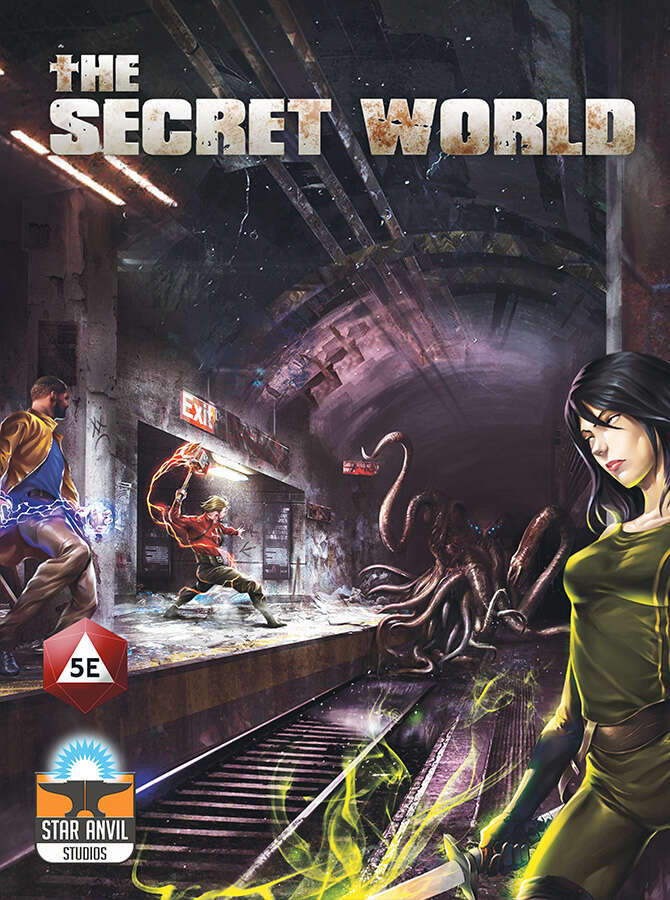
The Secret World began life as a 2012 MMORPG. Sadly, 2012 was one of the last few years when game developers still believed that the market for MMOs was infinite, and that it might somehow be possible for someone…anyone…to dethrone the longtime king of the genre, World of Warcraft.
While Secret World did a bunch of interesting, innovative things, it was really the modern, urban, “every conspiracy theory is true” setting, slow-burn mysteries, and brilliant writing that set it apart. Unfortunately, that wasn’t enough to overcome its clunky gameplay. The game stumbled along for several years, eventually spawning an updated, free to play re-launch and a few smaller games in the same universe.
I won’t lie. When I heard about a table-top RPG based on the IP, I was excited. The setting and story were always the best part of the Secret World, so a TTRPG made perfect sense to me.
The rules are based on 5th Edition Dungeons and Dragons, lightly adapted to a more modern, more urban setting and the Secret World character system. At this point, 5e D&D is probably both the most popular and most disliked TTRPG system out there. Because it’s so ubiquitous, and many people directly equate role playing games with D&D, it’s the obvious choice when adapting an IP that most people have never heard of. No point in limiting your audience.
Unfortunately, 5e has its downsides, and I suspect that the Secret World has once again paired its fun settings and stories with clunky gameplay systems. The book’s creators, Star Anvil Studios, might realize this, because as soon as they finished this edition, they announced a new Kickstarter to bring the Secret World setting to the Savage Worlds rule set. Or maybe it’s just a way to cash in in the IP by writing a new book that is 70% the same as the old book.
The 5e core book defines nine classes that will be familiar to anyone who has played Secret World Legends. Everyone is a spellcaster to some degree, but two of the classes are all about the spells. There is no true multi-classing, but there are Secret Architypes, which are like mini-classes that characters can collect as they level. Only one can be active at a time, but they can be swapped with a short rest. It feels like a fun way to scale characters horizontally, but I wonder if high-level characters will feel too much like a jumble of abilities.
The biggest draw, to me, is the setting, and the book wisely dedicates about 60% of its pages to the world, with descriptions of a large number of NPCs, the factions, and a good amount of the history and lore from the games. Sadly, there are limits to how much can fit in a single core book like this. The game will still likely be much more fun in the hands of a game master who knows their way around the Secret World setting.
There was a single premade adventure released as a part of the Kickstarter materials. I would love it if Star Anvil was able to craft a couple more, although I won’t be holding my breath.
What I’m Reading in May
I’m still reading The Witcher. For my short story fix, I’m thinking I’ll tackle a sci-fi novella collection from the 80s. And I’ve got a book of writing advice that has been calling my name for a while. See you in May!
This is the monthly post where I talk about what I’ve been reading. As usual, if you’re interested in any of these books, please use the included Bookshop.org links instead of Amazon. It helps independent bookstores, and I get a small affiliate commission.
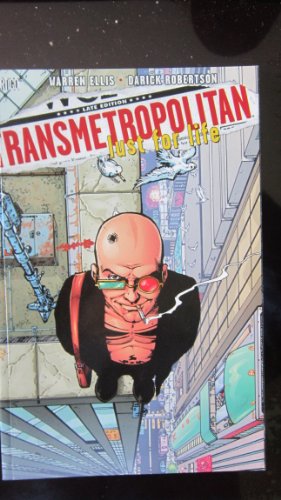
Written By Warren Ellis, Illustrated by Derick Robertson
Transmetropolitan has been on my radar for some time, even though I knew almost nothing about it. It was lodged in my brain alongside a bunch of other 90s-2000s non-superhero comics. I’ve recently discovered just how cheaply you can snag slightly beat-up trade paperbacks of old series at places like ThriftBooks, so I went ahead and purchased the first two volumes of the series just to see if I had any interest.
My feeling coming away from the first volume is that Transmetropolitan is weird for the sake of weird, and that particular brand of “edgy” that was popular in this era, but a little silly in retrospect. It is a depiction of the kind of cultural and technological singularity where almost everything is possible and is probably happening just down the street, but the absolutely schizophrenic nature of that kind of chaos doesn’t really jive with telling a deep or particularly coherent story.
The book begins with former journalist Spider Jerusalem living like a wild-man in a mountain-top cabin surrounded by booby-traps. He is naked, heavily tattooed, and clearly hasn’t gotten a shave or a haircut in a few years. We learn that he was the most famous journalist in a nearby city (simply known as The City), and he gave it all up to move out here. Unfortunately, he signed a contract for a book deal, overdue by five years, and now his publisher is threatening to take the money back. So off he goes, back to The City.
Spider breaks into the offices of his old newsfeed, secures a job and an apartment, removes all his hair with a chemical shower, and gets his trademark glasses out of the totally-not-a-Star-Trek-replicator in his kitchen. Then he turns on the news. There are cryogenic defrostees, people uploaded into nanite clouds, and humans surgically turning themselves into aliens and trying to succeed from The City and create their own colony. As it turns out, these will all be plots for subsequent issues.
The first volume didn’t wow me as an introduction. The chaos of The City struck me as an excuse to just throw any sort of futuristic spaghetti at the wall and see what sticks. The characters all range from unpleasant to outright awful, and I have a hard time taking it seriously when the city is called The City and the protagonist has a name like Spider Jerusalem. But hey, it’s the first volume, and a lot of series don’t find their feet right away, so I started in on the next one…
Transmetropolitan (vol. 2)
Written By Warren Ellis, Illustrated by Derick Robertson
I realized partway through this volume that the post-facts world of Transmetropolitan probably seemed more science-fictiony around the year 2000. Nowadays, it’s hardly any different than world outside my window. This certainly isn’t the first piece of sci-fi to satirize politics and religion, only to find that the future went and outdid them. Being subversive and edgy is not a good way to last—yesterday’s shocks are boring to tomorrow’s audience.
I also came to the conclusion that a lot of what rubs me the wrong way about the series is that it’s packed with big, obnoxious allegory. It’s constantly winking and nudging you.
Transmetropolitan doesn’t have an ongoing arc in these first couple volumes. It’s just a series of unrelated stories. This time, we get one about Spider’s assistant’s boyfriend, who decides to download himself into a cloud of nanites. After that, it’s a cryogenically frozen woman who wakes up and discovers that the future is impossible to acclimate to, and that nobody much cares to try and help her. Then there’s Spider’s tour of the “reservations,” hermetically sealed places throughout The City that are built to preserve different cultures and ways of life. Each of these works pretty well as a stand-alone short story, but it didn’t feel like it was building to anything bigger.
Ultimately, I found that Spider Jerusalem was one of the least interesting characters in his own book. It’s possible that some of these disparate threads will eventually weave back together into a larger story, but I wasn’t feeling it after two volumes. I don’t think I’ll be continuing this series.
This is the second Witcher book that’s billed as a short story collection. And it is, but they end up feeling like more than the sum of their parts. There are bigger arcs happening across these stories, continuing the events from the first book.
In addition to the titular Witcher, Dandelion the bard and the sorceress Yennifer are the other main characters. If there is an overall theme across the book, it’s the angst between Geralt and Yennefer, who are both outcasts and troublemakers in their own ways. They each think they can’t make the other person happy, while also being unable to permanently break things off.
There is also a great deal more world-building happening here, including the first mentions of the Wild Hunt, a mysterious recurring event where ghostly warriors cross the sky and portend disaster and war. These stories are still “low to the ground,” but they incorporate a bit more about the nations and politics of the northern kingdoms.
Of course, it wouldn’t be the Witcher without stories about the interactions between humans and magical creatures, whether that be a shapeshifter stealing friends’ identities or a pompous town mayor in love with a mermaid. It also sets up the series of books to follow, as Geralt meets Ciri, the kid princess whose destiny he inadvertently entwined with his own.
Written By Neil Gaiman, Illustrated by P. Craig Russell
Much like Volume 3, Dream Country, this is a set of mostly stand-alone tales where Dream takes on a minor role. There’s a story about Emperor Norton, the real person who declared himself Emperor of the United States of America, a fable about a clan of eastern European werewolves, a tale of young Marco Polo getting lost (and eventually found) in the desert, and story of a spectacular Baghdad, greater than we ever knew it because it was traded into dreams so it might stay perfect forever.
Unlike Dream Country, there are a few things of note that tie back into the broader ongoing plot. For the first time in the series, we actually see “the prodigal,” Destruction, the one member of the Endless who has abdicated his position. We witness a retelling of the ancient Greek tragedy of Orpheus, who is an oracle, and Dream’s son. We see why Orpheus lives eternally as a severed head, and the cause of the rift between him and his father.
These events lead directly into Volume 7, and it really feels like the meandering main story is picking up steam.
The Sandman: Brief Lives (Vol. 7)
Written by Neil Gaiman, Illustrated by Jill Thompson
The issues of this arc are labeled as “chapters,” and this is probably the most linear and focused volume since the first. The beginning pulls together several threads from earlier stories, and the end implies a whole lot of bad things are in store for Dream.
Each chapter begins with a sequence of cryptic phrases, like this for chapter one:
Blossom for a lady
Want/not want
The view from the backs of mirrors
Not her sister
Rain in the doorway
The number you have dialed…
They turn out to be little landmarks in the story, a game where the reader can try to guess what might happen from these tidbits, and then check items off the list as they come to pass. It got me thinking how excellent the whole series is at these little things. From the surreal Dave McKean covers and interstitial art to the introductory quotes to the entertainingly themed credits, the Sandman books feel like absolutely every single element was labored over more than was really reasonable. All the little things add up.
The story of this volume centers around the duo of Dream and his youngest sister, Delirium (who used to be Delight). Delirium’s personality is somewhere between a young child and a lunatic, and you get the feeling that the rest of the oh-so-serious Endless family is perpetually humoring her. She decides to go looking for Destruction, the brother that abandoned the rest of the Endless and made it clear that he doesn’t want to be found. Delirium asks her siblings to help her, but one by one they brush her off. When she comes to Dream, the most serious of them all, it’s a surprise that he agrees to go with her. So the pair set off to find Destruction.
Eventually, we learn that Dream had ulterior motives, and never really expected to find Destruction. But he takes his responsibilities seriously, and since he promised to help Delirium, he turns to the one person who has the power to find the Endless, even when they do not want to be found: his own son, Orpheus. For this favor, Orpheus (a severed head who cannot die) asks his father to end his suffering.
The book ends with foreboding. They find Destruction, only to have him leave again. Morpheus returns to his realm, everything neatly wrapped up, and then reveals his chalk-white hands stained with his son’s blood. It’s made clear that there are consequences for the Endless when they spill family blood. The only question is what those consequences will be…
Sometimes I look at the Hitchhikers’ Guide omnibus on my shelf and I think sadly about how I’ll never be able to read another Douglas Adams story for the first time. But if there’s anyone who can compare to Adams, it has to be Terry Pratchett. I’m grateful that unlike Adams, he wrote so prolifically.
There are 41 books in the Discworld series, and I’ve been slowly going through them, picking up new ones at Half Price Books whenever I see them. I’m savoring them, because I know eventually I’ll run out.
Small Gods is about an accidental prophet named Brutha, in the desert land of Omnia, where the people worship the god Om. Omnia is a strict theocracy where the church is the central pillar of life, and it’s not uncommon for supposed sinners to have the badness tortured out of them. Faith is of the utmost importance in Omnia, so it’s especially awkward when Brutha discovers that Om is trapped in the form of a turtle with hardly any godlike powers at all, and this is because nobody besides Brutha actually believes in him anymore.
Brutha goes on a hero’s journey, and despite his best efforts he manages to overthrow the Omnian order, restore (real) belief in Om, and generally start making the country a place where people can live their lives without worrying about being randomly tortured.
Small Gods isn’t my favorite Discworld book, but it’s a parody with plenty of laughs and a few sideways glances toward our world. As usual, an average book by Terry Pratchett is quite good by anyone else’s standards.
One of the joys of being a parent is getting to share things you enjoy with your kids. One of the strange things about being a parent of several children (with a few years in-between) is that I’ve shared a bunch of those things with my eldest kids, and my youngest knows nothing about them. So, although I read the Harry Potter books to my eldest son—and my daughter was sometimes in the general vicinity of the reading—I was told that we should read them again. And now we are.
I’ll say here that I don’t agree with Rowling and the garbage she is now known for spewing on social media. I also think it’s fashionable to criticize books by authors who are deemed terrible people. Despite Rowling acting out, I think the Harry Potter books are perfectly enjoyable.
A lot of the complaints about this series are about all the unbelievable aspects of the world-building. There are a lot of problems with the Wizarding World and its interactions with the regular world that just aren’t addressed. And that’s completely true. But I also think it doesn’t really matter.
The odd thing about this series is that it grew up along with its readership. The first book is very much a children’s story, in its form and in the language it uses. It’s not worried about perfectly consistent world-building, any more than Little Red Riding Hood or Goldilocks is, because the shape of the story still works. Part of that is because it borrows from fairy tales, starting with the classic evil step parents (or in this case, aunt and uncle), and the orphan boy who is destined to save the world.
So shockingly, my takeaway is that a super-bestselling book that started a huge pop-culture craze and made more money than some small countries does, in fact, do a lot of things well.
What I’m Reading in September
I’ll continue working my way through the Sandman and Witcher series. I might go for a couple brand-new books about writing that I just got. I also recently compiled a list of highly-rated comics from the last 20 years, and I might start working through some of those.
These past two weeks I’ve been reading a wide variety of things and doing more thinking about writing than actually writing.
Finishing Dune
First up, I finished reading Dune with my twelve-year-old at bedtime. His reaction to the conclusion was something like, “Wait, that’s the end?” It’s a fair reaction. The book does wrap up the plot quite nicely, destroying or subjugating all the villains while the heroes essentially take over the galaxy in a massive gambit. But this is also a book that is constantly looking into the future. Paul has his visions. The Bene Gesserit have their centuries-long plans. And nearly every chapter begins with quotations from a character who is only introduced near the very end of the book. It sets you up to want more.
Dune remains one of my favorite science fiction books. Its feudalism-in-space style gives it a timeless quality, and it addresses certain themes that still feel pretty fresh today.
Guards! Guards!
Moving on from Dune, we’re now reading “Guards! Guards!” at bedtime. This is one of Terry Pratchett’s “Discworld” books. There are 41 of them total, and I think I’ve read about half of those over the years. This happens to be one that I haven’t read, and I was excited to discover that it seems to be the first book to focus on the Night Watch of Ankh-Morpork. The books tend to follow a few different groups of characters, such as The Witches, The Wizards of Unseen University, and the Night Watch. I’m looking forward to reading the origin stories of a number of characters who show up in many of the later books.
Pratchett is truly a treasure, simultaneously creating an amazing fantasy world and also infusing it with brilliant British humor. My closest comparison is Douglas Adams, although he wrote science-fiction comedy. I always find it sad how few books we got from Adams, and I take solace in the huge number that Pratchett was able to write before his death (which still felt too soon).
Reading a new Pratchett book is comfort food. The only sad part is that someday I will have read them all, and I won’t get to have that experience again.
The Order of the Pure Moon Reflected in Water
Weeks ago, while cruising around writing Twitter I saw some recommendations for wuxia-inspired novellas. I bought the e-books on a whim, and now I’m working through them.
The first one I finished was The Order of the Pure Moon Reflected in Water. Although it’s a book that includes several fights and a little bit of magic, it is mostly a story that focuses on the tribulations and relationships among the members of a group of outcasts in the Tang Dynasty. It’s lighthearted and even funny in places without being straight comedy. It’s a fun read.
The author, Zen Cho, uses a fantastic trick that I plan to steal. Whenever the tension rises to a peak—an illegal sale goes awry or the group gets attacked by bandits, for example—Cho reveals one of the characters’ closely guarded secrets or a bit of their back-story, to the reader and to the characters. Not only are the characters in trouble, but their relationship is thrown into flux by this sudden addition of new information.
I think this is tricky to do in an organic way, but when it’s done well (like it is here) it takes an exciting scene and kicks it into an even higher gear. It also ensures that the characters have some new problems to work out as soon as they manage to resolve the mess they’re currently in.
I was a little disappointed by the end of the book; not because it was bad, but because it was short and it felt like it was only just getting going. The stakes never felt very high for the characters, and they never seemed to be in very much danger for very long. I was left wanting more of these characters and this setting, driven by a bit more danger and excitement.
What I’ve Been Writing
Not that much, if I’m being honest. I took a mini-writing-break, both from the blog and from my fiction.
I’ve got two short stories percolating in my head: one about using time travel for performance art, and one about the annoyances of reincarnation. I’m planning to work on at least one of those by the end of this week.
Of course, I also need to keep working on Razor Mountain, which remains my highest writing priority. Maybe I’ll try switching back and forth to stay fresh and motivated.
As I prepare to publish Razor Mountain, my serial novel, I have several side tasks to tackle. One of these is the book description. You might know this as the back cover or the book blurb.
The cover art and description are usually going to be your first (and often only) chance to catch the interest of a potential reader. The blurb isn’t the most important thing — the most important thing is to write a great book — but the blurb is the first thing. You have to convince your potential reader to start reading before they can see how great your book is.
Don’t think of the blurb as a simple summary. It’s a sales pitch. The blurb’s only job is to get a person to open the book and start reading. After that, it’s up to your story to keep them hooked.
Short and Compelling
Most writers don’t have a lot of experience crafting book descriptions. It can be a daunting task. If you’re writing a novel, it’s usually because you have a story that you want to explore over a lot of words. A luxurious amount of words. But there’s no such luxury to be had in the blurb. So the overarching idea of crafting a blurb is condensing and cutting that huge story into a few sentences that give the feel of the story and help sell it.
For Razor Mountain, I’m looking at services like Wattpad and Tapas as places built to publish serial fiction. Wattpad doesn’t limit the size of the book description, and Tapas has a limit of 2000 characters, which is quite a lot. A typical back-of-the-book blurb or Amazon description is in the neighborhood of 100-250 words, which equates to about 1/3 to 2/3 of a page, double-spaced.
The real limit is the reader’s attention span. We live in a world where we aren’t just competing with thousands of other books and stories, but all the other forms of entertainment available at the click of a button. We’re competing with Netflix and TikTok too.
In a great recent conversation about book openings on the Writing Excuses podcast, they told the story of an author who planned to throw away an unsolicited ARC they received, but got caught up in by the back cover blurb on the way to the trash can and ended up reading the book. That’s how short and compelling the blurb should be.
Resources
One of the best ways to get started is to find good examples and deconstruct them. What is the description actually telling you about the characters, plot, or conflict? What kind of language are they using? Does the description pull you in?
My first step was to pull books I love from my bookshelves. These are books that I’m already familiar with, so I can evaluate what bits of the book actually make it into the blurb. I have also been cruising Amazon’s most popular books and reading descriptions. Many of these are books that I haven’t read, so I have to strictly look at how the description makes me feel. Do I want to click the “buy” button by the time I’m done reading?
Ultimately, if you want to craft a great book description, you should read a ton of book descriptions. Like learning a new language, immersing yourself in this stuff is the best way to get into the right mindset for writing a blurb of your own.
It’s important to know what genre(s) you’re targeting, and look at similar books. If you have a list of comp titles, that’s ideal. You’ll quickly notice that certain structures are common in the blurbs for particular genres.
On the other hand, don’t limit yourself solely to your chosen genre. You may find that a blurb structure common to another genre happens to work for your story. Just make sure you’re not inadvertently posing your book as a different genre — you don’t want excited readers feeling let down when they realize what they’re reading is completely different from what the blurb advertised.
Of course, I’m not the only person who has ever tried to figure out what makes for a great description. It’s also worth looking at the analyses other people have done. I was able to find a few good articles on the subject:
You’ll notice that a lot of these articles claim to have the secret recipe (or “handy formula” or “step-by-step” guide). That’s great click-bait, because we all want to believe that there’s a simple and straightforward process for these things. Unfortunately, this is art, baby.
As is so often the case when it comes to writing, it can be unnecessarily limiting to treat a rigid recipe as the gospel truth and refuse to deviate. However, there are a few elements that are so common in a book description that they are almost obligatory. If you’re not touching on them, you should have a good reason why.
Hook(s) – This is a sentence or tiny paragraph at the start (and sometimes also at the end) of a blurb. This is straight up ad copy. It’s clickbait for your book. It should be surprising or shocking, exciting or unbelievable. A hook at the start of the blurb is a foot in the door, designed to get the reader to read the rest of the blurb. A hook at the end, on the other hand, should be the stinger — the summation of the blurb that compels the reader to immediately flip the book over and open it to chapter one.
Character(s) – If you have a single protagonist, especially with a first-person POV, they should feature prominently in your blurb. If your book is focused on the conflict between protagonist and antagonist, the antagonist should be prominent as well. However, if you have a large cast with multiple points of view, you may have to pick one character to focus on in the blurb, or lean more heavily on the overarching plot.
Plot & Conflict – Unlike a full summary or synopsis, you do not need to reveal the whole plot. What you need to do is reveal an important conflict or source of tension. If you have big secrets and exciting reveals, you can drop hints, but don’t give them away. Show the reader why they’ll want to keep reading. What is the challenge the characters will face? What will the consequences be if they fail?
Examples
Let’s look at some examples from my bookshelf.
The Martian, by Andy Weir
A MISSION TO MARS. A FREAK ACCIDENT. ONE MAN’S STRUGGLE TO SURVIVE.
When a dust storm forces his crew to evacuate the planet while thinking him dead, astronaut Mark Watney finds himself stranded on Mars’s surface, completely alone.
Armed with nothing but his ingenuity, his engineering skills — and a gallows sense of humor that proves to be his greatest source of strength — Mark embarks on a dogged quest to stay alive. But will his resourcefulness be enough to overcome the impossible odds against him?
At 86 words, this is a pretty short blurb. This is partly to make room for seven glowing quotes from major reviewers and authors. But it also reflects the story, which is a suspenseful sci-fi thriller.
The fact that it’s a sci-fi story comes through in the first four words.
You may or may not like the all-caps sentence fragments that form the hook here. “One man’s struggle to survive” reads a bit cliché to me. But there’s no question that this alone is a fair summation of the book, and it pulls me into the rest of the blurb.
The book has a single protagonist in Mark Watney, and that comes through clearly here. The bulk of the book is him, alone, on Mars. It’s told from his POV, and it’s a strong POV. His gallows humor is a selling point.
The conflict is also laid out clearly. He’s trapped, alone, on Mars. His crew thinks he’s dead, and he has to survive. This is the question that’s going to keep us turning pages.
Soul Music, by Terry Pratchett
When her dear old Granddad — the Grim Reaper himself — goes missing, Susan takes over the family business. The progeny of Death’s adopted daughter and his apprentice, she shows real talent for the trade. That is until a little string in her heart goes “twang.”
With a head full of dreams and a pocketful of lint, Imp the Bard lands in Ankh-Morpork, yearning to become a rock star. Determined to devote his life to music, the unlucky fellow soon finds that all of his dreams are coming true. Well, almost.
In this finger-snapping, toe-tapping tale of youth, Death, and rocks that roll, Terry Pratchett once again demonstrates the wit and genius that have propelled him to the highest echelons of parody next to Mark Twain, Kurt Vonnegut, Douglas Adams, and Carl Hiaasen.
This one is 133 words, but about 30 of them are spent putting Sir Terry Pratchett on a pedestal among literary greats, not on the story. Which is a good selling point, if you can get it.
The genre is again pretty clearly defined as quirky fantasy by the strange names and the personification of Death.
The book is equally split between two protagonists, Susan and Imp, and this blurb dedicates a paragraph to each.
What it doesn’t do is delve too deeply into the plot. We only get a hint of the conflict for each character. Susan’s heart goes “twang.” Imp is unlucky that his dreams are coming true. Almost.
American Gods, by Neil Gaiman
Shadow is a man with a past. But now he wants nothing more than to live a quiet life with his wife and stay out of trouble. Until he learns that she’s been killed in a terrible accident.
Flying home for the funeral, as a violent storm rocks the plane, a strange man in the seat next to him introduces himself. The man calls himself Mr. Wednesday, and he knows more about Shadow than is possible.
He warns Shadow that a far bigger storm is coming. And from that moment on, nothing will ever be the same…
Word count: 97. While this back cover has only one quote next to the blurb, it is from Stephen King, and the remainder of the space is dedicated to young, slightly goth Neil’s dreamy stare, which seems like reasonable use of the real estate.
This blurb focuses tightly on the protagonist, Shadow. Things haven’t gone well for him, and now they’re going worse.
From Mr. Wednesday’s strange name, and the implications of his impossible knowledge, we can guess that this is some sort of relatively down to earth fantasy. This description is the least clear about genre so far. However, that may be reasonable, as the book itself lives mostly in the mundane real world, even when there are gods involved.
Again, we get the start of Shadow’s story, but not much detail beyond that. We can presume that Shadow will have internal struggle with the death of his wife and the bad things in his past. All we know about the more external conflicts of the book is that trouble is on the way, and Mr. Wednesday seems to be involved.
Here we see a closing hook (although “nothing will ever be the same” feels a tad clichéd to me). The blurb ends with ellipses, explicitly suggesting that the reader can continue this thought by opening the book and reading on.
The Girl Who Drank the Moon, by Kelly Barnhill
“There is magic in starlight, of course. This is well known. Moonlight, however. That is a different story. Moonlight is magic. Ask anyone you like.”
Every year, the people of the Protectorate leave a baby as an offering to the witch who lives in the forest to keep her from terrorizing their town. But the witch, Xan, is really kind and gentle. She shares her home with a wise Swamp Monster and a Perfectly Tiny Dragon. Xan rescues the children and delivers them to welcoming families on the other side of the forest.
One year, Xan accidentally feeds a baby moonlight, filling the ordinary child with extraordinary magic. Xan decides she must raise this girl, whom she calls Luna, as her own. As Luna’s thirteenth birthday approaches, her magic begins to emerge with unpredictable consequences, just when it’s time for Xan to go collect another child. Meanwhile, a young man is determined to free his people by killing the witch. And a volcano, dormant for centuries, rumbles within the earth…
The opening paragraph is the hook here, set in a different font and color. In this case, we’re getting a quote directly from the book, to give us a feel for the prose. Just like The Martian, this hook uses short sentences, some just fragments, to pull us in. Interestingly, these sentences don’t appear all together in the book. There’s an extra paragraph in the middle that has been left out to achieve this punchy, staccato effect.
At 170 words, this is the longest description we’ve looked at. That extra word count affords it the opportunity to include the three main characters and quite a lot of plot.
Xan gets the most words, Luna gets fewer, and Antain (merely “a young man” here) gets the least. As far as I remember, this roughly matches how much of the actual book each of these characters appear in.
This blurb wears its genre on its sleeve. It’s clearly fantasy, and details like the witch and the Perfectly Tiny Dragon suggest that there’s no small amount of whimsical fairy tale here. The mention of leaving a baby as offering every year, on the other hand, suggests that there’s some classic fairy tale darkness as well.
The blurb finishes with a building-up of tension by stacking conflict on top of conflict. First, there’s Luna’s magic and its unpredictable consequences. Then Xan is away while it’s happening. Then the young man is introduced, and he wants to kill Xan. But wait, there’s more! A volcano, set to erupt.
Once again, there are the ellipses at the end, inviting us to open the book and find out what happens next.
Next Time
I’ll be continuing to talk about book descriptions later this week. I’m taking all this analysis and putting it into action as I craft a book description for my serial novel, Razor Mountain.
Do you have a favorite book with a great example of a back-cover description? Post it in the comments!













 Words Deferred