7 Duotrope Tips and Tricks

Anyone who has been keeping up with the blog lately will know that 2024 is my year of short stories. I’ve been writing short fiction and submitting it to publications. As a result, I’ve been using Duotrope quite a bit.

Duotrope includes a database of publisher information and a submission tracker for authors. (It’s not the only one: Submission Grinder and Chill Subs are out there too. Duotrope is just the tracker I’ve been using.) So, I thought I’d write about a few tips and tricks that I’ve discovered that make the submission process a little easier.

1. Search by Title

The Duotrope publisher search has a lot of options, so you might be surprised (as I was), that there is no option for the actual title of a publication.

For some reason, Duotrope decided that this belonged in its own section. The “Find by Title/Name” option in the Search menu gives you the option of inputting a partial or exact name. If you don’t quite remember the name of a publication, you can also try searching by alphabetical index.

2. Find Publishers for a Piece

Once you’ve added a story to your Duotrope submission tracker, it will show up on your “List of Pieces” page under Account -> Pieces.

When the piece is ready to be sent out, you can always search for publishers by manually entering the length, genre, and other parameters. But you don’t have to.

Instead, just click the “Publishers” link next to your story on the “List of Pieces” page. This will automatically populate a search with the information you’ve entered in the piece’s description.

3. Publishing News

The Publishing News section of the site shows publishers that have been recently added. Since brand-new publications are inherently less well-known, they may represent a good opportunity to get a story in front of editors that are hungry for content, with relatively small slush piles.

Publishing News also has a section for publishers that have recently opened to submissions, which can be another good way to find fresh options, especially when those publications are only briefly open to submissions.

4. Track Themes and Deadlines

Some publications are only open for submissions during specific windows. This is especially true for themed issues or anthologies. Duotrope can track these submission windows and deadlines.

On a publisher’s detail page, general submission windows will be listed under the Dates heading, and specific themes will be listed under Theme(s). In each of these sections, there will be a Track link and a colored bubble listing the number of Duotrope users who are already tracking.
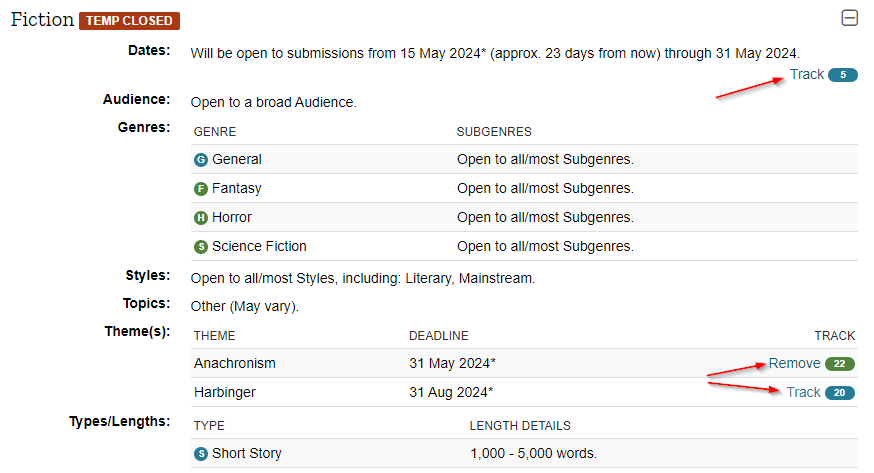
In the Account menu, you can visit “Themes and Dates” to see a convenient list of everything you’ve chosen to track.

5. Deadline Calendar

Whether or not you’re tracking any Themes or Deadlines, you can access the Theme and Deadline Calendar under the News section of the menu, or from the link at the top of the Theme tracking page.

By default, the calendar shows a list of all the themed submissions and deadlines in Duotrope, but you can filter by genre, payment, or your personal favorite publishers.

6. Overdue Responses at a Glance

Duotrope’s Submissions view shows information for all your tracked stories that are out on submission. It includes a trove of information, including some that makes it easier to decide if you need to follow up.

This view shows how many days each submission has been out, as well as the average response time reported by Duotrope users and the estimated response time provided by the publisher. But the status icon also has four different color options for pending responses.

Normally, the status is gray, but it will turn yellow if the submission has been out longer than the normal response time, and red if it exceeds the publisher’s stated response time. In some cases the publisher may state that they don’t always respond to submissions or don’t respond to status queries. In these cases, the icon will turn purple.

Of course, as with all things, you should confirm the publisher’s information on their website before blindly trusting Duotrope. It’s usually right, but occasionally there are discrepancies.

7. The Reports

Reports may sound dry and boring, but there are a few useful lists available there.

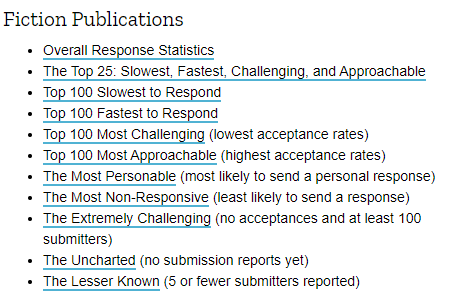
Authors who are sick of waiting for long response times can check the 100 fastest publishers to respond. Looking for feedback? Check the list of publishers most likely to send a personal response. Just trying to get a story accepted somewhere? Consider the list of publications with the highest reported acceptance rates.
What Else?

Do you use Duotrope? Are there any interesting features I missed? If you use a different tracker, I’d love to hear what they offer that Duotrope does not. Let me know in the comments.

Year of Short Stories — Week #6

2024 is my year of short stories. In this weekly series, I talk about the stories I’m working on, from idea and draft to submission.

  • Stories in Progress – 1
  • Submissions This Week – 0
  • Submissions Currently Out – 2
  • Rejections This Year – 2

It’s Quiet. Too Quiet…

I received no responses this week. Based on the average response times for the two places I’ve submitted, I expect to get at least one next week. Of course, as I get more stories into the rotation, this will pick up, and I’ll have fewer “quiet” weeks.

Revisions for Pleasant Hills

This was my big goal for the past few weeks: finish revisions on “The Incident at Pleasant Hills.” It only took about three times as long as I planned, but I’m happy with how the story turned out.

I finished with all of my revision notes, and it’s going to get one last read-through from my wife. Once she’s done and I’ve addressed her final feedback, it’ll be ready to send out.

Another One

One of the many nice things about writing short stories is that each one requires considerably less up-front thought than a novel. Now that I’m done with Pleasant Hills, I can jump right into the next.

I mentioned in previous weeks that I was thinking about “Portrait of the Artist in Wartime,” a story about a performance artist who uses time travel to make his point. I briefly thought about writing the story from the artist’s perspective, but I eventually decided that it would work better if it was told by his former assistant in the form of a magazine interview. Because the article is written with the expectation that the reader will already be familiar with some of the events of the story, I can leave out certain information at first, and create some twists and turns as it is revealed.

I reviewed my notes for this story, and discovered that I had actually written a few tentative pages at some point. I have a pretty clear idea of the ending, so I just need to plan out the rough beats that lead to that ending.

Other Bits and Bobs

Before I get too deep into “Portrait,” I’m going to think about some other projects as well.

I’d like to spend some time thinking about interactive fiction, to see if I can come up with an idea for Plotopolis. However, since interactive fiction is so niche, I don’t want to spend too much time on it. If I submit something and get rejected, there really isn’t anywhere else to send it, so it’s a dead story.

I’m also still occasionally stirring the stew of ideas for themed submissions. I might spend another few hours this week more actively working on that.

Goals for Next Week

  • Think about interactive fiction and themed submissions
  • Submit “Pleasant Hills”
  • Work on “Portrait”

Year of Short Stories —Week #4

2024 is my year of short stories. In this weekly series, I talk about the stories I’m working on, from idea and draft to submission.

  • Stories in Progress – 1
  • Submissions This Week – 1
  • Submissions Currently Out – 2
  • Rejections – 1

The First Rejection of the Year

“Tom, Dick, and Derek” garnered my first rejection of the year. This was a turnaround of only a few days, but it’s not too surprising since it’s a drabble and the magazine was only accepting flash fiction. I’m still not entirely sure of the viability of 100-word stories, but I’ll continue submitting to flash fiction publications and see how it goes.

Revisions for Pleasant Hills

This week, I re-read all the feedback I had received for “The Incident at Pleasant Hills” and condensed it into a page of bullet points of things to address, and several more pages of small line edits and suggestions for wording improvements. Most of these are straightforward fixes. A few are things that the story needs, and I just need to figure out where to put them. But there are a couple problems that I don’t have a solution for yet.

One of the things I need to improve about my writing process is handling revisions. I was hoping to be done or close to done with this story last week, but now that I’m in the middle of it, I’ll be happy if I can get it all done in the next week. I’m quickly realizing that writing short stories is a juggling act between keeping finished stories out on submission, and writing and editing new stories.

Themed Submissions

I mentioned last time that I was thinking about trying some themed submissions.

This week, I trolled the Duotrope listings, looking for themed submissions in speculative fiction genres that pay pro and semi-pro rates. I started with the basic search, and was annoyed to find no good search options to filter down to these. So I searched the listings and read the submissions pages. It was only after I had gone through twenty or thirty publications that I discovered Duotrope’s entirely separate page, the Theme and Deadline Calendar, which is designed for exactly this.

Having gone on my own search before discovering these listings, I know it’s not showing everything that’s out there. For example, Apex Magazine’s monthly flash fiction contest doesn’t show up. This probably comes down to how the listings are categorized.

If you’ve got the time and the inclination to write for these themed submissions, it might be worth doing your own research to track them down. However, the Duotrope listing is pretty good, and won’t suck up a whole afternoon.

With a few options in hand, I spent time brainstorming for the Parsec short story contest’s “AI Mythology” theme. I filled a couple pages with Story Engine ideas, but nothing that particularly excited me. I find Story Engine useful because it creates interesting constraints, but in this case, where the theme is already a significant constraint, I think it might be too much.

I plan to come back to these themed submissions every week or two and try other methods of brainstorming. It’s a good exercise to stay productive when I don’t feel like working on the stories in progress.

Fun Find – Plotopolis

Plotopolis is a new site for interactive fiction. It’s launching this winter, but open for submissions and proposals now. If you’re not familiar with interactive fiction, I wrote a post about it. It can be as simple as Choose Your Own Adventure-style branching narrative, or as complex and gamified as Fallen London, with character attributes and an inventory of items.

Interactive fiction has gained some acceptance as gaming in general has entered the cultural mainstream, but it remains a fairly small niche, so it’s nice to see something like this popping up. Hopefully they find their feet and are able to stick around.

Goals for Next Week

Only one goal this week: revise Pleasant Hills! I want to get this one done and out for submission.

Year of Short Stories —Week #3

2024 is my year of short stories. In this weekly series, I talk about the stories I’m working on, from idea and draft to submission.

  • Stories in Progress – 1
  • Submissions this Week – 1
  • Submissions Currently Out – 2

Submitting a Drabble

I reviewed quite a few options this week, and ended up submitting my drabble, “Tom, Dick, and Derek,” to a magazine taking flash fiction submissions. I’ve never sent out a drabble before, and I have no idea whether the incredibly short format will be a disadvantage or not.

As a general rule, it’s a little easier to sell short stories than long ones. In the old days, when everything was on paper, this was a simple matter of limited pages. Magazines cost money to print, and there’s a limit to the number of words that will fit. In a world where many publications are entirely online or have a web component, the limiting factor might be attention, rather than space.

However, I suspect the general rule breaks down when a story gets below about 500 words. While there are plenty of places to sell flash fiction, when the story gets short enough, the format becomes a distinguishing feature. There are a handful of publications that specialize in drabbles, but they’re few and far between.

Critique Revisions

My short story, “The Incident at Pleasant Hills,” is a more traditional short story at roughly 2000 words. I ran it through Critters a while ago, and got a lot of useful feedback. This week, I reacquainted myself with the story and began to re-read all that feedback, distilling it into broader issues and line edits. Hopefully I can finish those revisions this week.

Themed Submissions

While I was scanning publications in Duotrope this week, a few calls for themed submissions caught my eye. These are usually for one-off themed issues of magazines, but they can also pop up for anthologies or writing contests.

This is one of those things that I was aware of, but never really took seriously. Maybe it’s the difficulty of coming up with an interesting story for a specific prompt. Maybe it’s the concern that a story crafted to fit a theme will be harder to sell somewhere else if it’s rejected. However, if I’m going to be spending a year on short stories, it seems like a great time to get my feet wet.

I may spend some time brainstorming ideas for themed submissions this week, but if I don’t get around to it now, I’ll definitely try to dedicate some time later.

Goals for Next Week

  • Finish revising “Pleasant Hills”
  • Begin writing “Portrait of the Artist in Wartime”
  • Brainstorm ideas for themed submissions