Thoughts on Fiction, Read Aloud

Reading to my Kids

The first time I started regularly reading books aloud in adulthood was shortly after my first son was born. Books for the under-three crowd aren’t exactly high literature, but that’s okay. Babies aren’t discerning consumers, and I wasn’t an amazing narrator.

Still, it was clearly valuable. My oldest could turn the pages and recite his favorite books from memory long before he could actually read any words. All of our children have become voracious readers, and that literacy is an asset in school and life. Plus…you know…it’s fun to read.

My oldest child is now a high schooler, and no longer interested in me reading aloud to him. My youngest is also losing interest, although he still listens occasionally, when we find a book that piques his interest. For now, my middle child is the one who asks me to read to her. She’s a smart middle-schooler, and we mostly read adult sci-fi novels. It’s a gift to be able to share the books that I enjoyed at that age, and revisit them through her eyes.

I know those days are numbered. I suppose I’ll miss it when I no longer have someone asking me to read to them.

Reading fiction aloud for 30-60 minutes most evenings has made me much better at it. I know to shift my tone to better separate external and internal dialogue. I know to adjust my voice to differentiate between two characters in conversation. I know how much space is needed to create a scene break. Sometimes I even know when I’ve gone too far with the bad accents and silly voices.

I’m no professional narrator, but I’ve improved through 15 years of practice.

Audiobooks

I recently made a conscious effort to start “reading” audiobooks. They’re going through something of a renaissance. Enabled by the same streaming and on-demand technology that has upended movies and radio, audiobooks have also helped fill a sizable hole in publisher profits left by the rise of e-books and precipitous decline of physical (and especially hardcover) sales.

Audiobooks also happen to fit well into our current culture, where it often feels hard to sit down and dedicate time to reading, but there are still plenty of opportunities to connect a phone to the car radio during commutes, or put something on the headphones while doing laundry or mowing.

For me, including audiobooks in my reading diet has at least doubled the number of pages I consume. Maybe more. It has given me more opportunities to try new authors without adding to my overfull bookshelves.

I’ve also been slowly noticing the ways that listening to a story alters the way I perceive it. I have a harder time keeping track of different characters and remembering their names. It’s much harder to skip back a chapter and reread something for context.

Stories, Spoken

When humanity was young, storytellers were part historian, part wizard, part priest. Stories were a way for us to make sense of a confusing and  malevolent world, to preserve knowledge and wisdom, and to build a shared worldview. For thousands of years, all stories were spoken.

Even in modern times, when the world is more literate than it has ever been before; even as a writer who most values the written word, there is clearly some special power in a story, spoken aloud.

Writing Advice

Some oft-quoted advice for writers suggests the value in reading your work in progress out loud.

“It will help you find the parts of your prose that sound off.”

“It will help you hear the rhythm of your words.”

“It will help you find your characters’ voices.”

“It will help you find your own voice.”

Like most writing advice, I think these pearls of wisdom will work well for some and not for others.

My opinion these days is considerably broader. As a writer, I think there’s value in consuming many kinds of stories in many different forms and formats, just as there’s value in writing drabbles, flash, novellas, novels, and series, composed by pen or typewriter or computer, or even dictation.

I think writing fiction is an activity where generalists and jacks of all trades excel. We open ourselves up to the world and gather as much as we can, so we can sift it for notes of truth to sprinkle on the page.

And I think we’d be remiss if we didn’t at least dabble in the original medium of stories, the only one that has persisted since before humans were recognizable as human: the spoken word.

Disappearing is Easy, It’s Reappearing That’s Hard

I look at my dashboard today and see that it has been a month since I last posted, and the previous post was a month before that. I don’t think I’ve taken that much time off since starting Words Deferred back in 2020.

Sorry for the lack of communication. I didn’t know I was going to disappear either. I’d like to claim I had an exciting reason, like being black-bagged by the CIA or abducted by aliens, but my life is much more mundane.

Spring has been a struggle, with a seemingly never-ending series of cold and flu germs rampaging through my family. When everyone is well, the kids are now getting to the age where their school activities are taking up a lot of our time. Plus, there’s that general late-winter Minnesota malaise, as we eagerly await the warmer weather.

At the beginning of February, I was sick and struggling to write much of anything. I started a few blog posts, and then left them unfinished. I let myself get distracted, and as days slipped by without writing anything, it felt like a bigger and bigger task just to put pen to paper.

Starting to Write Again

I’ve always struggled with consistency when it comes to my writing, and I know I’m not the only one. Over the years, I’ve noticed two genres of blog post and online discourse among writers (and especially amateur writers):

  1. How to write consistently
  2. Oh no, I can’t seem to write consistently, what do I do?

These conversations often take as given that you have to be consistent to be successful, and therefore inconsistency is tantamount to failure. Writers just love self-flagellation.

As I’ve gotten older, I’ve gotten more consistent. Through trial and error, I’ve found ways to motivate myself and fight back against some of my less helpful habits. I’ve learned how to write more and better. I’ve also come to understand that consistency is a moving target. I suspect I will never feel as productive as I would like, no matter how much I improve.

Each writer is on a different stage of that journey, and starting from a different place. Some people are lucky to have the built-in drive and consistency to simply set themselves goals and then work toward them, day after day. Some of us have to treat getting stuff done like a heist, with elaborate plans to trick ourselves into productivity.

I’m happy to be in the position now where I know how to get going again. I’ve done it many times before. Unfortunately it’s still a pain in the ass. I have to get my brain back into that mode.

Other Updates

A few stories came back to me in February, all rejections. One of these was Dr. Clipboard’s Miracle Wonder Drug, which had been on hold at an anthology for a while, so that was a bit of a let-down.

After making myself a word count mini-goal in January, I had planned to dedicate February to revisions. That never happened, and I’ll most likely try again in April. February was a lost month as far as writing was concerned, and I’m taking March to get back into the groove of writing regularly again. That means the blog will be coming back to life. Otherwise, I’ll be doing a mix of things—whatever gets my fingers on the keyboard.

That’s All

This post was a little more off-the-cuff than usual. I needed to write something without worrying too much about format. I don’t really have a conclusion, except to say that I’m back, and you should expect to see me around more.

My 500th Post!

As 2024 comes to a close, I’ve reached a shocking milestone: 500 posts. Words Deferred started as an experiment in trying to write (and think about writing) more, and has become an integral part of my life. It’s strange to remember a time when I wasn’t documenting my writing and putting my thoughts out onto the internet.

I don’t normally go back and read my old posts, but I decided to use this occasion to peruse those 500 posts and see what stood out.

2020

I started Words Deferred in the autumn of 2020, almost exactly a decade after blogs stopped being cool. (Of course, blogs are still around, but like everything else on the internet they now have to live on a platform like Medium or Substack.) Looking back at those early days, I really didn’t know what I was going to be writing, but had some ideas: posts about technique, serialized fiction, and…live-streaming writing sessions?

I haven’t streamed anything, and I probably never will, but those other two categories were the core content of this site for quite some time. I quickly started the Reference Desk series about tools and resources for writers, which eventually grew to twenty-one entries. I also began to experiment with posts about craft and technique in those first few months, like Outlining vs. Exploratory Writing, Writing Spikes, and Guessing the Future for Science Fiction.

2021

Around the end of 2020, I also began working on Razor Mountain, my episodic sci-fi mystery novel. I eventually wrote 47 “pre-production” development journals that covered the process of outlining a novel, crafting a book description and author bio, and making a cover image. I began actually writing and posting chapters of Razor Mountain in late 2021, and continued the development journals as I went.

The other things I did in 2021 were mostly to get a break from planning and writing Razor Mountain. I played around with the shortest of short stories: microfiction and drabbles. I was looking for good writing blogs on WordPress, and started posting reblogs as a result of that. I began a sporadic series about Games for People who Prefer to Read, and started my tradition of the State of the Blog.

2022

I have always been leery of traditional reviews, and I’ve struggled to find interesting ways to discuss the things I was reading. In 2022, that mostly took the form of X Things I Learned from Y posts. Later in the year, I incorporated that into my Storytelling Class series where I discussed different aspects of writing fiction with my daughter.

I continued posting Razor Mountain chapters and the corresponding development journals through all of 2022, making it about halfway through the book by the end of the year.

I also found time for a seven-part series on writing short stories, and a complete re-theming of Words Deferred to the current look and feel.

2023

I posted the final chapter of Razor Mountain in the summer of 2023. Razor Mountain was a huge project, and I knew it would require a ton of revision to get into a state where I could consider it properly done. I also knew that the way it was developed would make it challenging to sell in traditional publishing, and I didn’t find self-publishing it very appealing. After posting the final chapter, I collected some feedback and began revisions, but I was feeling burned out and eventually decided to step away from the project.

Further evolution of book reviews resulted in a new format, the read reports. I also somehow managed to complete a full NaNoWriMo while writing daily updates, which was likely my heaviest month of writing since starting this website.

2024

This year, I cut back significantly on my posting schedule, and I’m on track for about 1/2 the wordcount of previous years. That was mainly to allow for more non-blog writing time.

That non-blog writing time was devoted primarily to the Year of Short Stories, a project that allowed me to really mix up my writing life. Not only could I write many different stories in different styles, but I could break up my time between first drafts; critique and revisions; and submissions. It was a great year of writing, and it only made me more excited to continue writing short stories.

Other content this year included a solidification of the format of Read Reports with a monthly cadence.

I had long considered some sort of brainstorming or writing prompt series, and that finally manifested as the Story Idea Vault.

Statistics

Finally, I like to be open with my data, just in case it’s interesting to others. Here are some statistics from a little over 4 years of blogging.

  • Posts: 500
  • Total Wordcount: 439,000
  • Views: 15,770 (not counting WP Reader or email subs, as far as I can tell)
  • Visitors: 11,468 (again, not counting Reader or email)
  • Most Views in a Day: 105
  • Most Popular Post: Great Writing – Can You Say Hero? (over 5000 views)
  • Most Posts in a Month: 29 in Nov. 2023 (for NaNoWriMo)

What’s Next?

The end of my Year of Short Stories and the start of 2025 means it’s time to think about change. I’m currently thinking about my writing New Year’s resolutions and how I want to schedule my work over the next year. I’ll talk more about that in an upcoming post.

Year of Short Stories — Week #46 & 47

2024 is my year of short stories. In this weekly series, I talk about the stories I’m working on, from idea and draft to submission.

  • Stories in Progress – 2
  • Submissions This Week – 1
  • Submissions Currently Out – 5
  • Acceptances This Year – 1
  • Rejections This Year – 28 (11 higher tier)

Happenings

It has been a busy two weeks, and I’ve been neglecting the blog. My wife and I had a double 40th birthday party, which necessitated the first thorough cleaning of the new house. We also finally finished putting away all the little things that had been neglected since the move, and added some finishing touches, like hanging pictures and paint touch-ups.

PerShoStoWriMo (my short-story-writing replacement for NaNoWriMo) was a bust. I tend to do well in these kinds of challenges when I have a good plan at the start and get ahead early. Unfortunately, I started this November a day behind, with merely a concept of a plan, and fell steadily further behind.

I did write drafts for several stories, but I’m nowhere near the original word count goal. Yes, there are still a couple days of November left, but I’m ending it here. It was fun and moderately productive, and that’s good enough.

I do still have one story, tentatively called The Loneliest Number, that’s partly done, and I may still finish it before the end of the month. However, I’ve also got other important things to do, like eat a huge Thanksgiving meal and lay on the couch.

Work in Progress

One of the things that distracted me from PerShoStoWriMo was critiquing. I did a ton of Critters critiques in November so my story, Red Eyes, could go out. Happily, I am now caught up, and I received ten responses, which is pretty good for a 6500-word story.

My next step is to compile all that feedback into a bullet-point list of bigger issues, smaller issues, and potential solutions. Then I’ll get into the revisions.

Submissions

I received two responses for previously submitted stories. My drabble, A Going Away Party, got a form rejection. Interestingly, this was a double submission to a publisher with separate handling of sci-fi and fantasy submissions. The second submission is still marked as “in progress.”

It’s always difficult to guess what’s happening with submissions, but it’s at least potentially a good sign that the second story didn’t get rejected around the same time as the first. Maybe it’s at least being held for consideration. Of course, it could just be a completely separate queue and editors for each story, and the delay doesn’t really mean anything.

The other response was from the Writers of the Future contest, for Dr. Clipboard’s Miracle Wonder Drug. It received an honorable mention, which is nice, although a little further investigation reveals that the contest has quite a few tiers below first, second and third place. There are about a dozen finalists and semi-finalists. Then there are about fifty “silver” honorable mentions, and even more regular honorable mentions beneath that.

There’s no way to determine exactly how many entries the contest gets each quarter, but it’s free to enter and has a big cash prize, so it’s certainly a lot. At least hundreds, and I wouldn’t be surprised if it was more than a thousand. So an honorable mention has some value, but I’d peg it as similar to one of those nice rejection letters that says “we liked your story, keep trying.”

I already sent Dr. Clipboard out again, this time to an anthology with a theme that feels like a pretty good fit. A Going Away Party is a drabble and technically a reprint, which makes it a little harder to find good places to send. I may just hang on to it until I see something like a theme issue where it makes sense to submit.

Goals for Next Week

  • Finish The Loneliest Number
  • Sift through Red Eyes critiques

A Foolish Consistency is the Hobgoblin of Little Minds

I’ve always loved this quote by Ralph Waldo Emerson, and not just for the image of a monster wriggling out of a tiny brain.

Modern life is rigid in many ways. School and work train us to believe that consistency should be valued and striven after. For many modern creators, the internet and its algorithms reward consistency. But we’re not robots, and consistency is often the enemy of creativity. The human brain is a creativity machine, but it needs constant stimulus and surprise as grist for the mill.

One of the things I’ve been consistent about over the last few years is this blog. Granted, I don’t always stick to a tight schedule, but over more than four hundred posts, I’ve rarely gone more than a week or two between posting. I’m happy about that, but I do wonder if it’s a bit of “foolish consistency”.

Life has been busy lately, and one of the results of that has been a sparseness and lack of variety here on the blog. So, I decided to take a little writing break. In that time, I moved to a new house and sorted out some of those dull real-life things that need doing.

Now I’m back, refreshed, with some new ideas. I’m currently on a much-needed vacation at the lake—the perfect time to write. I’ll be catching up on my short story submissions, and I may have some table-top content coming up in the not too distant future.

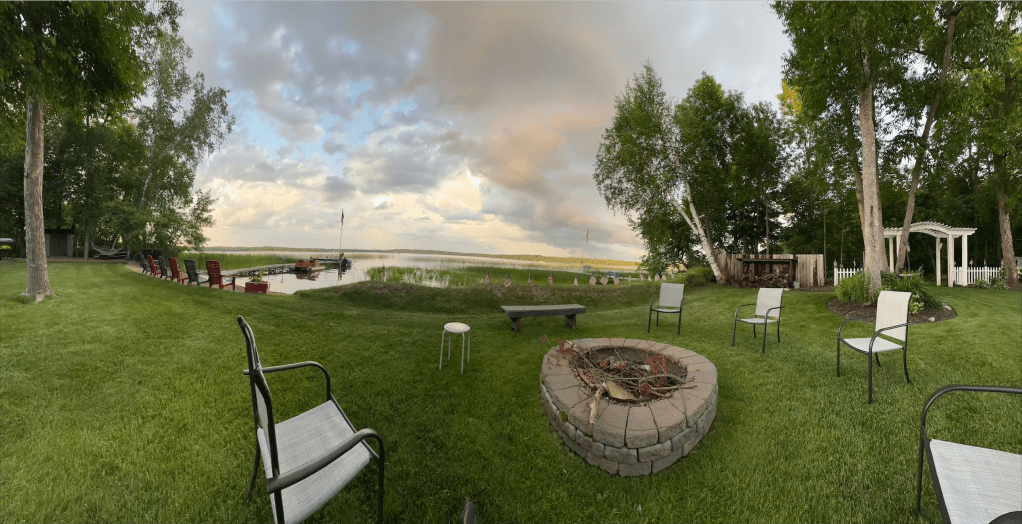
For now, here’s the peaceful panorama from the shore.

Some Numbers Happened

This August was the three-year anniversary of Words Deferred. Around that same time I also hit 10,000 views.

Is that a good amount? Who knows. It’s certainly ramped up since that first year, when I was more-or-less shouting into the void.

It’s hard to believe it has already been that long. But then, the flow of time broke sometime in 2020, so now everything gets lost in the temporal vortex.

Anyway, thanks for hanging out and talking about writing with me!

The Read/Write Report

This week, instead of the usual storytelling class that I have with my daughter, we just set aside some time to write together. It was nice to have that time set aside, and I think we may switch to a schedule where we have our “class” every other week, and just have a scheduled writing time for the weeks in-between.

However, one of the things I’ve really enjoyed about our writing class (and documenting it on the blog) is the opportunity to review what I read and wrote over the past week. I figured I can continue to do that even if I don’t have a separate topic to discuss as well.

What I Read

I continued to work my way through The Unwritten, finishing volumes 5, 6 and 7. This series is my favorite read of the year so far, and quickly becoming one of my favorite graphic novel series of all time.

One of the tricks that The Unwritten pulls off amazingly well is the constant expansion of the story. It’s a mystery at its heart, with the main characters trying to figure out the motivations and powers of their enemies, and even trying to understand how the world around them actually works. In each volume, our understanding expands. We learn more about the world, which reveals more questions and raises the stakes.

I’m already thinking about a dedicated post talking about the series once I’ve finished, so I won’t dig too deep now, but I’m thoroughly enjoying it.

I’m continuing to read Dune aloud at bedtime with my oldest son. It has been years since I last read Dune, so I get to come at it with fairly fresh eyes.

I’ve been struck by Herbert’s style, which is equal parts florid and terse. He seems almost allergic to conjunctions, and is happy to connect multiple sentences with nothing more than commas. He frequently has paragraphs that consist of a single short sentence, or even a fragment. And yet, there are moments when he waxes poetic, when he’s describing the geography and environment of the desert planet Arrakis, or when delving into the characters’ thoughts on philosophy and politics.

Like many works of science-fiction that have been able to endure for decades, Dune is a strange book. It is a mix of prescient futurism and anachronism.

It is infused with environmentalism and ecological systems inextricably tied to the human populations that live within them. It offers a generally positive view of Islamic cultures. It imagines a universe where people have rejected artificial intelligence, and spent centuries exploring, advancing and honing the possible modes of human thought.

It also imagines a far-flung spacefaring society that is fundamentally feudal, governed by all-powerful emperors and lesser royals, where the populations of ordinary people have no meaningful say in the structure of their society. The only competition for power comes from the Spacing Guild, who monopolize space travel; the CHOAM company, who monopolize life-extending spice; and the Bene Gesserit, who use social, political, and even religious manipulation to infiltrate the other powers and perform experiments in long-term eugenics. Power is almost exclusively amoral and self-serving. It’s not the sort of future most of us would be eager to experience first-hand.

Having read all of the Dune books (at least the ones by Herbert himself), I never felt that any of them stood up to this first one in the series. They are interesting though, because they do a better job revealing Herbert’s interests in vast timelines; huge interconnected systems; and ideas of humanity behaving as a single collective organism, with the fates of individuals being dictated more by the drives of the super-creature than any individual choices they make.

What I Wrote

I got about halfway through Razor Mountain chapter 9. I also started writing a short story that I’m calling “The Incident at Pleasant Hills.” The idea was inspired by a Story Engine prompt, and I used a slightly modified version  of Firewater’s Cube brainstorming method to flesh out the characters and setting.

I think I was in need of other fiction to work on alongside Razor Mountain. I’m still enjoying writing Razor Mountain and I’m committed to finishing it, but it’s nice to have small things to work on alongside the novel that I know I’ll still be working on for months to come.