
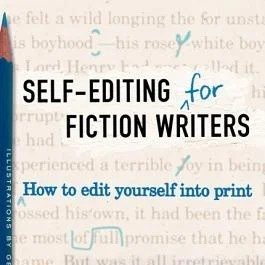

Renni Browne and Dave King aren’t household names. They aren’t famous authors like Chuck Palahniuk, or Chuck Wendig, or any of your classic famous authorial Chucks. They’re editors. Their advice isn’t wild or shocking, and it doesn’t claim to make writing easy or save you the hard work. It’s just twelve fairly straightforward ideas that can be used to edit fiction and make it better. The result is one of my favorite books on writing.
This book has been on my shelf for years. I have the second edition from 2004, and the original was published a good decade before that. It’s not exactly timeless, but it’s about as close as you can get while including references to a broad swath of literature. I take it out every few years when I’m planning to do a lot of editing, which is why I recently re-read it.
Each chapter focuses on one thing: Show and Tell, Dialogue Mechanics, Interior Monologue, etc. The authors explain a few problems they look for when editing, then provide short examples from published books, workshops, and manuscripts. Each chapter finishes with a bulleted checklist that can be used for your own work. Finally, they provide a couple of exercises that you can try, if you want to use the book as a sort of self-guided class.
After the last chapter, there are two brief appendixes. The first contains the editors’ answers to the exercises. The second is a list of recommended books for writers, split out into craft, inspiration, and reference. Lastly, there is a solid index, so you can easily find that half-remembered advice without needless skimming.
This structure is something worth noting. So many books on writing are meandering or mix anecdotes, ideas, and advice in ways that make them difficult to use as tools. This book has a few anecdotes and asides, but it’s organized so that you don’t have to wade through any of that when you’re busy trying to find some specific thing that resonated. It’s worth reading the book from cover to cover, but it’s also designed in a way that allows it to be useful as a reference.
If there is a weakness in this book, it’s a focus on a modern, mainstream, “popular” writing style. The authors don’t talk much about the exceptions to the rules, or how to make strange and unusual fiction. This is not a guide that will help much if you’re writing House of Leaves, or Poison for Breakfast, or This is How You Lose the Time War.
I don’t think that’s a major failing. Self-Editing for Fiction Writers advocates for clean, concise, clear fiction. That’s a pretty good starting point for any writer. I suspect the authors would suggest that this is table stakes for fiction. If you want to do something more, something wild and crazy that breaks the rules, you will do it more effectively if you have a good grounding in the basics first. This book provides that.

 Words Deferred
One thought on “Self-Editing for Fiction Writers — Reference Desk #22”