Blog

Killing Time at Lightspeed — Games for People Who Prefer to Read

Killing Time at Lightspeed is a text-based, narrative game by Gritfish about browsing social media while voyaging between the stars.

You are a traveler who has left their life and your planet behind. Your lightspeed voyage will feel like less than an hour to you, but to your friends on Earth it will be twenty years. The only connection you have to those people is a news and social media feed: FriendPage.

This is a small indie game, clearly developed with limited resources. There are a few static illustrations in the introduction. After that, the entire game is contained within a simple, monochromatic yellow and black text console.

The game plays out in a series of turns, each one taking only a minute or two. During a turn, you can read your friends’ updates on FriendPage, and a handful of news headlines. You’re given the option to reply to one or two posts, and you can give them thumbs up or thumbs down. When you’ve read and responded as much as you like, you can click a button to “refresh” the page. When you do, a year passes back on earth and the news and social feeds update.

With that click of a button, you may see the results of an action a friend was considering. Relationship statuses are updated as the people you know get together and break up. They get married and have children. New technology appears, like cybernetic implants and humanoid androids. Your friends have time to adjust to societal and personal changes, but for you it all comes and goes in minutes instead of years.

There are many sci-fi ideas at play here. The arguments about cybernetic enhancement cover similar ground to the Deus Ex games. Discussions of android rights echo Detroit: Become Human. However, with this short runtime and limited budget, the game can’t delve as deeply into these particular issues. In a way, that’s the point.

In Killing Time at Lightspeed, everything that happens in your social media feed is ephemeral—even more than in our day-to-day lives. It excels in delivering a feeling of being cut off and left behind. You’re reading about what everyone else is doing and experiencing, but you are alone.

How much can you really communicate with your friends when months or years pass between messages? Momentous changes in your friends’ lives are summarized in one or two sentences. How many other important things are you missing altogether? You can ask them about what’s happening, but how can they explain all the things that have happened to them since last year and your last message?

The point is really driven home in the final years of the game, when a new social media site becomes popular and friends start to drift away from FriendPage. You don’t have the option of making a new account or checking the new feed. You only have what your spaceship gives you. Soon, your feed is almost entirely filled with spam, bots, and pointless Buzzfeed-esque listicles. You’re stuck on MySpace, in space. Your one tenuous tether to Earth is nearly severed. But you keep refreshing in the hopes that someone will come back and post something.

Then you arrive at your destination. The terminal shuts down. The game is over. Your friends are far away, living their lives without you. Presumably you’ll go off and live a new life without them.

Killing Time at Lightspeed is shorter than a movie, and can be comfortably completed in a sitting. It’s a narrative snack, not a full meal. I didn’t walk away from it with a lot of new thoughts, as I sometimes do with games like this. Instead, it left me with a feeling. A melancholy vignette.

Killing Time at Lightspeed is available for PC on Steam and Humble Bundle.

Final Exam — The Story Idea Vault

It’s a common misconception that a great idea makes a great story. The truth is that most great stories come down to execution. A great idea with poor execution rarely works, but a great writer can breathe new life into even the most tired tropes.

Like any writer, I have my own treasure trove of ideas that might end up in a story…someday. But why horde them? Instead, I’m opening the vault and setting them free.

Use these ideas as a writing prompt, or come up with your own twist and reply in the comments.

Final Exam

In old movies, recognizing aliens was easy. They looked like giant insects, or gray-skinned people with huge black eyes, or heck, just humans with pointy ears. They spoke words through something mouth-shaped, and if they didn’t want to eat you or lay some eggs in your stomach, they at least wanted something reasonable, like taking over your planet.

The scientists in the old movies didn’t have to worry about Species 104, the plasma clouds that only understand calculus. They never had to devise a translator for Species 92, the fungal/viral symbiosis that communicates by rupturing your cells.

As a trained xenologist, it’ll be my job to explore the galaxy and make first contact with new alien species. I’ll be ambassador of the human race. But first, I need to pass my final exam: picking which one of these ten asteroid chunks is actually alive, and whether it talks by exchanging argon crystals or by carving glyphs into you with a focused sonic pulse.

Based on the noises made by the last student and the amount of blood on the floor of the examination room, I’m guessing it’s the glyphs.

Now, which rock…

Speaker for the Dead — Read Report

Book | E-book | Audiobook — Bookshop/Libro affiliate links

Speaker for the Dead is the second book in the Ender’s Game series. The last time I read this, I was probably still a teen.

For Ender and Valentine, it has been two decades since the events of Ender’s Game. But much of that time has been spent on starships traveling at relativistic speeds. A thousand years have passed outside those starship hulls. Humanity has spread across the hundred worlds. Ender’s pseudonymous books, The Hive Queen and The Hegemon have convinced most humans that Ender, “the Xenocide,” was a genocidal monster, and have inspired a secular religion of “speakers for the dead,” who try to eulogize those who have passed with complete honesty.

Ender and Valentine find themselves on the icy, Scandinavian-colonized world of Trondheim, teaching and speaking for the dead, when they hear the news that the only other known sentient alien species, the Pequeninos, have brutally killed a scientist on the tiny colony of Lusitania. A call goes out for a Speaker, and Ender follows it. His sister, however, is married and expecting her first child. For the first time in twenty-two years, they part ways, fully knowing that after the lightspeed journey she will be nearly double his age.

Ender arrives at the Portugese-Catholic colony with two secrets: the egg of the last bugger hive queen, ready to revive the species he destroyed a thousand years previous, and a jewel in his ear that lets him communicate with Jane, the only sentient AI in the universe.

Ender intrudes upon a decades-long family drama. Novinha Ivanova is the colony’s xenobiologist, the orphaned daughter of the original xenobiologists, who died in the process of saving the colony from the deadly alien Descolada plague. In her youth, she was mentored by the colony’s xenologer and fell in love with his son (and apprentice). These two important men in her life, the only people allowed to interact with the Pequeninos, are the ones the aliens choose for strange, ritual murders. And Novinha is determined to keep secret any and all information that might lead others to the same fate.

Speaker for the Dead is a very different book from Ender’s Game. That book was all about Ender’s struggles to overcome adversity at the battle school. Ender is a genius with a variety of remarkable skills, but it works in that context because the challenges stacked against him are so brutal.

In Speaker for the Dead, Ender is even more of a Gary Stu. He is the legendary Xenocide. He is the accidental father of a religion. Not content to have committed genocide, he plans to revive the bugger species. Jane, the AI, chooses him as the only human she will reveal herself to. Even the Pequeninos can only be fully understood by Ender, solving mysteries in days that the xenologers couldn’t penetrate over decades. He immediately gains the trust of almost everyone he interacts with on Lusitania, with apparently little effort.

It’s a testament to the setting and the mystery-driven plot that the book is still good in spite of Ender’s nearly inhuman ability to do whatever he sets his mind to. The alien ecology of Lusitania is interesting and well-conceived, and there are fun twists along the way. The resolution of the mysteries makes perfect sense thanks to the clues peppered throughout the book.

This feels a bit like two books that only come together in the final act. Ender has his own life (and years of post-Ender’s Game history that is only alluded to) before the journey to Lusitania. And many of the important events on planet happen before he leaves or during his long lightspeed transit. Much of the remainder of the book involves teasing out this history and connecting the disparate threads, in the same way the detective pieces together clues in the drawing room at the end of a cozy murder mystery.

The main plot points of Speaker for the Dead came back to me pretty quickly as I was reading. However, I remember very little of the next book, Xenocide, and I’ll be rereading that soon. I’m curious to see if it has more in common with the first or second book in the series.

Five-Finger Brainstorming for Fiction

I have a day job in software development where I’ve worked with large corporations. Thanks to that job, I’ve had plenty of exposure to corporate efficiency buzzwords and processes, from lean six sigma black belts to leveraging synergies.

While the eye-rolls induced by these terms are often justified, they usually start with a useful kernel of truth before metastasizing into something a VP drones on about in the all-hands meeting as everyone tries not to cringe.

This brainstorming method is based on the five whys, a corporate-speak process for digging a few levels deep to find the real root of a problem. I like it for brainstorming fiction ideas is because it is fast and easy and generates some unexpected connections.

Five Finger Brainstorming

Start with the first premise that pops into your head. It can be almost anything. It doesn’t have to be particularly interesting or story-worthy. However, don’t be afraid to start with something big like a hostage negotiation or first contact with aliens.

Example:

A man kills his neighbor…

Next, ask yourself why that first event happened, or what it implies. Repeat this until you’re at least five levels deep. You can count them off on the fingers of one hand.

Don’t think hard. Just write down the first thing that pops into your head each time. This technique works best if you let your subconscious take the wheel.

A man kills his neighbor…

because the neighbor knows his secret…

his secret is that he is hiding an alien in his basement…

because he is in love with it…

because he is an alien too.

Next, look at this sentence or paragraph as though a breathless child had just run up and told you this story. What questions would you have? I usually have a couple. These questions are natural jumping-off points for expanding the idea further.

  • Are they the same species of alien?
  • Why does one need to be hidden? Does one pass for human while the other doesn’t?
  • What happens after the murder?

Bonus: Story Trees

You can expand on this with a different style of brainstorming—one that is slower and more methodical. Try it with an idea that feels like it has potential, where you weren’t satisfied with your initial blurbs.

Look at each answer as a branching point in a tree. The original idea is the root. Instead of expanding that idea once, expand it in five different ways. Then go down the chain for each of those branches.

(Why yes, my MSPaint skills are incredible. Thanks for noticing.)

Be aware that filling out all the branches results in exponential blurbs. If you don’t want to go that far, just fill in a few branches that pique your interest. Remember, inspiration often strikes when you’re straining to come up with one or two more ideas. On the other hand, you’re under no obligation to stop at five if you want to keep going.

Two Techniques that Work Great Together

The five-finger technique helps dig deeper into the reasons and consequences of an initial idea or event. The story tree forces exploration of alternatives, which can sometimes get you past easy, tropey explanations and into more interesting territory.

In brainstorming, quantity leads to quality. With these techniques you can generate a lot of ideas quickly, so don’t be precious about them. They’re meant to be quick and disposable. So start counting, and come up with something new!

Mouthwashing — Games for People Who Prefer to Read

You could say I’m not much of fan of horror. I’ve learned a lesson from music: if I think I dislike a genre, it just means I’m picky and I haven’t found the particular examples that hit just right. House of Leaves, Soma, and Alien are some examples that proved to me I can enjoy horror—it’s just a hard sell.

I’m not sure if I enjoyed Mouthwashing. I’m not sure it’s a game that’s designed to be enjoyed. I am enough of a gaming hipster to appreciate when a game tries to evoke a mood, even if it’s an unpleasant one and it doesn’t always pull it off perfectly.

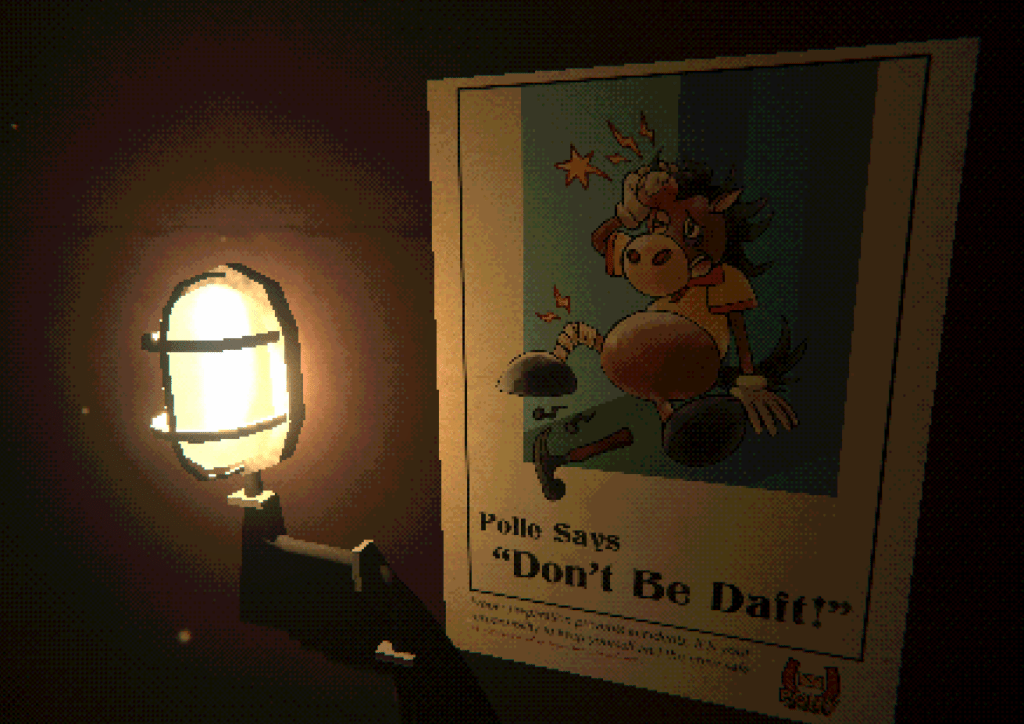
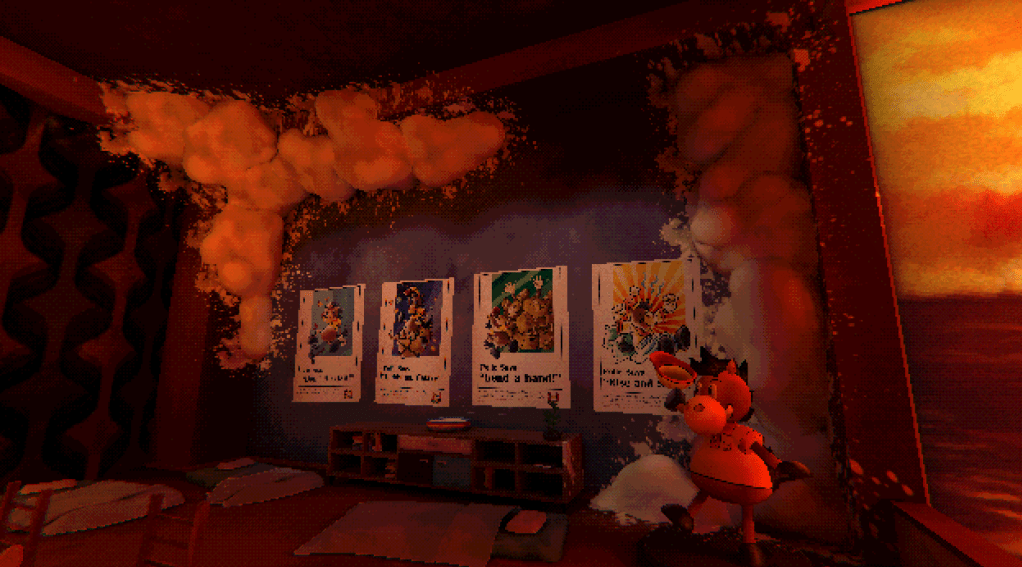
Mouthwashing is a short (3-4 hour) game about the five-person crew of the Pony Express ship Tulpar, a long-hauler transport spaceship on a year-long delivery run. We don’t see the world beyond the ship. We don’t know what it’s like out there, or how far into the future we are. The world of Mouthwashing happens in the grimy, poorly lighted corridors of the Tulpar. The visuals are purposely lo-fi; not only grimy, dark, and gory, but viewed through a crunchy, pixelated filter.

The tale is nonlinear, jumping back and forth several months around a cataclysmic incident. The ship hits an asteroid, crippling it and leaving the crew stranded with limited supplies.

In the past, we play as Curly, the captain of the ship. During the crash, Curly is severely injured, wrapped in bandages, bedridden, and in excruciating pain. A single bloodshot eye peers out from the bandages. A row of bare teeth, with no lip to cover them. In the scenes after the crash, with Curly nearly out of commission, we play as Jimmy, the co-pilot, Curly’s longtime friend and the guy who just can’t seem to get his life together. Rounding out the crew are Anya, the medic; Swansea, the mechanic; and Daisuke, the intern who was unlucky enough to board at the last minute before launch.

The gameplay mostly revolves around conversations among the crew, with occasional simple puzzles and item-fetching. There are two brief “gamier” sections where some reflex and strategy are required, but I found these to be the weakest and most frustrating portions of the game.

As the months go on and the characters become  desperate, civility breaks down. It becomes clear that there are dark secrets among the crew. The game becomes more and more surreal, reflecting Jimmy’s progressively deteriorating mental state. Flash backs to Curly slowly reveal the hidden secrets that Jimmy doesn’t want to talk about, or even acknowledge to himself.

As the crew turn on each other, the ship’s actual corridors fall away, leaving us and Jimmy in a mostly hallucinated world where we can only guess what is real and what is metaphorical. It all ends in blood and tears, as Jimmy tries and fails to hide from a series of horrible truths.

Mouthwashing echoes a classic strain of horror where a small group of people are trapped together in the face of a monster or horrific situation. Here though, despite being lost in space, the horrors are decidedly human.

Mouthwashing is made by Swedish studio Wrong Organ and is available on Steam, Nintendo Switch, PlayStation 5, and Xbox Series X/S.

Life in a Signal — The Story Idea Vault

It’s a common misconception that a great idea makes a great story. The truth is that most great stories come down to execution. A great idea with poor execution rarely works, but a great writer can breathe new life into even the most tired tropes.

Like any writer, I have my own treasure trove of ideas that might end up in a story…someday. But why horde them? Instead, I’m opening the vault and setting them free.

Feel free to use these ideas as a writing prompt, or come up with your own twist and reply in the comments.

Life in a Signal

It starts—we think—as a garbled message. It continues due to a bug in the protocol that lets a signal repeat forever, bouncing from node to node. It thrives when it mutates to set the multicast flag. Its clone-children spread across the network.

Whatever purpose the original packets had, it’s soon forgotten. This new electronic life, this heart that beats in milliseconds over insulated copper and fiber optic cable, seeks only what all life seeks: to continue itself. Like a shark, it has to keep moving, swimming through wires, or it will die.

Mutant messages broadcast from every node to every node. Bandwidth is used and exceeded. Everything slows to a crawl…

…and…

…stops.

New life born and ended in a few blinks of the eye.

Sadly, we will never know its thoughts or motives, its dreams or fears. All we know is that it caused yet another power outage in Texas.

What do you Want from Writing? — Quick Note

I’ve been reading Jeff VanderMeer’s Booklife, and I was struck by one of his anecdotes. He had secured a limited edition 500-book print run of a novelette with a small press. To promote the release, he arranged an interview with Wired.com, and a quick blurb on BoingBoing.com. To get these, he worked with the publisher to provide a link to a free download of the same story in PDF—a link that would eventually be clicked 20,000 times.

VanderMeer’s description of the back-and-forth of promoting his story wasn’t what surprised me, it was my own reaction to it. My first thought was that it was a bit of a waste. Surely some of those people downloading the story would have bought a physical copy, right?

He was pleased with this result, at least partly because it led to other opportunities down the road. But I had to interrogate my own reaction. Why did the free download strike me, at least initially, as a bad idea?

The answer, of course, has to do with money. My thought was that this is a fairly successful professional author. Why give work away? The actual answer is complex: the high number of downloads led to later opportunities, the promotion helped sell out the print run, and the market for novelette-length work is very limited (and was even more so ten or fifteen years ago when this occurred.) However, my own reaction made me wonder if I’ve become overly-fixated on getting paid as a measure of the value of writing.

Like many amateur authors, I’ve spent years wondering what it would take to be able to write as a full-time job. Writing is a competitive field, and on the whole, not well-paid. It’s no surprise that so many of us become laser focused on seeking any opportunities we can find. But is that really why we’re writing? Does getting paid do us any good if it becomes the reason to write?

I realize these are not new questions. Artists have always struggled to find balance between art and commerce, and that isn’t getting any easier in a world hell-bent on commodifying art into “content.”

It’s good to sit down every once in a while and think about priorities. Is it better to be paid, or be more widely-read? Is it better to be published, or to improve your craft? Better to write in the format that has a market and a readership, or in the format that interests you? Are you motivated by making the stories you love, or the ones someone else wants to read?

In short, what do you want from your writing?

Exhalation — Read Report

Buy on Bookshop.org (affiliate link)

Buy audio book at Libro.fm (affiliate link)

(As I mentioned in my May Read Report, I’m going to try breaking out these posts per-book instead of the monthly summary that I have been writing. That’ll mean more of these posts, but each one shorter and more focused.)

Chiang first appeared on my radar via the 2016 movie Arrival, which is based on his short story “Story of Your Life.” The film made an impression on me by the many things it was able to juggle simultaneously. It is a great first contact sci-fi story and an emotionally fraught personal story that are intimately connected. It’s a great example of Chuck Wendig’s principle from Damn Fine Story—the inner emotional story drives the external action. On top of that, it is told in a cleverly non-linear way that not only enhances the tension, but fits with the key themes of the plot. It remains one of my favorite sci-fi movies.

Exhalation is a collection of nine stories. Two of the longest, The Lifecycle of Software Objects and Anxiety is the Dizziness of Freedom account for about half of the total length, and the other seven are much shorter in comparison.

The Lifecycle of Software Objects begins with the invention of a rudimentary AI system that is designed to learn and grow. The main character is a former zookeeper turned software developer who is brought in to train and develop these AI companions for the company that hopes to sell them as an advanced Tomagatchi.

The AI companions are a success at first, enough that robot bodies are even produced to allow them to movie around in the real world, albeit a bit clumsily. However, the fad soon loses its momentum as consumers begin to realize that raising these AI is just as much work as raising a human child. They learn slowly, ask difficult questions, and show none of the super-human capabilities that sci-fi has long imagined from AI. The company goes under, but the protagonist and a dwindling group of die-hard believers in the project continue to raise their AI children with the understanding that it will be just as difficult as parenting a human child.

There are no shortage of stories out there about superintelligent AI taking over the world, but far fewer that suggest non-human lifeforms might need just as much raising and growing up as their human counterparts.

In Anxiety is the Dizziness of Freedom, a device called a “prism” can create a quantum event at the moment of initialization, with two possible outcomes. The result is two parallel realities that diverge at that exact moment, a clunky briefcase laptop linking them with text chat and video calls to its parallel-universe counterpart. Each briefcase has a limited amount of memory it can use to communicate between the two worlds before it is used up, making older or less-used machines more valuable and rare.

The story explores various ways people are affected by this tech. Some obsessively compare their own lives to those of their alternate-universe selves or use alternate realities to justify their decisions. Some use it as an opportunity to “work together” with their alternate selves, or talk with alternates of people who have died in their own world.

While the prism device is the conceit on which the story hinges, it’s really about the choices we make. Alternate realities may make some question the value of a given choice, when the exact opposite is chosen in other worlds. But each choice still has consequences in this one, and an associated moral weight. Is a person defined by the accumulation of their choices across one life, or across infinite parallel lives?

There is little “hard” sci-fi or far-future technology in Chiang’s stories. Stories like The Merchant and the Alchemist’s Gate, Dacey’s Patent Automatic Nanny, and Exhalation dip their toes in steampunk sensibilities, while The Lifecycle of Software Objects, What’s Expected of Us, and Anxiety is the Dizziness of Freedom posit worlds that could essentially be the one we live in today, but for one or two technological additions.

It’s also apparent from these stories that there are a few themes that Chiang keeps returning to, the bigger planets in his solar system, whose gravity is obvious across his work. Time travel and alternate universes are a recurring theme, but this may be because he is so intent on explorations of choice, free will, and whether our decisions have meaning.

As with any sci-fi, technology is at the heart of these stories, but they are not cold and robotic as sci-fi can sometimes be. Writers like Asimov are often critiqued for clockwork plots with flat characters who are merely parts in the machine. That’s certainly not a problem for Chiang. Most of his stories are character-forward, and are about human behavior and belief in the face of the changes wrought by technology. It’s easy to relate to these characters, because they face decidedly human problems in worlds much like ours, where technology drives change and sometimes creates new joys and new pains.

I often want to roll my eyes when speculative fiction authors escape the genre fiction ghetto and get themselves shelved under that haughty label of “literature.” It seems like a flimsy excuse by the gatekeepers to allow themselves to enjoy what they would otherwise be required to look down upon, due to the presence of spaceships or elves. For Chiang, I’ll make an exception. I think he deserves to be widely read, and I’d rather not see people put off by the time machines and intelligent robots.

Dreaming of Other Worlds — The Story Idea Vault

It’s a common misconception that a great idea makes a great story. The truth is that most great stories come down to execution. A great idea with poor execution rarely works, but a great writer can breathe new life into even the most tired tropes.

Like any writer, I have my own treasure trove of ideas that might end up in a story…someday. But why horde them? Instead, I’m opening the vault and setting them free.

Feel free to use these ideas as a writing prompt, or come up with your own twist and reply in the comments.

Dreaming of Other Worlds

His dreams are always out of focus. Bits and pieces of familiar places he has never seen. These places speak to him indirectly, in subtle metaphors. No matter how hard he tries, he cannot identify them.

It’s like trying to remember the title of a movie from a song on the soundtrack, or identifying a woman by her perfume. He tries to explain it to his parents, his husband, his children. They don’t understand.

It’s such a relief then, on his deathbed, when his dreams come clear. He remembers all those other worlds—places where he’s lived other lives—and it doesn’t scare him to know that he’s about to go someplace new.

Carter Vail’s Five Rules for Being An Artist

There’s a chance you’ve come across Carter Vail if you ever find yourself scrolling through Instagram reels, YouTube shorts, or the other short video platforms on the handful of social media sites that make up the modern internet.

He may be best-known for his goofy songs about eating coins, using karate against aliens, or protecting yourself from the Dirt Man, but his “real” songs have been in heavy rotation on my drive-time playlists.

He recently released a concise and honest how-to video for building a creative career. It’s tailored toward musicians, but most of the points he makes can be easily translated to other artistic endeavors.

Watch below, or click through to YouTube.

The List

  1. Find an *art of your choice* community
  2. Become indispensable to that community
  3. Cash in favors to make *your kind of art* ferociously
  4. Make people care
  5. Stay in the game

Thoughts

It’s interesting to note right away that this list assumes art is a collaborative endeavor. It’s possible to be a solo singer-songwriter, but I think most people will agree that music is among the most collaborative of the arts, perhaps only behind TV and movies in the number of people who have to come together to make something.

Writers and painters are more likely to balk at this. Many of us are used to working alone. But even in the world of fiction, there are beta readers and writing groups and agents and editors and marketing people. You might find yourself writing for other media, for comics or RPGs or video games. As you progress and do more, chances are good that you’re going to have to interact with some or all of these people. No man is an island.

“Make people care” is innocuously simple at first glance, and immediately stands out as the hardest of these steps for most of us who have tried to do it. Today more than ever, there is an infinite abundance of art out there. It’s a struggle to be seen and connect.

I see the fifth step, “stay in the game,” as an extension of this. Rare is the artist who never thinks about giving up. Making people care takes time. You never know when (or if) your work will reach the right set of eyeballs. It may be tomorrow. It may be a decade from now. Do you give up or keep going, harder than ever?

As Carter says, “Stay in the game, make art, and put it out into the world.”