Some Short Story Submissions

After focusing intensely on submitting short stories in 2024, I have to admit, I fell off hard in 2025. However, I haven’t been completely dormant. I’ve been writing a little and submitting a little, so I figured it’s about time for an update.

The Joy of Simultaneous Submissions

I have two stories out on submission right now, and both have been rejected a few times, mostly by big pro markets.

I submit to these big markets first, simply because an acceptance will come with a bigger check and more prestige. It would be fun to have my name on a cover that has been graced with genre greats; the magazines that I read when I was young.

Am I confident that my stories are a high enough caliber for those markets? No, but judging the quality of fiction is such a personal, opinionated thing, and doubly so when you’re the one who wrote it. So why not? It’s worth a shot.

The big magazines and websites can afford to be picky and demanding. They often have months-long slush pile backlogs, and don’t allow multiple or simultaneous submissions. Once you’ve submitted, your story could be in limbo for a quarter, six months, sometimes even longer. All for that <1% chance at a big acceptance.

The stories I have out right now are past all that. They had their shot. Now I’m submitting to lower-paying and less well-known markets. There are three reasons why this is nice.

  1. There are a lot of them! Even in the face of limited reading windows, narrow topics/genres, and themed issues, most stories have at least a couple reasonable places to submit in a given month.
  2. They have smaller slush piles, and that often equates to higher acceptance rates and faster responses.
  3. Many of them accept simultaneous submissions, which means you can send a story to several places at once.

So even though I only have two stories I’m currently submitting, I’ve been able to make 11 submissions, which isn’t too bad.

Timing the Market

Another thing I’ve noticed is that there seem to be a lot of markets that open for submissions in the summer, and close at the end of July or August. There are reading windows all year round, but there are also these larger trends. December and January seem to be the worst times to submit, with so many people out on holiday in the US and Europe.

I still check the Duotrope themed submissions calendar and publishing news pages fairly frequently. Their “Fiction publishers that have recently opened to submissions” list is a great way to track reading windows without trying to keep tabs on all the markets in your genres. The theme deadlines list is easy to glance through to see if anything matches any of the stories that I’m currently shopping around.

Drafts and Critiques

I’m still very behind on my rough drafts and critiques. I wrote a couple stories this year, and I’m now sitting on four that are somewhere between “technically complete” and “needs a final polish.”

The downside of using Critters for critique is that I’m not very good at keeping up my three(ish) critiques per month, so when I have stories I want to submit, I tend to have to do a couple months of critiques to get caught back up. However, with my finished stories out on submission, I really have no excuse. Aside from revision being the toughest part of the job.

The rest of August is going to be busy. I have a family vacation planned for the end of the month, and the kids are back in school the week after.

I’ve set myself a lofty goal of trying to get all four stories edited before the end of the year. That works out to almost one story per month. Doesn’t sound too implausible…until you compare it to my track record for the year so far.

That’s all the news that’s fit to print. How is your summer writing going? Let me know in the comments.

Year of Short Stories — Week #48

2024 is my year of short stories. In this weekly series, I talk about the stories I’m working on, from idea and draft to submission.

  • Stories in Progress – 1
  • Submissions This Week – 0
  • Submissions Currently Out – 5
  • Acceptances This Year – 1
  • Rejections This Year – 28 (11 higher tier)

Submissions

No rejections or new submissions this past week (or rather, this past 4-5 days, since I was late in posting last week’s update). My lone submission the previous week was Dr. Clipboard’s Miracle Wonder Drug, which had just come back to me with a contest honorable mention.

Since I do a lot of my writing work on the weekends, I often resend stories and write blog posts in the same day. Before I do that, I look at the Duotrope Theme and Deadline Calendar, and the Publishing News. The calendar gives me a convenient list of themed issues and anthologies with deadlines in the next month, and the news page gives me a list of new publishers and those that have recently opened to submissions. These two lists are incredibly valuable when you’re sending out short stories.

Most weeks, I don’t find anything particularly exciting in the theme calendar, but it’s still worth checking because I occasionally find an upcoming issue or anthology whose theme fits one of the stories that I’m resubmitting that week.

Last week was one of those weeks, and I found an anthology that sounds perfect for Dr. Clipboard. Sure enough, I got a response within a few hours, holding the story for further consideration.

Further Consideration

This is the first time I’ve gotten this style of response for a story submission. As is typical for anything related to short story submissions, Aeryn Rudel has an article. He puts holds, further consideration, and short listing all in the same bucket—a story that someone at the publisher read and liked enough to consider publishing it.

Since most markets are inundated with submissions and will only end up publishing a fraction of the stories they like, it makes sense for them to keep their options open until the end of their submission window.

Not every publisher notifies the writer that their story is being held. They’ll just hold it and either send an acceptance or rejection when they’ve made a final decision. As a writer, you can appreciate a publisher that communicates the hold, or you can be frustrated to have yet another reason to get your hopes up, and possibly disappointed if that hold results in a rejection.

Personally, I’d rather have the additional information. Even if the story ends up being rejected, a positive, personalized response still tells me that the story is probably solid, and I just need to find the right publication for it.

Stories in Progress

I still have some projects lingering from my truncated November “PerShoStoWriMo.” I haven’t gotten a lot of words down for those stories, but they’re still taking up brain space, and I may spend more time with them in the coming weeks.

I’m still in the process of condensing the critiques I received for Red Eyes into actionable changes. In some cases this is a straightforward rewording or cut, but in other cases it requires a fair amount of thought to figure out how I want to address a concern (or if I want to address it at all). I may write a post in the future about this process.

The most interesting piece of feedback I received was that the length of the story is good. It clocks in around 6,500 words, which is long for me, and I explicitly asked readers if they saw any good places to trim that word count. A few readers ignored the question, but most of them said there were no good places to make a significant cut. A couple even said that they’d like to see a longer version of the story. One suggested a novelette, the other suggested a full-blown novel.

While I don’t plan to follow that advice, the unified response does alleviate my fears that the story is too long. I suppose I’m just stuck with a longer story, and I’ll have to deal with that when I’m finished editing and have to look for markets to submit to.

Goals for Next Week

  • Continue revising Red Eyes
  • Spend some time on one of those other story ideas

Year of Short Stories — Week #33

2024 is my year of short stories. In this weekly series, I talk about the stories I’m working on, from idea and draft to submission.

  • Stories in Progress – 4
  • Submissions This Week – 1
  • Submissions Currently Out – 10
  • Acceptances This Year – 1
  • Rejections This Year – 17 (7 personalized)

Quick Update This Week

I’m going to be brief this week, because there’s not a lot to report. I continued to make progress on my unfinished stories, although I’ve been switching back and forth. This week I worked on The Vine again. My biggest worry was that it would end up being too long, but I had some ideas this week that I think will tighten it up quite a bit.

Once again, I received no responses to my submissions this week, but I did send out The Bluefinch and the Chipmunk to another publication that recently opened for submissions and seemed like a good fit.

Keeping tabs on Duotrope’s “What’s New in Fiction Publishing?” page also continues to pay off, as I noticed a couple of new or recently opened venues for my drabbles. I’ll be reviewing those this week to see if they’re worth a submission.

Goals for Next Week

At the risk of sounding like a broken record, my main goal is to continue making headway on my (too many) stories in progress. I may also submit a drabble or two if these new publications look promising.

Year of Short Stories — Week #27

2024 is my year of short stories. In this weekly series, I talk about the stories I’m working on, from idea and draft to submission.

  • Stories in Progress – 2
  • Submissions This Week – 0
  • Submissions Currently Out – 2
  • Acceptances This Year: 1
  • Rejections This Year – 17 (7 personalized)

Acceptance

It was a busy week for submissions, but the exciting news is that I received my first acceptance of the year. My drabble, Renter’s Dilemma, will be published in an upcoming horror anthology.

Part of being a writer is the “skill” of being simultaneously self-aggrandizing and self-deprecating, so my inner critic immediately looked for some reasons to get less excited: it’s just a drabble, it’s a big anthology series with lots of authors, and there’s no payment. But hey, the truth is that there are fewer and fewer publications that pay, and a writing credit is a writing credit. I’ll take a win, and keep on submitting. And I’ll post links when it’s released.

A Little Clarity?

I also received an odd email this week that made me realize even those who work in publishing sometimes have trouble communicating clearly.

This email was in response to a submission I had sent, and it said that the story had been “accepted for further consideration.” Since this publication accepts submissions via email, I am assuming this is nothing more than an acknowledgement that they received my story. (Duotrope’s guidelines for their normal response times also backs this up.) However, many publications do require submissions to pass through multiple readers or editors before acceptance, so this could conceivably be a note that the story made it through a first round.

The word “accepted” is a very loaded word in a response to a submission, so this phrasing that starts with the story “accepted” and ends with “further consideration” ends up being a linguistic rug pull for expectant writers.

Rejections

I received two speedy rejections this week: one for my recently renamed drabble, Tom, Dick and Larry, and one for Incident at Pleasant Hills.

I don’t normally talk about where I’m submitting, but I did want to mention how much I appreciate Clarkesworld Magazine. They are an excellent sci-fi mag with a very nice homemade online submission system, and they are remarkably fast at responding to submissions, despite being one of the biggest English language sci-fi markets.

Goals for Next Week

Quick turnarounds on submissions are a mixed blessing. It means I’m getting stories in front of more editors, sooner, but it also means I’m spending more time prepping and sending stories. It’s a lot easier to get to some of my other writing goals when stories aren’t coming back to me in 3-4 days.

As usual, I find myself with a lot of things I’d like to do, and not enough time to get them all done. I need to re-send those rejected stories, and I need to continue working on my stories in progress. That’s the bread-and-butter work.

I do still have a couple of completed drabbles that I have not been sending out, and this is mostly because it’s a pain to find places that are interested in a 100-word story. I also haven’t really done any simultaneous submissions, even when I’m sending stories to publications that allow it. That’s another way to get more stories in front of more editors.

Finally, there are always Critters critiques to catch up on. Those tend to be the first thing I let slide when I have too much to do. Luckily, I’ve built up a lot of credit, but it will eventually run out, and I don’t want to end up with a story blocked, waiting in the queue while I try to catch up on my quota.

So, I’ll throw down all of these as goals, with the understanding that I’m only going to get some of them done in the next week:

  • Resubmit rejected stories
  • Look for simultaneous submission options for The Bluefinch and the Chipmunk
  • Submit more drabbles
  • Work on incomplete stories
  • Catch up on critiques

7 Duotrope Tips and Tricks

Anyone who has been keeping up with the blog lately will know that 2024 is my year of short stories. I’ve been writing short fiction and submitting it to publications. As a result, I’ve been using Duotrope quite a bit.

Duotrope includes a database of publisher information and a submission tracker for authors. (It’s not the only one: Submission Grinder and Chill Subs are out there too. Duotrope is just the tracker I’ve been using.) So, I thought I’d write about a few tips and tricks that I’ve discovered that make the submission process a little easier.

1. Search by Title

The Duotrope publisher search has a lot of options, so you might be surprised (as I was), that there is no option for the actual title of a publication.

For some reason, Duotrope decided that this belonged in its own section. The “Find by Title/Name” option in the Search menu gives you the option of inputting a partial or exact name. If you don’t quite remember the name of a publication, you can also try searching by alphabetical index.

2. Find Publishers for a Piece

Once you’ve added a story to your Duotrope submission tracker, it will show up on your “List of Pieces” page under Account -> Pieces.

When the piece is ready to be sent out, you can always search for publishers by manually entering the length, genre, and other parameters. But you don’t have to.

Instead, just click the “Publishers” link next to your story on the “List of Pieces” page. This will automatically populate a search with the information you’ve entered in the piece’s description.

3. Publishing News

The Publishing News section of the site shows publishers that have been recently added. Since brand-new publications are inherently less well-known, they may represent a good opportunity to get a story in front of editors that are hungry for content, with relatively small slush piles.

Publishing News also has a section for publishers that have recently opened to submissions, which can be another good way to find fresh options, especially when those publications are only briefly open to submissions.

4. Track Themes and Deadlines

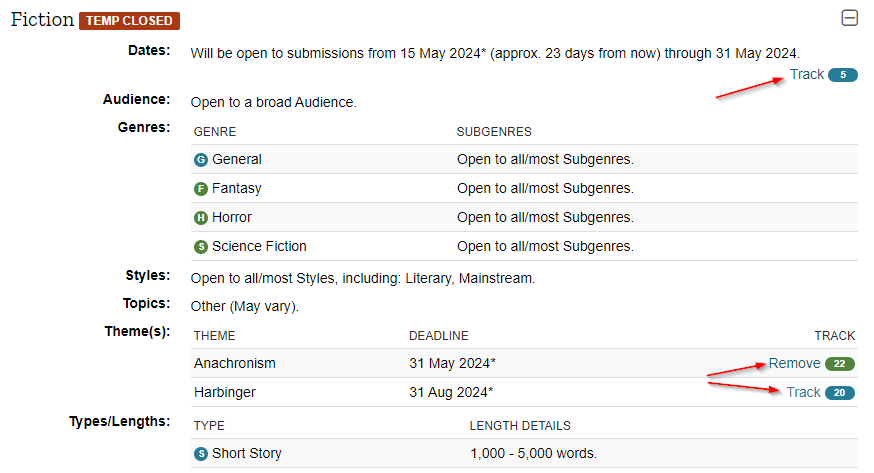
Some publications are only open for submissions during specific windows. This is especially true for themed issues or anthologies. Duotrope can track these submission windows and deadlines.

On a publisher’s detail page, general submission windows will be listed under the Dates heading, and specific themes will be listed under Theme(s). In each of these sections, there will be a Track link and a colored bubble listing the number of Duotrope users who are already tracking.

In the Account menu, you can visit “Themes and Dates” to see a convenient list of everything you’ve chosen to track.

5. Deadline Calendar

Whether or not you’re tracking any Themes or Deadlines, you can access the Theme and Deadline Calendar under the News section of the menu, or from the link at the top of the Theme tracking page.

By default, the calendar shows a list of all the themed submissions and deadlines in Duotrope, but you can filter by genre, payment, or your personal favorite publishers.

6. Overdue Responses at a Glance

Duotrope’s Submissions view shows information for all your tracked stories that are out on submission. It includes a trove of information, including some that makes it easier to decide if you need to follow up.

This view shows how many days each submission has been out, as well as the average response time reported by Duotrope users and the estimated response time provided by the publisher. But the status icon also has four different color options for pending responses.

Normally, the status is gray, but it will turn yellow if the submission has been out longer than the normal response time, and red if it exceeds the publisher’s stated response time. In some cases the publisher may state that they don’t always respond to submissions or don’t respond to status queries. In these cases, the icon will turn purple.

Of course, as with all things, you should confirm the publisher’s information on their website before blindly trusting Duotrope. It’s usually right, but occasionally there are discrepancies.

7. The Reports

Reports may sound dry and boring, but there are a few useful lists available there.

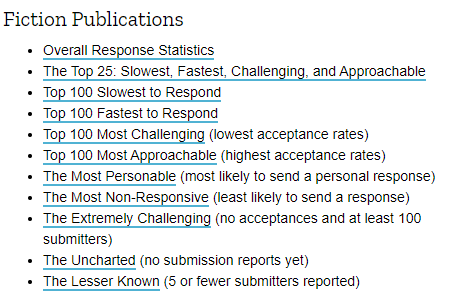
Authors who are sick of waiting for long response times can check the 100 fastest publishers to respond. Looking for feedback? Check the list of publishers most likely to send a personal response. Just trying to get a story accepted somewhere? Consider the list of publications with the highest reported acceptance rates.

What Else?

Do you use Duotrope? Are there any interesting features I missed? If you use a different tracker, I’d love to hear what they offer that Duotrope does not. Let me know in the comments.

Year of Short Stories —Week #8

2024 is my year of short stories. In this weekly series, I talk about the stories I’m working on, from idea and draft to submission.

  • Stories in Progress – 1
  • Submissions This Week – 2
  • Submissions Currently Out – 3
  • Rejections This Year – 4 (1 personal)

Let’s Get Personal

Two stories returned to me this week, both rejections. No problem; I’m developing that thick skin that’s needed for short story submissions. I get a story back, I send it out again, and I keep working on the next thing.

I was pleased to note that one of these rejections was “personal.” If you’re not familiar, there is a bit of a spectrum of rejections for short fiction. The typical rejection response says something to the effect of “Thank you for submitting, we read it and we decided to pass. Good luck elsewhere.” Short, polite, clearly uninterested. There’s really no useful information you can glean from a rejection like this. They might have hated it, or thought it was just okay. Because there are so many people submitting fiction, the vast majority of responses fall into this category, usually upwards of 90%.

However, many publications also have slightly more encouraging variations on rejection. These are usually along the lines of “We liked your story, but we have to reject it anyway.” That may mean that some editors/readers liked it and others didn’t, or that they liked it, but not as much as other stories. Unfortunately, the nature of the business is that a magazine will often have more good stories than they can publish.

A personal rejection is still not a sale, but it’s nice to have a magazine with pretty good pay rates (and thus, lots of submissions) telling me that they’d like to see more of my work.

Delving Into the Trunk

As I mentioned last week, I decided to open up my metaphorical trunk of old stories. It was fun to go back and look at how many stories I’ve written over the years. Not surprisingly, there are a number of these old short stories that are just not very good. They’ll be staying in the trunk. However, I was also surprised to discover several old stories that held up pretty well. In fact, I found three stories that I think are worth dusting off.

Admittedly, these stories need some work. I like to think that my skills are still steadily improving, and I immediately identified some opportunities to make these stories better. Two of them are too long and need better endings. Those will take a fair amount of effort. But the shortest one just needs some polishing.

That first old story is called “The Bluefinch and the Chipmunk,” and I’ve already done one editing pass. I’ll probably do one or two more in the upcoming week, put it in the Critters queue for critique, and start hacking one of the bigger stories down to a manageable size.

I’m happy that I dug up these old stories, because one of my current weaknesses is my ability to edit. This gives me an opportunity to work on that.

Developing a System

It’s still the first quarter of the year, and I feel like I’m just beginning to hit my stride in this project. So far, I am really enjoying it, far more than I thought I would. There is a joyous momentum to writing and submitting short stories that is just not present when writing a novel. A novel requires so much focus for so long that it’s sometimes hard to remember what life was like before you began the project, and hard to believe that it will someday end.

Writing short stories is a kind of willful amnesia. It’s a burst of intense focus to make a little thing as perfect as possible, and then it goes out into the world to meet its fate. Maybe it will succeed, maybe it will fail. In the meantime, I get to make something completely different.

Researching markets and submitting stories might sound like an unpleasant distraction to writers who want to focus completely on craft, but I’m finding the logistics of submissions interesting as well. Even with tools like Duotrope or Submission Grinder, it’s a surprising amount of work to find the “best” fit for a given story, especially when you’re optimizing for themes and pay rates. I haven’t even dealt with simultaneous submissions or publications that ask you to wait some amount of time before submitting something else. It’s a lot to track.

Right now, I’m still figuring out what’s important and what isn’t, and each submission feels like a new little adventure. Eventually, I expect to develop a rhythm, and I’ll find that I’m carrying out the same tasks for each submission. When I get to that comfort level, I’ll write a post describing that process, and hopefully it will save some new author a little bit of effort when they decide they want to start submitting their own short stories.

Goals for Next Week

  • Get a draft of “The Bluefinch and the Chipmunk” ready for critique.
  • Start editing another old story, tentatively titled “Red Eyes.”

Year of Short Stories —Week #5

2024 is my year of short stories. In this weekly series, I talk about the stories I’m working on, from idea and draft to submission.

  • Stories in Progress – 1
  • Submissions This Week – 1
  • Submissions Currently Out – 2
  • Total Rejections – 2

(I doubt anyone is setting their watch to my blog posts, but I wanted to note that I’ll be shifting these updates to Mondays, which fits better with my writing schedule.)

Second Rejection

This week marked my second rejection of the year, a response for Dr. Clipboard’s Miracle Wonder Drug, which had been out for about three weeks. I’ve now had one rejection for each story I’m submitting, which feels like a small milestone.

I’m learning to batch the effort of finding publications for a story by jotting down several options, so that when the story comes back to me, I can send it off again with less downtime.

Revisions for Pleasant Hills

After a couple weeks where I felt I wasn’t getting much done on this story, I tried to buckle down and get these revisions done. I even took a day off my day job to sneak in some extra writing time.

Revision is hard to quantify, especially with short stories. There are no word count quotas or chapters to measure progress against. I definitely get more done when I can set specific, measurable goals.

To that end, I made a checklist of problems to resolve and went through them one by one. Most of these items involved adding words, so the final step will be to trim, trim, trim.

So, as I suspected last week, I didn’t manage to finish. However, I’m close, and I should be done before the next update.

Goals For Next Week

  • Finish and submit Pleasant Hills
  • Start a new short story

Year of Short Stories —Week #4

2024 is my year of short stories. In this weekly series, I talk about the stories I’m working on, from idea and draft to submission.

  • Stories in Progress – 1
  • Submissions This Week – 1
  • Submissions Currently Out – 2
  • Rejections – 1

The First Rejection of the Year

“Tom, Dick, and Derek” garnered my first rejection of the year. This was a turnaround of only a few days, but it’s not too surprising since it’s a drabble and the magazine was only accepting flash fiction. I’m still not entirely sure of the viability of 100-word stories, but I’ll continue submitting to flash fiction publications and see how it goes.

Revisions for Pleasant Hills

This week, I re-read all the feedback I had received for “The Incident at Pleasant Hills” and condensed it into a page of bullet points of things to address, and several more pages of small line edits and suggestions for wording improvements. Most of these are straightforward fixes. A few are things that the story needs, and I just need to figure out where to put them. But there are a couple problems that I don’t have a solution for yet.

One of the things I need to improve about my writing process is handling revisions. I was hoping to be done or close to done with this story last week, but now that I’m in the middle of it, I’ll be happy if I can get it all done in the next week. I’m quickly realizing that writing short stories is a juggling act between keeping finished stories out on submission, and writing and editing new stories.

Themed Submissions

I mentioned last time that I was thinking about trying some themed submissions.

This week, I trolled the Duotrope listings, looking for themed submissions in speculative fiction genres that pay pro and semi-pro rates. I started with the basic search, and was annoyed to find no good search options to filter down to these. So I searched the listings and read the submissions pages. It was only after I had gone through twenty or thirty publications that I discovered Duotrope’s entirely separate page, the Theme and Deadline Calendar, which is designed for exactly this.

Having gone on my own search before discovering these listings, I know it’s not showing everything that’s out there. For example, Apex Magazine’s monthly flash fiction contest doesn’t show up. This probably comes down to how the listings are categorized.

If you’ve got the time and the inclination to write for these themed submissions, it might be worth doing your own research to track them down. However, the Duotrope listing is pretty good, and won’t suck up a whole afternoon.

With a few options in hand, I spent time brainstorming for the Parsec short story contest’s “AI Mythology” theme. I filled a couple pages with Story Engine ideas, but nothing that particularly excited me. I find Story Engine useful because it creates interesting constraints, but in this case, where the theme is already a significant constraint, I think it might be too much.

I plan to come back to these themed submissions every week or two and try other methods of brainstorming. It’s a good exercise to stay productive when I don’t feel like working on the stories in progress.

Fun Find – Plotopolis

Plotopolis is a new site for interactive fiction. It’s launching this winter, but open for submissions and proposals now. If you’re not familiar with interactive fiction, I wrote a post about it. It can be as simple as Choose Your Own Adventure-style branching narrative, or as complex and gamified as Fallen London, with character attributes and an inventory of items.

Interactive fiction has gained some acceptance as gaming in general has entered the cultural mainstream, but it remains a fairly small niche, so it’s nice to see something like this popping up. Hopefully they find their feet and are able to stick around.

Goals for Next Week

Only one goal this week: revise Pleasant Hills! I want to get this one done and out for submission.

Year of Short Stories —Week #3

2024 is my year of short stories. In this weekly series, I talk about the stories I’m working on, from idea and draft to submission.

  • Stories in Progress – 1
  • Submissions this Week – 1
  • Submissions Currently Out – 2

Submitting a Drabble

I reviewed quite a few options this week, and ended up submitting my drabble, “Tom, Dick, and Derek,” to a magazine taking flash fiction submissions. I’ve never sent out a drabble before, and I have no idea whether the incredibly short format will be a disadvantage or not.

As a general rule, it’s a little easier to sell short stories than long ones. In the old days, when everything was on paper, this was a simple matter of limited pages. Magazines cost money to print, and there’s a limit to the number of words that will fit. In a world where many publications are entirely online or have a web component, the limiting factor might be attention, rather than space.

However, I suspect the general rule breaks down when a story gets below about 500 words. While there are plenty of places to sell flash fiction, when the story gets short enough, the format becomes a distinguishing feature. There are a handful of publications that specialize in drabbles, but they’re few and far between.

Critique Revisions

My short story, “The Incident at Pleasant Hills,” is a more traditional short story at roughly 2000 words. I ran it through Critters a while ago, and got a lot of useful feedback. This week, I reacquainted myself with the story and began to re-read all that feedback, distilling it into broader issues and line edits. Hopefully I can finish those revisions this week.

Themed Submissions

While I was scanning publications in Duotrope this week, a few calls for themed submissions caught my eye. These are usually for one-off themed issues of magazines, but they can also pop up for anthologies or writing contests.

This is one of those things that I was aware of, but never really took seriously. Maybe it’s the difficulty of coming up with an interesting story for a specific prompt. Maybe it’s the concern that a story crafted to fit a theme will be harder to sell somewhere else if it’s rejected. However, if I’m going to be spending a year on short stories, it seems like a great time to get my feet wet.

I may spend some time brainstorming ideas for themed submissions this week, but if I don’t get around to it now, I’ll definitely try to dedicate some time later.

Goals for Next Week

  • Finish revising “Pleasant Hills”
  • Begin writing “Portrait of the Artist in Wartime”
  • Brainstorm ideas for themed submissions

Year of Short Stories —Week #2

2024 is my year of short stories. In this weekly series, I talk about the stories I’m working on, from idea and draft to submission.

  • Stories in progress – 1
  • Submissions this week – 0 (1 currently out)

An Unproductive Week, A Cool New Tool

Short post this week, as I ended up being busy and didn’t get much done in the short story department.

I did discover an exciting new tool, Chill Subs. It already provides a publication database and submission tracking tool for writers, similar to the Submission Grinder and Duotrope. Even better, it’s looking to unseat Submittable as the de facto tool for editors to receive and track submissions.

In recent years, Submittable has become almost ubiquitous among literary fiction magazines, pushing the transition from snail mail to electronic submissions for short fiction. But its pricing scheme is predatory. It charges not only a monthly fee, but a fee per submission processed. Since so many literary magazines live on the budgetary knife’s edge, this has helped to drive the now-common submission fees for literary writers hoping to get their fiction published.

I feel lucky to work in genre fiction. The fantasy and science fiction space has more than its fair share of technical people. We’re lucky to have developed tools like Moksha and the Clarkesworld submission system.

Chill Subs aims to bring its own submission manager to market some time in Fall 2024. Their delightful website even allows you to choose how optimistic you are about their chances, updating the language and graphics accordingly. It’s a small team operating with a surprising amount of transparency, and their love of the craft (and the authors and editors) shines through. I don’t know if I’m “confident AF,” but I really hope they succeed.

Goals for Next Week

Same as last time!

  • Revise “Pleasant Hills”
  • Research more publications and submit at least one drabble
  • Begin writing “Portrait of the Artist in Wartime”