2024 is my year of short stories. In this weekly series, I talk about the stories I’m working on, from idea and draft to submission.
Stories in Progress – 1
Submissions this Week – 1
Submissions Currently Out – 2
Submitting a Drabble
I reviewed quite a few options this week, and ended up submitting my drabble, “Tom, Dick, and Derek,” to a magazine taking flash fiction submissions. I’ve never sent out a drabble before, and I have no idea whether the incredibly short format will be a disadvantage or not.
As a general rule, it’s a little easier to sell short stories than long ones. In the old days, when everything was on paper, this was a simple matter of limited pages. Magazines cost money to print, and there’s a limit to the number of words that will fit. In a world where many publications are entirely online or have a web component, the limiting factor might be attention, rather than space.
However, I suspect the general rule breaks down when a story gets below about 500 words. While there are plenty of places to sell flash fiction, when the story gets short enough, the format becomes a distinguishing feature. There are a handful of publications that specialize in drabbles, but they’re few and far between.
Critique Revisions
My short story, “The Incident at Pleasant Hills,” is a more traditional short story at roughly 2000 words. I ran it through Critters a while ago, and got a lot of useful feedback. This week, I reacquainted myself with the story and began to re-read all that feedback, distilling it into broader issues and line edits. Hopefully I can finish those revisions this week.
Themed Submissions
While I was scanning publications in Duotrope this week, a few calls for themed submissions caught my eye. These are usually for one-off themed issues of magazines, but they can also pop up for anthologies or writing contests.
This is one of those things that I was aware of, but never really took seriously. Maybe it’s the difficulty of coming up with an interesting story for a specific prompt. Maybe it’s the concern that a story crafted to fit a theme will be harder to sell somewhere else if it’s rejected. However, if I’m going to be spending a year on short stories, it seems like a great time to get my feet wet.
I may spend some time brainstorming ideas for themed submissions this week, but if I don’t get around to it now, I’ll definitely try to dedicate some time later.
2024 is my year of short stories. In this weekly series, I talk about the stories I’m working on, from idea and draft to submission.
Stories in progress – 1
Submissions this week – 0 (1 currently out)
An Unproductive Week, A Cool New Tool
Short post this week, as I ended up being busy and didn’t get much done in the short story department.
I did discover an exciting new tool, Chill Subs. It already provides a publication database and submission tracking tool for writers, similar to the Submission Grinder and Duotrope. Even better, it’s looking to unseat Submittable as the de facto tool for editors to receive and track submissions.
In recent years, Submittable has become almost ubiquitous among literary fiction magazines, pushing the transition from snail mail to electronic submissions for short fiction. But its pricing scheme is predatory. It charges not only a monthly fee, but a fee per submission processed. Since so many literary magazines live on the budgetary knife’s edge, this has helped to drive the now-common submission fees for literary writers hoping to get their fiction published.
I feel lucky to work in genre fiction. The fantasy and science fiction space has more than its fair share of technical people. We’re lucky to have developed tools like Moksha and the Clarkesworld submission system.
Chill Subs aims to bring its own submission manager to market some time in Fall 2024. Their delightful website even allows you to choose how optimistic you are about their chances, updating the language and graphics accordingly. It’s a small team operating with a surprising amount of transparency, and their love of the craft (and the authors and editors) shines through. I don’t know if I’m “confident AF,” but I really hope they succeed.
Goals for Next Week
Same as last time!
Revise “Pleasant Hills”
Research more publications and submit at least one drabble
2024 is my year of short stories. In this weekly series, I talk about the stories I’m working on, from idea and draft to submission.
Stories in progress – 1
Submissions this week – 1 (1 currently out)
Reviewing the Backlog
This first week, I spent some time reviewing short stories that I already have finished and edited.
“Dr. Clipboard’s Miracle Wonder-Drug” is a 1400-word modern fantasy story about a man in a drug trial who experiences an unexpected transformation. It has already been through critique and polishing, and is ready to send out.
In general, there tend to be more venues for shorter stories than longer ones. This is a nice length because most publications will accept it. It’s right on the edge of flash fiction territory (depending on your exact definition).
I recently gave a Critters critique that got me thinking about story titles and the ways they can add to the story itself. I spent some time rethinking this title, and while I didn’t end up finding one I liked better, it was still time well-spent. One of the most valuable things I get out of critiquing others’ work is new insights that I can apply to my own work.
I also have four finished drabbles that I’m fairly satisfied with. One is new, but the other three are already posted here on Words Deferred, so they could only be submitted to publications that accept reprints.
I don’t really know how easy it is to sell drabbles, since they’re so short. I’ve only seen them in a couple of publications that specialize in them, so my guess is that they are harder to place than flash fiction in the 500-1000 word range.
Submitting Stories
Duotrope is a great tool for narrowing down possible places to submit stories. I start by narrowing my search to the appropriate genre(s) and length. I also limit my search to professional pay rates. Well-paying publications are going to be more competitive, but you might as well try. If the story gets rejected, you can always submit to the semi-pros markets next.
However, that filtered list of publications is just the start of the process. The bulk of the effort is in reviewing those publications to find a good fit. After all, it’s a waste of time to submit a story to a place that doesn’t publish what you’re writing.
Duotrope has interviews with the editors of some publications, and these (usually) provide some insight into what they’re looking for. Ultimately, though, the best way to get to know a publication is to read it.
So, I read a few of their stories, if possible, and try to get a feel for what the editors like. Conveniently, a lot of publications these days are online, and it’s common for at least some stories to be available for free.
This all has the added benefits of immersing my brain in good short fiction and giving me a better understanding of what the current market is like in my chosen genres. It feels like a lot of effort now, especially if I decide that a publication isn’t a good fit for the story I’m sending out, but I hope that over time I’ll develop a good feeling for many of these markets, and I won’t have to do quite so much research.
This week, I only submitted one story, “Dr. Clipboard,” and that’s at least partly because I spent a few days deciding where to submit.
Work In Progress
I have one story in progress, a 2000-word sci-fi story called “The Incident at Pleasant Hills,” about the detonation of an architecture bomb with the power to reshape a city. It has been through critique and needs some revisions before it’ll be ready to go out the door.
The final story I’ll talk about this week is one that I’m just starting, tentatively titled “Portrait of the Artist in Wartime.” It’s a science fiction story about a performance artist who uses time travel to create his magnum opus. I’m going to try to write this in the form of an interview with the artist’s former assistant.
It’s interesting to note that the core ideas of both of these stories came from my brainstorming sessions with Story Engine cards.
Goals for Next Week
Revise “Pleasant Hills”
Research more publications and submit at least one drabble
Early in the life of this blog, way back in 2020, I made my novel Razor Mountain a main feature. I thought it would be interesting to document the process of writing a book from start to finish, and put it out episodically. This had the added benefit of aligning my blogging with the fiction I wanted to complete. It kept me writing, and kept the blog active. I believe the tech bros call this “leveraging synergies.”
However, all good things come to an end, or at least slow to a crawl. I’m still in the process of revising Razor Mountain, but I’ve found that there just isn’t as much worth writing about in the revision process as there was when I was working toward a first draft.
In November, I participated in NaNoWriMo, and it turned into a similar project almost by accident. I started writing about the process every day, and decided to stick with it for the entire month. The result was an extremely smooth NaNoWriMo experience, where I was able to reflect on what I was writing.
2024
Now, a new year has been released from a secret compartment in the ceiling, and threatens to roll over us like that boulder from Indiana Jones. I don’t really believe in New Year’s resolutions, but I do have a new goal for the year, which is both simple and difficult: write, edit, and submit as many short stories as possible.
Since it has worked well for me with other projects, I’m going to try blogging my way through this as well. This is self-serving: I want my writing here to encourage me to accomplish my fiction goals. The current plan is to do weekly updates, but I may adjust that depending on how much I have to say.
As usual with the traditional publishing process, rejection is the norm. So once a story is out for submission, it will likely rack up a number of rejections. Even for successful short story authors, this is pretty normal. It’s rough out there.
As with my previous projects, my goal is to provide transparency for the curious. I’ll be honest about my successes and failures, and I expect there to be plenty of failures. But it should be fun, and I have no doubt I’ll learn a lot in the process.
The Short Story Series
As long as we’re talking about short stories, I’ll take a moment to plug my series about writing short stories. I wrote these in mid-2022. I’ve been thinking about a project like this for a while.
One of the goals of Words Deferred has always been to open up my writing process for everyone to see. I don’t claim to have the perfect process, and I think the best way to write will ultimately be different for each writer. However, there’s surprisingly little talk among writers about the day-to-day details of what writing is like, and I want to do my small part to change that.
As the end of the year approaches, I thought it would be interesting to look at the writing I’m doing and the tools I’m using in 2022. Then I can look back on this next year and see how things have changed, or if they’ve stayed the same.
Ideation
Writers are known for carrying little notebooks and jotting down ideas whenever and wherever they appear. In the past, I’ve carried pocket-sized notebooks, but I went entirely digital several years ago.
My digital notebook of choice is Microsoft OneNote. I have separate tabs for general brainstorms and ideas, short stories, novels, blog posts, lists of books I might eventually read, and more. When I need to take notes on the go, I just jot them down on my phone. OneNote synchronizes automatically between phone and laptop, with only occasional weird formatting issues.
My OneNote. There are a lot of pages hidden under those headings…
Novel Writing
For novels, when I’m ready to go beyond the idea-gathering stage, I move all my notes from OneNote into Scrivener.
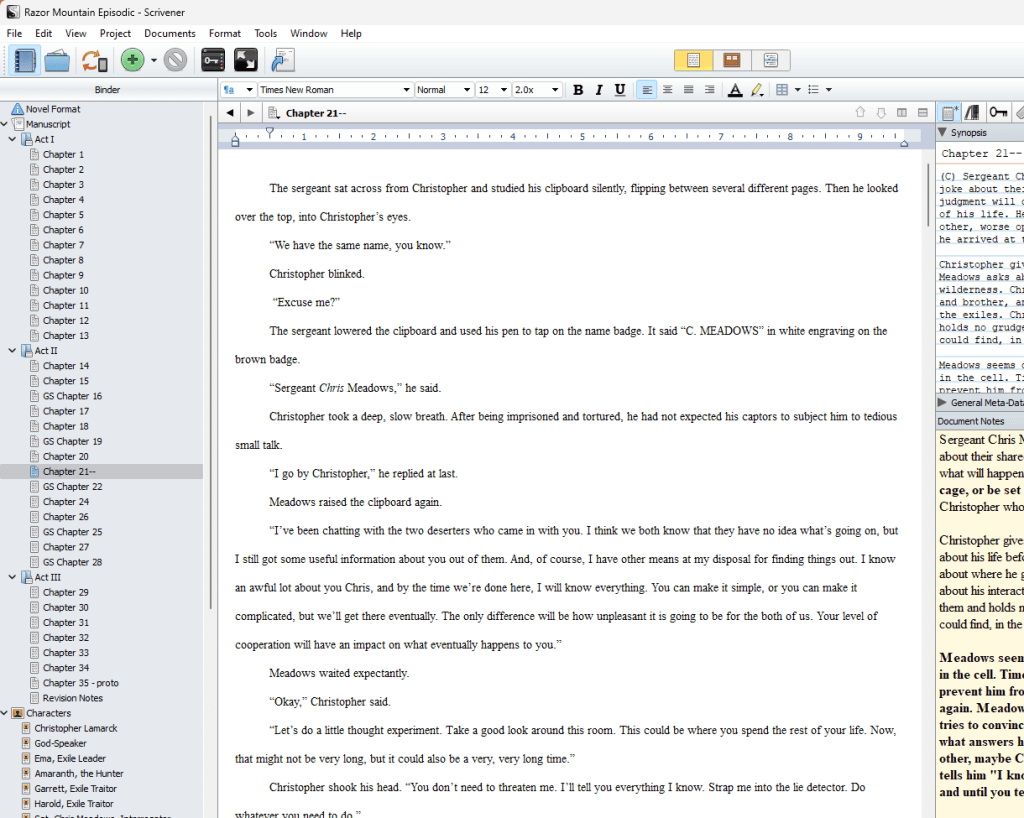
As far as I am concerned, Scrivener is the best novel-writing application out there. Where it really shines is in the way it lets me split a big project into nested parts. I split Razor Mountain into folders for each act, then split out each chapter into its own document under those folders. I have separate sections for major characters, locations and other research notes.
With a click of a button, I can look at the chapter summaries on a cork-board view, and I can drag-and-drop chapters in the document tree to rearrange them, something that has been really convenient as I’ve merged and moved chapters in Act II. Scrivener also has built-in support for “snapshots,” which I use to save each revision of each chapter. I typically save at least a rough draft, a second draft after some editing, and a third draft once I’ve gotten reader feedback.
To ensure that my work is fully backed up, I save my Scrivener files to Dropbox, which copies them across my computers and my phone for safe-keeping. I do have the mobile version of Scrivener, but I almost never use it. I love taking notes on my phone, but I do not enjoy long-form writing on that tiny keyboard.
Scrivener’s editing and cork board views.
Serial Publishing
I’m publishing Razor Mountain as a serial in three places: here on the blog, on Wattpad, and on Tapas. I chose to do this so that I could get a feel for the different platforms, and to try to increase the visibility. However, I haven’t done much to promote the Tapas or Wattpad versions, so pretty much all of my regular readership is on WordPress. I keep telling myself that I’ll eventually put some love into Tapas and Wattpad, and that may actually happen at some point. Either way, I’ll continue on all three until Razor Mountain is finished.
Because I’m posting to three platforms, my process for this is a little bit insane. It goes something like:
Write the first draft and first round of edits in Scrivener.
Copy it to Google Docs for easy beta reader feedback. Fix the formatting that doesn’t transfer nicely.
Make changes based on feedback in Scrivener, and decide how to split the chapter into multiple posts.
Copy it to a OneNote template with the brief description at the top and links to previous/home/next at the bottom.
Copy from OneNote to WordPress. Schedule the posts.
Copy from OneNote to Wattpad. Fix all the formatting that doesn’t transfer nicely. (Wattpad has no way to schedule posts.)
Copy from OneNote to Tapas. Fix the formatting that doesn’t transfer nicely. Schedule the posts.
On the scheduled day, chapter parts automatically post to WordPress and Tapas.
I have to manually post the saved draft to Wattpad. I also have to update the previous/next links in the WordPress post, and I need to add links to the Razor Mountain home page. Depending on how busy I am, I sometimes forget to do these things, and I typically don’t catch it until I start posting the next chapter.
Some of this complexity comes from posting in three places, each with their own idiosyncrasies. It’s obnoxious how often copy/pasting between tools and websites causes the formatting to be lost. It’s doubly obnoxious that Wattpad doesn’t let me schedule posts.
I suspect there is probably a way to add WordPress links (previous/next and home page) that point to a scheduled post and only work once the post is “live.” I haven’t spent the time to figure it out though.
Short Stories
The majority of my writing time this year went toward Razor Mountain and the blog, but I have managed to sneak in a few short stories.
For microfiction, drabbles, and flash fiction, I often just work in OneNote. Unlike novel writing, I sometimes do work on short short stories on my phone, and I typically do not need organizing features or formatting more complex than italics and bold.
For longer stories, I usually use Microsoft Word on the laptop. Oddly, I copy to Google Docs for easy beta reader feedback, but I never really write in it. I’ve been using Word for years and I’m comfortable with it.
For all of my stories, I save everything to Dropbox to make sure it’s backed up. When it comes time to find places to submit stories, I use Duotrope.
Blogging
My blogging schedule has fluctuated over time, but these days I try to post Razor Mountain chapters every other week.
Unless a chapter is around a thousand words or less, I will break it into 2-3 parts of about a thousand words each. I’ve read that 500-1000 words is the sweet spot for keeping readers’ attention for blogs, and a slim majority of my WordPress readers are on mobile, where a post of that size feels bigger on the page than it does on a full-size monitor or tablet. Tapas and Wattpad don’t have that kind of detailed dashboard for writers, but they do say that most of their readers are also on mobile.
Along with the chapters themselves, I write a development journal for each Razor Mountain chapter. Sometimes I post the chapter parts earlier in a week (e.g. Wednesday and Thursday), and the development journal on Friday. If I have three parts in a chapter or get a little behind, I will sometimes post the development journal the following Monday. I used to worry about maintaining an exact schedule, but nowadays I just aim for a schedule and adjust as needed.
I write blog posts unrelated to Razor Mountain on the “off” weeks, and sometimes for the Monday of Razor Mountain weeks as well. I’ve been blogging long enough now that I have a few ongoing series of posts, so I will often mix one of those posts with something stand-alone in a given week.
I’ve gotten in the habit of posting reblogs every other Wednesday. Writing three blog posts in a week is too much for me, and reblogs are low-effort (while hopefully still interesting content). They occasionally result in some cross-pollination with the other blog’s readership. Their main purpose is to serve as a good motivation for me to regularly read other writing blogs. I maintain a list of interesting articles and blog posts in my OneNote, and trawl through them for these reblogs.
For the header images on my posts, I use Pexels. I don’t usually do any picture editing apart from cropping. If I have a really difficult time finding an image that I’m happy with, I will occasionally check Unsplash. Both of these sites offer pictures that are free to use and do not require specific license language to be displayed.
(If you’re blogging, please do yourself a favor and always check the licensing and make sure you’re attributing correctly. There are trolls out there who will sue you for hundreds of dollars, even for such non-crimes as using the incorrect version of Creative Commons. And if the image isn’t licensed for your use, don’t use it!)
I make it easy on myself and always use the same cover image for Razor Mountain chapters, and pictures of mountains for development journals. For all other posts, I just search for terms vaguely related to the content.
I always write my blog posts in OneNote, do an editing pass, and then copy/paste them into WordPress. I almost never publish a post immediately. Instead, I schedule them for 7:00am CST on a subsequent day—usually Monday, Wednesday or Friday.
Tracking
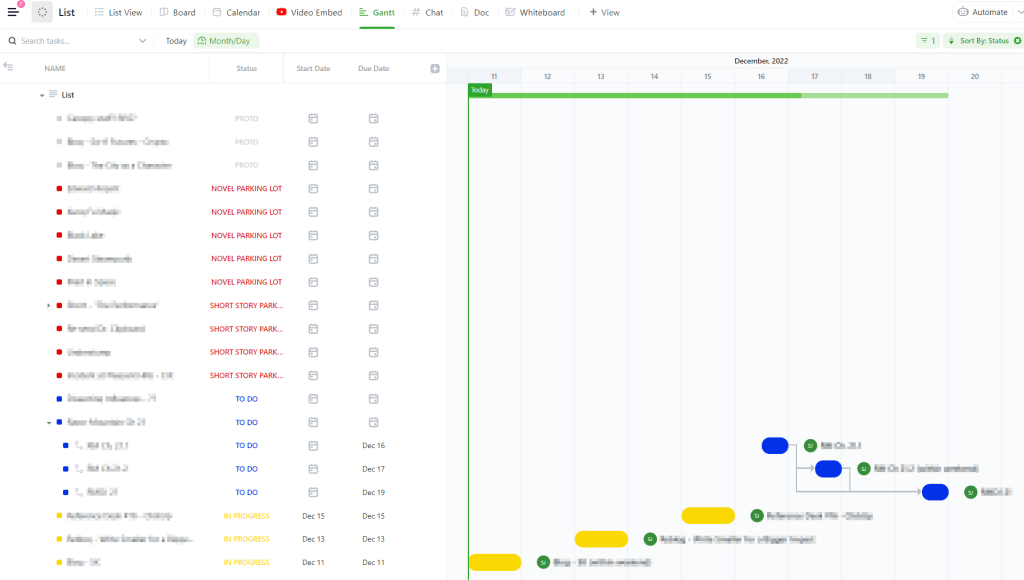
My latest endeavor is to try to get a better understanding of how I’m using my writing time. Lately, I’ve been using ClickUp. I like it for charting “deadlines,” even if they’re entirely self-imposed, and laying out a schedule of things I intend to write.
And even though I’ve explicitly said in the past that I don’t want to end up tracking things in Microsoft Excel, I’ve been doing a little bit of tracking in Excel. I haven’t found a great way to roll up the time spent on different projects in ClickUp in a way I like. Excel makes it dead simple to make a few columns and track days, projects and half-hour increments. It’s all compact and easy to eyeball, and there’s always an easily searched website that will tell you how to translate a few columns into an interesting graph, even if Excel formulas make me feel a little dirty.
This tracking stuff is still in flux, and I expect it to change. In every other respect I am an old man, set in my ways. It’ll be interesting to check back in next year, and see if anything is different.
This post is already much longer than I planned, so I’ll end it here. Hopefully it was interesting to see how another writer works. If you’re an author who writes about your own process, I’d love to read about how you’re working. Leave a comment or a link to a post of your own.
It’s the ultimate crossover event! Today we have a continuation of my short story series, as well as my Reference Desk series detailing useful tools for writers. Get ready for a battle of publication catalogues and a submission tracker showdown!
Finding the right place to submit your short fiction isn’t trivial. Back in the olden days, you might have to subscribe to an actual dead-tree trade journal just to have a somewhat up-to-date list of publications. These days, the internet gives us some easier options.
The two most popular submission tools for short fiction writers are Duotrope and Submission Grinder. Both of them are designed to help you find markets for your stories and track your submissions. Today, I’ll be comparing some of the different features between these two tools to give you a better idea of which one you might want to use.
Price
Let’s get this out of the way up front. Duotrope is a paid service. After a 7-day free trial, it costs $5/month or $50/year. Submission Grinder is completely free to use, although they have numerous options to donate.
If you don’t want to pay or can’t afford it, Submission Grinder is the tool for you.
Listings
Duotrope maintains listings of publishers of fiction, non-fiction, poetry and visual art. It also lists literary agents for fiction writers. Submission Grinder maintains fiction and poetry listings.
At the time of writing, Duotrope lists 5,027 fiction markets. They claim that they keep their listings accurate and up-to-date by checking each active listing for changes about once a month. They also run more thorough check twice a year, contacting the editors or agents if anything appears to be inaccurate or if there are signs that the market may be dead or on hiatus. (Websites not being updated is honestly a pretty big problem with small markets.)
At the time of writing, the Submission Grinder has 2,669 listings for fiction and poetry. It’s not entirely clear from the webpage how the listings are kept updated, although there are links for users to suggest a new market listing or suggest a correction, so it seems to be mostly crowdsourced.
Submission Tracking
Both tools let you
Add stories to your tracker
Add submissions for a story
Mark a submission as accepted, rejected, or no response
Track and search personal statistics
Track deadlines
Both tools also aggregate the statistics across their user base. This allows them to show information like what percentage of submissions are accepted or rejected by a specific market. They both have anonymized feeds of recent activity.
Duotrope has a plethora of statistics*, including the markets that are fastest and slowest to respond, and those that are most or least likely to accept (or even respond!)
*Note: you can see the list, but not the actual statistics, without a subscription
Additional Features
Both tools have an optional newsletter with new listings and other publishing news.
Duotrope has transcripts from hundreds of editor and literary agent interviews—possibly useful for getting a better idea of what your favorite market is looking for, or just general good practices.
Duotrope has some basic guides for writers, especially around submitting your work. It also has guides to using their various tools.
Takeaways
Honestly, both of these tools get the job done. They make it easy to search a lot of different markets, and to track your submissions as you send them out.
Overall, I do find Duotrope to be a little bit nicer. It has a few more features and a little more polish, but that’s to be expected when they have a subscription fee. If you don’t mind spending the money, I think Duotrope is good value for the cost.
Submission Grinder feels a little more like a community project, crowdsourcing market info and relying on donations. Maintaining a popular tool site takes work, and based on their Patreon, I think Submission Grinder is powered more by love than money.
If you have a story or two that you’re looking to send out, you should definitely try out one of these services. It will make it a lot easier to find ideal markets and keep track of what gets sent where.
Writing a brilliant short story isn’t enough. When it comes time to submit, you’re in a competition with every other author who’s submitting to the same magazine, anthology or contest. And often, that’s hundreds of other people—hundreds of other stories—you’re going up against. Make sure to seek out critique and make revisions. Polish that story until it shines.
If your story is accepted, an editor may certainly ask for changes, but you still need to show your very best work up front if you want to get that far. Editors and readers are looking for any excuse to reject your story to whittle down that huge pile of submissions. Don’t give them an easy excuse like typos or sloppy grammar.
Where to Submit
The first thing you need when submitting a short story is someplace to submit to. Hopefully you’ve been reading short stories, because this is a great way to do field research on publications in your chosen genre(s). The publishing landscape is ever-shifting, but it’s a good idea to read widely to get a sense of who the heavy hitters are.
For example, as someone who writes a lot of sci-fi and fantasy, I know that The Magazine of Fantasy and Science Fiction, Analog Science Fiction And Fact, and Asimov’s Science Fiction are three of the biggest speculative fiction magazines. They’ve been around for decades and pay professional rates for short stories. There is a prestige to getting published by them. However, there are a number of other magazines and websites that are popular and pay well, and an even larger number of smaller magazines and websites that often fill specific niches and tend to pay less.
Ultimately, what you want to do is understand your options and match your story to the places with the best chance of accepting it. The best way to do that is to read some sample stories and look at the submission guidelines.
Submission Guidelines
Most actively publishing magazines, open contests, and anthologies with open submissions will post submission guidelines on their website. Submission guidelines are just the publisher’s description of what kinds of submissions they want, and how they want to receive them.
Tools like Duotrope and Submission Grinder collect the submission guidelines of many different publications and make them easier to search, so these can be a real boon. However, they sometimes take a while to add new publications, remove defunct ones, or update guidelines that have changed. Always, always, always double-check the publication’s website, and follow those guidelines if there’s any discrepancy.
Submission guidelines typically have some subset of the following:
Genres, Subgenres or Topics – A description of the kind of stories the editors like. This can be very broad (“hard science fiction”) or considerably more specific (“steampunk,” “stories related to climate change”). Contests and anthologies often have a theme, and even big magazines will sometimes have “theme issues.”
Word Count – Most publications have hard limits on the size of story they will accept. They might also note the size of story that they prefer, even if they occasionally accept larger submissions.
Submission Windows – Anthologies and contests always have cutoffs, because they eventually have to publish or judge. Some magazines only accept submissions at certain times.
Pay Rate – Legitimate publishers say up-front how much they will pay. This is often a rate like X cents per word, although you will sometimes see a flat payment per story/poem. What counts as a “professional rate” is often decided by your genre’s professional organization. For example, the SFWA currently considers 8¢/word to be the minimum for sci-fi and fantasy.
Form and Formatting – Some publications only accept stories sent as Word documents to an email address. Others have a form directly on their website for submission. They may specify a specific font, font size, or line spacing. These may sound pedantic, but they’re designed to make it as easy as possible for the editors to wade through a sea of submissions. You do not want to be the person who makes an editor’s life a little more difficult.
Response Time – Submitting stories is slow! Most publishers take weeks or months to respond to a submission. Patience is a virtue, but if you wait for the specified response time and don’t get anything, you should feel free to reach out to the publisher, or move on and submit that story somewhere else.
Other Stuff – Submission guidelines may also say whether a publication accepts simultaneous submissions (sending one story to multiple publications at the same time), multiple submissions (sending several stories to the same publication at the same time) or reprints and translations. As a rule, don’t send any of these things unless it’s explicitly allowed.
Formatting
There is a standard format for short stories, and the incredibly detailed visual guides on William Shunn’s website have become the go-to place for writers to find them. Remember, the specific instructions within a publication’s submission guidelines should always be followed first. If the instructions aren’t specific on a particular point or leave something out, you can default to Shunn’s recommendations.
Submission Considerations
When you first finish a short story, there will probably be a number of publications that fit your story. The next step is to decide which of them to submit to first.
Consider starting with the best pay or highest prestige. Sure, I’m less likely to have my story accepted by Analog than a smaller magazine, but if they do accept it, I’m getting an excellent pay rate, and a really nice publication credit. If they reject it, I can always send it out to another.
There are other approaches, however. If you’ve found several potential publishers who accept simultaneous submissions, you can send your story to all of them at once. Simultaneous submission can really speed up the submission process, where you’re often waiting weeks or even months for a reply.
If one or more of your potential publishers has a submission window, you may want to submit to them while it’s open. If they reject it, you can submit to the others at any time.
Tracking Submissions
When you’re submitting your first short story, it may seem silly to talk about tracking your submissions. After all, it’s your baby, your pride and joy, and that publisher will surely love it. And even if it gets rejected, it’s not that hard to keep track of one story.
The truth is that writing and submitting short stories is a grind. Statistically, most publishers don’t take simultaneous submissions, it usually takes weeks to get a response, and most stories don’t find a home on their first submission. If you’re going to write short stories, you’re likely to end up with multiple short stories out for submission at once. Possibly a lot of them. You’re going to get rejections. And you’re going to have to keep writing.
Tracking your submissions ensures you know what stories are currently out, who has already looked at them, and who’s looking at them now. You’ll want to track the expected response time so you know when to check your spam folder, send a query, or give up and send to another publisher. You may want to make a list of the publications you’re interested in sending a particular story. You might also find it a useful place to track acceptances and payments (don’t forget those taxes!)
If you want to do your own tracking, Excel spreadsheets and Google Docs are infinitely flexible, and as long as you’re willing to put in the effort, you can craft exactly what you want. Alternatively, both Duotrope and the Submission Grinder have built-in submission tracking, and tracking your statistics in those systems helps to build statistics that can be useful to everyone.
Rejection
The hard part of the short story grind is the rejection. Nobody likes pouring their heart and soul into a story, only to be told that it’s not good enough. Unfortunately, the simple math of publishing is that there are far more stories being submitted than there are slots for publication. The majority of stories are never published.
The way to fight that math is to craft the best story you can, and then submit as much as you can. More (good) stories and more submissions raise your odds. You will need to build up the fortitude to be rejected over and over again and keep on going.
It’s also important to note that not all rejections are created equal. There are a few different kinds:
Form rejections – These are most common. The story didn’t pique the interest of the publication.
Higher-tier rejections – These may still be form rejections, but they usually mention that the editors were interested, or that they considered the story but ultimately didn’t find a spot for it. Some publications have multiple tiers of readers, and the story didn’t get all the way to the top.
Personalized rejections – These are rare and valuable. They are specific to you and your story, and explain in more detail why the story didn’t quite make the cut. If you’re lucky, they may suggest improvements or invite you to submit more work to this publisher.
While all rejection may seem bad, it’s a great sign to receive any personalized feedback from a publication. These people are constantly wading through the slush pile of submissions and working on tight deadlines, so they only spend time on a personalized response when they really like something. Unfortunately, due to the complexities of publishing, they may really like your story and still not be able to publish it. Take it as a win, and move on.
Rudel is an incredibly prolific short story writer who tries to make 100 short story submissions every year. His blog is a great general resource when it comes to writing and submitting stories, and his monthly recaps show just how much rejection even a successful author has to power through.
Submit!
At this point in the Short Story Series, we’ve been through all the basics of writing short stories. I’ll probably still have one or two more articles, but you know enough to get started. If you haven’t done it before, it may seem daunting to write a short story and send it off to a publisher. Great! The best way to gain experience is to try it.
Once your story is submitted you can forget about it for a few weeks and write something new. It’s the authorial circle of life. Don’t give up, and keep writing.









 Words Deferred