This is part of an ongoing series where I’m documenting the development of my serial novel, Razor Mountain.
You can find my spoiler-free journals for each chapter, my spoiler-heavy pre-production journals, and the book itself over at the Razor Mountain landing page.
Remember When This Book Had No Dialogue?
Having just written yet another chapter that is almost entirely characters walking and talking, it’s hard to believe that this book started with a single character, completely alone in the wilderness. For the entirety of Act I, Christopher had nobody to talk to. God-Speaker had his tribe, but even in those early chapters they didn’t have much to say to each other, and I purposely limited their vocabulary and the ways they communicated.
In Act II, that began to change. Christopher was slowly introduced to more people: Amaranth, then the exiles, and finally the people of Razor Mountain itself. God-Speaker built up a society around himself, becoming more sophisticated and social.
Now, in Act III, I’m finding that every chapter is stuffed full of dialogue by necessity. Dialogue is a fantastic tool for rolling out exposition in a natural and interesting way. I need to resolve all the mysteries that were set up along the way, and that means getting a lot of information across. Dialogue is great for that.
The potential downside of all that dialogue is the way it slows the pacing. Dialogue naturally tends to slow a story down, because it feels like it’s happening more-or-less in real time. An entire chapter of dialogue can span only a few minutes of time within the story. Narrative description, even when it’s flowery, can often pack more time and more events into fewer words.
I’m trying to keep the dialogue tight to counter this slowing effect, but I’m sure I’ll come back later and find more that I could have done. For me, dialogue is one of the hardest things to edit, because changing something early in a conversation can cause cascading changes throughout the rest of the conversation, like redirecting the flow of a river.
Parsing Feedback
Feedback for this book has been a strange beast. I get some real-world feedback before I publish a chapter, then it goes out onto the blog, Wattpad and Tapas, where it (sometimes) gets more feedback, mostly in the form of comments. And sometimes I’ll get comments on chapters that I wrote months ago, as new people find the story. This process, with a publicly available serial story is a very different experience from writing the whole book and then getting feedback from a curated group of people.
That said, I’ve been getting great (that is, useful) feedback on the last couple chapters. Hopefully that means readers are engaged and excited about the direction the story is going. It’s really helpful to see what questions readers have and what they’re wondering about at this stage.
As mysteries start to resolve and questions get answered, I think readers naturally become more and more aware of the questions that haven’t been answered yet. Getting feedback on what readers are wondering about is really useful here, because it can tell me whether I’ve really answered some questions as well as I think I have. It also tells me what I should emphasize in upcoming chapters.
So, if you’re reading and you have feedback, please drop me a comment! It’ll only make the story better.
Next Time
Chapter 28 turned out to be a long one—so long that I broke it in half. In Chapter 29, Cain and Christopher will confront the cabinet, and more will be revealed about what happened in the years while God-Speaker was gone from Razor Mountain.
This is part of an ongoing series where I’m documenting the development of my serial novel, Razor Mountain.
You can find my spoiler-free journals for each chapter, my spoiler-heavy pre-production journals, and the book itself over at the Razor Mountain landing page.
The Ol’ Switcheroo
This is it. The big reveal. The timelines have converged.
When I was working on the outline, I knew that I needed to show some of God-Speaker and Razor Mountain’s long history in the middle section of the book, but it quickly became apparent that I would have to limit the number of chapters dedicated to that history to not bog the whole thing down. However, I decided that I needed at least two chapters for this final part with Cain and Reed.
Firstly, I needed some time and words to build up these characters because of the pivotal role they play going into the last act. It also gave me the chance to set up a little twist. I placed Cain as the blatant bad guy, an echo of Strong-Shield, who had betrayed God-Speaker ten chapters earlier. I like to think I was a little more subtle in positioning Reed as a good guy, because he has God-Speaker’s implicit trust. That leads into the “small” twist when their roles turn out to be reversed.
The bigger twist is the nature of the connection between God-Speaker and Christopher. Admittedly, the structure of the book, following their two points of view, makes it pretty likely that there’s a connection there, but depending on how good of a guesser the reader is, it’s not clear what that connection is, or when it’ll be revealed. My hope, in layering the small twist and the big twist, is that the whole thing will be more impactful and feel like a bigger revelation. This, for me, is the most exciting part of the book so far.
This was a fun chapter to write, because it feels like I’ve been keeping a secret for a long time, and I no longer have to worry about accidentally giving it away. I’ve been perpetually worried that I’ll reveal something by accident. (I’ve accidentally swapped Christopher and God-Speaker’s names a few times, but as far as I know, I caught all of these slip-ups before posting. It still made me nervous that I’d miss one.
Beginning the End
This chapter is an inflection point: the end of Act II and the start of Act III. So the first thing it had to do was wrap up the middle of the book with an exciting reveal. But its other job is to usher in the final chapters by getting the reader interested in what is about to happen.
It provides some new questions to ask. How did Cain know about Christopher, and how exactly are Christopher and God-Speaker connected? What has happened between the cabinet members in the time since God-Speaker died, and is Reed still around? What exactly is Christopher going to do about all this?
That last question is a big one, because for most of the book Christopher has struggled to have some agency in what happens to him. A lot of shit happens to him—he’s a pinball in the first two acts. And while he makes decisions, it’s a little hard to tell how much those decisions are helping or hurting him.
My hope is that the reader is willing to accept that, for a while. But not forever. The protagonist has to have some control over what happens to him for the story to feel meaningful. The connection between God-Speaker and Christopher hints that he will have that chance in Act III.
Next Time
Having spent most of the book setting up mysteries, I’m thrilled to pretty much continuously reveal the answers for the remainder of the book. If writing Act II was like biking up hill, hopefully writing Act III will be more like coasting back down toward the big crash at the end.
This is part of an ongoing series where I’m documenting the development of my serial novel, Razor Mountain.
You can find my spoiler-free journals for each chapter, my spoiler-heavy pre-production journals, and the book itself over at the Razor Mountain landing page.
Q & A
My intent with Razor Mountain was always to write a “mystery box” story that actually resolved in a satisfying way. To do that, I created a starting premise with a lot of mysteries, and then made sure that I knew the answers—why everything was happening. In the first half of the book, most of my time was spent building up those mysteries. Now, as I approach the final act, it’s all about answering those mysteries.
I’ve long believed that it’s easier to create interesting mysteries than it is to resolve them, which is why so many mystery-centric stories fall flat at the end. However, in my hubris, I assumed that the hard work was in figuring out all the answers. Some of the feedback on early drafts of recent chapters has shown me that it’s not enough to just know the answer. The resolution has to come out in the story, while being clear enough that the reader doesn’t miss it, and organic enough that it doesn’t feel shoved-in just to make the story work.
So, one of the things I did while writing this chapter is to go back through my outline and review all of the things I set up early in the story, and make sure that I have plans for resolving them in the next few chapters. This chapter and the next one are important to some of these revelations, so it was a good exercise to do at this point in the story.
More Rearranging
I initially left out the third scene in this chapter. It was squeezed into the start of the next chapter because I was worried that it might reveal too much before the next chapter. This is part of the ongoing rearranging of the outline that I’ve been doing for the past few chapters.
However, when I began to write this journal I realized that the chapter felt purposeless without that third scene. Seeing Cain is interesting, because it’s a big link between the two narratives, but it’s not exactly a shocking stinger at the end of the chapter, and I would have had to be a little more coy in Christopher’s conversation with Speares to try to make it more of a revelation. The first two scenes are mostly the characters walking from A to B and talking, which is the same as Christopher’s previous chapter. Without the additional revelations and action at the end, it falls flat.
So once again I adjusted my chapters and pulled in that third scene. I also decided that I can write it without quite giving up certain big secrets. But this scene combined with the next chapter will serve as the climax for Act II and set up Act III.
The Value of Journaling
Despite the power of ego, when I sit down to write one of these chapter journals I sometimes wonder how worthwhile it actually is. There are certainly times when feel that I don’t have much interesting to say about a given chapter. However, when I look back, it’s often when I’m working on a journal that I realize I’ve missed something or need to do some rearranging (as I did this week).
As it turns out, when I force myself to think about process enough to be able to articulate a journal entry, it helps me better understand the story I’m telling. Maybe that seems like it should be obvious, but it’s a lesson that I keep learning.
That’s partly because I originally intended these journals to be a sort of documentary—a way for other writers to peek inside my head and see what I was thinking, alongside the actual product. Not because I thought it would be a breakout bestseller and everyone would be interested, but because I can only speak for myself, and it seemed like a fun hook for the blog. I think there’s a real tendency among authors to want to keep the secret sauce secret, or to be so deep in the impostor syndrome that we don’t want to risk the potential embarrassment of opening up to others.
Now that I’ve been doing this for most of a book, I’m beginning to think that journaling through a big project will often be worthwhile for a lot of writers, even if nobody else ever sees that journal. As writers, we are used to thinking through a lot of things in text, and keeping up that meta-narrative has really helped me to understand the story I’m writing, and probably do a better job than I otherwise would.
It also occasionally serves as a record that I can return to, if I forget a decision I made, or an idea that I set aside that turns out to be important.
Next Time
The next chapter is a big one. Things are happening now. It’s been a few minutes since Christopher’s life got worse, so I’m going to remedy that with some existential dread. It’s the end of Act II and the start of Act III. See you there.
As I approach the final leg of writing my serial novel, Razor Mountain, I feel like I’m finally on the other side of the difficult middle. The central 50% of novels almost always feel like the hardest part to me, and I know I’m not alone. However, I have a big advantage on this project: posting it on the blog gives me deadlines and external accountability.
When I finish writing a chapter, sometimes I feel pretty good about it, and sometimes I’m disappointed. But I set myself a schedule, and I keep writing more chapters and posting them. Sometimes, my only consolation is in telling myself that I can always perform major revisions after the thing is done.
On the good days, writing feels like making art, but on the bad days it feels more like working an assembly line. Clock-in, spend a few hours sticking words together, and clock-out. It’s not glamorous, but it’s often what needs to be done.
Is It A Good Day?
I recently binged through the incredible 32-episode documentary Double Fine PsychOdyssey, which follows the seven-year development of the game Psychonauts 2. Even if you’re not particularly interested in video games, it’s a fantastic study in the complexities and interpersonal challenges of building a creative project with a large group of people.
Tim Schafer, who is something of a game design and writing legend, has a habit of daily writing when he’s working on a project. Over the years he has accumulated piles of old project notebooks that he can look back on. This offers an amazing archaeological view into how these stories grew and changed over the course of development.
Early in the documentary, Schafer flips through a few pages of the notebook for the original game, Psychonauts. These pages contain the first mentions of many of the ideas that became central to the story, although he had no way knowing it at the time. Schafer reads these tentative forays into ideas that now seem predestined, laughs quietly to himself and says, “that was a good day.”
What’s interesting about these “good days” is that they’re often not obvious when we’re living in them. It’s only in retrospect that we can see what works and what doesn’t.
In those years, I would sit down at the keyboard, load up my text-editor, and try to think of words to write. Lots of words occurred to me, but they felt stupid and unworthy. I would chase my imagination around my skull, looking for better words, and, after hours, I would give it up, too exhausted to keep chasing and demoralized by not having caught anything.
That feeling of unworthiness and stupidity has never gone away. There are so many days when I sit down to write and everything that occurs to me to commit to the page is just sucks.
Here’s what’s changed: I write anyway. Sometime in my late twenties, I realized that there were days when I felt like everything I wrote sucked, and there were days when I felt really good about what I had written.
Moreover, when I pulled those pages up months later, having attained some emotional distance from them, there were passages that objectively did suck, and others that were objectively great.
But here’s the kicker: the quality of the work was entirely unrelated to the feeling I had while I was producing it. I could have a good day and produce bad work and I could have a bad day and produce good work.
What I realized, gradually, was that the way I felt about my work was about everything except the work. If I felt like I was writing crap, it had more to do with my blood-sugar, my sleep-deficit, and conflicts in my personal life than it did with the work. The work was how I got away from those things, but they crept into the work nonetheless.
This is a profound realization. There is a freedom in just writing (rather than trying to write well) that can be necessary to actually get anything done. The louder your internal editor is, the more important it becomes to be able to turn it off.
What Cory experienced is something I’ve noticed as well. I often don’t feel very good about my writing in the moment. It’s only when I come back to it later that I can take notice of the parts that I like. That’s not to say I don’t need editing. I always find plenty of things to improve. But most of the time my opinion of my writing is higher when I’m reading it back than when I’m in the process of writing it. I just can’t trust my own opinion while I’m writing.
And even if it turns out to be bad, I can always fix it later.
Writing as Manual Labor
As I get older and more experienced, I am more and more drawn to the idea of writing as manual labor. When I treat writing as a simple project of putting one word after another, it takes away the pressure to make those words great. I get the words written faster, and with less anguish.
I don’t always know if what I’m making will be good. I would love to feel constantly inspired—to have the muse always looking over my shoulder and making suggestions—but inspiration comes fitfully.
Sometimes the muse only strikes because I gave her room and did the work.
This is part of an ongoing series where I’m documenting the development of my serial novel, Razor Mountain.
You can find my spoiler-free journals for each chapter, my spoiler-heavy pre-production journals, and the book itself over at the Razor Mountain landing page.
Narrative Convergence
God-Speaker’s chapters throughout Act II have been jumping through time, showing key moments in God-Speaker’s evolution. They’ve also shown the evolution of Razor Mountain and its people. In this chapter, the narrative is finally approaching the present day. For the first time, we can start to see the same things from both God-Speaker’s and Christopher’s perspective.
This gives me the opportunity to set up some narrative tension by revealing things in God-Speaker’s chapters that will pay off in Christopher’s chapters. Sometimes tension comes from not knowing what will happen next. Sometimes it’s more exciting when the reader can guess what’s happening, but the characters don’t know.
God-Speaker’s Cabinet
The two new characters introduced in this chapter are Reed and Cain, and they are both members of God-Speaker’s cabinet. However, I looked through my notes and I had no record of what their actual positions are. I was certain I had thought about this when I was first developing the story, but it turns out that writing a book is a messy process, and I either lost those notes or never wrote them in the first place.
Internally, to the citizens of Razor Mountain, the cabinet is a secret arm of the US government that handles the day-to-day operations in the city. Only God-Speaker and the secretaries themselves know the truth about who runs the city. The populace “knows” that the secretaries report to a higher authority, but they’re told it’s the President of the United States and the military. God-Speaker doesn’t need to worry that the population will try to overthrow their autocratic king, because they don’t know that they have a king.
When deciding what positions there should be in this cabinet, I looked at the US presidential cabinet for inspiration. Razor Mountain is a sort of city-state, so a lot of those positions make perfect sense. Others are completely unnecessary (ambassador to the UN) and a few just need to be tweaked.
I wanted a large enough group to seem like a reasonable governing body, and to allow for interesting interactions between members.
These are the positions I ended up with:
Secretary of the Treasury – Responsible for overall budget, accounting, and income and outflows across all departments. Administers local banking system.
Secretary of Agriculture – Responsible for local farming and food processing. Works with the Trade Coordinator for food imports from outside.
Secretary of Commerce – Responsible for most non-food businesses internal to the mountain. Works closely with Secretary of Labor and Trade Coordinator.
Secretary of Labor – Responsible for labor conditions, allocation of labor across industries, work safety, etc.
Secretary of Housing – Responsible for maintaining and expanding housing supply within the mountain as needed for the population.
Secretary of Energy – Responsible for generation and distribution of electric power, lighting, and certain energy-related trade (batteries, generation equipment, etc.)
Secretary of Education – Responsible for the school and university system.
Director of Media – Responsible for producing local media, importing external media, censorship.
Director of Intelligence Operations – Responsible for gathering internal and external intelligence, as well as most external interaction with outsiders for trade.
Secretary of Science and Technology – Responsible for science and tech R&D, manufacturing, and external trade. Collaborates with Intelligence Ops for external hacking.
Director of Military Operations – Responsible for military within the mountain and the area around the mountain. Collaborates with Intelligence Operations for external military and espionage ops.
Trade Coordinator – Responsible for import/export and maintaining trade. Collaborates with Intelligence Operations for external negotiations and obfuscation.
I decided that Cain is the Secretary of Energy. He is very focused on his particular field, and is especially excited about developing and constructing new electric generation and distribution technology.
God-Speaker would be constantly thinking about how to balance power between the cabinet members, and play them off each other so that nobody can ever feel secure or think about turning against him. To this end, I thought he would avoid involving the Secretaries of Intelligence Operations and Director of Military Operations when it comes to investigating their fellows. Instead, he turns to Reed, the Secretary of Labor, who naturally collaborates with the Secretary of Energy on his big building projects.
Resolving Mysteries and Emotional Catharsis
My goal throughout most of this book has been to draw the reader in with a series of mysteries. However, it’s not structured like a classic “who-done-it.” It’s not building up to a revelation that wraps up the plot. Instead, in Act III I will be trying to rapidly resolve most of the open questions that have given the story momentum so far.
Unraveling these mysteries will reveal more about God-Speaker and Christopher, and those revelations will leave Christopher with some difficult things to do, and some difficult choices to make. The end of the story will not be about big mysteries, it will be about the choices Christopher decides to make and why he decides to make them.
This whole structure goes back to one of the big lessons I learned from Chuck Wendig’s Damn Fine Story: the big, world-shaking stakes should be tied directly to the main character’s “smaller” but more relatable personal stakes.
It will be up to Christopher to decide what the outcome is, for himself and for the world.
Next Time
Next chapter, we go back to Christopher as the two narrative worlds begin to collide.
This is part of an ongoing series where I’m documenting the development of my serial novel, Razor Mountain.
You can find my spoiler-free journals for each chapter, my spoiler-heavy pre-production journals, and the book itself over at the Razor Mountain landing page.
Outlining is Hard
Once again, I am making small adjustments to the outline for the end of Act II. The end-result is two more big God-Speaker chapters, and one small Christopher chapter left to write. I don’t remember having to do much rearranging in Act I, but I feel like I’ve been doing a lot of it in Act II.
Originally, I decided to do more outlining up-front for Razor Mountain than I normally would. I wanted to make sure I knew all the answers to the questions so that I didn’t pull a LOST and write myself into a corner. In that sense, my outline has served me very well. I have a good idea of everything that I need to keep track of and reveal as I go.
The reason the chapters have changed is mostly to accommodate the flow of the story, which I don’t always have a good feel for until I’m actually in the middle of writing. What makes sense in the outline doesn’t always make sense as a sequence of scenes, especially as little things change along the way. So, I’m still writing everything that was in the outline, but slightly adjusting the order it appears in.
The fact that I have two different narratives in different time periods gives me some additional flexibility. Each narrative still follows a linear sequence, but I can choose how I switch between them in order to maximize the mystery or create the most tension.
Exposition is Hard
This chapter, much like the previous one, is a bit of an exposition dump in the form of conversation. I’m taking advantage of the assumption that Speares can be a little forthcoming with Christopher because he’s not leaving Razor Mountain, and anything he knows won’t be going back out into the world.
The challenge of Razor Mountain is that there is a lot of history and a lot of things I’ve had to figure out for the story to make sense, but it’s hard to get all of that across when most of the characters don’t actually know the truth about it. I also need to be careful of “prologue syndrome,” over-explaining all the back-story just because I know it and not because it’s necessary for the reader to understand the plot.
Next Time
The climax of Act II includes a two-chapter episode of God-Speaker’s story. The recent God-Speaker chapters jumped through time, but this bigger episode will give me room to introduce a couple new characters and jump into Act III with some big revelations.
Just in case anyone picked up on it—yes, it’s Jules Verne who wrote Journey to the Center of the Earth, not H.G. Wells as Speares says. She’s just not very well-versed in old-school “scientific romance” stories.
This is part of an ongoing series where I’m documenting the development of my serial novel, Razor Mountain.
You can find my spoiler-free journals for each chapter, my spoiler-heavy pre-production journals, and the book itself over at the Razor Mountain landing page.
A Pyrrhic Victory
Christopher is out of the jail cell. He has escaped the grasp of Sergeant Meadows, and found a much more sympathetic ear in Specialist Speares (assuming she is actually what she seems). Still, he’s not exactly free—he’s traded a cell for a mediocre apartment, and it’s still unlikely that he’ll ever be able to leave Razor Mountain.
His only chance to help himself is to learn how to navigate the bureaucracy of the mountain and plead his case. Unfortunately, he knows very little about how Razor Mountain works.
Christopher also feels different after his torturous ordeal. He is, perhaps, a little more in control of himself, a little more Zen, even if he can’t exert much control over the world around him. The change in his character is still subtle, but I’ll be trying to bring it out more as the story continues.
Answers
This chapter is a turning point in the structure of the story. So far, Christopher has been doing nothing but ask questions, and in this chapter he’s getting some answers. They aren’t particularly good answers for him, but at least he has a better idea what’s happening.
On the other hand, the reader knows about God-Speaker, and something is still amiss with the story of the mountain that Christopher is receiving. My goal in this chapter is to start revealing a little more about the mountain while still making the reader wonder what happened in the years between God-Speaker’s chapters and the modern day. Then the last few chapters of Act II will reveal the answers to that.
Mysteries and Choices
This was one of the longer chapters that I’ve written in Razor Mountain. There is a lot of information to get across, and a good amount of dialogue.
This book is very uneven when it comes to dialogue. It was clear early on that there would be very little dialogue in the first half of the book. Christopher is alone in all of those chapters, with nobody to talk to except himself. God-Speaker’s tribe talks, but they’re not exactly loquacious.
As we work through Act II and introduce new characters, there is more and more dialogue. I expect it to continue to increase toward the end of the book. I always wanted a structure where the mysteries and questions steadily pile up for the first half of the book, and then more and more of them get answered in the second half.
I also realized at some point that the whole book won’t be driven solely by mystery. Before the end, all the big questions will be answered. The answers to those questions will then force the main characters to make hard choices, and the ending will be about those choices and their consequences. It’s nice to solve the mystery, but characters need to struggle and grow and change for the ending to really hit home.
Next Time
Christopher learns more about Razor Mountain, and may actually get some good news.
If you’ve been around here for a while, you might remember my review of The Story Engine. The Story Engine is part card game, part tool for generating semi-randomized writing prompts. I’ve used it as a fun way to brainstorm ideas for short stories, and I’ve found that it works well for me. As someone who enjoys card and board games, it’s just a much more fun and tactile way to generate ideas than sitting in front of the notebook with pen in hand.
Recently, the folks behind the original Story Engine kickstarted a new product in the same vein. It’s called the Story Engine: Deck of Worlds. Deck of Worlds is another card-based brainstorming game, but this time it’s focused on settings instead of plots. It’s billed as a tool for storytellers and TTRPG game masters to easily generate interesting and deep settings.
I received my order right before the holidays, and I was able to take Deck of Worlds for a test drive.
What’s In the Box?
The base set of cards for Deck of Worlds comes in a flat box with a plastic insert, magnetic latch, and a heavy tagboard sleeve that guarantees it will stay closed. This is nearly identical to the box that the original Story Engine came in, and the build quality is good. It’s the sort of box you’d expect from a premium board game.
However, the original Story Engine had many expansion packs that added more cards, and Deck of Worlds is the same. If you add extra cards to your set, you’ll quickly fill up the small amount of extra space in the box. Luckily, the creators of the Story Engine are well aware of this problem, and they’ve created a new card box with dividers that is capable of holding all the cards, even if you’ve got every single expansion. They’re inexpensive, so I got one for my original Story Engine set as well as my Deck of Worlds.
I also received three expansion packs for Deck of Worlds. “Worlds of Chrome and Starlight” is the science fiction expansion, “Worlds of Myth and Magic” is the fantasy expansion, and “Worlds of Sand & Story” is the deserts expansion. I chose these because sci-fi and fantasy are my two favorite genres to write in, and I have a TTRPG project percolating with a strong desert component.
Much like the original product, the Deck of Worlds main box includes a slim “guidebook,” which describes the intended ways to use the Deck of Worlds—although the creators are clear that there is no wrong way to play.
The Card Types
There are six card types in the Deck of Worlds: Regions, Landmarks, Namesakes, Origins, Attributes, and Advents. According to the guidebook:
Regions establish a setting’s main terrain type and act as a hub for other cards
Landmarks add geographical sites and points of interest
Namesakes combine with Regions or Landmarks to create in-world nicknames
Origins record significant events of the area’s past
Attributes highlight present-day features of the area and its people
Advents introduce events that may change the area’s future
Regions are the only cards with a single prompt on them, and have a nice background that illustrates the geography of the setting. Landmarks have two prompts to choose between, and each one has a background illustration. The other four card types have a symbol and color to identify the card type, and four different prompts to choose from.
Building Basic Settings
The simplest way to play with Deck of Worlds is to create small settings, or “microsettings” as the guidebook calls them. These will typically be built around a single region (terrain type) and a single landmark, like a building.
For my test run, I built a few of these microsettings. First, I chose the prompts I liked best and combined the cards. Then I expanded or focused the results, writing a little blurb about each setting. I only spent a couple minutes on each of these examples.
The Grassland of Crowds
The museum’s founding piece is a huge fulgurite dug out of a sandy hill. The museum was built around this dug-out hill, and the piece is displayed, unmoved, where it was found.
The “lightning festival” grew in this area, and is held during the season of rainless storms. People display all kinds of art. One of these presentations is voted the winner of each festival and incorporated into the museum.
The Scree of Rivers
(Cyberpunk) The scree was mined for the long, winding veins of precious metals near the surface, leaving a maze of narrow, shallow canyons and piles of leavings. Rivers form when it rains. A grey market meets here periodically, protected from government scanners by the trace metals in the rock, with lots of escape routes and hidey-holes for quick getaways.
Not sure about the prophecy bit.
City of Sand and Story
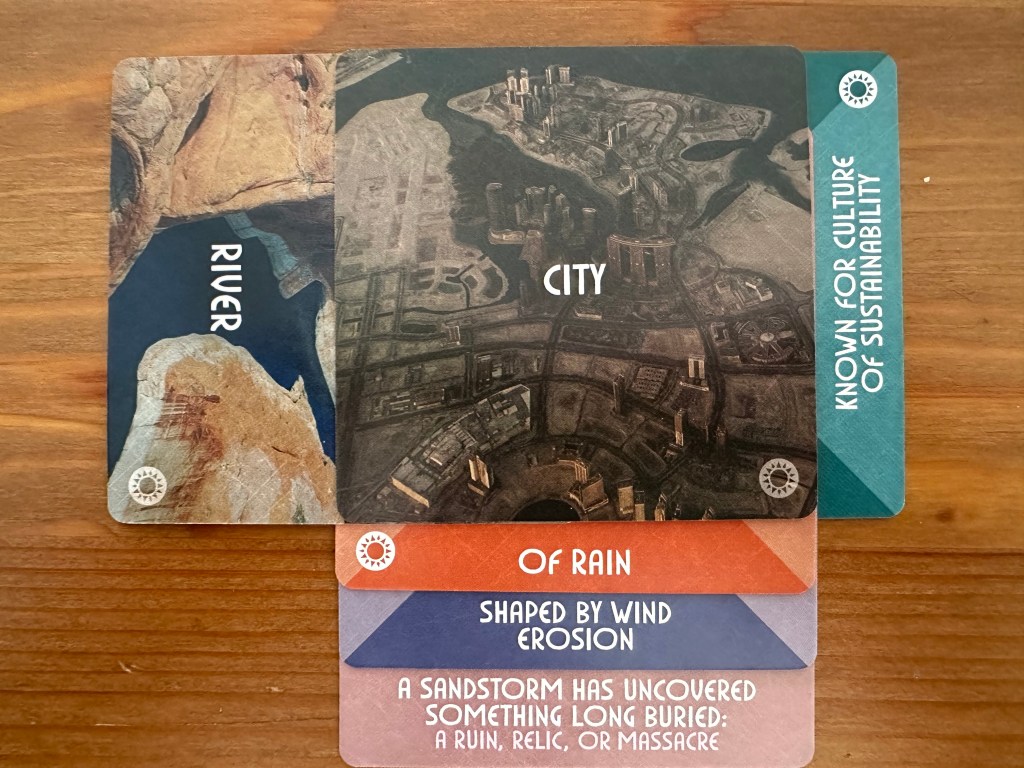
The City of Rains is nestled in rocky mountains in a desert. During the wet season, the mountains funnel moisture and clouds and it rains on the city, creating a temporary river. All inhabitents capture as much water as possible, to live on and trade for the rest of the year. They plant crops along the river while it lasts.
A recent sandstorm uncovered caverns in the rock beneath the city, leading to underground ruins and vast cisterns. The discovery of so much water could upend the economy of the entire region
Complex Settings
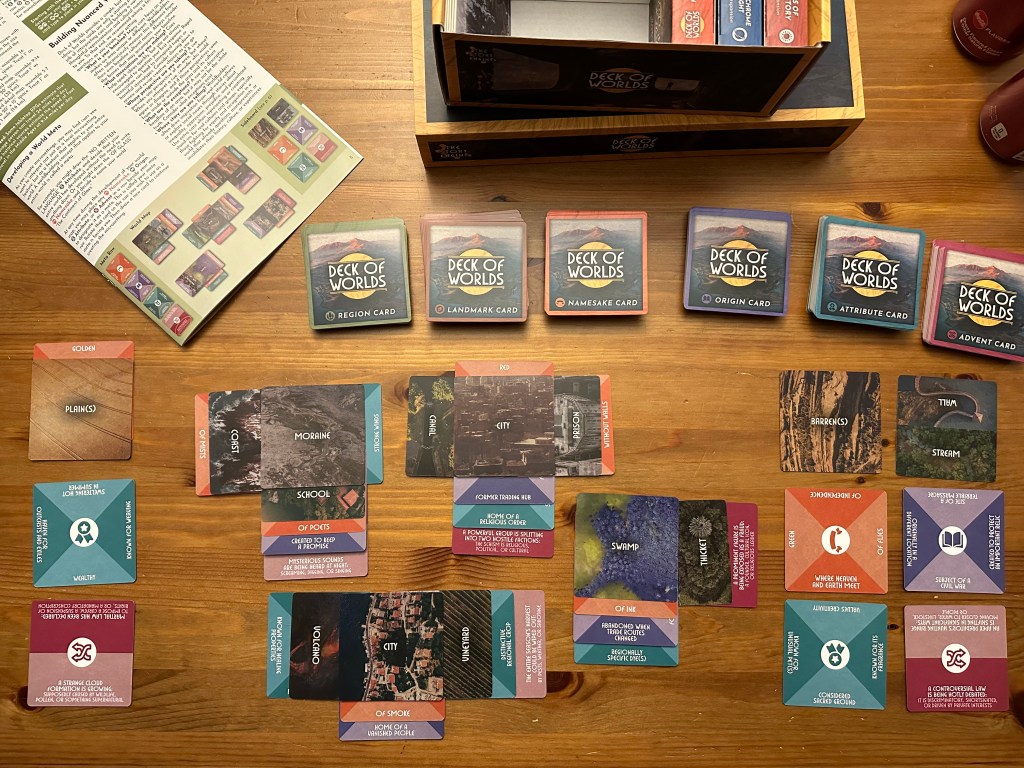
The guidebook also includes some rules for building more complex settings out of multiple microsettings. There is really no limit to the number of smaller settings you could combine. There are optional rules, including a “meta-row” for attributes of the larger area as a whole, a “sideboard” of extra cards to give you more choices when selecting any given card type.
To test this out, I built a setting from four different microsettings, using the meta-row (on the left) and sideboard (on the right).
The Golden Plains
Once known as a wealthy region, but its reputation is fading. The area has been covered with strange dark clouds for weeks, but there is little rain.
In the North: The Red City
Home of a religious order, this city was built on a river and filled with canals. It was once a hub of commerce, but the river grew over the years and eventually overflowed its banks south of the city, disrupting the flow and creating a vast swamp.
Now, the priests of the Red City ply a darker trade: they’ve made the city into a prison for the worst criminals. The prison is the center of the old city, and is called “The Prison Without Walls.” It is surrounded by deep and fast-running canals, and is only accessible by a single, heavily-guarded bridge.
The priests have traditionally been led by a patriarchal lineage of high priests, but now a lowly priestess is gathering a following among priests and prisoners alike. She has radical ideas of rehabilitating prisoners instead of working them to death as penance for their crimes.
In the South-East: The Swamp of Ink
These thickets were once hunting grounds of the nobility, until the river overflowed and the land became swampy.
The few people who still live here are led by an excommunicated priest from the Red City. They harvest “swamp mites,” tiny, stinging crawfish that can be ground into fine black dyes. Travelers from the North recently called out the priest as an exile, and he imprisoned them, but there is unrest and talk of rebellion among the people.
In the West: The Moraine
The coast of mists is the western edge of the Golden Plains region.
The Moraine is the home of the School of Poets. It was created by a celebrated poet who was known as a cantankerous jerk. The only woman who ever loved him, muse of his thousand poems, made him promise to teach other poets his craft.
The school is rumored to be haunted. While most of its inhabitants don’t take this seriously, many students have recently complained of strange and disturbing noises coming through the stone walls.
In the Southwest: The City of Smoke
A city on the slopes of an inactive volcano, built atop the ruins of the “old city,” which was destroyed by the last eruption.
Hot springs in the city are warmed by the heart of the volcano. They supposedly have healing properties, and draw tourists who hope to have their injuries or sickness cured.
Vineyards planted in the fertile volcanic soil use a unique variety of small, golden grapes, harvested after the first frost to make sweet wine.
The dark clouds that have shrouded the region threaten the growth of the grapes and the year’s wine harvest.
Takeaways
Overall, I’m pretty happy with the Deck of Worlds so far. It has a very similar feel to the original Story Engine. The cards strike a nice balance by giving you a few options to pick from, but also limitations that force your brain to make interesting and occasionally surprising connections between seemingly unrelated things.
Like any sort of brainstorming, not every single idea will be a good one. The randomization means that sometimes you get combinations that just fall flat or fail to inspire. Some of this depends on your own creativity and willingness to explore.
Like the original Story Engine, the quality of the product is great. The new boxes are an improvement, allowing me to keep all my original and expansion cards together in a form factor that takes up less space than the original box.
I don’t necessarily like all the rules suggested by the guidebook, but it’s easy to tweak the process until it works for you. They’re just cards, and they can be arranged however you see fit. The extra rules for bigger settings are a little complicated for my tastes, but the end result in my experiment had some interesting ideas that I wouldn’t mind exploring further.
The guidebook also has more rules that I didn’t get into, for collaborative multiplayer and for combining Deck of Worlds with the original Story Engine. All of that feels like more complexity than I want when I’m brainstorming—I would much rather create smaller ideas and then mix and match myself. However, I’m sure this style of prescribed creation could work for others.
Finally, I think this could be a great tool for GMs/DMs who run custom table-top RPG campaigns. I’ve long believed that the best way to approach TTRPG worlds is the “billiards” style described by Chris Perkins, where you set up a number of interesting locations full of interesting characters, and then let the player characters bounce around between them, setting events in motion.
The Deck of Worlds is a great way to invent these little islands of content, and I think it would be pretty easy to create quick and dirty sessions with very little prep, especially if you’re using a lightweight rule set.
Where to Get It
The Deck of Worlds and its expansions are available directly from the Story Engine website. In addition to the Sci-fi, Fantasy and Desert expansions I chose, there are Horror, Coastline, and Arctic expansions. If you’re planning to use the deck for tabletop RPGs, they also have expansions for lore fragments, cultures, and adventure prompts.
This is part of an ongoing series where I’m documenting the development of my serial novel, Razor Mountain.
You can find my spoiler-free journals for each chapter, my spoiler-heavy pre-production journals, and the book itself over at the Razor Mountain landing page.
Developing God-Speaker
In this chapter, I had two important things I wanted to accomplish. The first thing: showing a formative event for God-Speaker, where he once again loses someone close to him.
As I’ve mentioned previously, God-Speaker only gets about half as many chapters as Christopher in the book. This is partly because it draws out some of the mysteries, and partly because I want it to feel more like Christopher’s story than God-Speaker’s story.
In Act II, each of the God-Speaker chapters really needs to pull its weight in terms of developing God-Speaker’s personality, and revealing his long, long history. The challenge for me is that these chapters jump drastically through time and feature characters that only appear in a single chapter.
When a character dies, I usually want it to make a big impact on the reader. In the case of Strong Shield and Sky-Watcher, the reader barely knows these characters, and can’t really be expected to feel much for them. However, the purpose of these characters is really just to be foils for God-Speaker in different ways. They don’t have much development, but they have to help to build God-Speaker’s character.
Sky-Watcher accepts her own death with dignity, but God-Speaker does not. After all, he’s been alive for many lifetimes at this point, and he’s used to getting what he wants.
The Mechanics of Magic
The voices deep inside the mountain still aren’t completely explained. That’s a mystery that I want to draw out. However, there are plenty of hints about their origins that many readers will pick up on.
The voices provide God-Speaker with knowledge that would otherwise be far beyond human technological understanding at these points in time. This allows God-Speaker and his little civilization to excavate the underground city and make it livable.
The voices also give God-Speaker other powers, powers that seem to be beyond mere technological advancement. They give him the ability to live far beyond a normal human lifetime by transferring his consciousness to a new body. In this chapter, I also try to explain the mechanics of the “oracles,” specially trained people who can use the voices to move their consciousness through time instead of space.
I’ve found it a little challenging to clearly describe the mechanics of the “magic” while not making it feel like straight exposition. I may revisit this in a later editing pass.
Approaching the Present
In my outline, there are only two God-Speaker chapters left—in Act II and in the book as a whole. The final act of the book will belong to Christopher. These last two God-Speaker chapters will both take place in the same time period, bringing us within a couple decades of the modern day, in the final big time jump of the narrative.
This is an exciting part of the book for me, because it’s where the two main characters’ narratives finally come together. It also marks the point where a lot of the mysteries will be resolved.
Next Time
We’re back to Christopher for a long chapter. We’ll see a little bit of the modern state of the underground city, and see that things are not quite right. Christopher is still trying to get back home, but it seems less likely than ever that he’ll ever leave Razor Mountain.
One of the goals of Words Deferred has always been to open up my writing process for everyone to see. I don’t claim to have the perfect process, and I think the best way to write will ultimately be different for each writer. However, there’s surprisingly little talk among writers about the day-to-day details of what writing is like, and I want to do my small part to change that.
As the end of the year approaches, I thought it would be interesting to look at the writing I’m doing and the tools I’m using in 2022. Then I can look back on this next year and see how things have changed, or if they’ve stayed the same.
Ideation
Writers are known for carrying little notebooks and jotting down ideas whenever and wherever they appear. In the past, I’ve carried pocket-sized notebooks, but I went entirely digital several years ago.
My digital notebook of choice is Microsoft OneNote. I have separate tabs for general brainstorms and ideas, short stories, novels, blog posts, lists of books I might eventually read, and more. When I need to take notes on the go, I just jot them down on my phone. OneNote synchronizes automatically between phone and laptop, with only occasional weird formatting issues.
My OneNote. There are a lot of pages hidden under those headings…
Novel Writing
For novels, when I’m ready to go beyond the idea-gathering stage, I move all my notes from OneNote into Scrivener.
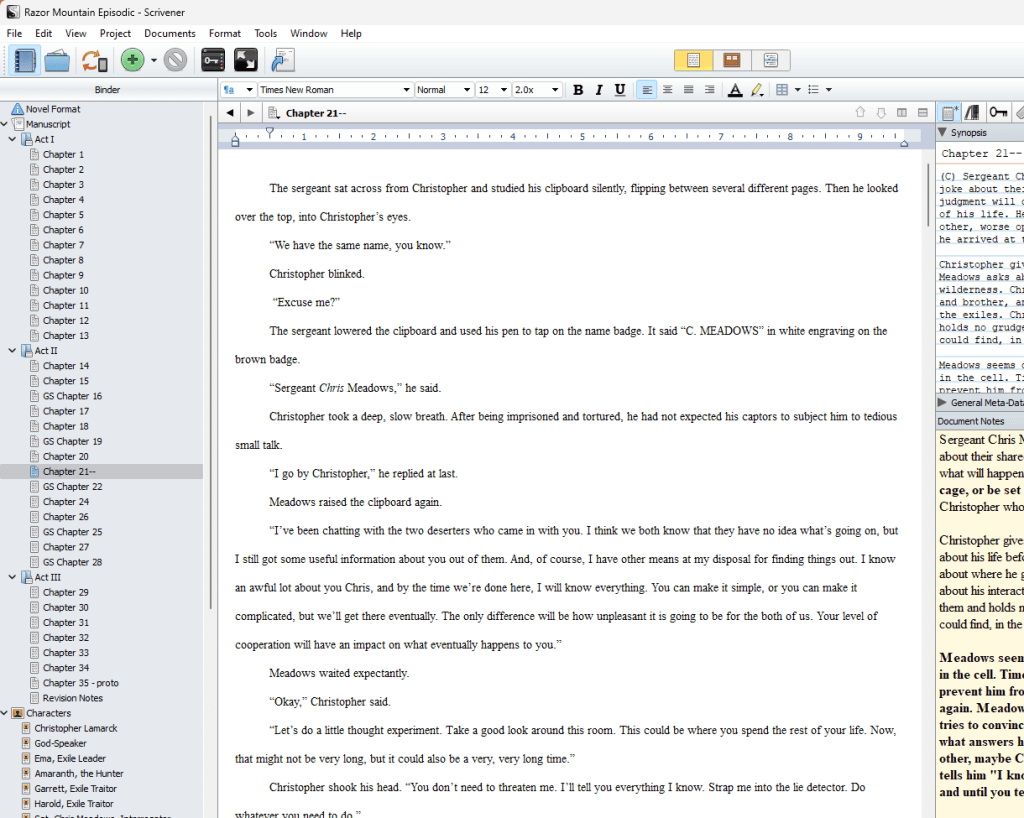
As far as I am concerned, Scrivener is the best novel-writing application out there. Where it really shines is in the way it lets me split a big project into nested parts. I split Razor Mountain into folders for each act, then split out each chapter into its own document under those folders. I have separate sections for major characters, locations and other research notes.
With a click of a button, I can look at the chapter summaries on a cork-board view, and I can drag-and-drop chapters in the document tree to rearrange them, something that has been really convenient as I’ve merged and moved chapters in Act II. Scrivener also has built-in support for “snapshots,” which I use to save each revision of each chapter. I typically save at least a rough draft, a second draft after some editing, and a third draft once I’ve gotten reader feedback.
To ensure that my work is fully backed up, I save my Scrivener files to Dropbox, which copies them across my computers and my phone for safe-keeping. I do have the mobile version of Scrivener, but I almost never use it. I love taking notes on my phone, but I do not enjoy long-form writing on that tiny keyboard.
Scrivener’s editing and cork board views.
Serial Publishing
I’m publishing Razor Mountain as a serial in three places: here on the blog, on Wattpad, and on Tapas. I chose to do this so that I could get a feel for the different platforms, and to try to increase the visibility. However, I haven’t done much to promote the Tapas or Wattpad versions, so pretty much all of my regular readership is on WordPress. I keep telling myself that I’ll eventually put some love into Tapas and Wattpad, and that may actually happen at some point. Either way, I’ll continue on all three until Razor Mountain is finished.
Because I’m posting to three platforms, my process for this is a little bit insane. It goes something like:
Write the first draft and first round of edits in Scrivener.
Copy it to Google Docs for easy beta reader feedback. Fix the formatting that doesn’t transfer nicely.
Make changes based on feedback in Scrivener, and decide how to split the chapter into multiple posts.
Copy it to a OneNote template with the brief description at the top and links to previous/home/next at the bottom.
Copy from OneNote to WordPress. Schedule the posts.
Copy from OneNote to Wattpad. Fix all the formatting that doesn’t transfer nicely. (Wattpad has no way to schedule posts.)
Copy from OneNote to Tapas. Fix the formatting that doesn’t transfer nicely. Schedule the posts.
On the scheduled day, chapter parts automatically post to WordPress and Tapas.
I have to manually post the saved draft to Wattpad. I also have to update the previous/next links in the WordPress post, and I need to add links to the Razor Mountain home page. Depending on how busy I am, I sometimes forget to do these things, and I typically don’t catch it until I start posting the next chapter.
Some of this complexity comes from posting in three places, each with their own idiosyncrasies. It’s obnoxious how often copy/pasting between tools and websites causes the formatting to be lost. It’s doubly obnoxious that Wattpad doesn’t let me schedule posts.
I suspect there is probably a way to add WordPress links (previous/next and home page) that point to a scheduled post and only work once the post is “live.” I haven’t spent the time to figure it out though.
Short Stories
The majority of my writing time this year went toward Razor Mountain and the blog, but I have managed to sneak in a few short stories.
For microfiction, drabbles, and flash fiction, I often just work in OneNote. Unlike novel writing, I sometimes do work on short short stories on my phone, and I typically do not need organizing features or formatting more complex than italics and bold.
For longer stories, I usually use Microsoft Word on the laptop. Oddly, I copy to Google Docs for easy beta reader feedback, but I never really write in it. I’ve been using Word for years and I’m comfortable with it.
For all of my stories, I save everything to Dropbox to make sure it’s backed up. When it comes time to find places to submit stories, I use Duotrope.
Blogging
My blogging schedule has fluctuated over time, but these days I try to post Razor Mountain chapters every other week.
Unless a chapter is around a thousand words or less, I will break it into 2-3 parts of about a thousand words each. I’ve read that 500-1000 words is the sweet spot for keeping readers’ attention for blogs, and a slim majority of my WordPress readers are on mobile, where a post of that size feels bigger on the page than it does on a full-size monitor or tablet. Tapas and Wattpad don’t have that kind of detailed dashboard for writers, but they do say that most of their readers are also on mobile.
Along with the chapters themselves, I write a development journal for each Razor Mountain chapter. Sometimes I post the chapter parts earlier in a week (e.g. Wednesday and Thursday), and the development journal on Friday. If I have three parts in a chapter or get a little behind, I will sometimes post the development journal the following Monday. I used to worry about maintaining an exact schedule, but nowadays I just aim for a schedule and adjust as needed.
I write blog posts unrelated to Razor Mountain on the “off” weeks, and sometimes for the Monday of Razor Mountain weeks as well. I’ve been blogging long enough now that I have a few ongoing series of posts, so I will often mix one of those posts with something stand-alone in a given week.
I’ve gotten in the habit of posting reblogs every other Wednesday. Writing three blog posts in a week is too much for me, and reblogs are low-effort (while hopefully still interesting content). They occasionally result in some cross-pollination with the other blog’s readership. Their main purpose is to serve as a good motivation for me to regularly read other writing blogs. I maintain a list of interesting articles and blog posts in my OneNote, and trawl through them for these reblogs.
For the header images on my posts, I use Pexels. I don’t usually do any picture editing apart from cropping. If I have a really difficult time finding an image that I’m happy with, I will occasionally check Unsplash. Both of these sites offer pictures that are free to use and do not require specific license language to be displayed.
(If you’re blogging, please do yourself a favor and always check the licensing and make sure you’re attributing correctly. There are trolls out there who will sue you for hundreds of dollars, even for such non-crimes as using the incorrect version of Creative Commons. And if the image isn’t licensed for your use, don’t use it!)
I make it easy on myself and always use the same cover image for Razor Mountain chapters, and pictures of mountains for development journals. For all other posts, I just search for terms vaguely related to the content.
I always write my blog posts in OneNote, do an editing pass, and then copy/paste them into WordPress. I almost never publish a post immediately. Instead, I schedule them for 7:00am CST on a subsequent day—usually Monday, Wednesday or Friday.
Tracking
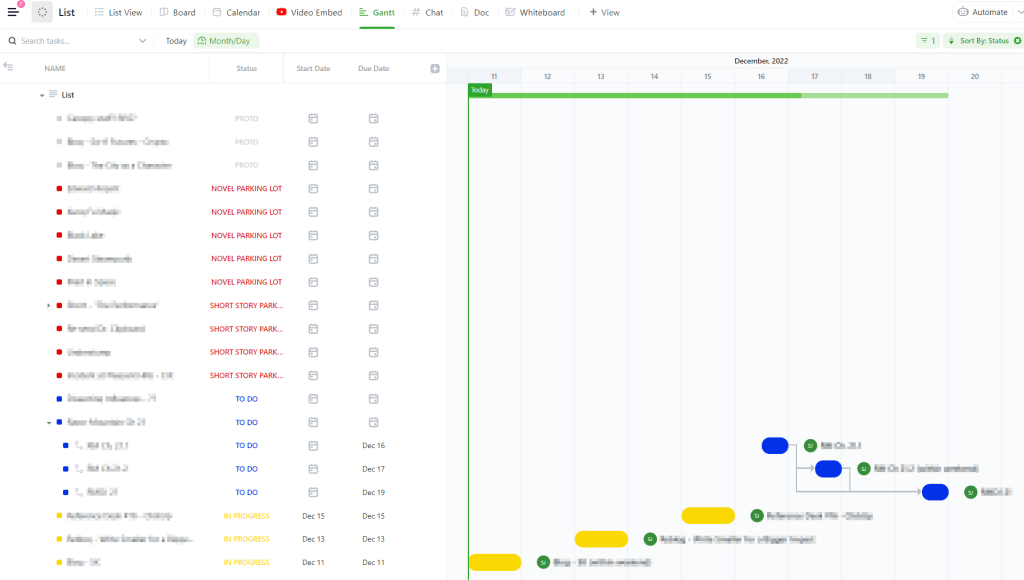
My latest endeavor is to try to get a better understanding of how I’m using my writing time. Lately, I’ve been using ClickUp. I like it for charting “deadlines,” even if they’re entirely self-imposed, and laying out a schedule of things I intend to write.
And even though I’ve explicitly said in the past that I don’t want to end up tracking things in Microsoft Excel, I’ve been doing a little bit of tracking in Excel. I haven’t found a great way to roll up the time spent on different projects in ClickUp in a way I like. Excel makes it dead simple to make a few columns and track days, projects and half-hour increments. It’s all compact and easy to eyeball, and there’s always an easily searched website that will tell you how to translate a few columns into an interesting graph, even if Excel formulas make me feel a little dirty.
This tracking stuff is still in flux, and I expect it to change. In every other respect I am an old man, set in my ways. It’ll be interesting to check back in next year, and see if anything is different.
This post is already much longer than I planned, so I’ll end it here. Hopefully it was interesting to see how another writer works. If you’re an author who writes about your own process, I’d love to read about how you’re working. Leave a comment or a link to a post of your own.









 Words Deferred