Razor Mountain — Chapter 21.1

Razor Mountain is a serial novel, with new parts published every week or two. For more info, visit the Razor Mountain landing page.

The sergeant sat across from Christopher and studied his clipboard silently, flipping between several different pages. Then he looked over the top, into Christopher’s eyes.         

“We have the same name, you know.”

Christopher blinked.

“Excuse me?”

The sergeant lowered the clipboard and used his pen to tap on the name badge. It said “C. MEADOWS” in white engraving on the brown badge.

“Sergeant Chris Meadows,” he said.

Christopher took a deep, slow breath. After being imprisoned and tortured, he had not expected his captors to subject him to tedious small talk.

“I go by Christopher,” he replied at last.

Meadows raised the clipboard again.

“I’ve been chatting with the two deserters who came in with you. I think we both know that they have no idea what’s going on, but I still got some useful information about you out of them. And, of course, I have other means at my disposal for finding things out. I know an awful lot about you Chris, and by the time we’re done here, I will know everything. You can make it simple, or you can make it complicated, but we’ll get there eventually. The only difference will be how unpleasant it is going to be for the both of us. Your level of cooperation will have an impact on what eventually happens to you.”

Meadows waited expectantly.

“Okay,” Christopher said.

“Let’s do a little thought experiment. Take a good look around this room. This could be where you spend the rest of your life. Now, that might not be very long, but it could also be a very, very long time.”

Christopher shook his head. “You don’t need to threaten me. I’ll tell you everything I know. Strap me into the lie detector. Do whatever you need to do.”

Meadows smirked, and it was not a pleasant expression.

“We don’t need your permission, Chris. And I don’t need to threaten you. I work in facts. These are the facts about what is at stake here. If you’re smart, you’ll tell me the facts that I ask of you. I will evaluate what you say against my other sources, and I will determine if you are telling the truth. If you lie or omit things, those will be marks against you. Do you understand?”

Christopher took a deep breath. He felt like his lungs weren’t providing him enough air. The weight of his body was hard to hold up.

“I understand.”

“That’s fantastic,” Meadows said. “Let’s start with Alaska. How did you come to be here in our fine state?”

Christopher told him about the flight from the small town of Homer, about waking up alone, and the frantic minutes leading up to his terrifying jump. His instinct was to leave out the parts that made no sense, but he didn’t dare. Instead, he told the story exactly as he remembered it, without embellishment or commentary.

Meadows stared across the table intently, occasionally looking down to jot something on his paper, but never showing emotion or commenting. He let Christopher tell the story up until the point where he crawled out of the lake, found the hatch, and somehow guessed the code.

Christopher paused and took a deep breath. The lack of feedback from Meadows was almost worse than immediate skepticism.

“That seems like a good place to stop for the moment,” Meadows said, “as it does answer my initial question. Now think back through your story and tell me if there’s anything you left out.”

“Just the facts?”

“Just the facts.”

Christopher thought.

“When I tried to open the door, I wasn’t thinking very straight. I assumed I was going to die, but I thought I might as well try to guess the code. I was going to enter my birthday, but I fat-fingered it.”

“What’s your birthday?”

“November 11, 1983.”

Meadows shook his head a fraction of an inch.

“The code, I mean.”

“111183.”

“And what did you enter, instead?”

“122199. I wasn’t actually sure what I entered at the time, but I figured it out after a little trial and error later on.”

“Interesting,” Meadows said. “Those numbers are quite different.”

“I was freezing to death,” Christopher said. “My hands were shaking.”

Meadows eyed Christopher.

“You certainly look rough around the edges, but you have all your fingers and toes, don’t you? And your entire nose. I think you weren’t quite so bad off.”

“Well, it felt like it at the time,” Christopher mumbled, trying not to sound petulant.

“Let’s back up,” Meadows said. “Where did you come from, before you came to Alaska? Where do you live?”

“I have an apartment in Minneapolis,” Christopher said. “Or at least, I did.”

“Oh, what happened to it?”

Christopher shrugged.

“I don’t know. I just assumed I’ve been declared dead by now. It’s been weeks.”

“Ah,” Meadows replied, no sympathy in his voice. “You lived alone then?”

“Yeah.”

“And where did you grow up?”

“Same general area. Suburbs.”

“Family?”

“My parents and my brother.”

“Older, or younger than you?”

“…younger.”

For the first time, Meadows face betrayed some hint of emotion, the faintest narrowing of the eyes.

“You hesitated.”

“My brother was three years younger. He was adopted, if that matters.”

Meadows shrugged.

“Does it?”

Christopher wasn’t sure what to say. He shook his head.

Meadows wrote for several seconds.

“You said your job brought you here.”

“Yes. It was supposed to be a sales trip. I just moved into a new position at work. Sales for northern North America.

Mostly Canada, Alaska, and a few of the north-most states.”’

“And where were you going, specifically?”

“Golden Valley Electric Association.”

“Anyone in particular who was expecting you?”

Christopher pinched the bridge of his nose.

“I don’t remember.”

“What about where you came from?”

“I…I stayed at the motel in Homer. I visited Homer Electric. I met a few people. I only really remember first names. There was Phil, Lisa…Sandy, I think.”

Meadows nodded, writing. Then he clicked his pen and stood.

“I think that’s enough to start with,” he said. “Someone will be along shortly to bring you back to your cell.”

Christopher blinked. “That’s it?”

“For now.”

“Look, I’m willing to tell you whatever you need to know.”

Meadows held up a hand.

“Be patient, Chris. We’ll get there, in time.”

“Can I please just sleep?”

“We’ll talk again soon,” Meadows said. He turned sharply on his heel and walked to the door. He didn’t even glance back as the door closed behind him.


<< PREVIOUS ] [HOME] [ NEXT >>

Reference Desk #16 — ClickUp

This series is all about tools and resources that are useful for writers. It’s been a while since I added a new entry, because I’ve written about pretty much every tool I use for my writing. However, I recently added a new one to my arsenal: a web-app called ClickUp.

Time Tracking for Writers

Part of the reason I started this blog was to get better at writing frequently and consistently. In that, it has been a success. I don’t write every day, but I do write several times a week. Between my job and family and everything we have going on, I’ve reached the point where I’m mostly happy with the amount of time I’m putting into my writing, and I’m balanced with the rest of my life.

However, ramping up my weekly writing time was an easy way to improve. If I assume that I’m going to maintain my current cadence, I have to find other avenues to increase the quantity or quality of my writing. My next step is to more closely track my writing time and how much of it I spend on different projects. If I can’t spend more time on writing, I have to get more efficient with how I use that time. I read some blog posts by writers who track their writing time, and it seemed like something that might be worthwhile.

If you think tracking your writing time sounds like an awful thing to inflict on yourself, I don’t blame you. It’s a little tedious, and it’s a distraction from the “real” work of actually getting words on the page. However, if you’re the sort of writer that wants to make writing into a full-time job, you might want to consider actually treating it like a job, even if only for a few hours a week—and that may include things like figuring out just how well you’re spending your time.

Even for those who aren’t interested in writing as a job, it can be a valuable exercise to actually track what you’re getting done. In my day job, this kind of tracking has opened my eyes to cases where I was spending much more or less time on certain things than my “gut feel” told me I was.

In any case, I decided it would be worth at least trying to track my writing time as an experiment. If I learned something useful, great. If I didn’t, then at least I tried. Thus began the long and painful search for decent project tracking software.

The Nightmare Hellscape of Business Software

Managing projects is big business, and selling software that supposedly makes those projects run more smoothly is therefore big business too. The Google results are packed with ads, and there are literally dozens of different applications that guarantee they will make your job infinitely better.

I’m sure this is obnoxious enough when you’re some middle manager at a Fortune 500 company, but it’s even worse if you’re just a freelancer or individual who just wants a basic solution for personal use. I’m not going to bore you with the list of products I tried. If you do a web search for project management or time tracking web applications, you’ll find them all.

I had a short list of features I wanted:

  • A list view of projects and categories
  • A way to track time spent on each project
  • A Gantt chart that understands dependencies between projects
  • A low price point – preferably free or a one-time charge

That last point, price, is a tough one. Almost all of these products are trying to sell to big business, and they want that recurring revenue stream. After all, they have to maintain their web infrastructure and all of those collaboration tools…that I don’t plan on using.

I was more surprised at how few tools make it easy to attach dates to projects and then see them all lined up on a schedule. This seems like pretty core functionality to me, but a lot of these products just show projects as line items or colorful squares, and don’t seem to understand scheduling. If all I wanted was a Kanban board, I’d just use Trello.

ClickUp

ClickUp ended up being the first tool I tried that actually did what I was looking for and didn’t try to lock me into a monthly contract after a brief trial.

The two views I’ve been using so far are the list and Gantt views. The list provides a set of category buckets that projects can be dropped into. You can set due dates, a priority flag, make comments, and track time. It’s possible to add more columns here, but I haven’t played with any others so I can’t comment on usefulness.

There is also a nice feature that allows association of sub-projects with a parent. I’ve used this to track things like the individual blog posts and development journals for my serial novel, Razor Mountain, or different drafts of a short story.

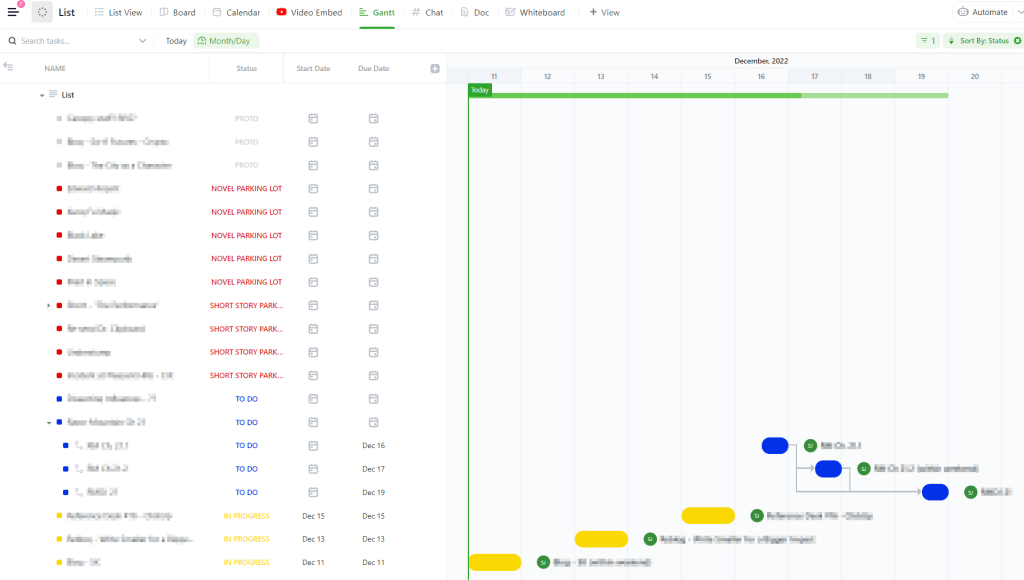
The Gantt view puts the list on the left side, and a scheduling view on the right. From here, tasks are placed according to their due dates, but the time range is easily adjustable. It is also possible to add dependencies between tasks in the task details and see them as little arrows on the chart. This is a little bit clunky, and I haven’t used it much.

ClickUp list view. (Project names blurred to protect the innocent)
ClickUp Gantt view.

There are a number of other features that I haven’t really used. ClickUp has several views of the same information, including a calendar and Kanban board. It has a chat feature, video embedding, and a document storage/wiki feature as well. The documents might be useful for some writers, but these are features that will eventually fill up the limited storage available to free accounts.

On that note…

Pricing

One of the key features of ClickUp that makes it work for me is a perpetually free account tier with a reasonable feature set. The only significant limitation is 100MB of storage, which is a good amount, but certainly possible to use up if you start attaching images or video to your projects.

There are several paid plans with various features, but they’re all targeting businesses, and I haven’t felt the need to dig into them. The free tier gives me what I need for my individual tracking.

But is it Useful?

I don’t really know yet. Although I’ve played around in ClickUp enough to decide it’s the tool I want to use for my time tracking experiment, I haven’t been consistently tracking my projects yet. I’ll need to spend some time figuring out my workflow and the features I want to use.

Once I’ve had some time to track my projects and decide if it’s valuable, I’ll write a follow-up post to tell you how it went.

Reblog: Write Small for a Bigger Impact — Joe Ponepinto

Today’s reblog comes from Joe Ponepinto, who reminds us that great fiction often tackles big, heady issues, but it doesn’t necessarily place them front and center. Instead, it forces us to infer that meaning from much smaller details. Fiction is a game of synecdoche, where the minute and the mundane must be representative of bigger, broader ideas.

Writers have to recognize and accept an essential artistic paradox that the more specific and individual things become, the more universal they feel.

That’s from an essay written by Richard Russo a couple of decades ago. I’ve been thinking about it a lot lately as I read stories in the submission queue, especially those by newer writers. I can tell they want to say something profound in their fiction. Why not? If you can write something that makes readers take notice, that makes them sit up from their reading and say, “Wow, that’s so true,” it could mean publishing success is not far off.

But many writers go about it the wrong way. Since they want to say something big and universal, they tend to write their stories in the universal. They create settings and characters that adopt the traits of universal subjects, which is to say they become flat and generalized, homogenized into composites. Sometimes the characters in such stories seem written to represent a particular side in a philosophical or social discussion. In reality, though, those “big” topics are so complex and nuanced that they can’t be described efficiently and adequately enough in a short story. The result then is a narrative filled with characters and scenes that don’t connect with readers, and a message that sounds artificial and predictable.

Read the rest over at Jane Friedman’s blog…

5K!

Last week I passed another little milestone.

Thanks to everyone for reading, especially my regulars.

One of the goals of this blog is an open writing process, and I include the inner workings of the blog itself in that. I’m not exactly an internet celebrity or SEO expert, but hopefully there’s some value to other bloggers in seeing what my numbers look like.

The progression of these view milestones is interesting to look at:

  • Sept. 2020 – Blog created
  • Nov. 2021 – 1000 views
  • Apr. 2022 – 2000 views
  • Dec. 2022 – 5000 views

As you can see, while starting from small numbers, the progression is more exponential than linear. It took 14 months to get enough readership to get a thousand views. The next thousand took only 6 months, and five thousand came 8 months after that.

A Little Traffic Analysis

Based on the traffic stats, I attribute most of my traffic to a fairly consistent posting schedule and the long tail of search results. Almost none of my traffic in the first year came from external search engines. It was driven almost entirely by regular readers and people who found the blog through the internal WordPress.com search and recommendations.

Once Google picked up some of my posts to rank on the first page of certain niche search terms, the bulk of my traffic started to come in from that. On a typical day, I see hits on my most recent 1-2 posts, hits on my top few posts in Google search, and one or two hits on random old posts. I assume these old posts come up in WordPress search and recommendations or in the “other posts like this” end-cap.

This shows why people chase that sweet, sweet SEO. Having posts that rank high in the Google results gives you a steady stream of traffic, and that traffic can be converted into regulars and get more visitors clicking on your other articles in the end-cap. I haven’t put much effort into SEO, so it typically comes as a surprise to me which articles end up ranking high enough in a niche search to drive traffic.

Smoothing Over Time

It’s worth noting that statistics like this “smooth out” as you look at longer time scales. If you’re a new blogger, please don’t drive yourself crazy looking at daily view counts and other statistics. Especially when your blog is small, there will be a lot of variation from day to day and week to week. Even on a monthly scale, my graphs jump up and down significantly.

This is why I have been doing my own State of the Blog posts every six months. I don’t find the statistics to be all that useful on time scales much smaller than that.

Razor Mountain Development Journal — Chapter 20

This is part of an ongoing series where I’m documenting the development of my serial novel, Razor Mountain.

You can find my spoiler-free journals for each chapter, my spoiler-heavy pre-production journals, and the book itself over at the Razor Mountain landing page.

A Long Wait for a Short Chapter

Chapter 20 might be the shortest chapter so far.

I went into Thanksgiving week thinking that I would get a lot of writing done. That didn’t happen. The kids had activities, we helped a family member move, and the actual Turkey Day prep didn’t help either. On top of that, we’ve had some family medical issues lately and multiple home appliances dying. It’s been a lot.

As a serial procrastinator, I have a lot of baggage around making plans and then not getting things done. However, I’m getting a little better at looking at it objectively, and it was pretty reasonable to not get much writing done. I try to chalk it up to life intruding, and adjust my plans accordingly.

I’m taking quite a bit of vacation at the end of December and January, and I’m hoping to really reset and have lots of free time for all my writing projects. I think it will also help if I can finish off Act II and get into Act III of Razor Mountain. I’m feeling some of the mid-book doldrums and I usually get a second wind when the end is in sight.

Approaching the Breaking Point

This latest chapter ended up being yet another short one. Part of that is down to the fact that there’s no dialogue or other characters for Christopher to interact with. Part of it is because I don’t want to spend too long on these scenes where it’s just him in an empty room having a bad time—just enough to set up what will be happening in subsequent chapters.

I wanted to get across the visceral awfulness, and the feeling that Christopher really getting close to his breaking point. He has been through a lot, and he is worn down. At some point it’s going to be too much.

But we’re not quite there yet.

Serial Villains

Razor Mountain doesn’t have a big, bad, ongoing villain throughout the entire story. In terms of high school English conflict definitions, it’s more “man vs. nature” and “man vs. self.”

What it does have is a series of minor villains that cause problems for the main characters. God-Speaker had to deal with  Finds-the-Trail and Strong-Shield. Christopher was kidnapped by Garrett and Harold, and is now imprisoned under the purview of Sergeant Matthews.

It’s challenging to make these villains menacing when most of them are only around for a few chapters. Their main effect on the story is acting as roadblocks that the main characters have to somehow overcome, but they need to feel like an organic part of the story. They need enough character development that their actions make sense and hint that there’s more going on with them than we get to see. They need motivations that put them at odds with the main characters.

A notable effect of chaining villains in this way is that it naturally results in arcs of tension as each conflict ramps up, and then is overcome or superseded by the next conflict. This can be good, because it provides a natural structure of rising and falling action—you need both moments of tension and release to keep the story interesting—but it can also create lulls in the action that I need to make sure aren’t too long or boring.

Next Time

Chapter 21 might just be the straw that breaks Christopher’s back. We’ll get to know our new friend, Sergeant Matthews, the first Razor Mountain authority figure that Christopher has encountered. Things are going to get worse before they get better. If they get better.

Razor Mountain — Chapter 20.2

Razor Mountain is a serial novel, with new parts published every week or two. For more info, visit the Razor Mountain landing page.

The noise came and went over and over. Christopher counted five times, then began to wonder if he had miscounted. It never seemed to be more than an hour between sessions, and he didn’t trust his sense of time at all while the noise was happening. It felt like it went on for hours. He wasn’t sure how much sleep he got in between sessions, but he knew it wasn’t remotely close to enough. He had crossed into the hazy place beyond mere sleep deprivation and exhaustion, a liminal world of almost-sleep where the world around him felt less than entirely real.

As soon as the noise stopped for the fifth time, the door to the room swung open, and a soldier entered. It came as a shock, it was so sudden and out of keeping with the rhythm of Christopher’s imprisonment thus far.

The soldier walked stiffly to Christopher’s cell, eyes staring straight ahead. The man’s demeanor called to his mind the British palace guards who assiduously ignored the tourists. When the man arrived at the cell door, he pulled out a ring of keys. He unlocked and opened the door, and his eyes actually focused on Christopher for the first time.

“Stand up!” he shouted in perfect drill sergeant cadence.

Christopher rolled over and sat up shakily on the metal bed before hauling himself to his feet. Apparently the soldier was not satisfied with how quickly Christopher was moving, because the man swept forward and turned Christopher around to slam him against the wall before he realized what was happening. He twisted Christopher’s arms behind his back and snapped handcuffs onto his wrists. Then he turned Christopher around and marched him out of the cell, over to the stainless steel table in the middle of the room.

The man pressed Christopher down into the chair, then unlocked one of the cuffs to snap onto one of the brackets welded to the table.

The endless hours of noise torture had left Christopher dazed, and the sudden manhandling had caught him completely by surprise. He felt like he ought to fight back, but he suspected that these people wouldn’t be afraid to really hurt him. Besides, he was hardly in a state where fighting back would do any good.

At the very least, it seemed like he ought to say something.

“When do I get my phone call?”

The soldier didn’t so much as blink. His job apparently finished, Christopher did not merit being seen or heard. The man walked to the door as stiffly as he had entered.

“I’d like to speak to my lawyer.” Christopher’s tongue was thick in his mouth, his words slightly slurred.

The door swung closed, clunking shut with finality.

Minutes went by, the room silent except for the sound of Christopher’s shoes on the smooth floor and the clanking of the handcuff chain on the metal table. He felt the effects of adrenaline fade, and exhaustion crept in again. He was tempted to lay his head down on the table and try to sleep, but it was clear by now that if he did that, they would just do something to jerk him awake.

He didn’t have to wait long however. The door opened again, and a man in a sharp-creased forest green dress uniform and red beret stepped into the room, holding a clipboard under his arm. He let the door close behind him, but he didn’t walk to the table immediately. Instead, he stood just beyond the threshold, studying Christopher, his face impassive.

The man walked forward slowly and sat down across from Christopher. He set his clipboard down on the table with an audible snap.

“I’m Sergeant Meadows,” the man said, “and I’m here to decide whether you deserve to rot in a cell for the rest of your life.”

<< PREVIOUS ] [HOME] [ NEXT >>

Razor Mountain — Chapter 20.1

Razor Mountain is a serial novel, with new parts published every week or two. For more info, visit the Razor Mountain landing page.

The sound was like a hammer on sheet metal. It resonated and echoed back on itself in the stone-walled room until it was an overwhelming roar of noise. First, it jerked Christopher from his half-slumber, spiking his heart-rate and triggering a frantic fight-or-flight response. In the steel-barred cell, he could do neither, and he found himself wide-eyed, hands over his ears, sitting on the metal bed with his back pressed against the wall.

As the banging continued, it enveloped him in sound so loud that he could feel it inside his organs. It felt like it was getting steadily louder, but it was possible that it only felt that way to Christopher as the overlapping waves of sound cascaded around the room and vibrated his bones.

He knew that sound was sometimes used as a weapon of torture, but he had never really considered how bad it could actually be. It made his teeth hurt. It was all around him, so there was nothing to focus against, nothing to push back against. He was unrestrained, but he felt trapped. As seconds and minutes ticked by, Christopher felt that he had to stand, had to find an outlet for the pent-up energy his body wanted to deploy against the pain.

He stood and moved to the bars of his cage, pulling on them impotently. They were firmly embedded in the floor and solidly constructed. He couldn’t budge them. They wouldn’t even rattle. Not that he’d be able to hear it.

He paced the too-small perimeter of the cell, his arms starting to ache from pressing his hands to his ears. He could feel the noise grinding him down. He had no idea if it had been going for minutes or hours. He wondered what kind of permanent hearing damage this would give him. He was beginning to think that he’d be willing to go deaf just to shut out the sound.

It stopped as suddenly as it had started, but the reverberations continued around the room for a few seconds, and even after they were gone, the echoes continued in Christopher’s ears, pulsing in time with his heartbeat. With the overwhelming sound gone, he felt like there was now an aching void between his ears.

He dropped his hands from his head. They were shaking. He stood, leaning on the bars, concentrating on the feeling of the cold metal against his forehead. Time passed, but his sense of time was too fuzzy to know how long. He sat heavily on the metal bed. Without the noise attacking him, the cell actually felt bigger, less restrictive.

He looked up at the cameras mounted high up the walls.

“What do you want?” His own voice sounded distorted and far away.

There was no response. He hadn’t really expected one. He didn’t see any speakers or obvious P.A. system, no obvious source for the horrible banging sound either. They had to be watching him, but what would they be looking for? Signs of a mental break? Christopher felt so exhausted at this point that he didn’t think he had the energy for a full-on breakdown. A catatonic state sounded like it might be nice.

He lay down on the uncomfortable slab of metal, turning to face the wall. If they thought he was trying to sleep, would they start up the noise again? The thought of enduring any more of that was enough to raise his heart rate.

He wondered if they could measure his vital signs without having him hooked up to a machine. Could they monitor his heartbeat? His core temperature? Maybe he wouldn’t be able to fool anyone.

Eventually, he got his breathing to slow. Surprisingly, even on the cold metal bed, knowing that some unknown torturer was probably just waiting for the right moment to inflict some new suffering on him, he began to feel the weight of exhaustion. He didn’t know if it was better to resist sleep or give in, and perhaps get a little bit of his strength back.

His body decided for him. He didn’t know how long he slept, but he woke to the heart-stopping sound of the metallic banging blasting into the room once again.

Christopher rolled over, laying flat on his back, eyes closed, and began a list of every expletive he knew, shouted uselessly into the sonic chaos.

<< PREVIOUS ] [HOME] [ NEXT >>

Drabble — A Going Away Party

The residents of the last escape ship wake up early and decide what events to attend. A Shakespeare reading or a striptease? A fistfight or a folk dance? A prayer service or a rave? An orgy or a tea ceremony?

The sacred, profane and mundane are represented in equal measure.

We disable the fire suppression systems for makeshift campfires. We sing songs and eat nutrient paste s’mores. Some laugh, some weep.

Enemy ships close in, faster and more powerful than ours. We take our sedatives, and sleep in each other’s arms.

All in all, not a bad send-off for humanity.

For more drabbles, check out the fiction section of Words Deferred

Great Writing — Why the Lucky Stiff

Programming computers is a serious business. It is a business involving tens of thousands of workers across thousands of companies, all busy making and spending hundreds of billions of dollars. It is an industry that I happen to have been in for most of my adult life.

You can see the seriousness of software development in the books about programming. They’re often big, weighty tomes, packed full of material that will be outdated within a few years.

What you do not find in typical software books is humor, silliness, or even mild fun. While programmers might occasionally wax poetic about “code as art,” it is art underpinned by logic and exacting precision. Software must be precisely written in order to work correctly. Unnecessary ornamentation is not generally considered a good thing when it comes to programming.

Why’s (Poignant) Guide to Ruby

Why the Lucky Stiff is a programmer. Or at least the online pseudonym of one (often shortened to just _why). I first discovered him the way many people did, through a book that he wrote called Why’s (Poignant) Guide to Ruby.

This strange book title, authored by this strange pseudonym, immediately caught my interest because it is so unlike the serious programmers and programming books that I have become familiar with throughout my career. The book doesn’t begin with a forward, with acknowledgements or a table of contents or a summary to sell you on what you’re about to learn.

It begins with comics. Weird comics. “An elf and his pet ham.” Pixel art and old pictures taken out of context and given captions.

When we get to the second chapter (page 2) and some actual text, it apes the format of a “normal” programming book, but continues to be absurd. The opening blurb sells the book by explaining that it will make us cry over the beauty of this programming language. There’s an extremely long sidebar (and dear God, programming books love sidebars), to talk about what the author will “do with the massive proceeds from this book,” which is, in fact, written under an open license that lets anyone do anything they want with it.

The remainder of the chapter is dedicated to a shaggy dog story with a literal shaggy dog, an explanation of how learning the Ruby programming language will make you a better person, and another nonsensical story to explain why the book has cartoon foxes. It’s a pretty accurate introduction to what you’ll be getting in the rest of the book.

The (Poignant) Guide does eventually settle down into some actual code examples and explanations. However, as you get further along, the code seems to be less and less of the book, while the bizarre stories and long-winded sidebars take up more and more of the text.

The truth is that, even if you’re a programmer familiar with other languages, the guide is not actually all that helpful for learning the Ruby programming language. It’s a fever-dream of non-sequiturs, silly stories and comics that happens to include some programming instruction. When I first read it, it inspired me to seek out other resources to learn Ruby, but it wasn’t enough by itself to really get a grasp on the language.

So what was the guide trying to be? Is it a post-modern masterpiece? An allegory? Just some weird stories that a programmer wrote down for fun? Maybe it wants to be a mish-mash of all of these things.

Why the Lucky Stiff

I only learned about _why after the fact.

_why developed many projects in the Ruby language, some larger, some smaller, some popular and some very niche. Over the years, his philosophies became more apparent through his writings, bloggings, twitter and projects.

He didn’t seem to put much stock in the serious programming that is the norm in the industry. He made useful tools, but he also just goofed around a lot in his literary projects and in his code. From writings like The Little Coder’s Predicament, we glimpse his frustration with the pain and complexity of “serious coding” and a desire to get back to basics: just hacking on things because they’re fun and interesting, and not worrying so much about doing it the “right” way.

I do not write tests for my code. I do not write very many comments. I change styles very frequently. And, most of all, I shun the predominant styles of coding because that would go against the very essence of experimentation. In short: all I do is muck around.

A letter from _why

Many people found inspiration in _why’s hacking and in his philosophy. Some were just in it for the cartoon foxes and the ham. And, of course, all the comics and goofy stories and non-sequiturs irritated a lot of people who didn’t get it.

Interestingly, as _why became more well-known, he remained pseudonymous. Even when he spoke at the occasional software conference or showed up to some real-life community event, he went by his online moniker. For the most part, nobody seemed to mind or think too much about it. It was just another fun quirk on top of all the others. But it turned out to maybe be important, because one day, _why disappeared.

Exile

_why didn’t just disappear. He removed all the evidence of his existence. He deleted all of his projects, his website, and his Twitter account. There was no warning. Nobody saw it coming.

If he was a somewhat divisive character before this, he became outright controversial in the wake of his disappearance. There were many people who used and relied on his projects, and many who simply felt abandoned by an important parasocial figure.

Whether or not there were more personal reasons for the emotion, most of the community’s anger manifested as irritation that _why had taken down all of his code. Broken and buggy dependencies on other people’s code are a perpetual problem when it comes to software development, and many members of this relatively close-knit community felt betrayed as they were forced to clean up all of _why’s missing projects.

Of course, we know by now that nothing ever disappears completely on the internet, and it turns out that most everything, from his code to his comics to his writings, were preserved in various electronic nooks and crannies. In time, pretty much all of his work was reassembled.

With the projects restored, much of the buzz of the event died down. There were some rumors that _why might have been doxxed, and this was what led to his self-imposed exile from the Ruby community and the internet at large. That still left the question of why he was so worried about remaining pseudonymous in the first place. The mystery of _why’s disappearance still bothered some people, but no clear answers were forthcoming, especially from _why himself.

Return

Three or four years went by. Why the Lucky Stiff became just another interesting anecdote in the vast morass of the internet. People occasionally found his writings (re-hosted by others). People stepped in to take over his projects.

It was a bit of a shock when he returned, and he did so in exactly the sort of bizarre and cryptic fashion that anyone familiar with his work would expect. He left a printer queue that provided a series of hidden messages. The internet, being what it is, immediately took up the puzzle, along with renewed arguments over whether _why should be celebrated or reviled.

The eventual results were nearly a hundred pages—another book, of sorts, which was eventually named CLOSURE. As far as I know, it’s the last thing written by _why.

This feels like the ultimate distillation of the _why aesthetic. It’s not wrapped up in being a programming manual. It’s just a series of strange jottings and stranger stories. But here, clearly, it’s not entirely random and surreal. The text itself makes reference to _why’s disappearance, the opinions of the crowd about him, and itself, wrapping around in a sort of literary ouroboros. It’s clearly allegorical, and sometimes even comes out and says things directly. But it’s also contradictory.

NOW: Lay into the printer queue thing. Just lait on thick with the “4 to 11” just over and over. Try to remember, this is the guy’s only chance to recover from annihilating self-sabotage, okay?

_why – CLOSURE

Closure

_why’s writings stand on their own. They’re a fascinating mix of surrealism, silliness, and occasionally deep thoughts. _why is a talented, if eccentric writer. He combines comics, drawings, stories and anecdotes into something cohesive.

However, I think _why is one of those writers that can’t be properly read without understanding some of the context around his writings. Being a programmer certainly helps, but his work, his exile and his return all play into his writings, especially CLOSURE.

We’ll never know exactly what motivated _why, what exactly made him go away, or what he thought about all of this. We only have his writings to go by. I suspect those are more interesting and satisfying than the plain, unvarnished truth. And so does he.

In CLOSURE, _why talks about reading all the works of Kafka, who asked a friend to burn all of his work when he died:

Of course he didn’t want them burned.

This was just Kafka, writing his own death.

This ending has his signature on it.

Reality’s a kind of medium, maybe greater than paper.

Further Reading

Narrative in Games — Revisited

Games are uniquely positioned as the newest narrative art form, the baby of a family that contains novels, stories, movies and television. Narrative games are an even newer invention—after all, there is no story to speak of in Pong, Space Invaders or Pac Man, and even many modern games still treat any sort of narrative as an afterthought. We’re still feeling our way through the possibilities opened up by this young new media.

Last time I talked about narrative in games, I discussed the two techniques games use to immerse the audience in the story: experience and participation. Recently, I’ve been thinking about these concepts, their limitations, and how they work together.

Inhabitive Experience

The first thing I want to do is redefine the idea of experiential narrative that I introduced in the original post. This is the idea that games immerse the audience by allowing them to directly experience being in the story.

Other kinds of media can provide this to a lesser degree. Many modern stories use close perspectives, where the audience sees the world of the story filtered by the character they are close to. The most extreme close perspective is first-person limited, where the audience seems to float somewhere in the back of the main character’s head, or reads their telling of the story after the fact.

Interestingly, one of the least-frequently-used perspectives in modern media is second-person. While third-person dictates the story from outside the characters and first-person provides the internal view from within a character, second-person provides the odd perspective of having the story directly addressed at “you,” the audience. (90s kids will remember the Choose Your Own Adventure series.)

Many games make the player see through the eyes of a character, and this is typically referred to as a “first-person” in terms like FPS: first-person shooter. However, there’s an argument to be made that the experience games provide is actually second-person in nature.

In a game, the player can inhabit a character, in the same way that a person comfortable with driving a car acts as though the car were an extension of themselves. When someone talks with the character, they also talk directly to the player. When something happens to the character, it happens to the player.

This inhabitive experience is the core of what allows games to be emotionally impactful.

How to Inhabit a Character

Counter-intuitively, detailed characters are easier to inhabit than generic ones. The history of video game writing is littered with generic protagonists, created with the mistaken belief that an empty vessel makes it easier for the player to step into the game.

A generic character doesn’t give the audience any place to root themselves in the story. There are no attributes to embody, no desires or aspirations to connect with. The player is dropped out of the sky into a foreign world, but the character they inhabit should not be. That character is the audience’s gateway into the world, and when the character has connections in the world, the player can learn about the world through them.

Participation is Secondary

In addition to inhabitive experience, there is a second trick that games use to immerse the player in the story: participation. Instead of merely experiencing the story, the audience can actively participate in it.

Participation can vary quite a bit. While some games allow the player’s actions to influence the narrative, in many cases the plot points are set in stone. In other cases, the player might decide what order a series of events happens, even if all those events must happen to progress the narrative. This may sound meaningless, but when done well, this small amount of choice can provide the player with a sense of agency.

Even simple participation, like freely exploring a confined area, gives the player a certain sense of involvement. The truth is that participation in the story does not necessarily mean control over the story. The player can be complicit even if they’re not in charge.

It is also important to note that participation, by itself, is not enough to create a narrative experience. The player is a very active participant in a game of Tetris. Even more complex games like city-builders and real-time strategy give the player complete control over the game pieces, but that control has little bearing on the story, if a story is even present.

The Key Narrative Combo

Participation must be paired with an inhabitive experience to create an effective narrative. The game places the player into a character that they can empathize with, then gives the player some degree of control over that character. Now, when the character encounters a series of story events, the player inhabiting that character experiences the events personally, and feels responsibility for the choices they make on behalf of that character.

Unfortunately, simply having these elements in the correct configuration doesn’t automatically make for a compelling story. The setting, characters and other typical story elements still have to be well-crafted to draw in the audience. These are only the prerequisites.

I can look at any of my favorite narrative games and find exactly these elements: a detailed and interesting character, rooted in an interesting world and given problems to overcome. The player is then given control of that character. Beyond that, the story is still a playground for the writer to choose what story they want to tell.

In Psychonauts, that’s a young misunderstood psychic boy trying to save the world and also fit in at summer camp. In Firewatch, it’s an emotionally vulnerable man spending a summer as a park ranger, trying to figure out how to mourn his dying, comatose wife.

Emergent Narrative is a False Promise

A popular idea when discussing deep narrative games is the promise of “emergent narrative.” Modern games are made up of many complex systems, and the argument in support of emergent narrative is that the player can interact with sufficiently complex systems to generate interesting stories that even the creators of the game couldn’t predict.

On a certain level, this is true. My family has certainly told each other stories about the ways an attack on a bokoblin camp can go surprisingly right (and terribly wrong) in Zelda: Breath of the Wild. These stories can involve an inaccurately thrown bomb knocking things around chaotically, or a well-aimed arrow miraculously saving the day.

Likewise, notoriously buggy games like the Elder Scrolls or Fallout series generate endless stories of unexpectedly levitating horses, launching enemies into orbit with a strangely-angled strike, or even stealing the entire contents of a shop after blinding the shopkeeper with a bucket placed over his head.

These make for fun anecdotes, but not for deep, impactful stories. They typically have an element of the comedically absurd or completely chaotic, and that is because the interactions of the player with multiple complex systems will naturally contain a large element of randomization.

Chaos and randomization can be fun, but they do not lend themselves to deep and affecting narrative. Narrative requires structure, and while authors and creators may argue endlessly about what structures work best, emergent narrative is inherently structureless.

We might argue that the job of the game writer is to anticipate or corral the player’s actions, aligning them with the game systems in such a way that a narrative naturally emerges. To me, this sounds like mixing oil and water. Players will always think of options that the creator didn’t anticipate. And if the creator effectively corrals the player into a pre-planned story, it often becomes apparent to players that they are being offered the illusion of choice. The narrative isn’t emerging. It’s being forced. This is something The Stanley Parable explored to great comedic effect.

That’s not to say that a carefully authored story is a bad thing in a game. In fact, I think it’s the only effective way to craft a good game narrative. Emergent narrative can be fun, but it will never result in the same quality of story that purposeful authorship can achieve, just as the proverbial thousand monkeys with typewriters will never produce Shakespeare.