State of the Blog — February 2023

It’s that time again. Since I started this blog, I’ve done a “State of the Blog” post every six months. This is the fifth such post.

One of the key tenets of this blog is an open writing process. I’ve brought that to my serial novel, Razor Mountain, with my development journals, and I bring it to the blogging process with these posts. While the Razor Mountain development journals focus mostly on fiction writing, these posts are about blogging in general.

Previous Posts

Metrics

Let’s start with the numbers:

  • Years blogging: 2.5
  • Total Posts: ~315
  • Total Followers: 128
  • Monthly views: 530 (average over last 3 months)

Search vs. Direct Traffic

The split between search traffic and direct traffic has stayed roughly the same in the past few months. Something like 75% of the traffic I get is from search, with one hero post and a handful of other mid-ranked posts capturing most of those views. The remaining 25% looks like it’s mostly from regular readers, and they’re mostly reading my new posts each week. As you’d expect, comments and likes come mostly from the regulars, while views are mostly the drive-by-searchers.

That search engine traffic varies quite a bit from week to week and month to month, so I’m in the odd position where my stats often aren’t driven much by what I posted recently, and instead come down to how many people wandered in from Google.

Slower Growth?

As I looked back at previous six-month windows, I saw fairly consistent growth in numbers. Usually, my views would just about double over the course of six months. The past six months were the first time where that wasn’t really the case. On average, those stats still went up, but not at that exponential rate.

Complicating the issue is that the numbers didn’t show a consistent trend. As you can see from the graph, there were a couple of fairly low months and a very high month. Turns out a lot of people have extra time to catch up on their blogs in the last two weeks of December.

It will be interesting to see what the next six months look like. This just isn’t a ton of data points to infer much from. I’m not really looking to change what I do based on these numbers—I won’t be doing a bunch of SEO stuff or using more clickbait-y titles. I’d love to see the blog keep growing, but if it does it will be because I keep posting what I enjoy posting, and people find it and like it too.

Approaching the End of Razor Mountain

There are ten chapters left in Razor Mountain. That number may change a little as I work through Act III, but that’s still well over 2/3 done. Plus, as an experiment, I already wrote a first draft of the last chapter at the start of the book. So as long as I can keep up my current pace, I should have all my chapters done before my next State of the Blog post.

I’ve been thinking about what happens next. First, I know I’m going to take a break from the book to get a little distance. Then I’ll be rereading and digging into whole-book edits and polish. I worked extra hard on the front-end to make these episodes as good as they could be when they are released, but I know that there will be a lot of opportunities to go back and further improve and tighten the story.

The bigger long-term question is what I want Razor Mountain to be. Right now, it lives on the blog, and on Wattpad and Tapas. I wanted this to be an open experiment, and I’m very happy with how it has gone. But with a rare few exceptions, traditional publishers are not interested in publishing a book that is already out in the world. I may decide to explore self-publishing, just in case there are folks out there who would be willing to throw a few bucks my way for a copy of the final book.

What Lies Beyond

Razor Mountain has been an integral part of my blog almost since its inception. My posting schedule changed when I went from pre-production to actually posting chapters, and it will probably change again when I get into editing. Then, at some point, I’m going to be done with the book, and there will be a big gap to fill in the posting schedule.

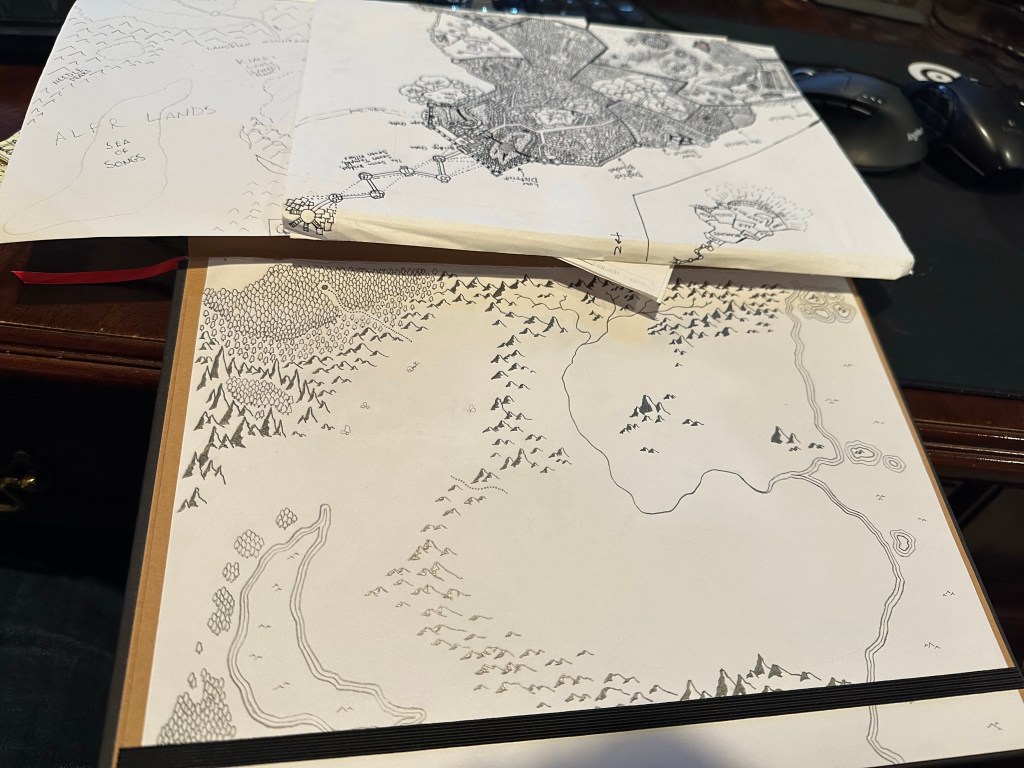
I have a few ideas of what I would like to work on next. I would love to spend at least a few months writing nothing but short stories and really grinding submissions to publishers. I also have dreams of writing a TTRPG campaign setting—I know there is a decent chunk of my regulars who are into that sort of thing, and I think it would bring in some new readership as well. I’ve been kicking around ideas for a setting for years, so it would be great to get it out of my head and onto paper.

I hear that people love maps…

Whichever project I choose to do next, it’s very likely that I will end up posting less frequently. I love the blog, and it has been very satisfying to get to a point where I put out at least three posts most weeks, but I also want to produce more fiction and other work that I won’t end up posting to the blog. Since there are only so many words I can produce in a given week, that necessarily means I will end up stealing time from the blog for other projects.

That’s okay. In some ways, I feel like the blog has grown up. It’s no longer a baby blog where I post my thoughts into the void. I have regular readers that I recognize, and writing and blogging friends that I occasionally trade comments with. I don’t want to stop blogging, but I feel like the blog can continue to grow and thrive with a little less care and feeding than I’ve been putting into it so far.

See You Next Time

That’s it for this time. I’ll see you in another six months for the three-year blogoversary!

Razor Mountain Development Journal — Chapter 24

This is part of an ongoing series where I’m documenting the development of my serial novel, Razor Mountain.

You can find my spoiler-free journals for each chapter, my spoiler-heavy pre-production journals, and the book itself over at the Razor Mountain landing page.

Outlining is Hard

Once again, I am making small adjustments to the outline for the end of Act II. The end-result is two more big God-Speaker chapters, and one small Christopher chapter left to write. I don’t remember having to do much rearranging in Act I, but I feel like I’ve been doing a lot of it in Act II.

Originally, I decided to do more outlining up-front for Razor Mountain than I normally would. I wanted to make sure I knew all the answers to the questions so that I didn’t pull a LOST and write myself into a corner. In that sense, my outline has served me very well. I have a good idea of everything that I need to keep track of and reveal as I go.

The reason the chapters have changed is mostly to accommodate the flow of the story, which I don’t always have a good feel for until I’m actually in the middle of writing. What makes sense in the outline doesn’t always make sense as a sequence of scenes, especially as little things change along the way. So, I’m still writing everything that was in the outline, but slightly adjusting the order it appears in.

The fact that I have two different narratives in different time periods gives me some additional flexibility. Each narrative still follows a linear sequence, but I can choose how I switch between them in order to maximize the mystery or create the most tension.

Exposition is Hard

This chapter, much like the previous one, is a bit of an exposition dump in the form of conversation. I’m taking advantage of the assumption that Speares can be a little forthcoming with Christopher because he’s not leaving Razor Mountain, and anything he knows won’t be going back out into the world.

The challenge of Razor Mountain is that there is a lot of history and a lot of things I’ve had to figure out for the story to make sense, but it’s hard to get all of that across when most of the characters don’t actually know the truth about it. I also need to be careful of “prologue syndrome,” over-explaining all the back-story just because I know it and not because it’s necessary for the reader to understand the plot.

Next Time

The climax of Act II includes a two-chapter episode of God-Speaker’s story. The recent God-Speaker chapters jumped through time, but this bigger episode will give me room to introduce a couple new characters and jump into Act III with some big revelations.

Just in case anyone picked up on it—yes, it’s Jules Verne who wrote Journey to the Center of the Earth, not H.G. Wells as Speares says. She’s just not very well-versed in old-school “scientific romance” stories.

Razor Mountain — Chapter 24.3

Razor Mountain is a serial novel, with new parts published every week or two. For more info, visit the Razor Mountain landing page.

Once again, the streets turned them back around toward the city proper.

“Can we walk anywhere?” Christopher asked, probing for information.

“Of course not,” Speares said, “but most of the places that are off-limits to you are also off-limits to any civilians, so they’re already locked up tight. If you want to go into town, we can do that.”

“Sure. Aren’t you worried I’ll see things I shouldn’t, as a prisoner? Aren’t you worried about telling me all these things?”

“Not really,” she said. “I already told you, you’ll probably be here indefinitely, and you’ll be given the same kind of basic access that any civilian would have. If, for some reason, they decided to lock you up again, well, you’d be locked up, and it wouldn’t much matter what you’ve seen or heard.”

“Comforting,” he said. “And if they somehow decide I can leave?”

She stopped walking and looked at him askance.

Christopher held his hands up, as though warding her off. “I know, I know. No chance at all. Still, I’d rather not make it any less likely than it otherwise would be.”

“I actually had one other important thing to talk to you about,” she said. “I’ve been trying to figure out the best way to tell you.”

“That’s either ominous or exciting.”

“It’s probably neither, which is what I really wanted to make sure you understood,” she said. “I submitted that motion you asked for, but the tribunal has temporarily deferred your case.”

“What does that mean?”

“It means they set it aside for the moment.”

“I’m not a complete idiot,” Christopher said. “Why did they set it aside?”

“Well, some of the questions I’ve been asking about you were flagged in our systems. Someone in the cabinet seems to have taken an interest in you.”

Christopher frowned. “I assume you’re talking about government, not furniture?”

“Yes.”

“As in, the president’s cabinet?”

“No, no,” she said, hurriedly. “Not quite that high up. There’s a cabinet just for Razor Mountain. The military and civil authorities all get their marching orders from the cabinet. There are secretaries for various different departments, and those departments are in charge of all the different aspects of government here.”

“So some Secretary of Excavations or whatever wants to know what I’m doing here?”

“Sure, something like that.”

Christopher sighed in exasperation. “What does that actually mean for me?”

“Well, it may not be a secretary, it may just be someone who works in their office. And I doubt they would outright fight a tribunal ruling, but they do have sway as long as that ruling hasn’t been handed down yet.”

“You think this person might actually intervene and get me a ticket home.”

“That’s exactly what I didn’t want you to infer,” she said. “Their interest could mean a lot of things. It might mean more questions. It might mean you get some additional privileges. A friend in high places, so to speak.”

“And?” he said, reading her hesitant tone.

“And…it means there is now a non-zero chance that you could actually get what you want. Not a good chance, but a chance. A hell of a lot more than there was yesterday.”

<< PREVIOUS ] [HOME] [ NEXT >>

Razor Mountain — Chapter 24.2

Razor Mountain is a serial novel, with new parts published every week or two. For more info, visit the Razor Mountain landing page.

Speares led him down the stairwell, going slow for his benefit. His body was still stiff and sore, but he already felt far better than he had the previous day. It was amazing what having basic needs fulfilled could do for a person. He wondered if he was actually supposed to be let out like this, or if Speares was feeling sorry for him. She did seem to be genuinely chagrined about his situation, but she didn’t strike him as someone who would break the rules.

They left the apartment building, and Speares led him deeper into the stone-bound neighborhood, away from the central cavern. She held her notebook open in one hand as they walked. The questions today focused on the details of the bunker and the landmarks around it. Christopher suddenly wondered what the purpose of this questioning was.

“Are you trying to figure out where the bunker is?” he asked. “I assumed your people knew where all those buildings are.”

“I’m not trying to figure anything out,” she said. “If we’re being honest, I’m just told what to ask about.”

“I could probably point out the location on a map, if that would be helpful,” he said.

“It might be,” she replied. “I’d have to get hold of a map though. Let’s put a pin in that.”

“Do you think they actually lost a whole bunker?”

She smiled. “As ridiculous as it sounds, it wouldn’t completely surprise me. There are a number of out-buildings, and they’re all well-hidden, for obvious reasons. From what I know, they aren’t all continuously populated. And in my experience, the bookkeeping isn’t always stellar.”

The narrow street wrapped around in a wide loop, eventually turning back toward the center of the city. They came to a cross-street, and Speares took a left, leading him into another side neighborhood.

“How old is this place?” Christopher asked. “It seems like it would take ages to carve this all out of the rock, even if there were already some caves here. I can’t imagine any caverns this size would form naturally.”

“I’m afraid I don’t know much about the engineering behind it,” she said. “I know that there has always been somewhere in the city where they’re drilling or digging, as far back as I can remember. The excavations aren’t exactly fast, but they just keep at it, day in and day out.”

“Someone must have designated the money for all this though. The president or something? When did it start?”

She smiled. “That’s the kind of knowledge that’s way above my pay grade. The laws around Razor Mountain have changed over the years, but it’s been around in some form for well over a century. Nobody living here today was around when they first started digging holes. Or if they are, they aren’t talking about it.”

“That’s crazy. How much of this could they even do with early 1900s technology?”

Speares lowered her voice mock-conspiratorially. “Well, there are all sorts of rumors. And only ninety percent of them are insane conspiracy theories.”

“Is that even a fair thing to call it?” Christopher asked. “As an outsider, I think it’s safe to say you live inside a giant conspiracy theory.”

“Fair,” she said, “but I’ve heard everything from hollow earth, H.G. Wells kinds of theories to ancient aliens. A lot of people subscribe to the theory that big chunks of these caverns were already carved out perfectly, and nobody knows how. They were just found.”

“What do you think?”

“I think, like most things, it’s probably a lot more straightforward and less interesting than anyone believes. I think someone clever figured out how to dig out the caverns, maybe a long ways back, when people wouldn’t have thought it possible. And then they just kept digging, using whatever new technology they could. I certainly have a hard time believing some of the crazier rumors. I think this place has always been a government project, or at least became one very early in its history.”

Christopher thought in silence for a moment.

“That sounds reasonable, even if I have a hard time believing that anyone could make this place without spending insane amounts of money.”

“I don’t get to see the bills,” Speares said, “but who’s to say they don’t spend insane amounts of money?”

“Surely someone would notice that much secret spending.”

Speares shrugged. “There are a lot of government programs that are…less than transparent. All those three-letter spy agencies have big budgets, and we don’t know what they get spent on.”

“Someone, somewhere is keeping tabs on those programs though,” Christopher said, questioning the words as soon as they exited his mouth.

Speares gave him a look like he was a small child making proclamations about things he didn’t understand.

“Yeah, okay. I still think it’d be essentially impossible to keep something so big and expensive hidden for so long.”

“You didn’t know about it, right?” Speares said.

“Of course not.”

“And that’s why you’re in…this whole situation,” she said, gesturing vaguely at Christopher.

“Yeah,” Christopher said. “That whole ‘effectively imprisoned for life despite doing nothing wrong’ situation.”

“That’s the one.”

<< PREVIOUS ] [HOME] [ NEXT >>

Razor Mountain — Chapter 24.1

Razor Mountain is a serial novel, with new parts published every week or two. For more info, visit the Razor Mountain landing page.

Christopher spent a day recovering. By the clock in the main room of his new apartment, he slept for nearly twelve hours. The bed was not particularly nice, but it felt like a luxury.

He noticed that the lights of the cavern dimmed and brightened—presumably with the cycle of the sun— and wondered if sunlight was somehow reflected in from above. There was certainly some artificial light as well, as even in the depths of the “night” there was enough to see the outlines of the buildings. The street lights stayed on at all hours.

He also noticed that all the lights, above and below, were a rich, warm yellow. The buttery light felt like it had come from a time foregone, as though he were living in a very strange Norman Rockwell painting. The little apartment too, was an odd jumble of modern, anachronistic, and outright ancient, as though there was a pileup on the highway of time and the years had all tumbled into one another here.

The appliances appeared relatively new, but the shape and style of them was  outdated. The cabinets were old wood, slightly warped but recently painted. The walls also had a fresh coat, although he discovered little spots behind the furniture where it was chipped or cracked, revealing older colors underneath, or even the base gray-black-flecked stone.

He first woke to the sound of someone just leaving. When he rose, he discovered that food had been delivered and placed in the fridge. Two sets of unmarked green fatigues had been left on the table, crisply folded. Christopher showered, dressed, and ate. As he took his late breakfast, he looked out the window, over the adjacent rooftops and down at the few people making their way up and down the narrow avenue.

He thought about the ridiculous sequence of events he had been put through, so fresh in his mind after the interrogations and interviews. Now, he realized that everything had become simple. Simple apartment, simple food, simple clothes. Simply waiting to find out what would be done with him. There was a part of him that thought he should be outraged, but he found that the simplicity of his surroundings and the peacefulness of breakfast at the window suited him.

Once he was done eating, there was little to do. The door to the apartment looked like an ordinary wooden door, but it was solidly locked. A black plastic plate had been fastened to the wall next to it, presumably to scan key-cards or some other form of ID for entry.

Christopher occupied himself exploring the apartment. He opened all the cabinets, slid the drawers out of the bedroom dresser. He moved the furniture to see if anything interesting had fallen behind it. There was nothing.

He wondered if the apartment was reserved for prisoners like him, or just an ordinary living space. Speares had made it sound like he was something of a rarity.

It didn’t take long to scour the small space. The only thing of interest that he found in his search was a place behind the bed where the paint had chipped away. The bare rock was exposed, and something had been crudely etched into it. Unfortunately, it was a language Christopher didn’t recognize. It had letters beyond the roman alphabet, perhaps Greek or something Cyrillic.

By early afternoon, Christopher had again taken up his spot in the chair by the window, and there was a knock on the door. The black square on the wall beeped, and the door unlocked with a click. It swung inward to reveal Specialist Speares standing in the hallway.

“May I come in?”

“Seems like a silly thing to ask when I’m the one locked in, and you’ve got the key,” Christopher said.

She sighed. “I understand if you still feel like a prisoner here…”

“I am,” he interjected.

She plowed through. “…but I’m trying to be as civil as possible.”

“I appreciate it,” Christopher said, “but that doesn’t make it any less silly.”

“I suppose not.”

She still waited at the door.

“Come in,” Christopher said.

She entered, closing the door carefully behind her and sitting opposite him at the table.

“Should I just keep this as formal as possible then?”

“Up to you,” Christopher replied. “I’m not very formal. You’re the soldier.”

She shrugged. “Honestly, I wear the uniform, but a lot of my day-to-day work is with civilians.”

“Is anyone really a civilian around here?” he asked.

“Sure. How many uniforms do you see down on the street?”

“Not many.”

“Do you want to take a walk?” she asked. “I have a few follow-up questions to ask, but we could walk and talk.”

“I was enjoying the view from the window,” Christopher said, “but I suppose I had better take any opportunity for an outing that I can get.”

<< PREVIOUS ] [HOME] [ NEXT >>

Giving Characters Direction

Sometimes, a main character seems to come into being, fully fleshed out, and a story just coalesces around them. More often it’s a lot of work to figure out what exactly a character is all about, and what they’re doing in the story. And occasionally, that character fights you every step of the way, and you find yourself uncertain where the story should go.

Today, I want to talk about finding a character’s direction: where do they want to go, and how are they going to get there?

What Do They Want?

The first thing you need to know about your character is what they want. A character with a goal has something to fight for, something to work toward. The story comes out of their adventures along the way to that goal. If a character excites you, there must be something interesting about them, and this interesting thing can often lead to their goal. A character trapped in poverty may want to start a business and become successful. A character whose fondest childhood memories are stargazing with their father may want to become an astronaut. Any strong emotional or physical need can embody the goal that drives the story.

The goal doesn’t have to be straightforward. It could be subtle. In the real world, most of us don’t always understand all of the things that motivate us. For as much as we cherish our reason and intellect, we are creatures of instinct and emotion. Often, feelings run deeper than any “reasonable” ideas about what we need.

Some characters might know what they want and actively seek it. Others may fight themselves at every turn, never entirely understanding what they are actually looking for, creating an internal conflict. Sometimes discovering the real goal can be a powerful revelation that the entire story hinges on.

Where Do They Live?

No character lives in a vacuum. They are a product of their environment, and the setting they live in will influence what their goals are, and what tools and allies are available to them. Sometimes when it feels like a character doesn’t have direction, it’s really a problem with the setting. It’s perfectly reasonable to have the setting be mysterious to the characters and to the reader, but it should not be mysterious to the author.

The character needs to be able to navigate the setting to achieve their goals, and if the author doesn’t know what roadblocks they can face or help they can find, it will feel very difficult to craft a story around them.

To create conflict on their journey, there must be hindrances that make this goal harder to achieve. To relieve some of the tension, the character needs help. Every time they fail to reach their goal, they need to pick themselves up, dust themselves off, and try again. This try-fail cycle keeps the story moving forward, and ideally, it keeps escalating the stakes.

Break the Steady State

Stories don’t happen because everything is staying the same. They happen because something changed, and that change has consequences that the main character can’t ignore. Throw a wrench in the gears. Screw up the character’s life so that there’s no going back.

The most common place to ruin a character’s life is a he beginning of the story (to get the action going) or near the end (to resolve the conflict). However, this technique is just as useful in the middle of a story that is starting to stall.

When the main character is succeeding left and right, a catastrophic failure can bring them back to earth and raise the stakes again. When a villain is running roughshod over the main character, they might let down their guard and suffer their own huge setback, getting the good guys back into the game.

A catastrophe can also serve as a reset button, forcing all the characters to reevaluate their goals and what’s really important to them.

Force Choices

A character needs goals, challenges to overcome, and help along the way. They also need options. Story comes from characters put into hard situations where they have to make choices. Those choices lead to new situations, new problems, and more choices to be made.

Choices are where characters reveal what’s important to them, and a great opportunity for unexpected revelations. When a character has to choose between something that ought to be important to them and something that really is important to them, they’re forced to reveal that secret (or keep it hidden and deal with the regret of not making the right choice).

When the character has clear goals, choices make the story interesting. If there’s only one path forward, then the character will just keep walking. But if there are many options, the character will have to decide among them. For the character and the reader, this amps up the tension as we wait to see if they made a good choice. Alternately, the author can reveal up-front whether it’s a good or bad choice, and the tension then comes from wondering what the consequences will be.

Direction

When a main character has direction, the rest of the story often accumulates around it. The goals of the character get them started, and roadblocks and challenges can divert them in unexpected directions and keep the story interesting. They have to make choices; find allies; try, fail, and try again.

If the character is stagnating, a catastrophe can force them to make new choices or reevaluate their goals, and is often a great twist in the middle of the story.

Finally, the most important thing is to remember what made you want to write that character in the first place. They have something awesome about them, and their direction should be tied tight to that. If it excites you, it’ll excite your audience.

Reblog: Want to Build Tension? Encourage the Reader to Ask Questions — Angela Ackerman

Today’s reblog comes from Angela Ackerman, guest-posting on Jane Friedman’s blog. She discusses how to use the push and pull of tension to draw the reader in and keep them wondering what will happen next.

We can make good use of the reader’s need to know by building scenes that cater to it. For example, imagine a jerk character in our story who is dating two women, Alice and Shai. Neither is aware of the other, which is just how Logan wants to keep it. But in an epic goof, he asks them both to meet him for dinner at the same restaurant on the same night.

When the women arrive (at the same time, of course), that’s conflict. When they both cross the room, unaware they’re meeting the same man, that’s tension.

Tension draws readers in by causing them to mentally ask questions:

Will the women find out Logan’s dating them both?

Will he worm his way out of it somehow?

What will the women do?

Will there be a big blowout?

Strong tension follows a pattern of pull-and-release—meaning, you let the tension build until it reaches its peak then resolve it by answering some of those unspoken questions.

Read the rest over at Jane Friedman’s blog…

Three Things I Learned From Startide Rising

I recently read the 1983 science-fiction novel, Startide Rising, with my kids. It’s the second book in David Brin’s first “uplift trilogy,” a series of loosely-related books that take place in a shared universe. I haven’t read these books since I was a teenager, and I didn’t remember too much about them before re-reading.

The previous book in the series was Sundiver, which I also wrote about.

1 – Unlimited Points of View

These books are very plot-heavy science-fiction, and Startide Rising has an expansive cast of characters. If it were me, I would look for a small number of main characters, and follow their points of view, adjusting the plot so that all the important action happens on their watch. That would be challenging in this story, because there are so many characters, in different locations and constantly shifting groups.

Brin sidesteps that problem by not really focusing on main characters at all. Some characters get more “screen time” than others, but it’s hard to say that this is a story about the dolphin starship captain Creideiki or midshipman Toshio or the genetically-modified couple of Gillian Baskin and Tom Orley. The story is about the Earth ship Streaker and its entire crew as they try to escape the galactic armada that’s bearing down on them.

Brin uses some tricks to make this constant switching between viewpoints less confusing. Most chapters are labelled with the name of the viewpoint character, so the reader doesn’t have to guess and the author doesn’t have to use narrative tricks to make sure it’s clear. There are a few chapters where there is no viewpoint character, or the story follows a group from an omniscient point of view. In those cases, the chapters are labelled with the setting. This might feel very heavy-handed, but it’s a simple and clear way to make the reader’s experience better.

Of course, there is still a notable cost that Brin has to pay for this wide-ranging story with so many point-of-view characters. As a reader, it’s hard to feel extremely close to any of these characters. The story focuses on the plot because there is less focus on the specific characters.

2 – Flat Characters are not Always Bad

This is something I’ve felt for a while, but this book certainly emphasizes the point. Because the cast is so big, it is already inevitable that some characters will be more fleshed-out than others. Because there is an intricate plot, some of the characters may be vital because of a few specific actions they take at key moments, while others are core drivers of the story from start to finish.

For those less important characters, they only need to be fleshed out enough that their actions make sense. They are mostly there to serve as cogs in the story machine. They make the thing keep moving. That doesn’t mean they can be free from any development—readers are still going to be annoyed by “plot robots” who do things that make no sense—but the development only needs to go just far enough that the character’s actions are believable.

Deep, rounded-out characters with complex motivations are important (and a lot of fun to write), but in a book like this, making every character like that would result in an overblown, muddled mess.

3 – Don’t Ignore the Ethics of the Future

The main conceit of the Uplift series is that humanity embarks on a project of genetic modification for dolphins and chimpanzees shortly before making contact with a vast multi-species extraterrestrial civilization where this exact sort of “uplift” is normal and codified into a form of species-wide indentured servitude.

Brin contrasts a kind, enlightened humanity, who treat their uplifted “client” species more or less as equals; with  the often-cruel galactic species, some of whom treat their clients as disposable slaves. Unfortunately, this simple, black-and-white presentation of morality sidesteps all sorts of ethical dilemmas.

At the start of the first book, Sundiver, there are hints that Brin is interested in exploring challenging ethical situations. In his imagined  future, there is an advanced personality test that can accurately predict violent and antisocial tendencies in people. The test Is mandatory, and the basis for a class system that limits the rights of those who fail it.

Unfortunately, the idea seems to be included mostly as setup for a red herring in the overarching mystery of the book. Sundiver does, at least, admit that this sort of policy would be highly controversial, even though it never gets into arguments of whether it is right or not.

By the time Brin gets to Startide Rising, there are even higher stakes. The book follows the first spaceship crewed by newly-sentient dolphins, and it puts the ideas of genetic “uplift” front-and-center. It is made clear that humans are trying to make dolphins their equals, but they are still in the midst of genetic manipulation, and it seems that the primary mechanism of this manipulation is through breeding rights. Individuals who show positive traits are encouraged to have as many offspring as possible, while those with negative traits are not allowed to procreate.

This is plainly a species-wide eugenics program in the name of “improving” intelligent animals into sophisticated people. Yet Brin shows barely any awareness that there are moral depths to be explored here. The “client” species accept this, even if individuals with fewer rights don’t like it, and no human ever shows qualms about the idea. When some of the dolphins eventually succumb to primal instincts under extreme stress, it is presented only as justification for these policies.

We live in a world where tech startups are making daily advances in AI, robotics, facial recognition, and dozens of other fields that could have a profound impact on society, but most of those companies are, in the classic words of Ian Malcom, “so preoccupied with whether or not they could, that they don’t stop to think if they should.”

Science fiction has a long history of considering ethical concerns around technology and culture that doesn’t actually exist yet. Sci-fi is a playground for exploring future ideas before they invade our real lives. It’s an opportunity for due diligence and to anticipate issues that may need to be addressed. More than ever, this seems like something we need.

It’s also only going to make your story better. As an author, you never want to be in a situation where the reader expects you to address something and you just let it go. If you’re writing a mystery and ignore an obvious clue, the reader will get irritated. If you’re writing science-fiction and you gloss over the ethical minefield of the technology you’ve invented, you should expect the reader to be just as annoyed!

Next: The Uplift War?

This first Uplift Trilogy finishes with The Uplift War, where the Terran inhabitants of a colony planet have to deal with the fallout of the galactic conflict started by the starship Streaker in Startide Rising. We’re halfway through it, and I’ll write a follow-up when we’ve finished.

Razor Mountain Development Journal — Chapter 23

This is part of an ongoing series where I’m documenting the development of my serial novel, Razor Mountain.

You can find my spoiler-free journals for each chapter, my spoiler-heavy pre-production journals, and the book itself over at the Razor Mountain landing page.

A Pyrrhic Victory

Christopher is out of the jail cell. He has escaped the grasp of Sergeant Meadows, and found a much more sympathetic ear in Specialist Speares (assuming she is actually what she seems). Still, he’s not exactly free—he’s traded a cell for a mediocre apartment, and it’s still unlikely that he’ll ever be able to leave Razor Mountain.

His only chance to help himself is to learn how to navigate the bureaucracy of the mountain and plead his case. Unfortunately, he knows very little about how Razor Mountain works.

Christopher also feels different after his torturous ordeal. He is, perhaps, a little more in control of himself, a little more Zen, even if he can’t exert much control over the world around him. The change in his character is still subtle, but I’ll be trying to bring it out more as the story continues.

Answers

This chapter is a turning point in the structure of the story. So far, Christopher has been doing nothing but ask questions, and in this chapter he’s getting some answers. They aren’t particularly good answers for him, but at least he has a better idea what’s happening.

On the other hand, the reader knows about God-Speaker, and something is still amiss with the story of the mountain that Christopher is receiving. My goal in this chapter is to start revealing a little more about the mountain while still making the reader wonder what happened in the years between God-Speaker’s chapters and the modern day. Then the last few chapters of Act II will reveal the answers to that.

Mysteries and Choices

This was one of the longer chapters that I’ve written in Razor Mountain. There is a lot of information to get across, and a good amount of dialogue.

This book is very uneven when it comes to dialogue. It was clear early on that there would be very little dialogue in the first half of the book. Christopher is alone in all of those chapters, with nobody to talk to except himself. God-Speaker’s tribe talks, but they’re not exactly loquacious.

As we work through Act II and introduce new characters, there is more and more dialogue. I expect it to continue to increase toward the end of the book. I always wanted a structure where the mysteries and questions steadily pile up for the first half of the book, and then more and more of them get answered in the second half.

I also realized at some point that the whole book won’t be driven solely by mystery. Before the end, all the big questions will be answered. The answers to those questions will then force the main characters to make hard choices, and the ending will be about those choices and their consequences. It’s nice to solve the mystery, but characters need to struggle and grow and change for the ending to really hit home.

Next Time

Christopher learns more about Razor Mountain, and may actually get some good news.

Razor Mountain — Chapter 23.4

Razor Mountain is a serial novel, with new parts published every week or two. For more info, visit the Razor Mountain landing page.

When Christopher had rested for a few minutes, they kept walking. The narrow residential street ran into a wider avenue within a much bigger cavern. There were a few buildings here that looked like multi-story apartments, but most of the buildings looked like storefronts and businesses. There was considerably more foot traffic here, and people on bicycles, but there was a distinct absence of cars, and there were no sidewalks. Everyone just walked in the street.

The ceiling of this cavern was high enough that Christopher had a difficult time estimating it by eye. The largest buildings seemed to top out at four or five stories, and the ceiling was well above them. Here, too, it was painted to look like sky, with a smattering of clouds here and there, but the illusion was broken by a web of geodesic support beams. Christopher also saw bundles of pipes in varying diameters running here and there along the walls or high across the ceiling. If he squinted, it almost looked like a vast glass ceiling with sky beyond.

It was like something out of science-fiction, and Christopher had the vague sense that he ought to feel more impressed than he did. But it wasn’t some gleaming futuristic metropolis of glass and steel. It all looked a little outdated and a little tacky, with too many layers of old paint and too many conflicting architectural styles. It reminded him of Las Vegas, the real city that never actually looked as glitzy as it was portrayed in the movies, and turned out to be built on the back of cheap labor and broken dreams, not just piles of money brought in by high-rollers.

The other thing that made it feel old-fashioned, regardless of how the storefronts actually looked, was the complete lack of chain businesses. There were no McDonald’s here, no familiar grocery or department stores. Across the street was Red’s Diner, and next to it was a place called Modern Chic that looked like it sold clothing. Further down, he saw a store simply called Furniture.

Speares distracted him by asking more questions about his journey from the bunker to Razor Mountain. He recounted his time in the wilderness and his interactions with the people he thought of as “the exiles.”

“What happened to Harold and Garrett?” he asked her, “and the rest of them, for that matter.”

“Those two will most likely have to face a court-martial,” she said. “I don’t know much beyond that. I’ll see if I can dig up some information, but it’s going to be limited. I’ll try to keep you out of those proceedings if possible. Hopefully your documented testimony here will be more than enough.”

They left the busy, large cavern and entered another one of the residential neighborhoods, but they didn’t have far to go. Speares led him to the door of a three story apartment, and they went inside. There was a little entryway, followed by a narrow staircase leading up.

“This might be a little rough on you,” she said. “I tried for a ground-floor place, but no luck. At least for now.”

Christopher took the steps one at a time, holding tight to the rail and getting both feet on a step before tackling the next one. He paused at each landing to catch his breath. Two landings per level, and three stories to the top. He felt like an old man. His whole body burned by the time he finished.

“You seem like you like to be self-deprecating, but you’ve held up pretty well considering what you’ve been through,” Speares said.

“Yeah, well, I think I’d like some more water and a bed to lie down in,” he replied.

“You’re in luck.”

The single door at the top landing opened onto a small, unremarkable apartment. It had a bathroom just large enough to contain a toilet, sink and shower; a bedroom with nothing but a bed; and a combination living and dining room with a small table, two chairs, and a simple kitchenette along one wall. There were two little windows—one in the bedroom and one in the living room—but they offered little light and a disappointing view of the stone-enclosed street outside. Most of the light came from recessed bulbs in the ceiling.

Christopher found a glass in the cabinets. There was a pitcher of water (and not much else) in the small refrigerator. He took his drink and sat at the table. Speares sat across from him, still holding her notebook.

“Who decides what happens to me?” Christopher asked.

“Your case will go before a tribunal. They’ll decide what happens, and how much…supervision you need. For now, you’re under house arrest.”

“So I go on trial?” he asked.

“Something like that.”

“When do I have to talk to them?”

Speares shook her head. “You don’t. They already have all the case information, including everything from Meadows. I’ll make my reports as well.”

Christopher frowned. “I get no say in what happens to me?”

Speares sighed. “I know it seems unfair, especially as an outsider. Those of us who live here know what to expect. The tribunal is not debating whether or not you can go back home. That’s not even a question. Part of it is secrecy, but it’s also to protect you from the bad guys. Even if you were willing to keep all the secrets you know, there are always going to be people out there trying to find out about this place, and if they get to you, they will do whatever is necessary to get you to talk.”

“I’m still debating who exactly the bad guys are,” Christopher said.

“I don’t blame you, but I’d suggest you try to be pragmatic instead of bitter. There are things we can change, and things we can’t. Work within the framework that’s available to you.”

“I’d like to at least make my case,” Christopher said. “You’re going to report to them. Tell them I want to at least talk to them in person.”

“That’s really not my purview…”

“Please. Like you said, I’m being pragmatic. This is the only opportunity I have to influence what happens to me.”

“It may not have the kind of influence you’re hoping for,” Speares replied.

“I’m willing to take that risk.”

“Well,” she said, “I suppose I could make a motion on your behalf. It’s only a request. Most likely they’ll reject it and make their decision without your input.”

“Then at least I tried.”

“Very well,” she said. She set the notebook onto the table and opened it. “Now, I have a few more things I want to go over before we’re done for today.”

<< PREVIOUS ] [HOME] [ NEXT >>