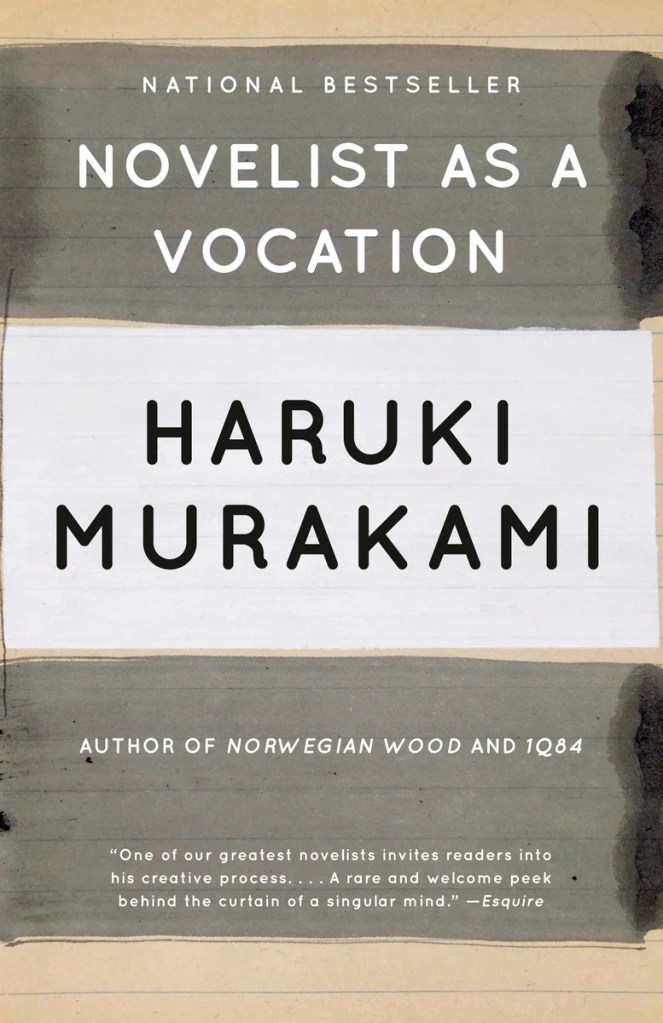
Haruki Murakami is a bestselling Japanese author whose novels have been translated into dozens of languages. He’s one of those literary writers who lives in the borderlands of literary magical realism and sci-fi/fantasy. My first introduction to his work was the monstrous tome 1Q84, which is almost 1200 pages.
Novelist as Vocation is a book about writing, but if you’re hoping for a technical manual or detailed tips on voice or pacing, this is not the book for you. The closest analogue I’ve read is Stephen King’s On Writing.
King’s book is half memoir, half writing advice. Murakami’s book also has a memoir component, but any writing advice is almost incidental. Murakami seems loathe to put himself on a pedestal with the implication that his advice might be valuable, but he does describe his writing process in some detail.
The book is split into a dozen chapters, each one standing alone and covering a different topic. Half of these chapters started life as essays Murakami wrote years ago and set aside, eventually being published as a serial feature in a Japanese literary magazine. The rest were written later to fill out the book.
For those who are fans of Murakami, the chapters “Are Novelists Broad-Minded” and “Going Abroad – A New Frontier” provide the most history of his career and insight into the man and his view of the world. For those seeking concrete advice, the chapters “So, What Should I Write About?” and “Making Time Your Ally: On Writing a Novel” give an overview of the author’s entire process leading up to, writing, and rewriting a novel.
If nothing else, Novelist as Vocation reinforces the common view of Murakami as a successful author who never quite fit into the literary establishment in Japan or internationally. He comes across as idiosyncratic and sometimes odd, having never been formally trained, and making a start at writing much later in life than many of his literary peers. Getting a glimpse of the man through these chapters, it seems almost obvious that this would be the person behind these unusual novels.
Murakami is self-deprecating and self-important in turns, on the one hand brushing off some critics’ poor reviews of his works and style, but then bringing it up so often that I can’t help but think it hurts him more than he would like to admit. He knocks his own writing as nothing special, but also repeatedly calls back to the prize he won for his first novel and his broad success since then. If nothing else, the fact that he wrote this book about his own life and writing has a certain egoism built into it.
Murakami also serves as a good reminder for any writer who is worried about not having an MFA, worried about starting later in life, or simply feeling like an outsider in the literary world: there are many definitions of and paths to success in writing, and we should not be discouraged or afraid to forge our own way.
Renni Browne and Dave King aren’t household names. They aren’t famous authors like Chuck Palahniuk, or Chuck Wendig, or any of your classic famous authorial Chucks. They’re editors. Their advice isn’t wild or shocking, and it doesn’t claim to make writing easy or save you the hard work. It’s just twelve fairly straightforward ideas that can be used to edit fiction and make it better. The result is one of my favorite books on writing.
This book has been on my shelf for years. I have the second edition from 2004, and the original was published a good decade before that. It’s not exactly timeless, but it’s about as close as you can get while including references to a broad swath of literature. I take it out every few years when I’m planning to do a lot of editing, which is why I recently re-read it.
Each chapter focuses on one thing: Show and Tell, Dialogue Mechanics, Interior Monologue, etc. The authors explain a few problems they look for when editing, then provide short examples from published books, workshops, and manuscripts. Each chapter finishes with a bulleted checklist that can be used for your own work. Finally, they provide a couple of exercises that you can try, if you want to use the book as a sort of self-guided class.
After the last chapter, there are two brief appendixes. The first contains the editors’ answers to the exercises. The second is a list of recommended books for writers, split out into craft, inspiration, and reference. Lastly, there is a solid index, so you can easily find that half-remembered advice without needless skimming.
This structure is something worth noting. So many books on writing are meandering or mix anecdotes, ideas, and advice in ways that make them difficult to use as tools. This book has a few anecdotes and asides, but it’s organized so that you don’t have to wade through any of that when you’re busy trying to find some specific thing that resonated. It’s worth reading the book from cover to cover, but it’s also designed in a way that allows it to be useful as a reference.
If there is a weakness in this book, it’s a focus on a modern, mainstream, “popular” writing style. The authors don’t talk much about the exceptions to the rules, or how to make strange and unusual fiction. This is not a guide that will help much if you’re writing House of Leaves, or Poison for Breakfast, or This is How You Lose the Time War.
I don’t think that’s a major failing. Self-Editing for Fiction Writers advocates for clean, concise, clear fiction. That’s a pretty good starting point for any writer. I suspect the authors would suggest that this is table stakes for fiction. If you want to do something more, something wild and crazy that breaks the rules, you will do it more effectively if you have a good grounding in the basics first. This book provides that.
There’s a chance you’ve come across Carter Vail if you ever find yourself scrolling through Instagram reels, YouTube shorts, or the other short video platforms on the handful of social media sites that make up the modern internet.
He recently released a concise and honest how-to video for building a creative career. It’s tailored toward musicians, but most of the points he makes can be easily translated to other artistic endeavors.
Cash in favors to make *your kind of art* ferociously
Make people care
Stay in the game
Thoughts
It’s interesting to note right away that this list assumes art is a collaborative endeavor. It’s possible to be a solo singer-songwriter, but I think most people will agree that music is among the most collaborative of the arts, perhaps only behind TV and movies in the number of people who have to come together to make something.
Writers and painters are more likely to balk at this. Many of us are used to working alone. But even in the world of fiction, there are beta readers and writing groups and agents and editors and marketing people. You might find yourself writing for other media, for comics or RPGs or video games. As you progress and do more, chances are good that you’re going to have to interact with some or all of these people. No man is an island.
“Make people care” is innocuously simple at first glance, and immediately stands out as the hardest of these steps for most of us who have tried to do it. Today more than ever, there is an infinite abundance of art out there. It’s a struggle to be seen and connect.
I see the fifth step, “stay in the game,” as an extension of this. Rare is the artist who never thinks about giving up. Making people care takes time. You never know when (or if) your work will reach the right set of eyeballs. It may be tomorrow. It may be a decade from now. Do you give up or keep going, harder than ever?
As Carter says, “Stay in the game, make art, and put it out into the world.”
Anyone who has been keeping up with the blog lately will know that 2024 is my year of short stories. I’ve been writing short fiction and submitting it to publications. As a result, I’ve been using Duotrope quite a bit.
Duotrope includes a database of publisher information and a submission tracker for authors. (It’s not the only one: Submission Grinder and Chill Subs are out there too. Duotrope is just the tracker I’ve been using.) So, I thought I’d write about a few tips and tricks that I’ve discovered that make the submission process a little easier.
1. Search by Title
The Duotrope publisher search has a lot of options, so you might be surprised (as I was), that there is no option for the actual title of a publication.
For some reason, Duotrope decided that this belonged in its own section. The “Find by Title/Name” option in the Search menu gives you the option of inputting a partial or exact name. If you don’t quite remember the name of a publication, you can also try searching by alphabetical index.
2. Find Publishers for a Piece
Once you’ve added a story to your Duotrope submission tracker, it will show up on your “List of Pieces” page under Account -> Pieces.
When the piece is ready to be sent out, you can always search for publishers by manually entering the length, genre, and other parameters. But you don’t have to.
Instead, just click the “Publishers” link next to your story on the “List of Pieces” page. This will automatically populate a search with the information you’ve entered in the piece’s description.
3. Publishing News
The Publishing News section of the site shows publishers that have been recently added. Since brand-new publications are inherently less well-known, they may represent a good opportunity to get a story in front of editors that are hungry for content, with relatively small slush piles.
Publishing News also has a section for publishers that have recently opened to submissions, which can be another good way to find fresh options, especially when those publications are only briefly open to submissions.
4. Track Themes and Deadlines
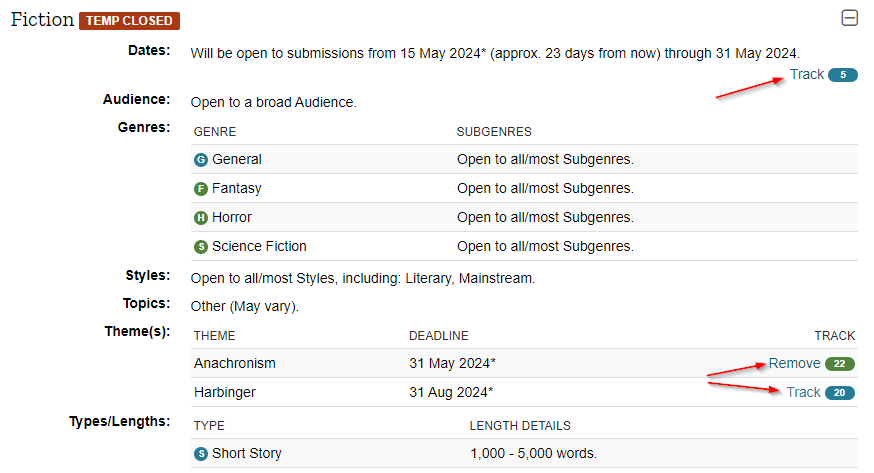
Some publications are only open for submissions during specific windows. This is especially true for themed issues or anthologies. Duotrope can track these submission windows and deadlines.
On a publisher’s detail page, general submission windows will be listed under the Dates heading, and specific themes will be listed under Theme(s). In each of these sections, there will be a Track link and a colored bubble listing the number of Duotrope users who are already tracking.
In the Account menu, you can visit “Themes and Dates” to see a convenient list of everything you’ve chosen to track.
5. Deadline Calendar
Whether or not you’re tracking any Themes or Deadlines, you can access the Theme and Deadline Calendar under the News section of the menu, or from the link at the top of the Theme tracking page.
By default, the calendar shows a list of all the themed submissions and deadlines in Duotrope, but you can filter by genre, payment, or your personal favorite publishers.
6. Overdue Responses at a Glance
Duotrope’s Submissions view shows information for all your tracked stories that are out on submission. It includes a trove of information, including some that makes it easier to decide if you need to follow up.
This view shows how many days each submission has been out, as well as the average response time reported by Duotrope users and the estimated response time provided by the publisher. But the status icon also has four different color options for pending responses.
Normally, the status is gray, but it will turn yellow if the submission has been out longer than the normal response time, and red if it exceeds the publisher’s stated response time. In some cases the publisher may state that they don’t always respond to submissions or don’t respond to status queries. In these cases, the icon will turn purple.
Of course, as with all things, you should confirm the publisher’s information on their website before blindly trusting Duotrope. It’s usually right, but occasionally there are discrepancies.
7. The Reports
Reports may sound dry and boring, but there are a few useful lists available there.
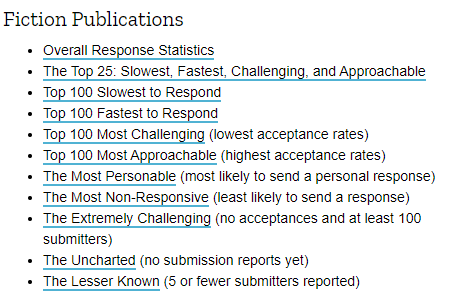
Authors who are sick of waiting for long response times can check the 100 fastest publishers to respond. Looking for feedback? Check the list of publishers most likely to send a personal response. Just trying to get a story accepted somewhere? Consider the list of publications with the highest reported acceptance rates.
What Else?
Do you use Duotrope? Are there any interesting features I missed? If you use a different tracker, I’d love to hear what they offer that Duotrope does not. Let me know in the comments.
I’m always on the lookout for good books on the craft of writing. Over the years, I’ve discovered that there are actually quite a few of them. I have at least a dozen on my bookshelf at any given time, a selection that morphs slowly, like the ship of Theseus. In fact, there are probably hundreds of good books on writing. These books have a tidbit here or there that will lodge in your head, only to pop up at an opportune moment, leading to some small improvement. Or they’ll provide some high-level idea that inspires an adjustment in your way of working.
Consider This is something else. Having just read it for the first time, I think it’s safe to say that it is one of those rare great books on writing. There is an easy way to tell if you are reading such a book. It reads like an autobiography. Writers see the world through writing, and it is only natural that we should get to know each other best through our writing philosophies. A great book on writing feels like you’ve cracked off a little piece of a writer’s soul and slipped it under your ribs. A warm little splinter next to your heart.
The subtitle of this book is, “Moments in my writing life after which everything was different.” I suspect a fair number of writers will count this book as one of those. This is not a book about how to write well. It’s a book about how to write when you are Chuck Palahniuk. And really, what other book could we possibly expect from him?
Postcards From the Tour
If you’re not familiar with Palahniuk (pronounced “paula-nick”), he is the author of Fight Club. He has written more than twenty other successful books and comics, a good amount of short fiction, and a few non-fiction pieces, but if you know him from anything it’s probably Fight Club. His writing career spans over thirty years.
Much like Stephen King’s On Writing, the book is half advice and half anecdotes from the author’s life. Unlike King, whose book is more or less neatly split into the writing parts and the biography parts, Palahniuk’s is a mish-mash.
Each chapter focuses on a particular broad topic: Textures, Establishing Your Authority, Tension, Process. Between these sections are Postcards from the Tour, vignettes from Palahniuk’s life that may or may not directly relate to what comes before and after. He wraps the thing up with a list of recommended reading, and an interesting, brief chapter called “Troubleshooting,” which is essentially a list of problems that you may run into with your work and his suggested solutions.
There are motifs that span the book, like the favorite quotes from authors Palahniuk has known, inscribed alongside tattoo art. “For a thing to endure, it must be made of either granite or words.” “Great problems, not clever solutions, make great fiction.” “Never resolve a threat until you raise a larger one.” And, of course, “Readers love that shit.”
Palahniuk makes it clear that much of the advice he’s providing is not his own. It was given to him by others. He may have taken it to heart, tweaked it, and made it personal, but it is really a collection of advice from all of the people who helped shape him. When Palahniuk makes a point he wants you to remember, he says, “If you were my student, I’d tell you…,” but this is not workshop book. It is not a syllabus to be followed. It’s a conversation between fellow writers.
If You Were My Student
Consider This is packed with small pieces of good advice; so much that it is impractical to dig into all of them here. In fact, I kept running into things that made me pause to consider how they would help me in one way or another with the stories that I’m currently working on, and made me wonder if I needed to revise some pieces I thought were done.
He tells us there are three textures for conveying information: description, instruction, and exclamation. A man walks into a bar. You walk into a bar. Ouch!
He tells us attribution tags can provide a beat within a sentence. Use quotation marks for detail and realness, paraphrase for distance and diminishment.
He tells us the Little Voice is objective and factual. It is unadorned description, the documentary camera. The Big Voice is explicit narration, journal or letter. It is opinionated. Intercutting Big Voice and Little Voice can convey the feeling of time passing.
Palahniuk also makes more than a few suggestions that made me think, “That’s all well and good for Chuck, but what about the rest of us?”
He suggests that each chapter should be a self-contained short story, to the point that it could be published independently.
He suggests a liberal mixing of first, second and third person points of view.
He says we should create a repeated “chorus” to break up the story parts, like the rules of fight club. Use lists, ritual and repetition.
I have an unsettling suspicion. The parts that feel wrong to me—the parts that seem too unique to Palahniuk—might be just as useful as the parts I found immediately helpful. I just haven’t quite grasped them yet. Maybe in five years or a decade they’ll hit me like a lightning bolt and I’ll feel the need to revise all my works in progress yet again.
Readers Love That Shit
If it’s not obvious, I think this is a book on writing that most writers should own. It’s raw and personal, often strange, and very particular to Palahniuk. That’s precisely what makes it work. It’s a collection of writing advice from many writers, all channeled through Palahniuk over a decades-long career. I took copious notes on my first read through, and I have confidence that I will find an entirely new selection of things to consider when I read through it again.
In my last post, I talked about revising my novel, Razor Mountain, and I mentioned that I was using Critters.org to get some feedback on the early chapters. I was sure that I had talked about Critters previously, in my “reference desk” series about useful tools for writers, but when I went back and looked through old posts, I was shocked to discover that there was no such post. Today, I’m going to remedy that.
Online Critique
I’ve written on a couple occasions about getting reader feedback and why it’s valuable. I think most writers will naturally understand the value of beta readers, editors, and improving writing through several drafts. Revisions without feedback are needlessly hobbled.
However, there’s more than one way to get feedback. An online critique group like Critters has some disadvantages: you won’t necessarily know everyone, and you aren’t engaging with readers face-to-face. You also don’t get to pick your readers, so the feedback may not be quite as tailored as a traditional writing group.
So why use an online critique group? Well, there are some advantages too. Online critique can be asynchronous, making it easier to avoid scheduling issues, and lower-pressure. Feedback is written out, which gives you a useful artifact that you can save and consult as needed during revisions. Since the group is less formal and doesn’t meet in the real world, people can come in and out according to their personal situations. In short, an online group like Critters is less formal than many in-person groups, which can be a good or bad thing.
Critters.org
Critters.org (and its pseudonym Critique.org) is an online writing workshop that has been around since 1995, with over 300,000 critiques in that time. The main, original workshop group is focused on speculative fiction: Science Fiction, Fantasy, and Horror. Since its inception, it has expanded to 17 different workshops covering most genres of fiction, mainstream and literary fiction, and other media such as comics, film, music, photography and more.
Critters is free to use, and always has been, surviving on goodwill donations. It is not exactly a svelte, modern, or flashy website. It still looks and functions a bit like a website from the 1990s—mostly text and links and a big top menu with dozens of pages. It is still maintained by the original founder, Andrew Burt, and a host of minion programs he has created. As a programmer, I feel right at home. For non-programmer writers, I imagine it’s a little bit off-putting.
The mechanics of critique are simple. Members can submit a manuscript via webpage or email by filling out some information and attaching their work. These pieces go into a queue, and each week a dozen or so are “released” to the group. Members then submit their critiques via webpage or email, and those critiques are forwarded to the authors.
To ensure that everyone gets good feedback, critiques must fulfill a minimum length (a paltry 200 words), and any member who wants their work sent out in the queue must submit a critique 75% of the time, or 3 out of every 4 weeks.
Cultivating Culture
A distributed group like this lives or dies by its culture. Plenty of message boards and chat rooms have fallen by the wayside because they didn’t moderate effectively, and became cesspools of hate speech and trolling. Critters has survived so long and continues to be successful because it has developed a culture of respectful and honest feedback.
When signing up for the group, new members are directed to several articles on the site about diplomatic language and effective critique. Authors are also warned that honest feedback can be hard to hear, and that some critiques are well-intentioned, but a little more blunt than you might like.
Members submitting critiques are also required to check a box stating that they have been diplomatic, which is obviously not hard for the malicious to overcome, but serves as a good reminder for those who are acting in good faith.
Of course, like any effective moderation policy, there are ways to escalate bigger issues. I’m sure there have been trolls in the past, but I suspect that Critters has the advantage of being a bit of a dusty niche of the internet, where troublemakers aren’t common and most people are putting forth some effort in order to improve their skills and their work.
My experience has been extremely positive. I have never had any outright problematic critiques, and I could count the number of overly-blunt or tone-deaf critiques on one hand. (Honestly, an occasional rough critique is probably good practice for being in this industry.)
Details
There are a few interesting little details about Critters that aren’t necessarily apparent unless you read through all the documentation up-front.
Partial Credits
Normally, an author submits a story and anyone who provides a critique of the minimum (200 word) length gets credit for participation that week, counting toward the 75% rule. However, if the story is short—under 2000 words—then any critiques will only count for half-credit. This is to encourage readers to critique longer stories, and not just focus on these quick reads. A half-credit does not count toward the 75% ratio until you’ve done two of them.
Critique Counts
It’s possible to see the current number of critiques submitted for each manuscript in the current week. These counts are updated in almost real time. Critters’ weeks run from Wednesday to Wednesday, and a lot of critiques come in over the weekend, so I like to look at the counts before I pick a story for critique. Sometimes one or two manuscripts will have very low counts, so I like to help those folks out. If someone already has 15 critiques, what are the odds that I’m going to be repeating things someone else has already pointed out?
In general, novel chapters get fewer critiques than complete stories, and longer stories get fewer critiques than shorter ones. So, you’re likely to get the most out of Critters if you write a lot of flash fiction, and considerably less if you write novels with long chapters.
RFDRs
RFDRs, or “Requests for Dedicated Readers” are submissions for novels, where the author is requesting volunteers to read the entire book and provide feedback. RFDRs often include chapters of the book, and anyone can still submit a critique for the submitted portion without signing up to read the whole book.
If a reader accepts an RFDR, they contact the author outside of Critters, typically by email, and coordinate the process. Because reading a whole novel is a big ask, completing an RFDR is worth one credit for every 5000 words of the book. So an 80,000-word novel, fully critiqued, would be worth 16 individual critiques! However, if the RFDR agreement is for the whole book, then the reader has to complete the whole thing to get credit. If they give up partway through, it’s up to the author whether they’ll still give credit for the work that was done.
My limited experience is that there are a lot of novels on Critters (about half of all submissions), and not very many people interested in RFDRs. This limits how much an author can get out of critique for a novel, since it takes a long time to send an entire novel through the queue, one or two chapters at a time, and not all readers will have read previous chapters to understand the full context.
Resets
The 75% participation ratio can be daunting, especially if you’re not used to critiquing. It’s easy to miss a couple weeks and fall behind.
I have been a member of Critters for years, but not continuously. I’ve taken months or years off, which will decimate the participation ratio. Luckily, this is a common issue. If you need to take time away, or you fall hopelessly behind, you can submit a request to have your participation ratio reset. You then only need to start submitting a critique each week to be back in good standing and have your work go out in the queue.
Giving and Receiving
Finally, I’ll reiterate something I mentioned on Twitter recently. It’s extremely useful to get feedback on a work in progress, but it’s equally valuable to critique the work of other authors. It’s practice for editing your own work with an unbiased eye. I have discovered problems in my own writing that were only apparent after I wrote critiques of other people’s stories. Sometimes it’s just easier to see an issue in someone else’s work than in your own.
Try It!
If you have a hard time getting a writing group together in the real world, or you simply prefer a less social, asynchronous, or easier-to-schedule option, Critters is a fantastic alternative. I’ve been using it for years, and there are plenty of professional and published authors who are members.
If you’re on the fence, I’d encourage you to give it a try. It’s as simple as submitting a story and doing a few critiques. You’ll likely get feedback from 5-20 people, and you can evaluate the quality for yourself.
ScriptNotes, as you might guess, is a podcast “about screenwriting, and things interesting to screenwriters.” It’s hosted by working screenwriters John August and Craig Mazin, with frequent high-profile guests like Christopher McQuarrie and Vince Gilligan.
I’ve never written a screenplay. While it might be fun to try at some point, my interests mostly lie in prose fiction. Luckily, I’ve found that most of the episodes I’ve listened to are filled with good advice and discussion that’s applicable to all sorts of fiction writing, not just movies and TV.
The podcast recently crossed the 600-episode mark in their 11th season (what do seasons even mean in podcasting?) Episodes are typically about an hour long, and vary from screenwriter interviews to listener Q&A to deep dives on specific writing topics or specific movie scripts.
As an example, recent episodes included a discussion about the dynamics of writing a story with a large cast of characters, and an analysis of the “side-quests” and “sub-quests” that make up the scene-to-scene meat of a larger character arc.
The show only keeps something like the most recent 20 episodes in their free feed. As someone who sometimes binges podcasts, I was actually a bit relieved to not feel the need to “catch up” on something new with so many episodes.
However, if you really like the free samples and are willing to pay, the entire back catalog and some bonus content is available via subscription on their website, for $5 per month or $49 per year. They also include a few minutes of bonus content at the end of each episode, for subscribers. I may decide to pick up a sub for a month or two, just to surf through some of the old episodes.
John and Craig welcome back screenwriter Mike Makowsky (Death by Lightning, Bad Education) to ask, how do you dramatize a historical event that no one's heard of? They look at the dramatic engine behind the Garfield assassination, the long journey Death by Lightning had to getting made, and the importance of finding great stories in obscure history. We investigate the peculiar habits and compulsions of our own writing practices, and see how personality typologies can help figure out what makes our characters tick. We also follow up on a certain orange book, breaking into Hollywood in your 30's, and offer our thoughts on the impending sale of Warner Bros. In our bonus segment for premium members, which TV shows had the best "coaching trees"? We marvel at the writers' rooms that launched the most successful writers today. Links: Death by Lightning on Netflix Mike Makowsky on IMDb and Instagram Episode 448 (The last time Mike was on the podcast) Which TV Show Has the Best Coaching Tree? Alan Sepinwall for The Ringer Size matters: a single representation underlies our perceptions of heaviness in the size-weight illusion New evidence for the sensorimotor mismatch theory of weight perception and the size-weight illusion Friedman Personnel Agency Destiny of the Republic by Candice Millard The Ballad of Guiteau from Assassins The Four Tendencies by Gretchen Rubin Writer's Guide to Character Traits by Linda Edelstein A Fentanyl Vaccine Is About to Get Its First Major Test by Emily Mullin for WIRED Heated Rivalry on HBO Max The Good Lord Bird Get your copy of the Scriptnotes book! Get a Scriptnotes T-shirt! Check out the Inneresting Newsletter Become a Scriptnotes Premium member, or gift a subscription (now with fewer emails!) Subscribe to Scriptnotes on YouTube Scriptnotes on Instagram John August on Bluesky and Instagram Outro by Luke Foster (send us yours!) Scriptnotes is produced by Drew Marquardt and edited by Matthew Chilelli. Email us at ask@johnaugust.com You can download the episode here. (9:00) Scriptnotes: A Book About Screenwriting and Things That Are Interesting to Screenwriters (Unabridged)
I wrote about Writing Excuses almost two years ago, as a part of my Reference Desk series. It’s still my favorite podcast about writing. I’m not a consistent podcast consumer, so I tend to let quite a few episodes build up and then burn through them. I’m currently enjoying several episodes on mystery and tension in Season 18.
If you haven’t listened before, don’t let that number of seasons intimidate you. Each episode is only 15-20 minutes and generally self-contained, so it works perfectly well to just start with the current episodes and work your way backwards.
While the show has had a rotating cast of hosts and a lot of guests over the years, they’ve announced a slight format change with the latest season. The core hosts now include several long-standing members and a couple of new-ish faces who have guested previously. The show is more diverse than ever, not only in terms of gender, race and orientation, but in the different perspectives each host brings to writing and publishing.
Writing Excuses also feels a little bit more organized now, with each host lined up to do a deep dive this season. However, it’s still very much unscripted, and still contains unexpected tangents and the occasional bad joke. It mostly feels like a group of smart people who love stories and writing, sitting around and having a chat about a particular topic each week.
The Tools of Tension
The Writing Excuses folks suggest a list of tools for building tension:
Anticipation
Juxtaposition
Unanswered Questions
Conflict
Micro-Tension
Anticipation, or suspense, is anything that lets the reader know something is coming, whether it be good, bad, or of uncertain providence. It’s Alfred Hitchcock’s bomb under the table. It’s the flash-forward at the beginning of the police procedural that lets us know what’s going to happen, but not how. It may even be built into the genre itself, like the detective’s big reveal at the end of a classic murder mystery.
Juxtaposition is anything that plays with the differences between two or more things. In movies, this might be a contrast between the style of music or voice-over and the action on the screen. In fiction, it might be the calm and collected way the high-class villain writes about the gruesome murder he has committed.
Unanswered questions can find a home in almost any kind of story, but are exemplified in the Mystery Box style of story. The reader keeps reading to find out why strange things are happening, and what will happen next. This was the type of tension that I chose as the driving force in my serial novel, Razor Mountain.
Conflict is that old classic that everyone talks about. It’s characters who want the same thing, when only one of them can have it. It’s a clash between diametrically opposed viewpoints. It’s the kung-fu fight in the martial arts movie, or the shoot-out in the western. It might just be the easiest form of tension to write, and the easiest for the reader to parse, which explains why it’s so popular.
Finally, micro-tension is any of these forms, shrunk down into a tiny little dose. It’s what pulls us through each conversation between characters, each scene, each chapter. It’s what keeps us turning the page. Contrasts are important for pacing, but micro-tension keeps the reader engaged in the lulls between the bigger payoffs.
Just a Taste
This is just a condensed example of the kind of conversations about craft that make Writing Excuses so great. If this kind of nuts-and-bolts writing advice interests you, I’d highly encourage you to check it out.
The episodes on types of tension run from 18.9 – 18.14.
Becoming a Writer is a slim volume written by Dorothea Brand in 1934, based upon her experience as a creative writing teacher. As Brande is quick to point out, this is not a book about stylistic technique or story structure. She’s happy to guide readers to other books for that (and there are far more now than there were in the 30s). This book is exactly what it purports to be: a book about how to become a writer, and not necessarily how to write well.
The intended audience seems to be college students or post-school adults who want to get into writing, but aren’t quite sure how to start. Rather than get into all the technical details, Brande suggests what they need is an understanding of how to get into a writer’s headspace, to learn how to think and work like a writer.
While some of the language feels outmoded and there are one or two references to streetcars, Brande’s book stands up well almost a century after its original publication.
Writing Practice
As a first task for a writer to tackle, Brande suggests getting used to writing daily. The prospective writer must embark on a plan of writing immediately after waking up in the morning, before doing anything else. Once this has become habit, she advocates setting specific writing times based on each day’s schedule, and varying them to get used to writing at any time of day.
As a night owl, I am already fairly miserable in the mornings, even when I do get enough sleep. I’ve tried “morning pages” with mixed success in the past. I’ve decided that this is advice I can follow on the weekends, but I’m hit-or-miss during the week.
On the other hand, I have recently tried scheduling mini writing breaks in the middle of my day. It works surprisingly well, and increases my output a small but noticeable amount.
The Mindful Author
Brande is of the opinion that most writers spend too much time discussing the conscious work that a writer has to do, and not enough on the unconscious part of the writing brain. She believes that much of what makes for great writing comes from this unconscious well of ideas, and that great writers learn to effectively use and cultivate it.
To this end, she offers a series of exercises that sound an awful lot like mindfulness and meditation to the modern ear, but must have seemed rather “out there” when the book was first published.
She encourages writers to pay attention to the world around them, observing it with as much child-like wonder as they can muster, and avoiding distractions. This observation, however, should be followed by carefully describing the exciting bits with exacting and detailed language—practice for the unconscious brain in observing, coupled with practice for the conscious brain in relating the raw experience through words.
She also believes that consuming stories while working on a story of one’s own will contaminate it with other authors’ voices. Instead, to release a writer’s inner genius, she suggests some mostly-mindless, hypnotic activity to help free the unconscious—whether that be walking, cleaning, sewing, etc. She essentially recommends cultivating a meditative state with the story as its focus.
Here There Be Writers
A short book with strong opinions, Becoming a Writer tackles the task of writing in a surprisingly wholistic way. On the other hand, it makes sweeping generalizations about artistic sensibilities in almost every word, and I can’t bring myself to believe that those kinds of generalizations ever apply to everyone. But it’s a unique take on the writing book, with ideas that kept me thinking well after I had finished it
Despite being a book of concrete ideas about how to cultivate a good writing process, it is surprisingly romantic—and even borderline mystical—about writers and their art. It treats us as dragons and unicorns, imbued with a certain amount of innate magic, but also gets detailed about the practical care and feeding of these creatures to get optimal results.
If you’re looking for a writing book that is more about getting in the writing headspace, and less about rehashing the hero’s journey for the umpteenth time or tightening up your first five pages, Brande’s book is a good choice.
If you’ve been around here for a while, you might remember my review of The Story Engine. The Story Engine is part card game, part tool for generating semi-randomized writing prompts. I’ve used it as a fun way to brainstorm ideas for short stories, and I’ve found that it works well for me. As someone who enjoys card and board games, it’s just a much more fun and tactile way to generate ideas than sitting in front of the notebook with pen in hand.
Recently, the folks behind the original Story Engine kickstarted a new product in the same vein. It’s called the Story Engine: Deck of Worlds. Deck of Worlds is another card-based brainstorming game, but this time it’s focused on settings instead of plots. It’s billed as a tool for storytellers and TTRPG game masters to easily generate interesting and deep settings.
I received my order right before the holidays, and I was able to take Deck of Worlds for a test drive.
What’s In the Box?
The base set of cards for Deck of Worlds comes in a flat box with a plastic insert, magnetic latch, and a heavy tagboard sleeve that guarantees it will stay closed. This is nearly identical to the box that the original Story Engine came in, and the build quality is good. It’s the sort of box you’d expect from a premium board game.
However, the original Story Engine had many expansion packs that added more cards, and Deck of Worlds is the same. If you add extra cards to your set, you’ll quickly fill up the small amount of extra space in the box. Luckily, the creators of the Story Engine are well aware of this problem, and they’ve created a new card box with dividers that is capable of holding all the cards, even if you’ve got every single expansion. They’re inexpensive, so I got one for my original Story Engine set as well as my Deck of Worlds.
I also received three expansion packs for Deck of Worlds. “Worlds of Chrome and Starlight” is the science fiction expansion, “Worlds of Myth and Magic” is the fantasy expansion, and “Worlds of Sand & Story” is the deserts expansion. I chose these because sci-fi and fantasy are my two favorite genres to write in, and I have a TTRPG project percolating with a strong desert component.
Much like the original product, the Deck of Worlds main box includes a slim “guidebook,” which describes the intended ways to use the Deck of Worlds—although the creators are clear that there is no wrong way to play.
The Card Types
There are six card types in the Deck of Worlds: Regions, Landmarks, Namesakes, Origins, Attributes, and Advents. According to the guidebook:
Regions establish a setting’s main terrain type and act as a hub for other cards
Landmarks add geographical sites and points of interest
Namesakes combine with Regions or Landmarks to create in-world nicknames
Origins record significant events of the area’s past
Attributes highlight present-day features of the area and its people
Advents introduce events that may change the area’s future
Regions are the only cards with a single prompt on them, and have a nice background that illustrates the geography of the setting. Landmarks have two prompts to choose between, and each one has a background illustration. The other four card types have a symbol and color to identify the card type, and four different prompts to choose from.
Building Basic Settings
The simplest way to play with Deck of Worlds is to create small settings, or “microsettings” as the guidebook calls them. These will typically be built around a single region (terrain type) and a single landmark, like a building.
For my test run, I built a few of these microsettings. First, I chose the prompts I liked best and combined the cards. Then I expanded or focused the results, writing a little blurb about each setting. I only spent a couple minutes on each of these examples.
The Grassland of Crowds
The museum’s founding piece is a huge fulgurite dug out of a sandy hill. The museum was built around this dug-out hill, and the piece is displayed, unmoved, where it was found.
The “lightning festival” grew in this area, and is held during the season of rainless storms. People display all kinds of art. One of these presentations is voted the winner of each festival and incorporated into the museum.
The Scree of Rivers
(Cyberpunk) The scree was mined for the long, winding veins of precious metals near the surface, leaving a maze of narrow, shallow canyons and piles of leavings. Rivers form when it rains. A grey market meets here periodically, protected from government scanners by the trace metals in the rock, with lots of escape routes and hidey-holes for quick getaways.
Not sure about the prophecy bit.
City of Sand and Story
The City of Rains is nestled in rocky mountains in a desert. During the wet season, the mountains funnel moisture and clouds and it rains on the city, creating a temporary river. All inhabitents capture as much water as possible, to live on and trade for the rest of the year. They plant crops along the river while it lasts.
A recent sandstorm uncovered caverns in the rock beneath the city, leading to underground ruins and vast cisterns. The discovery of so much water could upend the economy of the entire region
Complex Settings
The guidebook also includes some rules for building more complex settings out of multiple microsettings. There is really no limit to the number of smaller settings you could combine. There are optional rules, including a “meta-row” for attributes of the larger area as a whole, a “sideboard” of extra cards to give you more choices when selecting any given card type.
To test this out, I built a setting from four different microsettings, using the meta-row (on the left) and sideboard (on the right).
The Golden Plains
Once known as a wealthy region, but its reputation is fading. The area has been covered with strange dark clouds for weeks, but there is little rain.
In the North: The Red City
Home of a religious order, this city was built on a river and filled with canals. It was once a hub of commerce, but the river grew over the years and eventually overflowed its banks south of the city, disrupting the flow and creating a vast swamp.
Now, the priests of the Red City ply a darker trade: they’ve made the city into a prison for the worst criminals. The prison is the center of the old city, and is called “The Prison Without Walls.” It is surrounded by deep and fast-running canals, and is only accessible by a single, heavily-guarded bridge.
The priests have traditionally been led by a patriarchal lineage of high priests, but now a lowly priestess is gathering a following among priests and prisoners alike. She has radical ideas of rehabilitating prisoners instead of working them to death as penance for their crimes.
In the South-East: The Swamp of Ink
These thickets were once hunting grounds of the nobility, until the river overflowed and the land became swampy.
The few people who still live here are led by an excommunicated priest from the Red City. They harvest “swamp mites,” tiny, stinging crawfish that can be ground into fine black dyes. Travelers from the North recently called out the priest as an exile, and he imprisoned them, but there is unrest and talk of rebellion among the people.
In the West: The Moraine
The coast of mists is the western edge of the Golden Plains region.
The Moraine is the home of the School of Poets. It was created by a celebrated poet who was known as a cantankerous jerk. The only woman who ever loved him, muse of his thousand poems, made him promise to teach other poets his craft.
The school is rumored to be haunted. While most of its inhabitants don’t take this seriously, many students have recently complained of strange and disturbing noises coming through the stone walls.
In the Southwest: The City of Smoke
A city on the slopes of an inactive volcano, built atop the ruins of the “old city,” which was destroyed by the last eruption.
Hot springs in the city are warmed by the heart of the volcano. They supposedly have healing properties, and draw tourists who hope to have their injuries or sickness cured.
Vineyards planted in the fertile volcanic soil use a unique variety of small, golden grapes, harvested after the first frost to make sweet wine.
The dark clouds that have shrouded the region threaten the growth of the grapes and the year’s wine harvest.
Takeaways
Overall, I’m pretty happy with the Deck of Worlds so far. It has a very similar feel to the original Story Engine. The cards strike a nice balance by giving you a few options to pick from, but also limitations that force your brain to make interesting and occasionally surprising connections between seemingly unrelated things.
Like any sort of brainstorming, not every single idea will be a good one. The randomization means that sometimes you get combinations that just fall flat or fail to inspire. Some of this depends on your own creativity and willingness to explore.
Like the original Story Engine, the quality of the product is great. The new boxes are an improvement, allowing me to keep all my original and expansion cards together in a form factor that takes up less space than the original box.
I don’t necessarily like all the rules suggested by the guidebook, but it’s easy to tweak the process until it works for you. They’re just cards, and they can be arranged however you see fit. The extra rules for bigger settings are a little complicated for my tastes, but the end result in my experiment had some interesting ideas that I wouldn’t mind exploring further.
The guidebook also has more rules that I didn’t get into, for collaborative multiplayer and for combining Deck of Worlds with the original Story Engine. All of that feels like more complexity than I want when I’m brainstorming—I would much rather create smaller ideas and then mix and match myself. However, I’m sure this style of prescribed creation could work for others.
Finally, I think this could be a great tool for GMs/DMs who run custom table-top RPG campaigns. I’ve long believed that the best way to approach TTRPG worlds is the “billiards” style described by Chris Perkins, where you set up a number of interesting locations full of interesting characters, and then let the player characters bounce around between them, setting events in motion.
The Deck of Worlds is a great way to invent these little islands of content, and I think it would be pretty easy to create quick and dirty sessions with very little prep, especially if you’re using a lightweight rule set.
Where to Get It
The Deck of Worlds and its expansions are available directly from the Story Engine website. In addition to the Sci-fi, Fantasy and Desert expansions I chose, there are Horror, Coastline, and Arctic expansions. If you’re planning to use the deck for tabletop RPGs, they also have expansions for lore fragments, cultures, and adventure prompts.