Mouthwashing — Games for People Who Prefer to Read

You could say I’m not much of fan of horror. I’ve learned a lesson from music: if I think I dislike a genre, it just means I’m picky and I haven’t found the particular examples that hit just right. House of Leaves, Soma, and Alien are some examples that proved to me I can enjoy horror—it’s just a hard sell.

I’m not sure if I enjoyed Mouthwashing. I’m not sure it’s a game that’s designed to be enjoyed. I am enough of a gaming hipster to appreciate when a game tries to evoke a mood, even if it’s an unpleasant one and it doesn’t always pull it off perfectly.

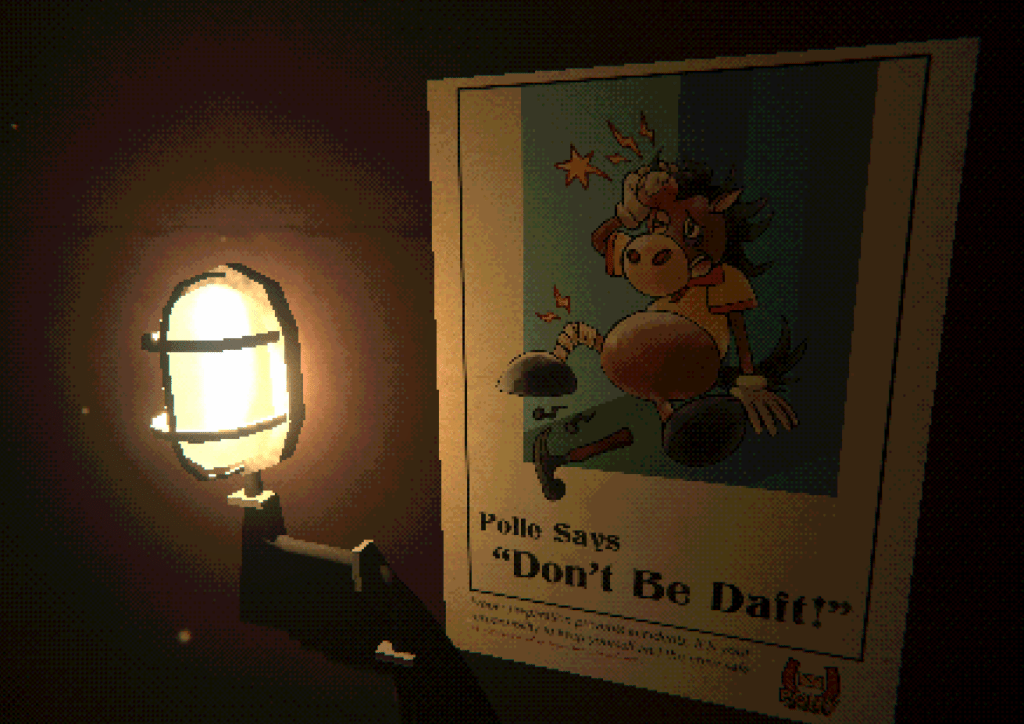
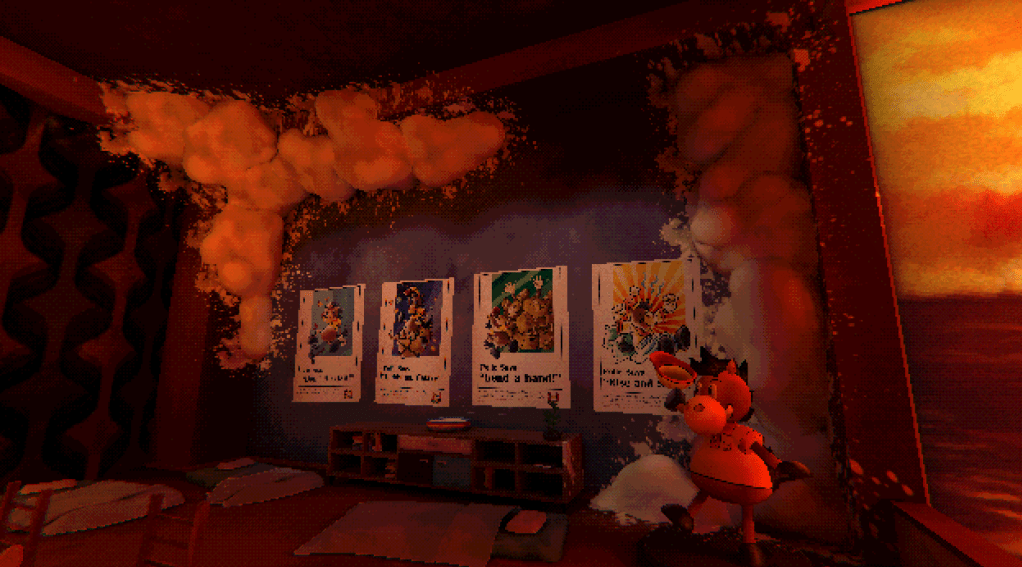
Mouthwashing is a short (3-4 hour) game about the five-person crew of the Pony Express ship Tulpar, a long-hauler transport spaceship on a year-long delivery run. We don’t see the world beyond the ship. We don’t know what it’s like out there, or how far into the future we are. The world of Mouthwashing happens in the grimy, poorly lighted corridors of the Tulpar. The visuals are purposely lo-fi; not only grimy, dark, and gory, but viewed through a crunchy, pixelated filter.

The tale is nonlinear, jumping back and forth several months around a cataclysmic incident. The ship hits an asteroid, crippling it and leaving the crew stranded with limited supplies.

In the past, we play as Curly, the captain of the ship. During the crash, Curly is severely injured, wrapped in bandages, bedridden, and in excruciating pain. A single bloodshot eye peers out from the bandages. A row of bare teeth, with no lip to cover them. In the scenes after the crash, with Curly nearly out of commission, we play as Jimmy, the co-pilot, Curly’s longtime friend and the guy who just can’t seem to get his life together. Rounding out the crew are Anya, the medic; Swansea, the mechanic; and Daisuke, the intern who was unlucky enough to board at the last minute before launch.

The gameplay mostly revolves around conversations among the crew, with occasional simple puzzles and item-fetching. There are two brief “gamier” sections where some reflex and strategy are required, but I found these to be the weakest and most frustrating portions of the game.

As the months go on and the characters become  desperate, civility breaks down. It becomes clear that there are dark secrets among the crew. The game becomes more and more surreal, reflecting Jimmy’s progressively deteriorating mental state. Flash backs to Curly slowly reveal the hidden secrets that Jimmy doesn’t want to talk about, or even acknowledge to himself.

As the crew turn on each other, the ship’s actual corridors fall away, leaving us and Jimmy in a mostly hallucinated world where we can only guess what is real and what is metaphorical. It all ends in blood and tears, as Jimmy tries and fails to hide from a series of horrible truths.

Mouthwashing echoes a classic strain of horror where a small group of people are trapped together in the face of a monster or horrific situation. Here though, despite being lost in space, the horrors are decidedly human.

Mouthwashing is made by Swedish studio Wrong Organ and is available on Steam, Nintendo Switch, PlayStation 5, and Xbox Series X/S.

Exhalation — Read Report

Buy on Bookshop.org (affiliate link)

Buy audio book at Libro.fm (affiliate link)

(As I mentioned in my May Read Report, I’m going to try breaking out these posts per-book instead of the monthly summary that I have been writing. That’ll mean more of these posts, but each one shorter and more focused.)

Chiang first appeared on my radar via the 2016 movie Arrival, which is based on his short story “Story of Your Life.” The film made an impression on me by the many things it was able to juggle simultaneously. It is a great first contact sci-fi story and an emotionally fraught personal story that are intimately connected. It’s a great example of Chuck Wendig’s principle from Damn Fine Story—the inner emotional story drives the external action. On top of that, it is told in a cleverly non-linear way that not only enhances the tension, but fits with the key themes of the plot. It remains one of my favorite sci-fi movies.

Exhalation is a collection of nine stories. Two of the longest, The Lifecycle of Software Objects and Anxiety is the Dizziness of Freedom account for about half of the total length, and the other seven are much shorter in comparison.

The Lifecycle of Software Objects begins with the invention of a rudimentary AI system that is designed to learn and grow. The main character is a former zookeeper turned software developer who is brought in to train and develop these AI companions for the company that hopes to sell them as an advanced Tomagatchi.

The AI companions are a success at first, enough that robot bodies are even produced to allow them to movie around in the real world, albeit a bit clumsily. However, the fad soon loses its momentum as consumers begin to realize that raising these AI is just as much work as raising a human child. They learn slowly, ask difficult questions, and show none of the super-human capabilities that sci-fi has long imagined from AI. The company goes under, but the protagonist and a dwindling group of die-hard believers in the project continue to raise their AI children with the understanding that it will be just as difficult as parenting a human child.

There are no shortage of stories out there about superintelligent AI taking over the world, but far fewer that suggest non-human lifeforms might need just as much raising and growing up as their human counterparts.

In Anxiety is the Dizziness of Freedom, a device called a “prism” can create a quantum event at the moment of initialization, with two possible outcomes. The result is two parallel realities that diverge at that exact moment, a clunky briefcase laptop linking them with text chat and video calls to its parallel-universe counterpart. Each briefcase has a limited amount of memory it can use to communicate between the two worlds before it is used up, making older or less-used machines more valuable and rare.

The story explores various ways people are affected by this tech. Some obsessively compare their own lives to those of their alternate-universe selves or use alternate realities to justify their decisions. Some use it as an opportunity to “work together” with their alternate selves, or talk with alternates of people who have died in their own world.

While the prism device is the conceit on which the story hinges, it’s really about the choices we make. Alternate realities may make some question the value of a given choice, when the exact opposite is chosen in other worlds. But each choice still has consequences in this one, and an associated moral weight. Is a person defined by the accumulation of their choices across one life, or across infinite parallel lives?

There is little “hard” sci-fi or far-future technology in Chiang’s stories. Stories like The Merchant and the Alchemist’s Gate, Dacey’s Patent Automatic Nanny, and Exhalation dip their toes in steampunk sensibilities, while The Lifecycle of Software Objects, What’s Expected of Us, and Anxiety is the Dizziness of Freedom posit worlds that could essentially be the one we live in today, but for one or two technological additions.

It’s also apparent from these stories that there are a few themes that Chiang keeps returning to, the bigger planets in his solar system, whose gravity is obvious across his work. Time travel and alternate universes are a recurring theme, but this may be because he is so intent on explorations of choice, free will, and whether our decisions have meaning.

As with any sci-fi, technology is at the heart of these stories, but they are not cold and robotic as sci-fi can sometimes be. Writers like Asimov are often critiqued for clockwork plots with flat characters who are merely parts in the machine. That’s certainly not a problem for Chiang. Most of his stories are character-forward, and are about human behavior and belief in the face of the changes wrought by technology. It’s easy to relate to these characters, because they face decidedly human problems in worlds much like ours, where technology drives change and sometimes creates new joys and new pains.

I often want to roll my eyes when speculative fiction authors escape the genre fiction ghetto and get themselves shelved under that haughty label of “literature.” It seems like a flimsy excuse by the gatekeepers to allow themselves to enjoy what they would otherwise be required to look down upon, due to the presence of spaceships or elves. For Chiang, I’ll make an exception. I think he deserves to be widely read, and I’d rather not see people put off by the time machines and intelligent robots.

The Read Report — May 2025

Another month has passed, and I’m here to talk about books.

There are a lot of them. Really, a shocking number of books. They keep coming out!

Despite my best efforts, I haven’t read them all. But I promise, I’m working on it. Let’s talk about the ones I finished in May.

Where possible, I include Bookshop and Libro affiliate links instead of Amazon. If any of these books pique your interest, please use those links. I’ll get a small commission, and you’ll support real book stores instead of luxury ice for billionaires’ cocktails.

Annihilation (Southern Reach – Book 1)

By Jeff VanderMeer

(Audiobook on Libro.fm)

As I mentioned last time, I’ve been getting into audio books as a way to read more. The three-books-in-one Area X collection was my second audio book purchase, and it was a fantastic choice. I’ve loved Jeff VanderMeer’s work for years, but between the Borne books and the Southern Reach series, he might just be my favorite author.

Annihilation begins with a simple premise: there is a place somewhere in the coastal US where something supernatural or alien has taken root. (The exact location never entirely clear, but it’s in the South, and VanderMeer himself lives near Tallahassee.) This place, dubbed Area X, is surrounded by an invisible barrier that vanishes any living creature that crosses it. The only entrance or exit is a gate of scintillating light.

The government has surrounded Area X with a military blockade, created a cover story of “ecological catastrophe,” and created a clandestine organization called The Southern Reach to study it, because that’s the sort of thing governments do.

We enter into this situation with The Biologist, one of four members of the 12th expedition sent into Area X. Her fellows are The Anthropologist, The Surveyor, and The Psychologist, who also serves as the expedition’s leader. They are discouraged from knowing anything about each other, even their real names.

Within Area X they encounter mysteries and monsters, and The Biologist soon has reason to believe that the Southern Reach knows more about Area X than it has told the members of the expedition.

Annihilation was shorter than I was expecting, only six hours as an audio book, but it’s packed full. Each chapter provides new revelations about the situation or unfurls new backstory about the characters in a way that kept me constantly revising my understanding of what was going on. And even so, the central mystery of “what is Area X” kept the story moving forward.

It’s interesting to see themes from VanderMeer’s other books present here. His stories are off the map. Deep in the unknown. Places that feel alien, and characters that often feel alien despite being human.

The man is obsessed with fungus as a vector for our fear of parasites, a foreign body that brings death—or transformation. Mushrooms and mushroom-people figured heavily in the Ambergris stories. He also clearly has a deep love for ecology and nature, especially coasts and tidal pools. The Biologist, with her aquatic obsessions, mirrors the protagonists of Dead Astronauts, another book by VanderMeer.

This feels like cosmic horror, but subtle. It says the world is unknown, and unknowable. Inscrutable. It reminded me of House of Leaves. You can’t trust the laws of physics, the constancy of space and time. There is a feeling of Area X holding forbidden knowledge that will destroy anyone who comes across it.

Authority (Southern Reach – Book 2)

By Jeff VanderMeer

(Audiobook on Libro.fm)

As soon as I finished Annihilation, I jumped into Authority. I was hooked.

It starts with a twist that immediately grabbed me. One of the characters in the first book wasn’t who they pretended to be. Everything I knew from the 12th expedition was turned on its head.

This time, we follow the brand new director of the Southern Reach, a man who insists on being called Control— though it quickly becomes apparent that very little is actually in his control.

He has been brought in to replace the old director and “fix” the Southern Reach. Central, a shady government agency that may or may not be the CIA, is concerned that the organization is rotten—somehow infected or sympathetic toward Area X despite the directive to contain and control. They have become too close to the problem.

Control arrives just in time for the debriefing of the survivors of the 12th expedition, despite at least some of them appearing to be dead at the end of the first book. One of these survivors is The Biologist.

Beyond the weirdness of Area X and secret government organizations vying for power, Control has to contend with all the difficulties of being the outsider brought into a dysfunctional organization he doesn’t understand, to be in charge of people who don’t trust him and quietly resist any significant change.

As is often the case with clandestine organizations, Control soon realizes that he really doesn’t know everything going on at the Southern Reach or at Central. He is being manipulated from all sides while becoming more and more obsessed with the mysteries of Area X.

Even worse, the past has been purposely muddied. There have been far more than twelve expeditions, but the numbers are reused, the members lied to. The facts are hidden from all but the highest-ranking officials. The previous director’s notes indicate that Area X is expanding, though there seems to be no outward sign of it.

Control cannot even trust himself. The Southern Reach uses hypnosis to condition and control the members of the expeditions, and it seems increasingly likely that Central uses the same conditioning on its own people. Can he be sure of what he knows? Can he be sure of who he is?

The first book ended in personal catastrophe: death and failure for the 12th expedition. The second book ends in what appears to be a global catastrophe as Area X suddenly and rapidly expands, not only extending its border, but surpassing it, spreading its seeds out into the wider world. Control flees, but like everyone who spends time at the Southern Reach, he can’t really get away, and he finds himself returning to Area X.

If Authority has a hypothesis, it’s that nobody is truly in control. You can take a name or a title, you can construct borders to protect yourself, you can perform as much rigorous, scientific categorization and classification as you’d like. It won’t stand up in the face of the unknown.

Acceptance (Southern Reach – Book 3)

By Jeff VanderMeer

(Audiobook on Libro.fm)

Annihilation and Authority mostly follow linear narratives, even if information about the past is revealed in bits and pieces throughout. Acceptance is decidedly non-linear. It intermingles three stories.

The time before the border fell over the Forgotten Coast is told by Saul Evans, lighthouse keeper and former preacher. He encounters the Séance and Science (S&S) Brigade, a weird collection of locals who investigate strange phenomena from scientific and paranormal angles, and somehow seem to be intimately involved in the eventual advent of Area X.

The time after Area X appeared is told by the director of the Southern Reach who preceded Control. She reveals the origin of the organization, some of its ties to Central, and what really happened across the many expeditions and years of investigation.

The present, then, is told by Control and The Biologist—or at least something that looks like The Biologist, but calls herself Ghost Bird. Control is drawn to Area X, repulsed by it, obsessed with it and terrified of it. Ghost Bird has a connection to Area X that she does not completely understand. They both suspect she is the only one who can stop it.

In the aftermath of the border’s expansion, the pair trek through the pristine wilderness of Area X, to the island off the coast. They meet an old friend and formulate a desperate plan to return to the buried tower that forms the heart of Area X, to stop the threat it poses to all of humanity.

The trilogy is built as something of a mystery box, with the ultimate question for readers being the cause and purpose of Area X. Is it supernatural? Alien?

I’d argue that VanderMeer is better than most at constructing this kind of mysterious narrative while still giving up big, exciting revelations along the way, but there are plenty of questions left to answer going into book three. To his credit, most of the questions are answered by the last page.

There are revelations about the origin and purpose of Area X, but they are oblique. Some readers will be satisfied with that, either constructing their own head-canon from the pieces, or accepting that there will always be a little uncertainty. On the other hand, I’ve seen plenty of folks online still looking for more clarity.

Personally, I came well-prepared, having read another VanderMeer series first — the not-quite trilogy of Borne, The Strange Bird, and Dead Astronauts. Those books are delightful explorations of language in a post-apocalyptic future, but they’re challenging and they leave a lot of questions unresolved. In comparison, the Southern Reach trilogy is practically overflowing with answers.

And luckily, there may be more. After ten years away, VanderMeer recently released a fourth Southern Reach book: Absolution. (Of course it has to start with A.)

What I’m Reading in June

When do you know you’re reading too many books at the same time? Right now, I’m halfway through an audio book that I listen to in the car. I’m also halfway through an e-book that I can read in spare minutes on my phone. And I’m halfway through a physical book that I keep next to my bed.

Next month, expect to hear about some sci-fi short stories, one of the most award-winning fantasy authors of recent times, and yet more from Jeff VanderMeer.

I’m also considering a change in format. I originally started these Read Reports as a way to combine my thoughts on a few books into a single post, but now I’m finding that it ends up being an awfully long post when I write about a month’s-worth of books.

So let me know in the comments — do you like these consolidated Read Reports, or would you rather have bite-sized posts on one book at a time?

Blue Prince — Games for People Who Prefer to Read

Previously in this series I have mostly recommended games that might be described as light on gameplay and heavy on narrative. Most of them are of the genre pejoratively titled “walking simulators.”

My goal is to recommend games that don’t require twitch reflexes or a lot of experience with  game systems, interfaces, or particular genres. There is narrative greatness in the world of video games, it just takes some looking to find.

Blue Prince

Blue Prince is a “gamier” game than I would typically recommend in this series—not because it’s frantic or overly-complex, but because it’s less narrative-forward and more mechanical at a surface level.

The story is still there, but it’s a mystery, and you have to search for answers and clues, making inferences. Because this is a mystery, the challenge of the game comes from puzzles, and these work on two levels, which I’ll call “the grid” and “the meta-puzzles.”

The Grid

The grid is the surface puzzle. You’ve inherited a mansion, and every day the rooms reconfigure themselves. The house contains a 5×9 grid, and every time you open a door, you choose from 3 semi-random rooms to occupy that space in the grid. Your goal: to get to the far end of the mansion, find a hidden 46th room, and claim your inheritance.

The grid is a game of resource-management, with a finite number of steps per day, used up with each room. There are keys to unlock doors, coins to buy things, gems to pay for more exciting rooms, and the rooms themselves offering 1-4 exits and other perks. There are also special, unique items to be found, which increase your resources or provide beneficial effects.

The grid offers plenty to keep the player busy, at first. But after a few failed attempts to get through the house, the second part of the game begins to reveal itself: the meta-game.

The Meta Game

Some rooms work in combination with each other. Some rooms have clues for puzzles in other rooms. And there are many, many rooms to discover and unlock. Eventually the player will find ways to go beyond the house and find new revelations on the grounds and beneath the foundations. The game is much larger than it first appears.

Here, Blue Prince introduces “roguelike” elements—new tools and additional resources that persist across days. Meta-puzzles can unlock new areas, but they can also reveal new information. Books in the library, newspaper clippings in the archives, letters hidden in safes and locked diaries all reveal narrow slices of a larger narrative.

I won’t spoil the story, but it involves the aristocratic family to which the player character belongs. A history of the surrounding countries—politics, warfare, and xenophobia—is revealed over the course of the game. The family must navigate these dangerous waters, and it becomes apparent that they did not always manage to pass through unscathed.

The Price of Something New

I think Blue Prince stands as something unique: a roguelike puzzle game that manages to embed an interesting story within a mechanically dense framework. However, it is not entirely without downsides.

I found that the puzzles were well-tuned while I was working toward the “end” of the game—the stated goal of finding the 46th room of the mansion. Each new day I was able to find new clues, solve a puzzle or two, and often experience a room or item or new mechanic that kept things interesting.

Entering the “final” room isn’t the end though. Not really. It’s a revelation, but most players will still have a few dangling story threads and unfinished puzzles to keep them playing after that initial victory. It doesn’t take long to discover that there is plenty more that can only be uncovered after supposedly winning.

The puzzles get harder and more obtuse. The items are all found, and it starts to become more and more rare to discover a new room or a new clue.

The game provides more resources to the player as they solve meta-puzzles, making progress in the daily grid game easier. There are a couple of mechanisms that the player can use to tweak their likelihood of finding specific rooms or items. But eventually, the repetition starts to wear thin, especially when you want to try a puzzle solution or find a specific bit of information and just can’t get the randomness of the house to cooperate. You might only feel like you’ve made progress once every few days. I found myself wishing I could do more to stack the deck in my favor.

There were also at least a couple puzzles that I couldn’t get past without a guide. I don’t begrudge a puzzle game its challenging puzzles, but I am disappointed when the clues don’t point clearly to the actual solution.

The Limits of Narrative through Setting

Blue Prince tells its story through its setting. It relies on the rooms themselves, supplemented with the letters, clippings, emails and books found within. It allows a few concessions to gameyness (nobody is surprised by the magically rearranging house in an otherwise normal world). The story has to fit within the framework of the grid game.

These limits prevent Blue Prince from creating the kind of curated narrative arc that is present in What Remains of Edith Finch or The Beginner’s Guide. That’s okay. It’s a different kind of game and a different kind of story.

Ultimately, it shows that the borders of interactive storytelling continue to expand.

The Read Report — April

It’s Spring. Here in Minnesota it may be 40 or 80 degrees on any given day. The animals have that springtime energy. The kids can sense that summer is almost in spitting distance. But there are also those notorious April showers, and some cooler days, and plenty of reasons to curl up inside with a good book. Let’s talk about some of them.

Where possible, I include Bookshop affiliate links instead of Amazon. If any of these books pique your interest, please use those links. I’ll get a tiny commission, and you’ll support real book stores instead of scalp polish for Jeff Bezos.

Audio Books and Libro.fm

I recently decided to try audio books as a way to “read” more while I’m driving, folding laundry, or performing other mundane tasks. I was excited to discover Libro.fm, an audio book alternative to Amazon’s Audible, much like Bookshop.org has become my default option for buying paper books.

While Bookshop is a B Corp and Libro is a Social Purpose Corporation, both share profits with local bookstores and seem to have a moral framework beyond simple money-making. While the moral aspects of my purchases have become increasingly important to me, I’ll also note that both of these websites (and in Libro’s case, their mobile app) are well-constructed and easy to use, and the buying experience is very good. So I don’t feel like I’m missing out or working harder for the same product.

The first audio book I purchased through Libro was Jade City, by Fonda Lee.

Jade City

By Fonda Lee

I could tell immediately that Jade City fits my fantasy sensibilities perfectly. There are no elves or dragons to be seen, no medieval castles. Yes, the story takes place in a secondary world, and yes, there is magic in that world, but it feels grounded and real. High fantasy this is not.

The story takes place in the small, Asian-inspired island nation of Kekon, and almost entirely in the capital city of Janloon. The country is in a transitional period in the decades following the Many Nations War, a world war which distracted colonial overlords long enough for native, magic-imbued freedom fighters to drive them out.

As is often the case, without a shared enemy to fight the guerrilla army fractures into feuding clans. While there is an official, somewhat clan-neutral government over Kekon, these clans have an effective monopoly on magic and exercise significant power. They operate like mafia houses with spiritual, commercial, and governmental components,  controlling and battling over territory. The fight to free the country from outsiders is still within living memory, but that memory is fading.

Although the world of Jade City is in the early stages of industrial revolution, with cars being commonplace and guns only slightly less so, the magic is decidedly wuxia, focusing on close-range martial arts fighting with knives and swords. Even then, the magic serves to move the plot as a political and social element, and only occasionally comes to the fore in tense life-or-death battles.

Magic is derived from bio-reactive jade, and this jade is only to be found in Kekon. Moreover, not everyone can use jade. It requires a genetic component, luck, and training.

However, there is a loophole. A drug has recently been invented—SN1 or “shine”—that allows those without aptitude and genetics to use jade. It threatens both the political order of Kekon and the Kekonese control of jade. Larger powers out in the world are eager to get their hands on both jade and the means to use it, and most of them are indifferent towards Kekon.

Within this complex historical and geopolitical backdrop, the story follows a single family: the Kauls, leaders of the No Peak clan. They are one of the largest clans, second only to the Mountain clan. But the longstanding equilibrium is broken as the Mountain makes moves to consolidate power inside and outside the island, no longer following the codes of honor that have long bound the actions of jaded “greenbones.”

Jade City is a family drama, as well as a political and crime drama. It’s Wuxia Godfather. It’s a fantastic first entry for a fantasy trilogy, and I’ll definitely pick up the sequels.

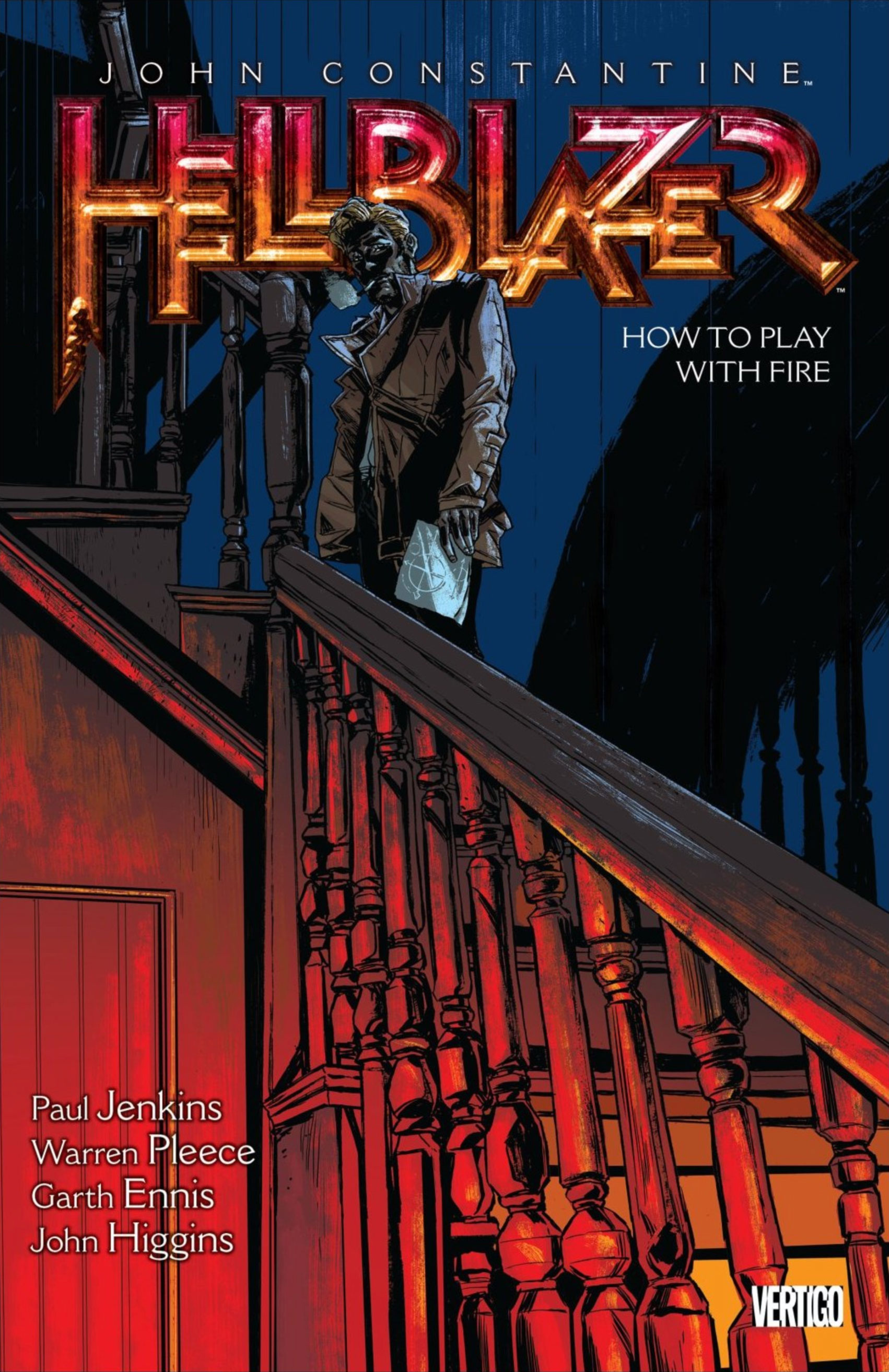
Hellblazer Vol. 12 – How to Play With Fire

By Paul Jenkins, Warren Pleece, Garth Ennis, John Higgins

There are questions you ask at the start of any Constantine story arc. Which old enemy is going to show up? Which estranged friends? What terrible thing is going to happen to this girlfriend? Does the big bad evil plan to wreck up the entire planet, or only London?

This trade paperback collects three story arcs, four issues each. In the first, Constantine is in New York to meet the latest girlfriend’s family. And for some reason, he’s up against that classic villain, Satan. But the devil isn’t raining down fire and brimstone, he’s unleashing some kind of overly-vague psychic malaise on New York, the girlfriend’s family included. Of course, John manages to save the day with the help of the girlfriend’s grandpa and a psychic he happens to know. Or at least he clears off the bad mojo from her family. Everyone else is on their own.

This arc really felt like filler to me. The actual danger is described in such vague terms, and the solution is just as unclear. I don’t need every story to conclude with a beatdown of the villain, but I do need to actually understand what’s going on, and as far as I can tell the plot of these issues seems to be that America is psychically sick, and the only cure is to share memories with boomers who know what it means to really live.

The second storyline is classic Hellblazer, with old friends turned to enemies and demonic forces desperate to get even with Constantine. As usual, everything in John’s life begins to fall apart. His buddies are estranged and his girlfriend leaves him. But all it takes to fix it is making a deal with the devil.

The final arc is the best of the bunch. John’s friend Chas gets accidentally mixed up in some gangster business and hopes that Constantine can get him out of it. Unfortunately, John has history with these gangsters too—he once did them a dangerous favor that ended in a little bit of demonic possession. This one does end in a proper showdown with a big nasty demon. So maybe that is something I need in a Hellblazer story to really enjoy it.

American Gods

By Neil Gaiman

I last read American Gods about two decades ago. It holds up pretty well, all things considered.

It is a love letter to America and especially the Midwest, a novel whose story runs across rural highways and through chintzy roadside attractions. It looks on America kindly, but also observes our weaknesses and foibles as only an outsider can.

In American Gods, there is a spiritual void in modern America, and the gods are dying. They are being forgotten, their worshipers dwindling. In their place, new concepts ascend: media, the internet, and mysterious three-letter government organizations. And yet, for some, the transition can’t happen soon enough. Among the new gods, there are those who aren’t content to let the old gods fade. They want blood.

Meanwhile, Shadow is getting out of prison. He’s served his time and he’s going home to his wife. He has a job lined up. Then, right before release, he finds out that his wife is dead, and everything falls apart. That’s when he meets an old man who calls himself Mr. Wednesday, and Shadow is pulled into the war among the gods.

The end hinges on several surprise twists, which are nicely telegraphed, but not obvious. The final chapters are satisfying without being glib or wrapping things up too cleanly.

Acknowledging Monsters

I would be remiss to write up this book without acknowledging the recent accusations against Gaiman. His stories never shied away from dark topics like sexual assault—which once seemed like a clear-eyed view of an often terrible world. Now, it comes across as something more personal and disturbing.

I won’t argue for or against the death of the author. I can understand appreciating a piece of work, even while disagreeing with or hating the author. I’ve certainly enjoyed stories by authors like Card or Heinlein while vehemently disagreeing with their politics and social views. I also can’t blame anyone who can’t (or doesn’t want to) separate the author and the story.

There are things I love in many of Gaiman’s works. I would have called myself a fan of his not so long ago. It’s unfortunate that those stories will now be tainted. They will always have that dark coda attached.

What I’m Reading in April

Hey, it turns out audiobooks are pretty cool. I can turn a lot more of my mundane task time into listening time. And what I’m listening to next is the Area X trilogy by one of my favorite literary SFF authors: Jeff VanderMeer. I’ve also got short fiction by Ted Chiang, and maybe a couple other things from the TBR pile. See you next month.

The Read Report — March

March was my recovery month. I quit slacking off and got my writing mojo back, and I also read a few books. Some are oldies from the bookshelf, and one is a new library find.

As usual, I include Bookshop affiliate links instead of Amazon. If any of these books pique your interest, please use those links. I’ll get a tiny commission, and you’ll support real book stores instead of massive political spending by billionaires.

Hyperbole and a Half

By Allie Brosh

Hyperbole and a Half lives in an interesting space between web-comic and autobiographical blog. It began on Blogger at a time when blogs and web-comics were approaching their zenith of popularity, and was rocketed to fame by panels that became widespread memes, like this:

Brosh’s MSPaint-style art depicts every person and animal as wide-eyed and crazed, with mouths that span their faces. Every expression is extreme. It is as hyperbolic as the name suggests.

She mines her childhood, relationships, pets, and a wide variety of unusual life experiences for material, crafting stories in the vein of comedians like Mike Birbiglia or David Sedaris, but with a chronically online millennial perspective.

Several stories follow her family’s adventures living with a “simple” dog, and the adoption of a “helper” dog who turns out to be just as problematic. She describes her childhood determination to steal a birthday cake that belongs to someone else. And she recounts the experience of being attacked by an angry, wild goose in her own house.

Brosh also uses the same comic-story lens to examine her experiences with depression and becoming suicidal. These heavy topics are treated with vulnerable honesty while still managing to find the humor lurking in these dark corners (or under the fridge, in this case).

Solutions and Other Problems

By Allie Brosh

Solutions and Other Problems is the long-awaited sequel to Hyperbole and a Half. Seven years have passed between books. Brosh has gone through medical issues, mental health challenges, divorce and remarrying. The book still contains plenty of her trademark goofiness, but there is a notable shift in tone and perspective.

Brosh has also clearly leveled-up her art. It somehow manages to convey the same level of absurdity and retains the lo-fi MSPaint aesthetic while being far more detailed and varied.

Where many of the stories in the first book originally appeared on the Hyperbole and a Half blog, almost all of the content of this second book is new. Which probably explains the dearth of content on the blog in recent years.

If you enjoyed the blog and the first book, the second book provides more of the same, and does almost all of it even better.

The Last Hero: A Discworld Fable

By Terry Pratchett, Illustrated by Paul Kidby

This was an unexpected library find for me. The Last Hero is a lushly illustrated novella, written for the same adult audience as Pratchett’s other Discworld books. It occupies that sparse space between comics, children’s books, and novels. In fact, the only other illustrated story like this that I can think of is The Truth is a Cave in the Black Mountains. It’s too bad that experimentation in format like this is so rare.

Drawing from the usual massive cast of Discworld characters, this story stars Rincewind (the original inept wizard from Pratchett’s earliest books), the brilliant Da Vinci-esque inventor Leonard of Quirm, Cohen the Barbarian, and a supporting cast of wizards and barbarian heroes.

The barbarians are growing old, and they want to go out with a bang. They want to return fire to the gods. A whole lot of it. Unfortunately, exploding the magical mountain where the gods live will very likely destroy the entire Discworld, so the wizards and Leonard set out to stop them.

The storyline following Cohen and the barbarians parodies the classic D&D “murder-hobo” style of heroism, and the storyline of Leonard building a craft to fly to the highest mountain on the Disc parodies classic space-dramas and the Apollo program.

The illustrations are incredibly beautiful and detailed, in the mold of the best classic fantasy covers, so the absurdity of Discworld details (like “Wizzard” stitched onto Rincewind’s pointy hat) stand out all the more.

What I’m Reading in April

I’ve come to the realization that I often talk about reading books in this section, only for them to not appear in next month’s report.

I’m not messing with you. I promise. I just have a bad habit of reading too many things at once. And now I’ve found an exciting new way to increase my number of half-finished books, through the power of audio books!

That’s right, I’m currently listening to Fonda Lee’s Jade City on Libro.fm. And I’m still in the midst of American Gods and Ted Chiang’s short stories. And some day I’ll get beyond the first chapter of the final Witcher book. If we’re really being honest, I’ll probably pick up something else before the month is out.

What will I actually finish? Tune in next month to find out.

Games for People Who Prefer to Read — Dr. Langeskov

Okay, the full, absurd name of this game is Dr. Langeskov, The Tiger, and the Terribly Cursed Emerald: A Whirlwind Heist. If you’re a reader who has never, ever played a video game, this might be the ideal first game for you to try. It’s free, it only takes about 15 minutes to complete, and it requires no reflexes or puzzle-solving skills. It’s available on Steam for those who have it, and Itch.io for those who don’t.

I don’t generally throw my lot in with the “hardcore gamers” who heap derision on so-called walking simulators, but it might be more accurate to call this a narrative experience than a game. Still, it’s a fun narrative experience.

The game promises an adventure in thievery, but even in the description on the store pages, it’s clear that something is amiss. Halfway through the description of the game, the person writing it decides to join “the strike,” complaining about being forced to do multiple jobs, and signs off with “I’m out.”

The opening menu screen also suggests an over-the-top adventure, with a moody forest scene illuminated only by the taillights of a car. You click the button to start the game. A loading screen appears for “heist.map,” cycling through several tips about the history of the mansion that you will presumably set out to rob in just a moment.

Suddenly, the music cuts out. The screen glitches, and you’re back at the title screen again. There is a voice; distant and muffled. You realize you’re hearing “back-stage,” where people are getting the game ready for you, as though it were a live stage production. Then there’s silence. Nothing is happening. You wait.

At some point, you decide to do something. Maybe click the “start game” button again? Moving the mouse causes the camera to shift, and you realize this isn’t the start menu at all. It’s a huge poster of the start menu on a wall. You’re in a drab waiting room, staring at a painted replica of the menu background.

This immediate double fake-out sets the stage for a very silly game where most of the “behind the scenes” workers running the game have gone on strike. You’re recruited to help, pulling levers and pushing buttons back-stage so some other player can enjoy the experience you thought you were going to have. The voice over the loudspeaker assures you that if you just help out a little bit more, you’ll get to play the game next. Promise.

Dr. Langeskov was developed by a small, indie studio called Crows Crows Crows, which includes William Pugh, best known for his work on The Stanley Parable and the considerably expanded version, The Stanley Parable: Ultra Deluxe.

It’s very similar to the Stanley Parable; with limited modes of interaction; a narrator that leads you along; the light, absurdist tone; and the playful ways the game gives you to rebel against the narrative by refusing to do what you’re told. It’s smaller than The Stanley Parable, but it feels like the perfect size for what it’s doing, and doesn’t overstay its welcome.

The Read Report — January and February 2025

Alright, February was a train wreck for me, so I never managed to get January’s post out. But that’s fine. We’re all here now. We’ll do it live!

Where possible, I include Bookshop affiliate links instead of Amazon. If any of these books pique your interest, please use those links. I’ll get a tiny commission, and you’ll support real book stores instead of longevity injections for billionaires.

Moving Pictures

By Terry Pratchett

I’m still working through the Discworld series with my kids. Thankfully, Pritchett was a prolific author, and if I stretch them out I can continue reading his books for several more years before I’ve read them all. It’s nice to think that a favorite author can live on in this way, through his books.

Moving Pictures is an experiment in how many movie-related references and metaphors Pratchett can cram into a fantasy world. Alchemists have invented movies, their cameras powered by the dangerous combination of little imps and highly flammable cellulose film. Within weeks, the seaside shanty-town of Holy Wood springs up on an otherwise deserted stretch of beach, and people are drawn toward it by the chance for fame, and perhaps a more nefarious force.

One of the newly minted actors who found his big break at Holy Wood happens to be a  student wizard from Anhk-Morpork’s Unseen University. He starts to see signs that there’s more than movie magic going on: in fact, there may be other realities (like our own) leaking into the Discworld from the void between universes. Where there are weak places in the fabric of the universe, there are Cthulhu-esque “Things” looking for a way in.

Much of the silliness of the book comes from twisted versions of familiar movie tropes: the Orangutan-transformed University Librarian picked up by a 50-foot woman climbing a tower in an inversion of King Kong; or the bald, golden, statuesque ancient protector against cosmic evil who just happens to look like everyone’s uncle Oscar.

Like the Simpsons, Discworld has a massive cast of characters that can be pulled into service for any given plotline. Detritus the troll and perpetual scammer “Cut-me-own-Throat” Dibbler get higher billing than usual, with the wizards of the University making a strong appearance toward the end.

Pratchett’s super-power, however, is the ability to write a silly story in a silly setting, packed with quips and jokes, and still build a real plot and characters with actual motivations that make you root for them.

Katusha: Girl Soldier of the Great Patriotic War

By Wayne Vansant

Like many of the more unusual comics I pick up, this was a Half Price Books impulse buy. There is now a whole sub-genre of historical fiction and biography within indie comics (see Maus, Palestine, and Persepolis in my previous months’ reading), and while I don’t generally gravitate toward it, I’m glad I picked up Katusha.

Firstly, this thing is a tome, clocking in at almost 600 pages. Unlike many trade paperback comics, this has a strong binding that has held up well so far, despite that size.

When I started reading, I wasn’t especially excited by the art, which has a sketchy look that sometimes skimps on detail. However, it grew on me over time, and I came to understand that Vansant was picking and choosing important panels to fully flesh out. I could call the art “workmanlike,” but that is not an insult. It is straightforward, and there is never any confusion about what is happening. It is impactful at all the right moments, and really fits the documentarian feel of the story. I can hardly blame Vansant for lack of detail here or there. The fact that one person was able to write and illustrate this entire book is a small miracle.

The story follows the titular girl soldier from the early war, before the German expansion east into Russia, all the way through the messy German retreat to Berlin.

The first few chapters provide a day in the life before the war, introducing Katusha’s mother and father, her adopted sister, her best friend, and her mysterious troublemaker of an uncle.

Katusha and her family are Ukrainian, and their life under Soviet rule is already sometimes fraught. When the Germans invade, making promises to civilians of a better life under their rule, rural Ukranians have to wonder whether the occupation might improve their lives.

Unfortunately, those promises soon prove hollow, as the family witnesses brutal suppression and an immediate round-up of Ukrainian Jews and others the Germans consider undesirable. Katusha and her family are forced to flee their home town to stay with relatives, and then flee again and again. The family is separated, and Katusha and her sister become partisans under the leadership of their uncle, creating a rebel base in a well-hidden cave.

After a winter of successful operations against the Germans, the sisters are briefly reunited with their father, a tank factory supervisor, who helps them enroll in the Soviet tank school. They spend the remainder of the war manning, and eventually commanding their own tanks.

For a book that is concerned with brutal war, there is no excessive gore. When there is violence, it isn’t skimmed over, and it feels honest. Over the course of the war, Katusha loses many family members and friends. It is a sad coming-of-age story that must mirror what millions of teenagers went through in many countries over the course of the war.

Vansent is careful to show the complexity of wartime politics, with multiple factions of Ukrainian partisans. Some fight with the Soviets, while others fight with the Germans, and some fight against both in a bid for independence. Even after the Germans retreat, the fighting continues in what eventually proves to be a vain hope for Ukrainian independence. It is a particularly timely reminder that the Ukrainian people have spent so much of their history fighting for the right to choose their own destinies.

Katusha ultimately survives beyond the end of the war, but like any good war story it is a melancholy victory. She marries a fellow soldier who nearly died of his injuries. Most of her family is gone. And despite the best efforts of the partisans, Ukraine returns to the grip of the USSR. It’s a long and bittersweet journey.

Severance: The Lexington Letter

(Unattributed)

Like the rest of America, I’ve been watching Severance. The Lexington Letter is a little in-universe book (exclusive to Apple Books, of course) that includes a series of emails and a pamphlet titled “The Macrodata Refiner’s Handbook.”

The emails chronicle the brief story of a severed worker who finds clues that her “innie”—the separated personality that only activates at work—has found evidence of bad things happening at her employer, Lumon. After trying in various ways to sneak information out of the company, the woman quits and contacts a reporter at the Topeka Star with her information. The story, however, is ultimately suppressed. The editor killing the story has a name that will lead observant fans to realize he is likely in the company’s pocket, and the woman turns up dead soon thereafter.

The handbook in the second part features a cartoonized severance brain chip as a mascot that guides new workers through the mysterious job featured in the show: macrodata refinement. It is full of the tone-deaf and slightly sinister corporate propaganda-speak that the show is known for, and filled with a plethora of little details that seem like they might be clues, but probably don’t mean anything. In short, perfect fodder for the mega-fan conspiracy theorists.

Typical r/SeveranceAppleTVPlus Redditor

The entire book can be easily read in a sitting or two, and serves to add a little more content to the Severance universe, without really revealing anything new or exciting. It is definitely focused on existing fans, and newcomers to the series will likely not find much for them here. However, if you’re a hardcore fan of the show and desperately counting down the days until the next episode release, this might just tide you over for an evening.

I’ll also note that I hate it when big media tie-ins do this thing where they don’t credit the author(s) of the tie-in material. Yes, the book is effectively a stealth advertisement for the show, but there was clearly some effort put into the writing and illustration. Those people deserve credit.

What I’m Reading in March

I’m currently working my way through American Gods, a book that I loved when I first read it, years ago. It’s by Neil Gaiman, award-winning author and person recently outed as being somewhere on the spectrum between avid sex pest and serial abuser. Never have heroes, kids. You’ll be disappointed.

I’m also working through some excellent Ted Chiang stories, something I’ve wanted to do ever since I fell in love with the movie Arrival, based on his Story of Your Life. See you next month!

The Read Report — December 2024

The final month of 2024 has come and gone. As usual, I’m reading too many books at once. As a result, I have only one to discuss for December. Luckily I have a lot to say.

Where possible, I include Bookshop affiliate links instead of Amazon. If any of these books pique your interest, please use those links. I’ll get a tiny commission, and you’ll support real book stores instead of longevity injections for billionaires.

The Amber Spyglass

By Philip Pullman

I finally finished reading the “His Dark Materials” trilogy with my kids. Unfortunately, the cracks in the story that were apparent in the second book caused the whole thing to fall apart in the third.

Trilogies and longer series are interesting. They are weightier than a single, self-contained book. Each book in a series needs to function at least partly on its own, while a larger arc plays out across all of them. However, readers are also willing to give the author some grace in a series; just because something is unresolved or unclear in one book doesn’t mean it won’t resolve by the end of the series. I continued reading to give Pullman a chance to make it all work.

Unfortunately, when the mysteries, confusing bits, and strange motivations don’t resolve by the end, you run into the “LOST” phenomenon (or Game of Thrones, if you prefer a more recent reference). Rabid fans can instantly sour on it due to an unsatisfying ending. All of that willingness to forgive goes away when the series ends and the problems remain. And that’s how I feel about His Dark Materials.

I usually try to avoid talking negatively about stories, books, and other media. After all, I haven’t published a successful trilogy, right? There are certainly things to criticize in my own work. That said, I think this trilogy is a showcase for a number of things that every author should try to avoid. So I will be a bit harsh on His Dark Materials, in order to better understand why it doesn’t work for me.

The Hook

Critically, I think the first book, The Golden Compass, is pretty good. In fact, I would recommend it as a book to read on its own. For what it’s worth, my kids also thought that the first book was good, while the second and third were “confusing.”

The Golden Compass introduces a main character, Lyra; the antagonist, Mrs. Coulter; the mysterious Lord Asriel (Villain? Ally?), and quite a few interesting, but less rounded characters that help Lyra on her way. Lyra has a clear quest—to rescue her friend from Mrs. Coulter—and understandable motivations. She has clear character traits, being clever and almost reflexively anti-authority, and happily willing to lie when it serves her or just seems like a good time. The setting is an alternate history Britain with a dash of steampunk sensibility, where everyone has their own soul-bound animal companion. It manages to feel both fresh and familiar.

Lyra sets out on her quest, collects allies, learns about the world, and makes a number of choices (both good and bad) in her efforts to rescue her friend. It’s a well-worn story arc, but that’s because it works.

The book is not without its weaknesses, as Lyra overcomes most challenges a little too easily and practically every secondary character she encounters quickly vows to help her even at the cost of life and limb.

The story ultimately ends in tragedy, as Lyra goes to the ends of the earth only to fail at the last moment. This also resolves that open question of whether Asriel is villain or good guy. The result is a satisfying resolution to this book—the end of Lyra’s quest—while providing an open question that leads us into the next two books: just what is Asriel up to?

Book Two Problems

The second book, The Subtle Knife, immediately steps away from the setting of the first book, and introduces a new main character: Will Parry. Lyra soon follows, but her agency in this book is so diminished that she’s practically a secondary character. It’s jarring. Even more problematic is that neither Will nor Lyra have very clear motivations or goals.

The children certainly both have problems, but neither of them have plans to try and resolve them. They go from place to place, exploring a brand new world and facing its dangers, but this meandering doesn’t have the sense of going anywhere purposeful. They acquire the namesake of the book, the Subtle Knife, completely by accident.

Mrs. Coulter is back as the villain. New characters are introduced, both allies and enemies, but this also seems haphazard. Characters from the first book reappear, but they feel as though they are pushed into their necessary positions by deus ex machina, strictly to perform actions and say words that advance the plot.

This book ups the stakes by killing off two characters, but the emotional sting is blunted by how absurd these deaths are. One character dies at the hands of someone barely seen, for a silly reason mentioned once in passing. The other dies nobly, to protect Lyra, but only because he completely forgot that he had a “get out of jail free” card that was inconvenient to the plot.

The book ends in what ought to be a cliffhanger. Lyra has been captured by villainous forces, and separated from this book’s protagonist, Will. Will has just lost the father he wasn’t even sure was alive, and decides (like most everyone else in the series) that he must help and protect Lyra.

Then, suddenly, some angels appear.

A Limp Ending

This is how we arrive at the third book, The Amber Spyglass. It’s nearly as long as the first two books combined, and it has a lot of explaining to do.

This book contains most of the anti-religious sentiment and outright blasphemy that has made Pullman so hated by Christian groups, and it’s unfortunate that his vitriol ends up channeled into decidedly bland villains with no redeeming characteristics and no desires beyond total power. Heaven is ruled by a powerful angel with a lust for control, and he sends the armies of angels and human believers across many different worlds to do his bidding, which mostly involves killing everyone who doesn’t fall in line.

This leaves us with three villains. The book implies a change of heart for Mrs. Coulter and Azriel, but they’ve done nothing to earn it. In the most perplexing twist of them all, these three supposedly mismatched villains end up in a brawl and fall into an abyss together. It’s not even the climax of the story—the book continues for more than a hundred pages afterward. The supposed protagonists, Will and Lyra, aren’t present for the fight, and have nothing to do with it.

Since the story can’t wrap up with a final battle between good and evil, or the characters overcoming some major challenge, it instead ends with heartbreak. It turns out our protagonists are in love, but they can’t be together. Pullman does a pretty good job dropping hints about Will and Lyra’s feelings for one another, even if it’s not very subtle. But the reasons why they can’t be together feel flimsy, at best. Pullman must have thought so too, because he spends a significant number of pages on the characters coming up with all the reasons why they have to end up apart.

Maybe I’m a jaded old guy, but this conclusion of love lost didn’t tug very hard at my heartstrings. How tragic can it really be for someone to not end up with their middle-school sweetheart? It’s implied that they’ll pine away for the rest of their lives…but…why? How many of us end up with our first crush?

Lessons Learned

Know your protagonist, and set your readers’ expectations accordingly. This series sets up Lyra as the protagonist, but by the end she’s little more than a bystander. Will takes over the mantle, but even he fails to have much influence on the events of the story. Readers expect the main characters to make a difference. The arc of the story is their arc.

Plot with purpose. It doesn’t matter whether you’re an outliner or an exploratory writer, either can work. But every scene and chapter should be there for a reason. Each character should have motivations and goals. Ideally these all work together to bring the story toward a conclusion that feels inevitable without feeling forced.

Stay focused. Novels are huge projects, and trilogies are even bigger. It’s easy to go down cul-de-sacs by exploring interesting ideas or building characters that aren’t really necessary. The fantastic idea that doesn’t fit in the book is just as important to cut as a bad idea. As they say, kill your darlings (or at least save them for another story, where they belong).

What I’m Reading in January

I’m working through the massive historical epic comic, Katusha; the final Witcher book; and some sci-fi short stories. See you next month!

The Read Report — November 2024

Where did November go? I got distracted for a minute, and the whole month was over.

Despite my best intentions, the month was light on both writing and reading. Still, I managed to sneak a few things in. I’m still working on the final volume of the main Witcher series, and still working through the last of the Dark Materials books with my kids. With some vacation time on the horizon, I have high hopes that those will be in the December report.

But, back to November…

Where possible, I’ve included Bookshop affiliate links instead of Amazon. If any of these books pique your interest, please use those links. I’ll get a small commission, and you’ll support real book stores instead of cocktails of longevity drugs for billionaires.

The Umbrella Academy — Vol. 1, 2, and 3

By Gerard Way, Illustrated by Gabriel Bá

My first experience of the Umbrella Academy was being in the room while my wife watched the Netflix show. While I have arguably “seen” most of that series, my attention was not necessarily focused.

The impression I got from the show was that it was a near miss for me: lots of individual elements that I loved, but it somehow didn’t quite gel together to make something that really excited me.

So, either in spite of, or because of that, I had fairly high hopes for the comics. After all, most comic adaptations either crash and burn (cough, cough…League of Extraordinary Gentlemen, cough) or have trouble capturing the magic of their source material. However, as a power-nerd, I tend to come to those adaptations already familiar with the comics. In this case, I was starting with the show and going backward. As much as I try to remain unbiased, there’s a common tendency to appreciate the format where you first discovered the story.

My first impressions, in volume one, is that this is a setting that’s a bit whacky, without leaning especially hard into comedy. I mean, it practically starts with a cybernetic Gustav Eiffel attempting to launch the Eiffel Tower as a rocket into space.

This is very much a superhero comics world. Superhero comics are the background radiation, even if it’s not obsessed with muscle-bound men and women in incredibly resilient spandex. It’s a world where insane happenings are just a normal part of life.

These books follow the titular Umbrella Academy, seven super-powered children adopted by a cold and uncaring father and trained to save the world. Much like Disney channel actors, this thoroughly messes them up. Unlike Disney channel actors, only one in seven becomes a drug addict.

Volume one felt like a rushed introduction. Not only does it need to establish this world, but the seven super-powered children, their adoptive father, their robot mother, the chimp butler, and a handful of other miscellaneous characters. It’s a lot for six issues.

There’s a story here about the one estranged sibling turning villain against the others, but it’s so lost in the tumult. I never felt like the story had time to understand why she was angry, or so quick to “go bad.” Each character is touched on, but there’s not enough time to dig into any of them in depth. Ironically, the TV series gave me extra context that helped me understand the books. I suspect I would have had a tougher time without that.

Volume two feels like the real, proper beginning. The characters have been introduced, and we’re at least familiar with the surface-level. While this second series focuses on one particular member of the squad, we get more interaction and more background on pretty much all of the characters. We also get two completely deranged villains. I have to appreciate this, since absolute crazy people with incomprehensible motives are difficult characters to make work, and they work pretty well in this particular setting. And there are time travel shenanigans, which always makes me happy.

I think the second volume is the strongest story arc of the three. There’s a clear instigation, as the time-travel police come after a member of the Umbrella Academy, there’s a clear resolution by the end, and the story is neatly structured to build up the characters along the way.

The third volume is the longest of the three, boasting seven issues instead of six. It’s also the most ambitious in expanding the world and characters of the Umbrella Academy universe. Unfortunately, I can’t help but feel that it’s an interstitial story, setting up a Volume Four that has yet to release five years later. (Supposedly it’s in development.)

I have pretty mixed feelings about the series overall. It’s definitely unique among the series I’ve read, and I like to think I’ve covered a decent breadth of indie comics. But it has that same “not quite hitting it” feeling that I got from the TV show. Still, if Volume Four ever comes out, I’ll definitely buy it, so that says something.

Interestingly, and somewhat surprisingly in the era of Marvel ascendent, the Netflix show excised almost all of the superhero background radiation, and still made it work pretty well. For a show where the leader of the time-travel police is a robot body with a goldfish bowl for a head, it’s surprisingly grounded. If nothing else, it’s a great case study in making a comics-based show appeal to a non-comics audience. As much as such a thing even exists these days.

EVE Online “Chronicles”

I’m not generally interested in tie-in fiction. I’ve been burned too many times before.

When I was young, I read some of the early Star Wars tie-ins. I remember the novelizations of the original trilogy being pretty good. And then there was the Heir to the Empire trilogy, which was so successful as to spawn the entire Star Wars Expanded Universe. Of course, it was written by Timothy Zahn, who turned out to be decent apart from Star Wars. (I really enjoyed his Conqueror’s trilogy as a teen. Having not read it since, I assume it must still hold up…)

The Myst games were among the first games I played that felt like they had a real story (as little as you could glean from them) and I devoured the trilogy of books that expanded that universe. For my money, the first two Myst games and those three books are still probably the best example of games and books that tell a great story together.

My first real disappointment with tie-in fiction came several years later. I had discovered the relatively young and expanding world of ARGs, and found an archive of a Halo ARG now commonly known as ilovebees. It was a strange and seemingly futuristic way to deliver a story, and came in the form of a sort of radio-play pieced together from 30-second clips by a group of people discovering it as it went along.

I decided to delve into the Halo books, and quickly discovered that they were pretty much unreadable, even for a teen with possibly questionable taste.

Since then, I have steered clear of tie-in fiction. I may have dabbled here and there with some D&D-adjacent stories, but I’ve mostly turned up my nose at those shelves in the bookstore packed with D&D, Star Wars, Star Trek and myriad examples of trying to make a novel out of a hundred lines of in-game dialogue.

And now we come to the present day, where I am an old man having just turned forty, and I have begun dabbling in EVE Online.

How could this have happened? Well, there honestly aren’t that many games with spaceships. I’ve bounced off this one twice before, and for some reason, this time it stuck. I just couldn’t escape the gravity of a game that seems to be populated mostly by middle-aged dads with a high propensity for programming.

EVE is one of those incredibly rare MMOs that isn’t World of Warcraft, and yet keeps puttering along, staying alive for over twenty years. Throughout all that time, they’ve been releasing fiction in this world.

Don’t get me wrong, I haven’t read any of their books yet. There are a few of them, but I’m not that far gone. Instead, I’ve been perusing the “Chronicles,” which encompass a bunch of dry descriptive reads about particular factions or technologies, and a slightly shocking number of short stories.

It’s now been a couple of years since I’ve participated in a long-running TTRPG group, and I find that this really scratches that itch. It’s the same satisfying combination of playing in a world, and then really digging into the setting. The only difference is that this one is online. (Well, okay, I guess my last D&D group met online too, thanks to the pandemic.)

What I’m Reading in December

Yes, I’m still reading the last Witcher book. Yes, I’m a little worried that the whole story is going to fall apart in the final volume. I’ll also be trying to wrap up the Dark Materials series, and I’ve still got a few more comics trade paperbacks waiting in the wings.

See you next month!