Three Things I Learned from Glass Onion

Glass Onion: A Knives Out Mystery is the second movie in this loosely-connected series, written and directed by Rian Johnson. Although they share the character of Benoit Blanc, the world-famous detective, Glass Onion’s story is completely independent.

Glass Onion follows a group of colorful characters who are invited by their tech billionaire friend to a vacation on his private island. He hosts a murder mystery party where people start dying for real.

Good Parody Has to be Good First

Glass Onion is a parody of the classic murder mystery in many ways. It features tropes like a world-famous detective, a murder mystery party that turns to real murder, a secret twin, a shooting by a gloved hand from just off-screen, and a bullet stopped by an item in a breast pocket.

It also features silliness like a voice shouting “dong” across the island instead of a proper bell, an unexplained dudebro who intrudes in random scenes, Jeremy Renner’s homemade hot sauce, and a rich-guy exercise app that features famous sports figures “on the clock” in a constant live stream, waiting for the rich guy to exercise.

However, all of the tropes and silliness are layered into a well-executed mystery, with a cast of interesting and potentially murderous characters, whose motives and backgrounds come out in a series of reveals that each change our perception of the story.

The titular glass onion is the top room of the billionaire mansion, but also the structure of the story, called out within the dialogue as a metaphor for a mystery where all the layered complications are distractions, and the real answer was obvious all along.

In short, a really good parody must understand exactly what it is parodying. It has to be a good example of the conventional in order to call out the absurd aspects of a genre.

Genre is 50% Superficial

Many of the parts of Glass Onion that feel most like a classic mystery are simple visuals: the entrance and pose of the femme fatale when she first appears, or the sweep of the island’s lighthouse light through the mansion windows after the power goes out.

These things aren’t vital to the story, but they’re visually stunning and they do a tremendous amount of work to set the mood. This is an important lesson for genre writers, many of whom tend to favor plot or characterization over authorial voice and lyricism. It’s good to remember that stylized writing can pull the reader into the story just as effectively as brilliant world-building or dialogue. Ideally, we provide a healthy mix of both.

Bring the Audience Into the Story

The movie came out in 2022, with a brief theatrical release followed by Netflix. It is set in the height of the pandemic, and as it introduces the characters, it also smartly roots the world in its time and place.

We meet the politician taking TV news interviews from her living room, the scientist on a Zoom call at work, the self-centered fashionista hosting a huge unmasked house party, and the “manoshpere” influencer streaming from the house where he lives with his girlfriend and mom. The famous detective, Benoit Blanc, is in the tub, slowly losing his mind out of boredom and losing a game of Among Us with a bunch of celebrities. The bathroom is full of liquor bottles and piles of books.

The cast spends a bit of time solving their puzzle-box invitations to the murder mystery island vacation, revealing little tidbits of who they are before we jump to the luxury yacht trip from the Greek mainland to the island where the remainder of the movie will take place. The characters are given a mysterious concoction that is implied (but not outright stated) to protect them from Covid, and this is the last we see of the masks and social distancing.

What’s interesting about this first half of the first act is that it chooses to start in the midst of the pandemic, even though it has little bearing on the remainder of the movie. It could have done what many movies did, and simply ignored the plague times altogether. Instead, we start in a very relatable (maybe too relatable) time and place, and the movie brings us along into its fantastic world of ultra-wealth and murder.

Easing the audience gently into an unfamiliar world is common in fantasy and science fiction, where the world of the story is often very different from the world we live in. However, Johnson shows that it can be equally effective in a modern mystery story that takes place in a world very similar to ours.

A Mystery Worth Emulating

I really enjoyed Glass Onion. It’s the kind of movie that rewards re-watching, not just to notice all the clever clues hidden throughout, but to study the intricate layering of structural elements. Rian Johnson is frankly showing off. If you’re looking for a great study in constructing a mystery, this is a modern masterpiece of a classic genre.

The Read Report — May 2023

Good God, I read a lot of books in May. You can find out more about why in another post.

I don’t have the desire or time to write full-on blog posts for every book I read, but I’ve come to appreciate how blogging gives me an opportunity to reflect a little bit more explicitly on what I got out of a book. So, I’m going to start writing these monthly posts to talk about what I’m reading.

If you’re interested in any of these books, please use the included Bookshop.org links instead of Amazon. It helps independent bookstores, and I get a small affiliate commission.

Ways of Being: Animals, Plants, Machines: The Search for a Planetary Intelligence

By James Bridle

This triply-titled book is the kind of non-fiction that is perfect for fiction writers. It’s full of interesting ideas that could spark a story. Bridle is a little bit “out there,” but this exploration of intelligence comes at an old topic from an interesting perspective.

The book postulates that we should consider a lot more under the umbrella of intelligence than we typically do. The human definition of intelligence always seems to be “things that humans do,” and Bridle argues that this definition dramatically limits our understanding of the universe.

As you might guess from the title, Bridle argues that various animals, plants and machines all have their own varied forms of intelligence, often radically different from our own. He provides some interesting examples to back up his opinions, although some of the leaps of logic toward the end of the book didn’t quite land for me.

The Way of Zen

By Alan Watts

This is an introduction to the basics of Zen Buddhism, along with some history and context.

Alan Watts was an odd duck. A British-born writer and speaker who gained popularity after moving to California in the 1950s, he was a priest before becoming enamored with Asian religions and philosophy, and he found a receptive audience in the hippie movement.

I don’t really know if Watts is much appreciated in more mainstream or traditional Zen circles, but he has an entertaining style and a knack for explaining abstract concepts through metaphors and parables aimed at a western audience. His many recorded philosophical lectures have found new life on the internet in the YouTube era.

Becoming a Writer

By Dorothea Brande

I wrote a whole post about this one.

The Black Tides of Heaven / The Red Threads of Fortune

By Neon Yang

A fun pair of fantasy novellas set in an Asian-inspired secondary world. Despite a pair of royal twins and a magic system based around elements, these books feel original and fresh. Quick reads full of action and adventure.

What I really appreciated about these books was that all of the magical fantasy action was driven by relatable and varied interpersonal conflicts: disagreements between parents and children, irritation with in-laws, and the loss of loved-ones.

The first book also successfully tricked me into believing that it would end with a big fight, then switched it up at the last second and gave me a more cerebral conclusion.

Animal Farm

By George Orwell

Originally published in 1945, Animal Farm is a skinny little book that Orwell sometimes described as a fairy story. It’s a modern (for its day) fable about a group of animals that take over the farm, only to have their noble rebellion slowly subverted back into tyranny.

I’ll be the first to say that allegorical novels aren’t exactly the sort of thing I’m very excited to read, and I probably wouldn’t have read this if it wasn’t considered such a classic. However, it’s a very quick read, and entertaining enough that I didn’t regret it.

In many ways, this book feels like an early prototype of Orwell’s 1984, which was published only four years later. Many of the same ideas appear in that book, but in less simple, satirical forms.

The Wes Anderson Collection / The Grand Budapest Hotel

By Matt Zoller Seitz

These are big “coffee table” books with some great illustrations and images from the movies.

The original book spent a good amount of time on each of Anderson’s first seven movies. While I’m not much of a movie critic, I do have an appreciation for experts talking about the things they love. This was an interesting look into that world. While a lot of it is specific to filmmaking, there are some useful tidbits about building good stories in general.

The second book is a bit thinner, but focused entirely on a single film. For my money, Grand Budapest is Anderson’s best work, but this still felt like more of a deep dive than I needed on the one movie, especially when contrasting it with the first book.

While they may make more of these books as the director continues to make movies, I think these two were enough to satisfy me, and I’ll get off the ride at this stop.

Flash Futures

(Anthology, edited by Eric Fomley)

This was one of my backer rewards from a Kickstarter for The Martian magazine. It’s an anthology of sci-fi flash fiction, generally on the darker side. I have to admit, while there were some enjoyable stories here, I prefer the drabbles on the site.

I think flash fiction is one of the hardest formats to write. I enjoy drabbles and micro-fiction because it’s hard to even tell a coherent story at that length. Pulling it off is a bit of a magic trick. At the 500 or 1000 words of a flash piece, you still can’t tell very much story, but you also don’t have the incredible tightness of a drabble, where you’re fighting to fit every single word and forced to cut words in clever ways.

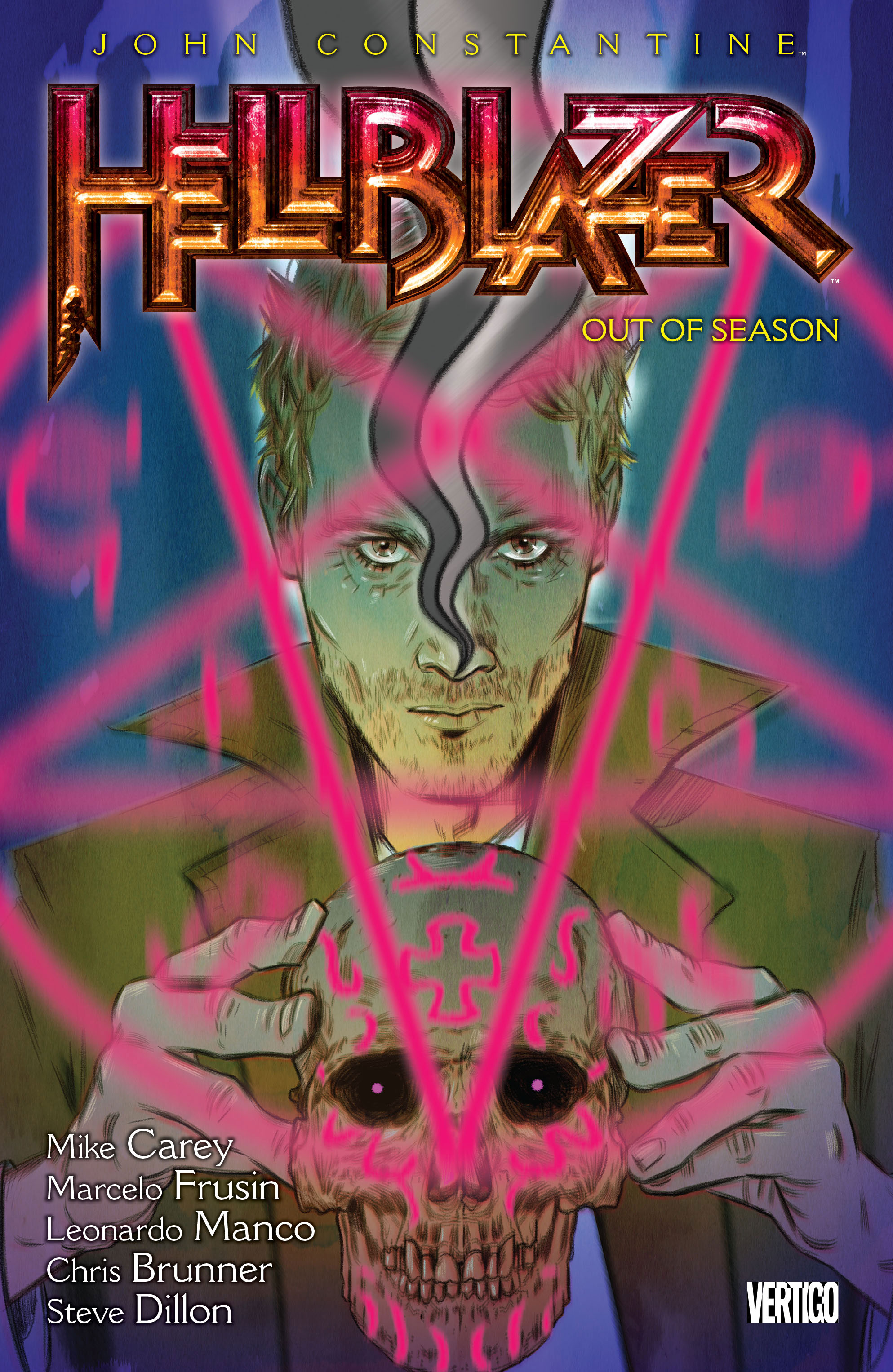
Hellblazer: Out of Season (Volume 17)

Written by Mike Carey

Art by Chris Brunner, Leonardo Manco, Marcelo Frusin, Steve Dillon

This was a random pick from the library.

I love Constantine as a character, and his whole milieu, but how many times can there be a worldwide supernatural apocalypse event? It seems like it happens every year or so in these books. I really prefer the smaller, more intimate story arcs that focus on just how miserable it is to be in Constantine’s social circle.

I will say, this is a pretty great connecting arc. The twist at the end is interesting, and it creates new characters and problems. It’s a great example of finishing a chunk of episodic story by building a lot of new scaffolding that future stories can be built upon. That’s not always an easy thing to achieve. Good lessons for anyone who wants to write a series.

The Sandman: Overture

Written by Neil Gaiman

Illustrated by J.H. Williams and Dave Stewart

Not my first time reading this, and it won’t be my last. If you love comics and you haven’t read this book, you are missing out.

It is, by far, the most beautiful Sandman book, and that is a high bar. There are no straight-edged standard panels here. It’s a master-class in all the different ways a comics page can be composed. While the original Sandman was often very dark and brooding, Overture contrasts its serious blacks with all sorts of psychedelic color.

I’ve read some complaints about the story not being as good as the originals. And that might be true, but I also don’t think it’s too far off the original series. Neil Gaiman does his usual Neil Gaiman things, crafting stories that feel simultaneously new and old, familiar and strange, playing around in one of the worlds where he is most comfortable.

Although this is a prequel, I think it definitely ought to be read after the original run. Narratively, the story comes before the other books, but the references and emotional beats are clearly designed as a follow-up.

Reading this again gave me the itch to read even more Sandman. So…

Sandman: Preludes and Nocturnes (Volume 1)

Written by Neil Gaiman

Illustrated by Sam Keith, Mike Dringenberg, Malcolm Jones III, Kelley Jones

The big, bad original, from the early days of DC’s Vertigo imprint.

Despite Morpheus (a.k.a. Dream) being almost infinitely old when we first meet him, this is a fantastic origin story. It’s a satisfying arc in its own right, as Morpheus is trapped, escapes, and then has to regain his tools and repair his kingdom. It also sets the tone for the entire series: a delightful mix of modern and ancient stories in a new mythological frame.

Almost all of the issues collected here are dedicated to the main plot, with the exception of the final one. “The Sound of Her Wings” remains one of the greatest single issues of a comic of all time, characterizing Death as a whimsical, kind, and profoundly compassionate older sister to Dream.

What I’m Reading in June

In June I’ll be continuing my re-read of the original Sandman series. I’m also delving into the Witcher series and a brand new TTRPG.

Becoming a Writer – Reference Desk #21

Becoming a Writer is a slim volume written by Dorothea Brand in 1934, based upon her experience as a creative writing teacher. As Brande is quick to point out, this is not a book about stylistic technique or story structure. She’s happy to guide readers to other books for that (and there are far more now than there were in the 30s). This book is exactly what it purports to be: a book about how to become a writer, and not necessarily how to write well.

The intended audience seems to be college students or post-school adults who want to get into writing, but aren’t quite sure how to start. Rather than get into all the technical details, Brande suggests what they need is an understanding of how to get into a writer’s headspace, to learn how to think and work like a writer.

While some of the language feels outmoded and there are one or two references to streetcars, Brande’s book stands up well almost a century after its original publication.

Writing Practice

As a first task for a writer to tackle, Brande suggests getting used to writing daily. The prospective writer must embark on a plan of writing immediately after waking up in the morning, before doing anything else. Once this has become habit, she advocates setting specific writing times based on each day’s schedule, and varying them to get used to writing at any time of day.

As a night owl, I am already fairly miserable in the mornings, even when I do get enough sleep. I’ve tried “morning pages” with mixed success in the past. I’ve decided that this is advice I can follow on the weekends, but I’m hit-or-miss during the week.

On the other hand, I have recently tried scheduling mini writing breaks in the middle of my day. It works surprisingly well, and increases my output a small but noticeable amount.

The Mindful Author

Brande is of the opinion that most writers spend too much time discussing the conscious work that a writer has to do, and not enough on the unconscious part of the writing brain. She believes that much of what makes for great writing comes from this unconscious well of ideas, and that great writers learn to effectively use and cultivate it.

To this end, she offers a series of exercises that sound an awful lot like mindfulness and meditation to the modern ear, but must have seemed rather “out there” when the book was first published.

She encourages writers to pay attention to the world around them, observing it with as much child-like wonder as they can muster, and avoiding distractions. This observation, however, should be followed by carefully describing the exciting bits with exacting and detailed language—practice for the unconscious brain in observing, coupled with practice for the conscious brain in relating the raw experience through words.

She also believes that consuming stories while working on a story of one’s own will contaminate it with other authors’ voices. Instead, to release a writer’s inner genius, she suggests some mostly-mindless, hypnotic activity to help free the unconscious—whether that be walking, cleaning, sewing, etc. She essentially recommends cultivating a meditative state with the story as its focus.

Here There Be Writers

A short book with strong opinions, Becoming a Writer tackles the task of writing in a surprisingly holistic way. On the other hand, it makes sweeping generalizations about artistic sensibilities in almost every word, and I can’t bring myself to believe that those kinds of generalizations ever apply to everyone. But it’s a unique take on the writing book, with ideas that kept me thinking well after I had finished it

Despite being a book of concrete ideas about how to cultivate a good writing process, it is surprisingly romantic—and even borderline mystical—about writers and their art. It treats us as dragons and unicorns, imbued with a certain amount of innate magic, but also gets detailed about the practical care and feeding of these creatures to get optimal results.

If you’re looking for a writing book that is more about getting in the writing headspace, and less about rehashing the hero’s journey for the umpteenth time or tightening up your first five pages, Brande’s book is a good choice.

Four Things I Learned From The Uplift War

A little while back I finished reading David Brin’s first Uplift Trilogy with my kids. It was an interesting experience for a few reasons:

  1. It was published in 1987, which is a period that (to me, at least) doesn’t feel old enough to qualify as “classic” sci-fi, but is certainly old enough to see how the genre has changed and compare to more modern stuff.
  2. I originally read it when I was in my early teens, possibly before I even had an inkling that I wanted to be a writer. Now I’m a middle-aged dad writing my own sci-fi. It gives me a very different perspective.
  3. I read it out loud. This is something I pretty much never did before I had kids, but now I’ve been doing it for more than a decade. Reading aloud is slower, and different in ways that are a little difficult to quantify.

1. Life Goes On

The Uplift Trilogy encompasses three stories that take place in the same universe, but are only very loosely related. Interestingly, The Uplift War doesn’t even resolve the loose plot that ties the last two books together: the scout ship Streaker fleeing from alien armadas with secret information that may upend the galaxy-spanning pseudo-religion.

Each story in the series is wrapped up by the end of the book, but the backdrop is a galaxy in flux, and the larger picture is left unresolved. Startide Rising follows Streaker as it crash-lands on an inhospitable planet, and the crew fights mutiny and the threat of the aliens giving chase. They escape, but they’re still on the run.

The Uplift War is about the invasion of Garth, a small and battered Earthling colony world, invaded by one of Earth’s most dangerous enemies. By the end, the invasion is foiled and the Earth gains some new allies, but the outcome of the war is far from certain.

For some readers, I have no doubt that this lack of resolution on a grand scale would be frustrating (especially before Brin wrote a second trilogy in the same universe). For me, it makes the setting feel more grounded, more real. The story of this particular place and time may have a beginning and an ending, but the galaxy keeps on turning. Just like in real life, there are always loose threads and uncertainties.

2. Don’t Use Difficult-to-Pronounce Names

Okay, this might be a little petty, and it was admittedly influenced by the fact that I was reading out loud.

Here are some character names from the book: Uthacalthing, Athaclena, Mathicluanna, Prathachulthorn. Oh, and also Robert, Megan and Benjamin. Can you guess which ones are aliens and which ones are Earthlings? Well, you’re probably right about everyone except for Major Prachachulthorn, the most shallow and under-utilized villain of the series, and decidedly human.

Oddly, I am perfectly willing to deal with names that are difficult to pronounce when they come from a real culture and are just unfamiliar. And I have little doubt that if we ever make contact with real aliens, they’ll have impossible-to-pronounce names, if they have names at all. But made-up alien names composed entirely of X’s, Z’s and punctuation are deeply irritating to me. I’d much rather sacrifice a tiny bit of verisimilitude for a heaping helping of readability.

On the other hand, I’m a firm believer that it’s an effective and easy aid to the reader to make all your important character names very different, especially in books with huge casts of characters like these. These unpronounceable names are pretty good in that regard. You’re not likely to confuse Uthacalthing with Prathachulthorn. Or Benjamin.

3. Appendices Suck

Okay, The Uplift War doesn’t actually have appendices. It has a glossary and cast of characters and two different maps. I’m talking about pretty much everything that takes up pages before or after the story itself.

Don’t get me wrong, I love maps. Maps can be art. I play TTRPGs, and let me tell you, you’re going to see some maps when you play those games. In fact, I think maps are much more suited to something like that. The maps in The Uplift War aren’t art. They’re bare-bones representations whose purpose is clearly just to show you the basic lay of the land.

The glossary and cast of characters read like reference material. Because they are.

All of these things solve the same problem: what if the reader gets confused? The answer to that question should be fixing the story so that they don’t get confused. If the reader can’t remember which character is which, that means you have too many characters or they aren’t interesting enough to remember. If the reader is confused about the lay of the land, it means you haven’t described it very well. And if the reader doesn’t understand how to conjugate verbs in elvish…well, then your name is probably J.R.R. Tolkien and you should have just written a separate linguistics study for your made-up languages.

World-building should happen in the story, not in appendices.

4. Don’t Write Sexy Alien Girls

This trope was worn out before Captain Kirk started seducing every green-skinned babe in the galaxy. It feels like adolescent wish-fulfillment. Which is fine, I guess, if that’s what you’re going for. But it’s out of place in otherwise serious sci-fi.

If your hunky main character absolutely has to fall in love with a hot alien, at least have the good sense to make them a sentient cloud of nuclear plasma or fire-breathing kaiju.

Invisible Cities — Settings In Search of Story

I have an imaginary city, and I don’t know what to do with it.

I’ve been building it, on and off, for years. It’s a setting without a compelling story attached. I’ve considered using it for a TTRPG campaign. I used it as the backdrop for a not-very-interesting NaNoWriMo attempt. I’ve thought about giving up on it and putting it on the shelf forever, but I don’t really want to. So I’ve been on the lookout for ideas; interesting ways to use a city like this in my fiction.

The best examples of cities in fiction still place the city secondary to the characters and plot: Ambergris, New Crobuzon, Ankh-Morpork—they are all intricately crafted cities, but they’re still backdrops to the real action. Ambergris is probably closest to the city as a character, and Vandermeer even includes a fairly dry history of the city in the original book. But the city is mixed up with a much larger milieu of interconnected characters, events and ideas (including the author himself) that that loop around each other in a kind of metatextual Ouroboros.

I picked up Italo Calvino’s Invisible Cities because I hoped it would be a guide. It is a book about many imaginary cities, as described by the explorer Marco Polo to the emperor Kublai Kahn. I hoped that it would show me some interesting new ways I might use my own city.

An Endless Road Trip

I hoped that a book about imaginary cities would be unabashedly focused on setting, but it really isn’t.

With the exception of occasional short dialogues between Marco Polo and Kublai Kahn, every page describes a city. And yet, I couldn’t name for you any individual city, or tell you what’s interesting about it. Despite being a short book, it feels like an endless montage of places without any meaning or context.

The descriptions of the cities are well-written, and many of the cities are interesting. They are described not just in architecture, but in the culture of the people who live there, and sometimes even more vaguely, as the “character” of the city, the way it feels, without any explanation as to why.

There’s a city on stilts. A city dominated by a huge aquarium, where the people perform auguries by the movements of the fish. A city where the inhabitants pick up and move to an entirely new place periodically, leaving a series of municipal corpses in their wake.

Fifty-five cities come and go in this way. It’s a road trip with no stops, passing through city after city with only a brief observation, and then forgetting about it as soon as it’s in the rear-view mirror. It feels a bit like traveling a great distance, but not experiencing any of it.

No Resolution

Ultimately, I didn’t finish the book. I found myself less and less inclined to read it, and it sat on my desk for weeks.

I got to the end by skipping over at least a dozen cities. I skimmed the descriptions, hoping that some sort of connective tissue would become apparent—something that would tie these disparate places and ideas together. Finally, I just read the remaining dialogues between Marco Polo and Kublai Kahn. Maybe they would discover some deeper meaning in this endless stream of cities.

Unfortunately, they did not. Even at the end, the dialogue between the explorer and the king didn’t come together in a satisfying way. There was no resolution, because there was no tension. I was given no questions to ask, so there were no answers I cared about. No last-minute revelation to salvage the thing.

In reading the glowing reviews of Invisible Cities, there is a lot of talk about the mingling of prose and poetry. I can’t help but feel that this book falls into the category of literary fiction that I find insufferable: fiction where the mechanics matter more than the content. It is a book full of beautiful writing, and many inventive descriptions of imaginary cities and cultures, and I can’t bring myself to give a shit about any of it. The characters have no depth, the plot is barely existent, and I find nothing to relate to on a personal level.

Setting is Not Enough

Invisible Cities was not the guidebook I was looking for. It didn’t give me any magic formula to craft fiction focused on setting. If anything, it reenforced my belief that a setting by itself—no matter how intricate and deep—is not enough to be interesting.

Three Things I Learned From Startide Rising

I recently read the 1983 science-fiction novel, Startide Rising, with my kids. It’s the second book in David Brin’s first “uplift trilogy,” a series of loosely-related books that take place in a shared universe. I haven’t read these books since I was a teenager, and I didn’t remember too much about them before re-reading.

The previous book in the series was Sundiver, which I also wrote about.

1 – Unlimited Points of View

These books are very plot-heavy science-fiction, and Startide Rising has an expansive cast of characters. If it were me, I would look for a small number of main characters, and follow their points of view, adjusting the plot so that all the important action happens on their watch. That would be challenging in this story, because there are so many characters, in different locations and constantly shifting groups.

Brin sidesteps that problem by not really focusing on main characters at all. Some characters get more “screen time” than others, but it’s hard to say that this is a story about the dolphin starship captain Creideiki or midshipman Toshio or the genetically-modified couple of Gillian Baskin and Tom Orley. The story is about the Earth ship Streaker and its entire crew as they try to escape the galactic armada that’s bearing down on them.

Brin uses some tricks to make this constant switching between viewpoints less confusing. Most chapters are labelled with the name of the viewpoint character, so the reader doesn’t have to guess and the author doesn’t have to use narrative tricks to make sure it’s clear. There are a few chapters where there is no viewpoint character, or the story follows a group from an omniscient point of view. In those cases, the chapters are labelled with the setting. This might feel very heavy-handed, but it’s a simple and clear way to make the reader’s experience better.

Of course, there is still a notable cost that Brin has to pay for this wide-ranging story with so many point-of-view characters. As a reader, it’s hard to feel extremely close to any of these characters. The story focuses on the plot because there is less focus on the specific characters.

2 – Flat Characters are not Always Bad

This is something I’ve felt for a while, but this book certainly emphasizes the point. Because the cast is so big, it is already inevitable that some characters will be more fleshed-out than others. Because there is an intricate plot, some of the characters may be vital because of a few specific actions they take at key moments, while others are core drivers of the story from start to finish.

For those less important characters, they only need to be fleshed out enough that their actions make sense. They are mostly there to serve as cogs in the story machine. They make the thing keep moving. That doesn’t mean they can be free from any development—readers are still going to be annoyed by “plot robots” who do things that make no sense—but the development only needs to go just far enough that the character’s actions are believable.

Deep, rounded-out characters with complex motivations are important (and a lot of fun to write), but in a book like this, making every character like that would result in an overblown, muddled mess.

3 – Don’t Ignore the Ethics of the Future

The main conceit of the Uplift series is that humanity embarks on a project of genetic modification for dolphins and chimpanzees shortly before making contact with a vast multi-species extraterrestrial civilization where this exact sort of “uplift” is normal and codified into a form of species-wide indentured servitude.

Brin contrasts a kind, enlightened humanity, who treat their uplifted “client” species more or less as equals; with  the often-cruel galactic species, some of whom treat their clients as disposable slaves. Unfortunately, this simple, black-and-white presentation of morality sidesteps all sorts of ethical dilemmas.

At the start of the first book, Sundiver, there are hints that Brin is interested in exploring challenging ethical situations. In his imagined  future, there is an advanced personality test that can accurately predict violent and antisocial tendencies in people. The test Is mandatory, and the basis for a class system that limits the rights of those who fail it.

Unfortunately, the idea seems to be included mostly as setup for a red herring in the overarching mystery of the book. Sundiver does, at least, admit that this sort of policy would be highly controversial, even though it never gets into arguments of whether it is right or not.

By the time Brin gets to Startide Rising, there are even higher stakes. The book follows the first spaceship crewed by newly-sentient dolphins, and it puts the ideas of genetic “uplift” front-and-center. It is made clear that humans are trying to make dolphins their equals, but they are still in the midst of genetic manipulation, and it seems that the primary mechanism of this manipulation is through breeding rights. Individuals who show positive traits are encouraged to have as many offspring as possible, while those with negative traits are not allowed to procreate.

This is plainly a species-wide eugenics program in the name of “improving” intelligent animals into sophisticated people. Yet Brin shows barely any awareness that there are moral depths to be explored here. The “client” species accept this, even if individuals with fewer rights don’t like it, and no human ever shows qualms about the idea. When some of the dolphins eventually succumb to primal instincts under extreme stress, it is presented only as justification for these policies.

We live in a world where tech startups are making daily advances in AI, robotics, facial recognition, and dozens of other fields that could have a profound impact on society, but most of those companies are, in the classic words of Ian Malcom, “so preoccupied with whether or not they could, that they don’t stop to think if they should.”

Science fiction has a long history of considering ethical concerns around technology and culture that doesn’t actually exist yet. Sci-fi is a playground for exploring future ideas before they invade our real lives. It’s an opportunity for due diligence and to anticipate issues that may need to be addressed. More than ever, this seems like something we need.

It’s also only going to make your story better. As an author, you never want to be in a situation where the reader expects you to address something and you just let it go. If you’re writing a mystery and ignore an obvious clue, the reader will get irritated. If you’re writing science-fiction and you gloss over the ethical minefield of the technology you’ve invented, you should expect the reader to be just as annoyed!

Next: The Uplift War?

This first Uplift Trilogy finishes with The Uplift War, where the Terran inhabitants of a colony planet have to deal with the fallout of the galactic conflict started by the starship Streaker in Startide Rising. We’re halfway through it, and I’ll write a follow-up when we’ve finished.

The Read/Write Report – January 2023

It has been a while since I did one of these posts, but the new year seems like a great time to jump back into it. Here’s what I’ve been up to lately.

Vacation

At the end of 2022, I took what is probably the longest vacation I’ve taken in the past 15 years—three whole weeks. The last two weeks of the year were “stay-cation” around the house, and in the first week of 2023 my family escaped the snow and cold of Minnesota and went down to Florida.

I stayed fairly busy during my time at home, and we did quite a bit of sightseeing and beach time while in Florida, but I was able to do about twice as much writing as I typically do. Most of this went into Razor Mountain, but I couldn’t entirely resist poking at side projects and some potential future blog stuff. But I’ll talk about those things another day (maybe).

New Year’s Resolutions

I generally don’t put much stock in New Year’s resolutions, but I’m trying one this year. I’m not a person who tends to collect many possessions, with a couple notable exceptions. Firstly, as you might expect from a writer, I tend to collect a lot of books. I have a couple shelves full of physical volumes I haven’t yet read, and a handful of e-books on the Kindle.

I’m also a sucker for video games and, to a lesser extent, board games. There are a lot of inexpensive video games these days, especially with various services competing to offer the best sales. So I wish-list a lot of games and buy them when they’re cheap.

My not-too-serious resolution for the year is to not buy any new books or games, and try to work through the backlog that I already own. We’ll see how that goes.

Recent Reading

As usual, I have ongoing bedtime reading with my kids. We finished Startide Rising and moved on to The Uplift War, the last book in David Brin’s first “uplift trilogy.” It has been interesting, because these were formative books that I read in my teenage years, but I actually remember very little about them. I’m certainly seeing things that I missed when I was young.

On my own, I’ve started a slim little volume called Invisible Cities, by Italo Calvino. The book is framed as conversations between Marco Polo and Kublai Khan, where Polo describes the many cities that he’s visited in his travels.

I’ve been sitting on an idea for a fictional city for years, but I’ve never quite figured out whether it fits into a novel, a TTRPG, or something else. Invisible Cities is one of the pieces of fiction that I’m investigating to find some inspiration with my own fictional city.

Waiting for the Secret World

In November, a Kickstarter project popped up on my radar: The Secret World TTRPG.

The Secret World was originally an MMORPG released in 2012, back when people still believed that a new game would someday overthrow World of Warcraft. It was moderately successful on launch, but it was a little clunky, didn’t get a lot of updates, and slowly lost players over time. In 2017 it was relaunched with some new systems as the free-to-play Secret World Legends. That iteration was equally unsuccessful, and it eventually went into maintenance mode while the developers moved on to other projects in order to keep paying the rent.

Secret World, in both its iterations, was a very strange MMORPG. While the gameplay itself never really shined, it had a fantastic story, amazing settings, great voice acting, and some interesting puzzle design that was often a bit like an ARG. It’s a little cosmic horror, a little X-Files, with some Jules Verne and The Matrix thrown in for good measure. It still has a cult following, and those that love it stick around because of the story.

A TTRPG seems like a perfect fit for this kind of rich, expansive setting, so I’m excited to see what Star Anvil come up with. A few people have voiced concerns that it will be using the Dungeons and Dragons 5E rules, which may not be a perfect fit for this style of game. However, that’s the most popular TTRPG around, so I can’t really fault a small indie studio with a relatively unknown property for hedging their bets.

The current goal for releasing the book is October 2023, and over-funded Kickstarter projects aren’t exactly known for meeting their deadlines. , the project got me itching for some science-fiction or science-fantasy TTRPGs. To scratch that itch, I dug into two other games: Shadowrun 6e, and Cyberpunk Red.

Shadowrun

I’ll be honest. Shadowrun 6e seems like a mess. Both gameplay and setting feel like they took the “kitchen sink” approach, with a lot of different fantasy ideas and sci-fi ideas all fighting for attention, while nothing really stood out to me. Some of the ideas, like big dice pools, seem fun. But, having never played Shadowrun, I felt like the core book really didn’t give me a good feel of what it would be like to play, and I didn’t get enough of the setting to feel comfortable running a game. I think any core rule book should have snippets of gameplay or an example adventure, and this had neither.

I was a little leery of spending any more money on the game, so I tried looking in the…somewhat legally gray areas of the internet…for campaign books. The 6e adventure books I found were still frustratingly vague about actual gameplay, and seemed to largely eschew the mission-based play described in the core book.

By the time I got through the book I was fairly irritated, and I went down the rabbit hole of reddit posts and forums. As far as I can tell, Shadowrun players spend about half of their time debating which version of Shadowrun to use, or which bits to cannibalize from all the different versions. 6e doesn’t seem to be popular. And I started regretting purchasing the book at all.

Cyberpunk Red

To soothe myself, I moved on to another venerable franchise, one that recently had a very over-hyped video game made in its image: Cyberpunk. The latest iteration of Cyberpunk is called Cyberpunk Red. It is also quite recent, and interestingly, it seems to have been made alongside the development of the video game.

One of the challenges of the game’s namesake genre is that it was popularized in the 80s, and in some ways it has become retro-futurism. Cyberpunk Red takes an interesting approach to modernization. Rather than rewrite history, Red moves it forward. In the “Time of the Red,” decades have passed since previous Cyberpunk games (and their outdated references). The world has changed. It’s still an alternate-history version of our world where technology advanced faster than it did for us, but letting a few decades pass allowed the creators to change the setting so that it feels like it’s exploring and expanding upon today’s problems, not the ones that were relevant thirty or forty years ago. It’s an elegant solution.

It may not be fair to compare Cyberpunk Red to Shadowrun, but I read them back to back, so I’m going to do it anyway. Cyberpunk Red pretty much addresses all of the things that irritated me about Shadowrun. Where Shadowrun is all over the place with fantasy and sci-fi tropes, Cyberpunk Red is laser-focused on its cyberpunk setting. There are lots of character options: you can play as a rock star, mid-level executive, or freelance journalist, as well as the soldier and hacker types you’d expect from the setting. You can outfit yourself with all sorts of cybernetic hardware. But everything fits nicely in the setting. Everything seems to make sense.

The book includes a thousand-foot view of world history and geopolitics, but it focuses on a single city. This overall focus makes it feel like Cyberpunk Red can dig a lot deeper into the details of the setting. Even better, it includes a meaty section on how to run the game, some fiction to get a feel for the setting. It doesn’t include an example adventure, but there are a couple small free ones easily found online.

Back to the Grind

With my long vacation at an end, I’m back to work, kids are back at school, and we’re getting comfortable with our routines again.

My main writing project remains Razor Mountain, and I look forward to finishing it in 2023. After that, I’m going to have to think about what to do with this blog—I’ve been working on that book in some form for almost the entire life of Words Deferred. It’ll be an exciting new adventure!

For now, I still have a ways to go, and I’m back in my normal writing routine. Look for a new chapter next week.

Narrative in Games — Revisited

Games are uniquely positioned as the newest narrative art form, the baby of a family that contains novels, stories, movies and television. Narrative games are an even newer invention—after all, there is no story to speak of in Pong, Space Invaders or Pac Man, and even many modern games still treat any sort of narrative as an afterthought. We’re still feeling our way through the possibilities opened up by this young new media.

Last time I talked about narrative in games, I discussed the two techniques games use to immerse the audience in the story: experience and participation. Recently, I’ve been thinking about these concepts, their limitations, and how they work together.

Inhabitive Experience

The first thing I want to do is redefine the idea of experiential narrative that I introduced in the original post. This is the idea that games immerse the audience by allowing them to directly experience being in the story.

Other kinds of media can provide this to a lesser degree. Many modern stories use close perspectives, where the audience sees the world of the story filtered by the character they are close to. The most extreme close perspective is first-person limited, where the audience seems to float somewhere in the back of the main character’s head, or reads their telling of the story after the fact.

Interestingly, one of the least-frequently-used perspectives in modern media is second-person. While third-person dictates the story from outside the characters and first-person provides the internal view from within a character, second-person provides the odd perspective of having the story directly addressed at “you,” the audience. (90s kids will remember the Choose Your Own Adventure series.)

Many games make the player see through the eyes of a character, and this is typically referred to as a “first-person” in terms like FPS: first-person shooter. However, there’s an argument to be made that the experience games provide is actually second-person in nature.

In a game, the player can inhabit a character, in the same way that a person comfortable with driving a car acts as though the car were an extension of themselves. When someone talks with the character, they also talk directly to the player. When something happens to the character, it happens to the player.

This inhabitive experience is the core of what allows games to be emotionally impactful.

How to Inhabit a Character

Counter-intuitively, detailed characters are easier to inhabit than generic ones. The history of video game writing is littered with generic protagonists, created with the mistaken belief that an empty vessel makes it easier for the player to step into the game.

A generic character doesn’t give the audience any place to root themselves in the story. There are no attributes to embody, no desires or aspirations to connect with. The player is dropped out of the sky into a foreign world, but the character they inhabit should not be. That character is the audience’s gateway into the world, and when the character has connections in the world, the player can learn about the world through them.

Participation is Secondary

In addition to inhabitive experience, there is a second trick that games use to immerse the player in the story: participation. Instead of merely experiencing the story, the audience can actively participate in it.

Participation can vary quite a bit. While some games allow the player’s actions to influence the narrative, in many cases the plot points are set in stone. In other cases, the player might decide what order a series of events happens, even if all those events must happen to progress the narrative. This may sound meaningless, but when done well, this small amount of choice can provide the player with a sense of agency.

Even simple participation, like freely exploring a confined area, gives the player a certain sense of involvement. The truth is that participation in the story does not necessarily mean control over the story. The player can be complicit even if they’re not in charge.

It is also important to note that participation, by itself, is not enough to create a narrative experience. The player is a very active participant in a game of Tetris. Even more complex games like city-builders and real-time strategy give the player complete control over the game pieces, but that control has little bearing on the story, if a story is even present.

The Key Narrative Combo

Participation must be paired with an inhabitive experience to create an effective narrative. The game places the player into a character that they can empathize with, then gives the player some degree of control over that character. Now, when the character encounters a series of story events, the player inhabiting that character experiences the events personally, and feels responsibility for the choices they make on behalf of that character.

Unfortunately, simply having these elements in the correct configuration doesn’t automatically make for a compelling story. The setting, characters and other typical story elements still have to be well-crafted to draw in the audience. These are only the prerequisites.

I can look at any of my favorite narrative games and find exactly these elements: a detailed and interesting character, rooted in an interesting world and given problems to overcome. The player is then given control of that character. Beyond that, the story is still a playground for the writer to choose what story they want to tell.

In Psychonauts, that’s a young misunderstood psychic boy trying to save the world and also fit in at summer camp. In Firewatch, it’s an emotionally vulnerable man spending a summer as a park ranger, trying to figure out how to mourn his dying, comatose wife.

Emergent Narrative is a False Promise

A popular idea when discussing deep narrative games is the promise of “emergent narrative.” Modern games are made up of many complex systems, and the argument in support of emergent narrative is that the player can interact with sufficiently complex systems to generate interesting stories that even the creators of the game couldn’t predict.

On a certain level, this is true. My family has certainly told each other stories about the ways an attack on a bokoblin camp can go surprisingly right (and terribly wrong) in Zelda: Breath of the Wild. These stories can involve an inaccurately thrown bomb knocking things around chaotically, or a well-aimed arrow miraculously saving the day.

Likewise, notoriously buggy games like the Elder Scrolls or Fallout series generate endless stories of unexpectedly levitating horses, launching enemies into orbit with a strangely-angled strike, or even stealing the entire contents of a shop after blinding the shopkeeper with a bucket placed over his head.

These make for fun anecdotes, but not for deep, impactful stories. They typically have an element of the comedically absurd or completely chaotic, and that is because the interactions of the player with multiple complex systems will naturally contain a large element of randomization.

Chaos and randomization can be fun, but they do not lend themselves to deep and affecting narrative. Narrative requires structure, and while authors and creators may argue endlessly about what structures work best, emergent narrative is inherently structureless.

We might argue that the job of the game writer is to anticipate or corral the player’s actions, aligning them with the game systems in such a way that a narrative naturally emerges. To me, this sounds like mixing oil and water. Players will always think of options that the creator didn’t anticipate. And if the creator effectively corrals the player into a pre-planned story, it often becomes apparent to players that they are being offered the illusion of choice. The narrative isn’t emerging. It’s being forced. This is something The Stanley Parable explored to great comedic effect.

That’s not to say that a carefully authored story is a bad thing in a game. In fact, I think it’s the only effective way to craft a good game narrative. Emergent narrative can be fun, but it will never result in the same quality of story that purposeful authorship can achieve, just as the proverbial thousand monkeys with typewriters will never produce Shakespeare.

The Genre of Inscrutability

I recently watched a show called Bee and Puppycat: Lazy in Space with my kids. The show has had an interesting life, starting as a web short, kickstarting a full series, and then getting a sort of semi-sequel series on Netflix that encapsulates the earlier versions in the first couple episodes. For what it’s worth, I only watched the Netflix series.

The show is a silly and deeply weird cartoon about a lazy girl named Bee and an interdimensional space puppy/cat/thing. Bee is fired from her job for the aforementioned laziness, and Puppycat helpfully takes her to the interdimensional temp agency to do strange odd jobs across the universe every time the pair needs a little cash.

At first glance, Bee and Puppycat is just a goofy cartoon, but it is so strange that I found myself thinking about it quite a bit once we had finished the series. Like a curious kid, I wanted to take this show apart and try to understand how it works.

The Legacy of Adventure Time

Adventure Time was a cartoon that exploded into pop culture. It combined absurdism, surrealism, and what I now think of as millennial-style non-sequitur humor with storylines that took unexpectedly emotional turns and occasionally addressed serious topics from silly angles. While it started as ostensibly a kids’ show, it grew a fanbase that was largely young adults.

Adventure Time changed in tone over the course of its ten seasons, perhaps due to a change in show-runners, influence from its fan-base, or its creative staff getting older. The earlier seasons are whimsical and light, often silliness for silliness sake, while the later seasons seem more burdened by the serious undertones, a little more self-conscious, but also trying to be more than just a series of goofy bits.

Clearly, a lot of cartoon television talent was cultivated around the show, because people involved in Adventure Time have gone on to work on many other well-crafted shows. Among that diaspora, the influence of Adventure Time and its aesthetics are clear. Stephen Universe, Over the Garden Wall, and Bee and Puppycat all share some of that Adventure Time DNA.

The Genre of Inscrutability

The world of Bee and Puppycat is strange and mysterious, and we’re dropped right in the middle of it. Initially, it has some of the trappings of the mundane world. A girl losing her job at the café and needing to do odd jobs to make ends meet is a fairly ordinary premise. But this quickly spirals into stranger and stranger territory. What kind of creature is Puppycat, and where is he from? Is Bee actually a robot? Why is her landlord a small child, and why does his comatose mother cry magical tears that transform everything they touch? Why is pretty much everything and everyone on her island home so bizarre, and yet nobody seems to care?

Mysterious settings aren’t uncommon. In fact, they’re a great way to pull the audience into a story. Pretty much all speculative fiction (sci-fi, fantasy and some horror) create a secondary world that the audience has to figure out. And while older examples of these genres might have front-loaded exposition and lengthy prologues, time and experience have shown that the most effective way to get into this kind of story is to throw the audience right into the middle of it, and help them to figure it out as they go along.

The implicit promise in most of these stories is that the setting is a puzzle that the audience will be able to solve, piece by piece. At the beginning of the Lord of The Rings, all we know about are hobbits and the Shire and a weird old guy named Gandalf. It’s only later that we learn about elves and dwarves and orcs and ents and more elves and the Numenorians and the Maiar, etc., etc. The extreme fans will read and re-read and glean all the little hidden details, and spend hours debating what the heck Tom Bombadil is. But even the average reader will know quite a lot about Middle Earth by the time they get to the end of the third book. Tolkein lays it all out on the page.

What’s interesting about Bee and Puppycat is that it takes place in a mysterious world full of interesting details, but it doesn’t do much to explain how they all fit together. It doesn’t lay everything out. The setting is a puzzle, but the pieces are all mixed up, and a few of them might be missing altogether.

I’ve started to think of this kind of story as the Genre of Inscrutability.

A Very Bad Idea That Seems to Work Anyway

To be in the Genre of Inscrutability, a story has to have a few key things:

  1. A fantastical setting – it may be similar to the real world, or wildly different, but it’s clear that the setting has some unreal rules at play.
  2. The fantastical elements aren’t explicitly addressed.
  3. There’s some mechanism to make that okay

    Now, thing number one is straightforward enough, but thing number two immediately gets us into trouble. Good storytellers know that you don’t show the gun on the mantle unless it’s going to go off, and you don’t set up a mystery that you don’t intend to resolve. The resolution of the mystery and the catharsis that comes out of it are necessary to make a mystery story feel complete. Thing number two seems like a Very Bad Idea from a storytelling standpoint, which is what makes it interesting.

    The big question, then, is how do we do thing number three? How do we make it okay? To answer that, I think it’s helpful to look at more examples.

    Examples

    The Bee and Puppycat series hints at Puppycat’s past without actually explaining very much. We’re shown what Bee is, but it’s never explained why she was created, or where her “father” is. I still have no idea what’s up with Cardamon or his mom. However, Bee and Puppycat isn’t really about these things at a structural level. The episodes tend to focus on relationships and interactions between Bee and the other characters, or occasionally just between the other characters.

    Jeff Vandermeer’s Ambergris stories also contain unexplained mysteries. The city is founded on the ruins of a much older (perhaps much more advanced) city inhabited by the mushroom dwellers. The mushroom dwellers go into hiding beneath the city, and collect the refuse the city-dwellers leave behind. While individual mushroom dwellers are superficially weak, it is implied that they are collectively powerful—enough to completely empty the city of inhabitants during The Silence, and perhaps to retake the city permanently in some indistinct future. Who or what they are is never really explained. However, the city and its history are just backdrops to these stories. The mushroom dwellers make it clear that the city itself is a transitory state. There was a before, and there will be an after. They are a natural, elemental force set in opposition to the crass, industrial humanity of Ambergris.

    Mark Danielewski’s House of Leaves is a book about a book about a film that tells the story of Will Navidson and his family moving into an old house, which slowly reveals itself to be a supernaturally shifting non-Euclidian space. The book relies on the multiply nested frame stories and footnotes to construct a sense of verisimilitude as well as mystery. Though all of it is fictional, receiving the story through a game of telephone with multiple unreliable narrators only adds to the intrigue. It feels like stumbling into a particularly vivid and heavily documented conspiracy theory.

    Did the Navidson Record ever actually exist, or is it just the crazed ramblings of Zampano? Did the house itself ever exist? And if it did, how did it come to be? How long has it been there? We are never given answers to any of these questions. Instead, we are expected to wonder.

    How to Make It Okay

    The Genre of Inscrutability builds a setting full of mysteries that it doesn’t intend to resolve. This is not to be confused with something like LOST, a very unfortunate show that intended to resolve its mysteries and catastrophically failed to do so. Here, we are talking about purposeful inscrutability.

    As we see in Bee and Puppycat, one way to make this okay is to keep that mystery separate from the tension and catharsis. If the story is about whether the main character will follow his dreams and leave his small town to go to culinary school, his mysterious island home is just interesting set-dressing. When he overcomes his fears and decides to go, the tension is resolved in a satisfying way. The mysterious setting is still present, but it’s not blocking the satisfying resolution of the story.

    Ambergris shows another possibility: a setting so grandiose in scope that it is not fully knowable. I cannot know every nook and cranny of my home city. I certainly cannot know all of its long history. Likewise, Ambergris is a setting with fuzzy edges. We might know some of its history, its inhabitants, its streets and buildings, but we cannot know all of it. There is vague malice lurking beyond the torn edges of the map, monsters that might just come up out of the ground one night and whisk everyone away. Such a setting makes the characters feel small and weak in a very big and dangerous world.

    House of Leaves fully leans into the mystery. The mystery is entirely central to the book. The book itself is a puzzle box, a literary game. It doesn’t give away all the clues, because that would be too easy. You have to want the answers and work for them. You can theorize and guess, but at the end of the day, the book just winks, shrugs, and walks away. It’s up to you to convince yourself you’re right, based on the evidence at hand. House of Leaves forces the reader into the position of the conspiracy theorist, just like its numerous narrators.

    In Medias Res

    When I was a young whippersnapper, I once accidentally read the sixth book in a seven-book series. I didn’t know it was part of a series. I didn’t find out until I got to the end and found the whole series listed out. It was a very disconcerting experience. It is the ultimate form of in medias res.

    This is exactly the experience that the Genre of Inscrutability cultivates, but it’s a dangerous game. Some readers won’t put up with it. I have no doubt that all of the stories I talked about above have left readers and viewers behind. Not everyone wants to work to enjoy a story, and no matter how the inscrutable story tries to make it okay, it is requiring extra effort from the audience.

    On the other hand, the inscrutable story offers a real depth of experience to a dedicated fan. One need only look at the wikis, forums and social media conversations to see that fans of this kind of content derive a huge amount of satisfaction from combing through every detail of the work, and then discussing it with other fans. But woe unto the author who accidentally inserts some small error that the fans latch on to as a meaningful clue. Even if you don’t intend to reveal all the answers, internal consistency is still important.

    If you know of any other stories that you think fall into the Genre of Inscrutability, let me know in the comments. I’d love to find other examples.

Three Things I Learned From Sundiver

In my recent post on dissecting influences, I mentioned the Uplift double-trilogy by David Brin. At the time I wrote that, I was looking for another book to read with my kids at bedtime, and decided that this would be a good time to revisit the series.

Now we’ve finished the first book, Sundiver, and the kids enjoyed it enough to want to keep going. It had been more than a decade since I last read the book, so my memory of it was vague and tinged with nostalgia. It’s a good book, but maybe not quite as good as I remembered. The world-building is solid and the diverse alien species are a highlight (although that all gets much further developed as the series goes on). The dialogue and characterization are sometimes a little clumsy. The main character is honestly a bit of a weirdo. But weak characterization is nothing new in plot-driven sci-fi, and I think Brin still does a better job than someone like Asimov.

The book is structured as a mystery, centered around the discovery of two new species of aliens living in the upper layers of Earth’s sun. This mystery turns out to be the focus of conspiracies and alien politics. The main character, Jacob Demwa, is a Sherlock-esque genius who is dealing with the psychological fallout of his traumatic past, and it falls to him to figure out what’s really going on.

1 – Great Clues Are Memorable, Not Obvious

As the story progresses, we see more and more of the behavior of the aliens on the Sundiver ship. Some things come off as strange, but most of it is fairly mundane. Some of the human characters parse these actions much as they would for other humans. The more savvy among them understand that an action doesn’t necessarily correlate to the same emotions or motives in aliens that it might among humans.

This serves as worldbuilding, but these alien actions are also clues. To the reader, the aliens are already a little mysterious, so it’s easy to chalk up any of their behavior as “alienness” unless it’s really clearly suspicious. Focusing on their actions, and even describing the same things repeatedly, ensures that the reader will remember these incidents. However, the significance will only become clear later in the story, as Jacob begins to understand what’s going on and as more is revealed about the alien species.

For some veteran mystery readers, this may be irritating. If you are trying to solve the mystery before the answers are all revealed by the book, it’s going to be frustrating to discover that you didn’t have all of the context and information about these aliens that would allow you to fully understand what their behavior meant.

I think speculative fiction readers may be more open to this kind of storyline, because they’re used to the exercise of discovering the details of the world as the story progresses. However, I’m more of a sci-fi enthusiast than a mystery reader, so I may be biased.

2 – Clues Should Point to Multiple Possibilities

This may seem obvious to readers and writers who have thought a lot about mysteries, but it’s an important lesson on effective mystery structure. A clue that points to multiple possibilities broadens the scope of the mystery, while a clue that only has one explanation narrows the scope.

Many of the clues laid down in Sundiver could be explained by several different characters acting with different motives.  There are at least two humans and two aliens who seem somewhat suspicious, and many of the clues could point to each of them.

The initial mystery of Sundiver is set up fairly early on, although it morphs and changes a few times before the end. At the same time, the suspicious characters are all introduced early on as well. Some of them have more obvious motives, but some of them are suspicious simply because of their interactions with the other characters. Some are just irritating, causing trouble for the nicer main characters, and that’s enough to seed at least a little suspicion in the reader’s mind.

This cast of potential scoundrels is already nicely established when problems appear and things begin to go wrong.

3 – The Detective Can Be Wrong…For a While

The main mystery of Sundiver is solved about 2/3 of the way through the book. There is a classic reveal scene where Jacob Demwa gathers the characters and spells it all out. The villain is taken into custody. At this point, my son asked if we were almost done, and he was shocked when I told him that we still had over a hundred pages left.

This is a dangerous play. Brin purposely defuses the main source of tension in the story, with a lot of the story still to be told. He only keeps a few loose threads dangling: the personal problems of the main character (which has been a B-plot for most of the book) and some concerns around those freshly discovered aliens living on the outskirts of the sun.

The book then has to reveal the true villain and lead into a suspenseful finale. This knocks the “detective” character down a peg: he was wrong about the most critical thing in the story. It also pays off all that work into clues that point to multiple possibilities, and ideally even clears up one or two things that a clever reader may have noticed not fitting neatly with the first, false resolution.

An Interesting Crossover

Sci-fi/Mystery strikes me as a challenging mix of genres to write. The difficulties of creating a believable future world and the difficulties of crafting an intricate puzzle only seem to further complicate each other. I appreciate Brin’s offering, even if there were one or two places where it didn’t quite work for me.

This is also one of his earliest works. I’m partway through the second book in the series now, and it manages to be cleaner and more tightly written, despite a much larger cast of characters. So, we’ll keep reading, and may be pulling more lessons from the rest of the series.