The term “solarpunk” has been on my radar for a couple years: a fuzzy idea of a genre that has ecology and climate change near its center, and the overused “-punk” suffix that we can no longer trust to have much real meaning.
When I finally picked up an actual solarpunk anthology at my local Half-Price Books, the introduction sent me spiraling down an Internet rabbit hole. I found myself with 30 tabs of solarpunk open, at least that many already combed through, and a small pile of dead links and dead ends.
The term solarpunk is now more than a decade old, but it still exists in the periphery, the outskirts and wild country of sci-fi, futurism, fashion, and politics. It may be a short-lived idea that never achieves critical mass. Only time will tell if it’s something that has actually taken root and begun to grow.
As evidence of this tenuous position, I submit most articles, posts, and papers that mention solarpunk. The vast majority are just like this one: explanations that attempt to answer “What is it, really?”
And yet, there is a cult following. Among this small cohort, there is clearly a hunger for more of this genre and aesthetic. There appears to be a demand that far outstrips the supply (a couple anthologies, small online magazines, and a smattering of discourse).
I’d love to talk about where solarpunk might go, and how it can grow and gain traction. But I’ll have to save that for later posts. First, I have to start where everyone starts. What is solarpunk?
Origins
The first piece of Solarpunk literature generally cited is Solarpunk: Historias Ecologicas e Fantasticas em um Mundo Sustentavel—a 2013 Brazilian anthology, first published in English in 2018.
Another widely cited early work is a Tumblr post that popularized the term on that platform. The tag now has 20k followers.
Well, okay, that’s just my personal position. Others will disagree.
There aren’t any. Not really. This is my position. Others will disagree.
Plants and nature have an obvious place in it. Stained glass and art nouveau have been proposed as a component. Reclaimed and recycled materials, decomposable and natural materials; metal, glass, fabric, stone and wood. Less plastic. Or the polar opposite of Apple’s design philosophies.
A fair amount of ink has been spilled trying to corral an aesthetic, but these attempts often come at it from the wrong direction. You can’t start with an aesthetic and then back into a genre from there. The recognizable elements of cyberpunk and steampunk were distilled from many examples of those genres.
I’d argue that there simply aren’t enough popular examples of solarpunk to achieve the critical mass needed for generally agreed-upon aesthetics to emerge. That’s okay. It’s exciting. The field is still wide open, and resonant ideas still have a chance to shape what the genre might become.
The Politics of Solarpunk
If the “punk” in cyberpunk and steampunk ever held any political connotations, I would argue that they have long been ground down and worn out. The philosophy of cyberpunk is largely nihilistic: a wildly unequal world full of wealth disparity, desperation, and hopelessness, where the unification of corporate greed and governmental control has made the rich practically unassailable. If I were a cynic, I might say it’s a slightly grimier, neon-lighted version of the world we appear to be living in.
The politics of steampunk is anachronistic Victorian British, which isn’t much better.
Solarpunk might have more right to claim “punk” than its older siblings. It has an inherently political core: a belief that the average Joe has the duty to fight back against the status quo, that the system dominated by corporatism, greed, indifference to human rights, and ecological catastrophe must be overthrown. It’s a belief in individualism and self-sufficiency, but also in local small communities, human- and environmentally-conscious economics, and grassroots support systems.
This is a modern twist on the original punk movement of the 70s and 80s, strongly anti-authority and inherently suspicious of both government and corporatism. Wild and chaotic, but also joyful in a way that only people living on the edge of desperation can be.
Solarpunk currently has a streak of willful nonviolence (at least toward people). This, perhaps, runs contrary to the punk ethos that if The Man is going to push you down, you had better go down swinging, and knock some of his teeth out along the way. I suspect there might be a real audience for a rougher, more violent strain of eco-fiction like this, but I’m not sure it could call itself solarpunk.
The Challenges of Writing Solarpunk
The first challenge, as you might already suspect, is trying to define the boundaries of the genre and writing within them. Solarpunk invites you to choose your own adventure, and then find out whether others think you’ve hit the mark.
The second, and much bigger problem, I feel, is that solarpunk strives for a utopic vision, and utopias are dangerously boring. Nobody wants to read a story where all the challenges and difficulties have been smoothed out. That’s why so many utopias turn out to be dystopias once the protagonist discovers a few nasty truths.
Luckily, the road to utopia is rough, and there are plenty of solarpunk stories to be told along the way. I see the best place for solarpunk stories living in the time between the present and some glorious, distant future.
That brings us to the third challenge: imagining solutions to very hard, very real problems. We don’t live in a solarpunk utopia today because there are daunting technological, societal, political, and economic challenges that prevent it. Those conflicts and tensions are fertile ground for stories, but they also require some serious thought about how we should try to overcome them.
The soft sci-fi of technobabble problems and technobabble solutions don’t work well here. The readers of today are all too familiar with climate change, oligopoly, and enshittification. A story that proposes half-hearted or unrealistic solutions to these modern woes will fall flat. It’s not easy to imagine solutions (or even battle tactics) that feel plausible. And yet, this is one of the great delights of science fiction, and a reason why the genre continues to inspire the real future. People use stories to make sense of the world.
Future Positive
I hope this brief introduction has whet your appetite for more. Although it’s young, solarpunk strikes me as a genre that is shockingly well-suited to the current moment. We don’t need the nihilism of cyberpunk or the escapist fantasy of steampunk. We need something grounded and fighting mad.
Solarpunk takes the energy and anti-authority attitude of classic punk, and marries it with determined optimism and ethical technology. It is a rebuttal to the world outside the window, and an opportunity to imagine better futures.
My writing time for the past few weeks has been focused on revision. My latest story, Red Eye, has now been reworked more thoroughly than any other short story I’ve written.
Does that make it the best thing I’ve ever written? No, not necessarily. There are a million factors that determine a story’s quality. What careful revision does is help make a story the best possible version of itself.
I think revision is not discussed enough. This is partly because there’s more romanticism to first drafts: the blank page, the whispers of the muse, and bringing a new piece of art into the world. The raw creative energy of a first draft.
But first drafts often aren’t that good. They can be misshapen and muddled. They may be missing pieces, or not quite sure what they want to be. Like the golem, revision takes a roughly shaped form and puts magic into it that brings it to life.
First, I’ll outline some basic principles. Then I’ll discuss how they played out in my revisions for Red Eye.
Principles of Editing
These are a few things that work for me. Use what works for you and ignore what doesn’t. I am never entirely consistent with this process. I’m always changing and trying new ways of working.
Each story also has different requirements. So even if you have a consistent general process, it may still need to adapt to each individual story’s needs.
Focus on the Core Concept
Unlike longer works, short stories don’t have much room for meandering and asides. They work best when they have a distinct core concept. This might be an idea, a plot point or twist, a character, or even the structure of how the story is told.
There are many different engines that can power a story and drive it forward. The core concept is often very close to whatever got me excited about writing the story in the first place, although some stories will turn out to have a completely different focus from what you expected when you started writing.
The core concept is the measure for everything else in the story. Anything that doesn’t strengthen, deepen, or explore the core concept should be questioned and considered for removal.
Get External Feedback
The written word is an imperfect communication channel. The author stands on one side, with an idea of the story in their head. The reader stands on the other. Between them: two cans connected with string. This is the story, and just because you think you’re sending it with perfect clarity over the wire doesn’t mean the reader is receiving it the way you want them to.
The only way to effectively reconcile the story in your head with the story the reader received is to ask them. If you aren’t used to detailed feedback, you may be surprised how many different experiences and interpretations a dozen readers can have with the exact same story.
The first challenge is finding those readers. Friends and family may be an option. Writing groups and online critiques are another. More is generally better, but the sweet spot is probably 5-15 readers. Fewer, and you’ll miss useful critique, more and it will become overwhelming.
The second challenge is parsing the feedback. Put aside ego and be as open and honest as you can be. Some feedback you will disagree with. The reader may want something that doesn’t align with your core concept. The reader may identify a valid problem, but offer a bad solution. Individual readers will inevitably miss or misinterpret things, or get confused. This isn’t necessarily a problem if it’s only one reader in fifteen. If multiple readers have the same issue, it deserves scrutiny.
The final challenge is deciding what to change. It may be helpful to start with a list of problems, and then translate those into solutions. One change may be able to fix several problems, or one problem may necessitate several changes. I like to make checklists and take many editing passes, focusing on one or two things each time.
Big to Small
Try to make big, sweeping changes before line edits and more localized changes. It’s a waste of time to polish a paragraph if you’re just going to delete or replace the whole scene later.
This is something to strive for, but editing is an iterative process, so don’t stress over it too much. Sometimes an epiphany doesn’t strike until deep into the editing process. Don’t let the sunk cost fallacy discourage changes that will make a story better.
Cut, Cut, Cut
This was a hard lesson for me to internalize. If you have a naturally flowery or verbose style, it’s perfectly fine to run wild in early drafts. However, it’s important to cut that back as much as possible in revisions. Even first drafts written in a sparse style can often be trimmed significantly.
When cutting, look at what reinforces the core concept. Compare the trimmed and untrimmed versions of a sentence or paragraph. Be honest about what is really lost when removing a word here or there. Only keep what’s valuable.
Value isn’t measured solely in understandability of the plot. It may be critical characterization, or lyricism, or structure. You should be able to articulate why a cut doesn’t work, and default to brevity.
If you’re not used to ruthless cutting, it may feel bad at first. Short stories are an inherently tight medium, and given two versions of a story, the one that can say the same things in fewer words will generally be stronger. If you’re trying to get your work published or sold, there are simply more opportunities for shorter stories than longer ones.
Take frequent breaks when trimming. Once you’ve read and tweaked the same sentence a few times, it becomes hard to look at it objectively. Time is a necessary part of the process.
Example: Red Eye
Red Eye is a sci-fi noir short story in a future where a longevity serum extends lives. In rare cases this serum makes the person a “Red Eye,” activating a latent psychic power to see the future. These visions always come to pass so long as the Red Eye is still alive, and every Red Eye sees an apocalyptic cataclysm looming in the future.
The main character is a Red Eye police detective who catches other Red Eyes so they can be given a longevity-counteracting drug, in the hope that this will stop the collective catastrophic vision from coming to pass.
Red Eye is a long story for me, generally staying in the range of 6000-7000 words through many iterations. It is also an old story that stole ideas from things I wrote in my twenties. A version of it sat in a drawer for a number of years when I wasn’t submitting my work for publication. I revived it in 2024, and that is when I began editing it in earnest.
For stories I write today, I generally let the first draft sit for a couple weeks. Red Eye was an outlier in that regard.
Initial Revisions
My first editing pass is a gut check. I try to forget everything I know and come at it as a reader. What obviously works or doesn’t work? I try to find my core concept. At first, this was the idea of the psychic who locks the future in place by seeing it.
I also noted right away that the story was long, and I wanted to trim it down significantly.
I made some initial changes, fixed obvious problems, and did my best to trim. My goal at this early stage is to have the right scenes in the right order and rough shape. (Realistically though, things can change.) Then I take a light polishing pass where I check spelling, grammar, and flow. Much of this polish will be wasted, but I do it to avoid distracting first readers with small errors.
First Feedback
My first audience is my family. They are avid readers in various genres. At face value, they are not necessarily the “perfect readers” for my work, but that’s fine. They are kind enough to give me their time and energy, and they’ll be somewhat gentle with me while pointing out any major flaws.
With their initial feedback, I hope to catch anything egregiously confusing, any plot holes, and a handful of random smaller problems. They may also bring ideas or suggestions.
For Red Eye, the feedback told me that this is a complicated plot, and it was hard to relate to the main characters. That meant I would need to make it easier to understand what was happening while simultaneously putting more of the characters’ feelings and motivations on the page. And I still wanted to make the story shorter.
I made some changes based on this feedback, and jotted a few notes for later.
Detailed Feedback
Next, I submit to Critters, which is an online writing group designed for getting feedback on works in progress. It takes a story a couple weeks to get through the queue, which provides another natural break.
If I have major concerns from my initial edits and first reader feedback, I may include a question or two along with the story. Often I do not. I find that including specific questions will cause many readers to focus solely on those concerns, and I really want this feedback to clue me into any problems that I’m completely unaware of.
The Critters critiques will dribble into my inbox over the course of a week. I usually read each one the day it comes in, but I do nothing about them at first.
Reading feedback from strangers can be emotional, depending on how effective they are at constructive criticism. I have received a good amount of critique and I like to think I’m even-keeled about it. I still think it’s normal and expected to feel good when a reader compliments your story, and bad when they dislike it or are confused by it. Reading feedback as soon as it comes in gives me space to feel any of those things without the need to take any action. It lets some of that feedback lodge in my brain and start to marinate.
When all the critiques are in, I go through them again, systematically. Any initial feelings I might have had are now blunted and I can take in the critique more honestly. I respond to everyone with a brief thank-you email. This isn’t strictly required for Critters, but it’s polite, and it forces me to consider the feedback. I’ll often write a sentence or two in my email in response to what was said.
While I’m doing this, I copy all the feedback into a single document. I may do some light organizing, like putting similar feedback together or trimming out empty pleasantries and suggestions or complaints that I’ve decided to ignore.
The feedback for Red Eye reaffirmed my concerns about plot and characterization, and provided a lot of good smaller-scale line editing suggestions. Interestingly, while I was worried about the story being too long, my readers really didn’t think it was.
The Hard Edits
This is the toughest part. I have a story and a ton of feedback. Now it’s time to make it better.
Since this story was longer than I’m used to and I received a ton of good feedback, it took me a long time to organize my document of problems, and a long time to decide how I wanted to try to solve each of them.
For this particular story, I created a reverse outline in the form of a list of scenes. I gave each scene a descriptive title and noted the pages it started and ended on. Red Eye had eleven scenes ranging from less than a page to seven pages.
I also listed all my characters. This can help to see where whole characters can be cut or combined, although I didn’t do that with Red Eye.
I then looked at my checklist of problems and solutions and placed them under the scenes where I thought they made sense. This included big things and small things, with the big things first. Some bullet points migrated between scenes as I worked.
This is the grunt work, simply going through one problem after another, sometimes finding that your idea for a fix doesn’t work and finding a new one, and rearranging, adding, deleting. This is usually where my opinion of my own writing is at its lowest, because I am working through all the worst parts of the story. It’s important to remember that the end is near, and the story that comes out of this process will be the best it has ever been.
Additional Rounds of Feedback
I will note here that you may choose to make major changes to a story, and then go back for a more rounds of feedback to get an idea of how well those changes worked.
I did not do this with Red Eye, but I certainly see stories go through Critters multiple times. It all comes down to how worried you are about the shape of the story and the changes you’ve made.
I also think that there comes a point where it becomes more valuable to move on to the next story than iterate yet again on the current one. This is just something you have to feel out and decide for yourself.
Polish and Cleanup
When the big, sweeping changes are done and I’ve addressed the major problems, I turn to polish and cleanup. The scenes, characters, and plot are solidified, and I look at the individual sentences and words. First I address small items from reader feedback. Then I read through each scene several times to find anything that sounds off.
Haruki Murakami says that you know you are nearly done with editing when you find yourself adding words or punctuation in one pass, then changing it back in the next. Some changes will come down to your current mood and the time of day.
My final step, again, is to cut, cut, cut. Tighten all the screws. Get that word count as low as it will go. For Red Eye, I allowed my word count to creep up by nearly a thousand words throughout the process of fixing all the bigger issues. Then I trimmed about the same number of words out again.
That might sound pointless at first, but it’s actually fantastic. I was able to effectively replace something like 10-20% of my words with better words! That’s what editing is all about.
Take a Victory Lap
If you get to this point, all that’s left is to put your manuscript into a word doc with standard formatting. Add the author info and title and page headers. Add the word count (and see if you can shave off another fifty or hundred).
Then stop and take in your beautiful story. Appreciate your hard work. Editing is all about finding the flaws—the negatives. Take a moment to feel the good vibes of a finished story. Be proud.
Then fire up Duotrope or Submission Grinder and find somewhere to submit that thing. And start working on the next story.
As a speculative fiction writer, I tend to stay in the zones of sci-fi and fantasy. I don’t go across the tracks to horrorville very often. However, I’m currently writing a horror story featuring a monster who appears human. That got me thinking about monsters and how to write them effectively.
Despite my limited horror writing experience, I do read a good amount of horror and have analyzed a fair number of short stories through Critters critiques. As authors, we inevitably read far more work than we produce, so it’s important to learn not just from our own mistakes, but from others’ mistakes (and successes) as well.
In my opinion, horror is reliant on pacing and rising tension more than any other genre. While “conflict” and “tension” are sometimes used interchangeably, the difference is important here. Physical violence is common in horror (although it’s hardly the only form of conflict available). But too much violence runs the risk of verging into absurdity or action/thriller and losing those “creeping dread” horror vibes.
To feel like horror, there should be rising tension throughout, and outright conflict only at key “peaks” of the story.
Save the Reveal
Any connoisseur of monster movies knows that revealing the monster too early is a mortal sin. Mystery, uncertainty, and fear all build tension. So long as the reader and the characters don’t have a complete understanding of the antagonist, there’s always the possibility of something new and unexpected happening.
To this end, it’s important to slow roll the reveal. Dribble out information and understanding. The characters might think they have a chance against the monster when they discover that it’s blind. They’ll learn how wrong they are when they discover it has superhuman hearing and sense of smell.
The unknown is always more spooky. This goes for all aspects of the horrific. When describing the monster, give the characters and the reader glimpses, not straight on views. Show us a stray tentacle, a slime trail, a bloodshot eye through the crack in the door, or the sound of sharp claws scraping on the window.
If there has to be a full reveal, it should come close to the end. However, there doesn’t always have to be a reveal. Sometimes the story can resolve, and the characters can even win, without ever completely understanding the monster. Cosmic horror especially relishes the unknowable, and often outright refuses to fully explain its biggest bad guys. They are too horrific or mind-bending for mere humans to comprehend while staying sane.
Use All of Your Senses
Vision is the sense that able-bodied humans use most, and it’s usually the first mode of description authors reach for. Hearing is a distant second place. The rest of the senses are a lap behind on the track.
In any fiction it’s a good idea to shake this up. Hearing, touch, smell and taste can all add verisimilitude and depth to a story. For horror, this is even more important. Since mystery and the unknown are vital to creating tension, preventing characters from seeing the danger will ramp up that tension.
Since a lot of horror lives in the realm of speculative fiction, there may even be opportunities to include “extraordinary” senses beyond the standard five. Characters might get the feeling that they’re being watched, or the extrasensory certainty that something horrible is about to happen.
Using the full array of senses is an opportunity to make associations with things that cause discomfort—the feeling of bugs crawling over skin, dripping slime in an unexpected place, the smell or taste of rot, the sound of crunching bones. These kinds of sensory discomforts are another key way to ramp up the tension in a story.
Be aware that you may lose certain readers when you get into phobia territory. This is par for the course with horror, and audiences should expect a certain amount of discomfort, but you’re still going to encounter certain readers who absolutely can’t get enough axe murder and will still throw a book across the room when they get to the bit with the spiders under a character’s skin or the clown in the sewer.
Metaphor and Synecdoche
Another important way to maintain mystery and reveal without revealing is to use layers of indirection. Metaphor and simile can give a sense of what the monster is like, without providing the whole picture. Synecdoche substitutes a part of the thing for the whole.
We know the creature has a snout that snuffles like a pig when it seeks out its victims. We know that it has a slimy hide with bristly, needle-like hair. We know that when it was feeding on that old man in the shadows, it was all sharp claws and red-tinged fangs.
Twisted or False Innocence
Another tactic for introducing mystery and uncertainty is to start with something safe and known, and systematically show that this surface-level simplicity hides sinister depths.
The classic examples of this tend toward typical innocence and innocuousness: children, dolls, nuns, clowns. These cheerful, delightful, or inherently good things and people slowly reveal aspects that do not match what they’re supposed to be.
The feeling of understanding something, only to have to revise that initial impression naturally brings some level of discomfort and tension with it. It speaks to the primal parts of the human brain that are responsible for studying the dark jungle around us and noticing on the third or fourth pass that the ordinary shadow under that tree is really a tiger.
Reveal Through Reaction
Effective fiction requires a level of empathy between the reader and the characters. Luckily, most humans are natural empathy machines—when we see something happen to somebody else, we tend to think about how that makes the other person feel, and we can even generate a sympathetic response that makes us feel the same feelings we perceive in someone else.
In all fiction, and especially in horror, it’s the author’s job to help the reader activate that sympathetic response. Sensory descriptions are a great way to do this. Again, as a culture that’s immersed in TV and movies, we tend to think very visually, but other senses often are even better at eliciting this empathy in the reader.
Importantly, fiction offers an avenue that isn’t entirely possible to replicate in TV and movies: the inner thoughts and emotions of the characters. Of course, the POV of the story may be a limiting factor, but in first person, second person, and “close” third person points of view it should be possible to delve into the thoughts and emotions of at least one character.
Reveals are Climaxes
With mysteries and uncertainties providing vital sources of tension in horror stories, it’s only natural that reveals should be moments of excitement or relief. Major revelations should come at a point of maximum tension. This can be used as a pressure release valve before moving into a new part of the story and ratcheting up a new source of tension. However, the reveal is often closely coupled with a moment of violence, pain, or trauma, turning that inherent excitement toward terror.
Reveals are also sometimes opportunities to raise the stakes. What started as “I don’t want to die,” may become “I can’t let this evil be unleashed onto the world.” One of my favorite takeaways from Chuck Wendig’s Damn Fine Story is that the character’s personal story should tie into the broader external action. What this means is that good stories have personal stakes for key characters, but those stakes are tied to the bigger events.
In Stranger Things, a group of kids has to fight monsters to save their friends, but those monsters also have bigger plans to wreak havoc on their small town and the world. In The Omen, fear of a monstrous child is heightened by the possibility that he may be the Antichrist. The Alien movies aren’t just about avoiding the Xenomorph, but about preventing it from spreading.
Most horror—or at least horror with monsters in it—ends in defeat, or victory snatched from the jaws of defeat. The climactic reveal may be the piece of information that is needed to fully understand the monster, and thus discover a weakness that can be used to defeat it.
The final opportunity for tension comes at the end of the story, just beyond the climax. The monster was finally defeated…or was it? Did that mangled corpse twitch? Did the eye open? Or is there a clutch of eggs somewhere cool and moist, waiting to hatch? Was the demon really banished, or is there a strange glint of red in that side character’s eye?
One of the hallmarks of horror is leaving the reader with an unsettled feeling even after the final sentence, and a great way to do that is to leave some tension unresolved.
After my recent re-read of Self-Editing for Fiction Writers, I decided to create a revision checklist. For this list, I started with items from the book, then added some of my own based on my weaknesses and what I typically look for. I’ve split these into several categories to help focus. If you want to make your own checklist, you can split items up into whatever categories make sense to you.
There is a lot to keep track of when revising a story. Too much, in fact, to keep track of all at once. This is why it pays to make multiple revision passes, working from big to small, and working on only a few things at a time. The checklist is a convenient tool for keeping track of it all.
One checklist like this can’t cover everything. It’s just a starting point. There will be changes that are specific to each story. The “general purpose” checklist can also change with your writing style. As you rid yourself of bad habits, you may find that you don’t need to check for those things anymore. If you want to focus on something new (maybe something that comes up repeatedly in reader feedback), you can add it to the checklist.
Story
☐ Introduce important characters early
☐ Describe character physically when first introduced.
☐ Can any characters be merged?
☐ Avoid using multiple channels to show the same characterization or plot point (dialogue, action, narration, etc.)
Chapter/Scene
☐ New scene or chapter when location/timeframe/POV changes
☐ Pacing - should this feel faster or slower?
    ○ Adjust scene or chapter length
☐ Focus on important aspects for scene
    ○ Characters/characterization
    ○ Physical action
    ○ Dialogue
    ○ Background info
    ○ Tone
Dialogue
Mechanics
☐ Avoid swifties (alternatives to "said," adverbs on "said")
☐ Single attribution per character per POV/scene
☐ Avoid tagging with redundant explanations
☐ Beats (action in dialogue)
    ○ Do two things at once — illuminate character, reveal something
    ○ Punctuate an emotional shift
Character
☐ Each line fits character/shows character
☐ Dialect - word choice, cadence, grammar. No phonetics.
Misc
☐ Read aloud!
    ○ Read each character’s dialogue consecutively, out loud, to hear inconsistencies in voice.
☐ Avoid big soliloquies - back and forth flow
☐ Complexity - misunderstandings, indirect questions, leaving things unspoken
Details
☐ Avoid weak words - seemed, mostly, some, a little, a bit, slightly, somewhat, sort of, kind of, like, as though
☐ Avoid cliches and idioms
☐ Avoid italics and ”emphasis” quotes
☐ Avoid phrasing that draws attention to itself
☐ Avoid description in a dependent clause (accidentally simultaneous actions)
☐ Avoid repetition
☐ Use exclamation points very judiciously
☐ Use brand names judiciously
☐ Use expletives judiciously
☐ Use adjectives judiciously
☐ Replace adverbs with better verbs
Narration
☐ Bad/excessive summary or exposition.
    ○ Work in exposition along the way
    ○ Provide information at the point it becomes relevant
☐ Narration follows POV character's focus
Characters
☐ Avoid summarizing character feelings
    ○ Show through action/dialogue
    ○ Have a character react to or describe another
☐ Time spent/level of detail on character should reflect importance
Point of View
☐ Establish POV as quick as possible in a scene.
☐ Evaluate POVs
    ○ What info is necessary? Is an omniscient  perspective necessary
    ○ What perspective is most interesting?
    ○ More distance makes perspective changes less jarring
☐ Limit interior monologue
Pacing
☐ Should this feel faster or slower?
    ○ More or less description
    ○ Sentence and paragraph lengths
Renni Browne and Dave King aren’t household names. They aren’t famous authors like Chuck Palahniuk, or Chuck Wendig, or any of your classic famous authorial Chucks. They’re editors. Their advice isn’t wild or shocking, and it doesn’t claim to make writing easy or save you the hard work. It’s just twelve fairly straightforward ideas that can be used to edit fiction and make it better. The result is one of my favorite books on writing.
This book has been on my shelf for years. I have the second edition from 2004, and the original was published a good decade before that. It’s not exactly timeless, but it’s about as close as you can get while including references to a broad swath of literature. I take it out every few years when I’m planning to do a lot of editing, which is why I recently re-read it.
Each chapter focuses on one thing: Show and Tell, Dialogue Mechanics, Interior Monologue, etc. The authors explain a few problems they look for when editing, then provide short examples from published books, workshops, and manuscripts. Each chapter finishes with a bulleted checklist that can be used for your own work. Finally, they provide a couple of exercises that you can try, if you want to use the book as a sort of self-guided class.
After the last chapter, there are two brief appendixes. The first contains the editors’ answers to the exercises. The second is a list of recommended books for writers, split out into craft, inspiration, and reference. Lastly, there is a solid index, so you can easily find that half-remembered advice without needless skimming.
This structure is something worth noting. So many books on writing are meandering or mix anecdotes, ideas, and advice in ways that make them difficult to use as tools. This book has a few anecdotes and asides, but it’s organized so that you don’t have to wade through any of that when you’re busy trying to find some specific thing that resonated. It’s worth reading the book from cover to cover, but it’s also designed in a way that allows it to be useful as a reference.
If there is a weakness in this book, it’s a focus on a modern, mainstream, “popular” writing style. The authors don’t talk much about the exceptions to the rules, or how to make strange and unusual fiction. This is not a guide that will help much if you’re writing House of Leaves, or Poison for Breakfast, or This is How You Lose the Time War.
I don’t think that’s a major failing. Self-Editing for Fiction Writers advocates for clean, concise, clear fiction. That’s a pretty good starting point for any writer. I suspect the authors would suggest that this is table stakes for fiction. If you want to do something more, something wild and crazy that breaks the rules, you will do it more effectively if you have a good grounding in the basics first. This book provides that.
Last week, in the second post of my series on writing short stories, I had already missed my weekly goals. Hardly the end of the world, but I was still a little disappointed in myself.
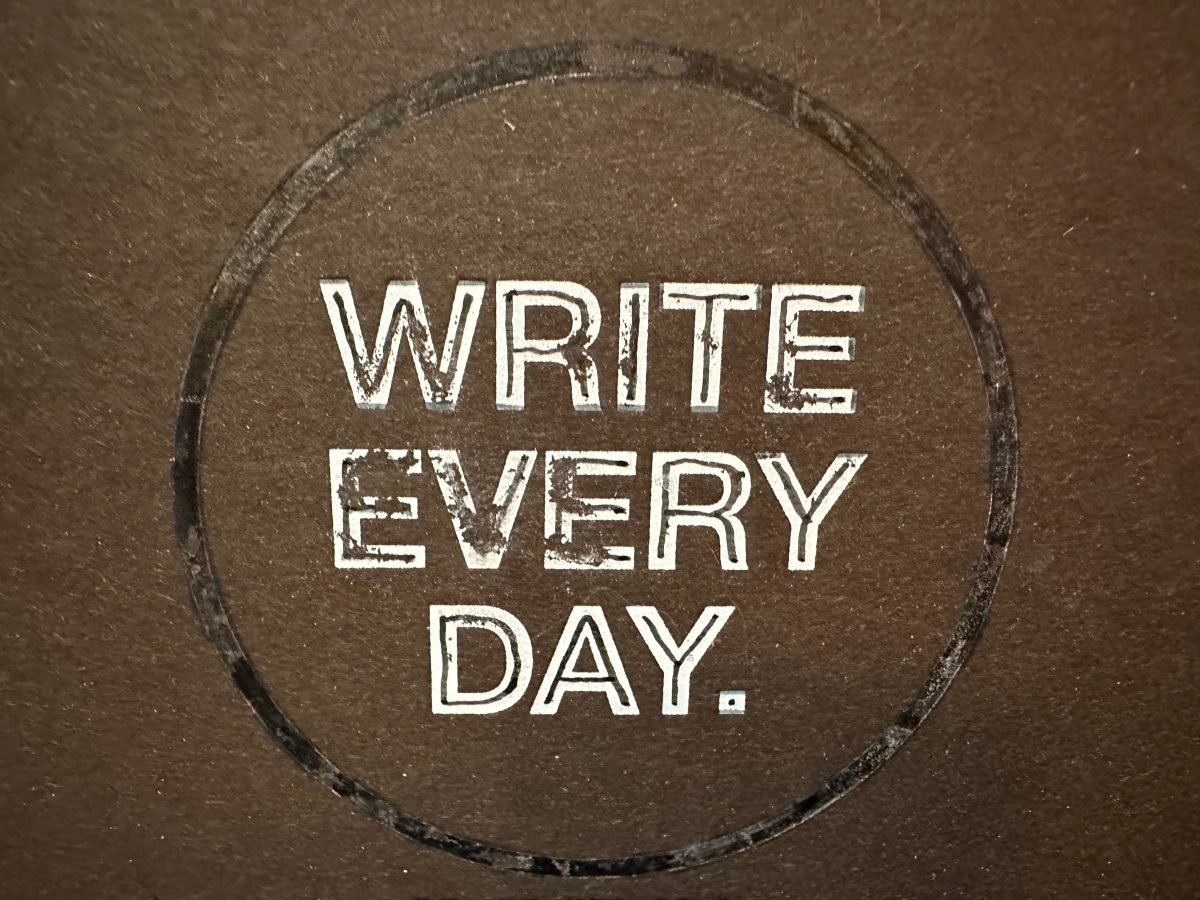
I have a notebook from NaNoWriMo that says “Write Every Day” on the cover. It’s exactly the thing that NaNoWriMo advocates. It might be the most commonly given writing advice. After all, if you want to be prolific, you’re going to need to write a lot. Right?
Well, yes and no.
The reason we have this mantra is because it’s hard. Most of us don’t write every day, even if we aspire to. However, simple aphorisms usually obscure a more complicated truth. Writing every day doesn’t guarantee success, and success doesn’t require writing every day.
The Self-Designed Job
Most of us who write fiction on spec are writing entirely on our own. There is no job description, no education or work history requirements. Nobody evaluated our resumes. We woke up one day and decided to write. Even those of us who have more formal writing jobs are often freelancers or contractors.
It can be powerful to choose your own goals and working hours. It can also be difficult. It’s not as simple as going into the office 9–5. It’s not as easy as having work handed down from a boss. Being self-directed means there are no defined boundaries to the job. You can work too little, or far too much.
I realized a few years ago that I was always setting goals for myself, and almost never satisfied with my own achievement. My performance reviews for my self-defined job were consistently bad. But this is really just my own personality issue. It doesn’t actually reflect my performance. Understanding that, I can more easily recognize that feeling and let it go.
Writing is More Than Writing
It’s not surprising how many writers hate talking about their own work, or trying to sell it. We write because we love writing, not because we want to do writing-adjacent business stuff. Unfortunately, that’s not the real world. If you want people to read what you’re writing, there’s probably some amount of business and self-promotion that needs to be done.
Beyond that, writing is more than putting words on the page. There’s work to be done before the first draft, coming up with ideas and refining them. There’s work to be done after, revising and editing. There are classes, books, and blogs about craft.
There is even the undefinable work of being out in the world, observing people and things, having the experiences that will inform the work. Fiction can only be as interesting as the inner world of the author. That stew of ideas requires ingredients and time.
I’ve even found blogging or journaling to be incredibly useful for my writing. Sometimes experience isn’t enough; it takes reflection to unlock that understanding. I can’t count the number of times that writing about my process resulted in exciting new ideas.
Moving Toward the Mountain
If you’re like me, and you have that voice in the back of your head that complains when you’re not writing “enough,” there are a few things you can do to address it. Make a list of all the things that contribute to the writing. Include things like ideation, editing, and critique. Include that fun business stuff, whether it be sending work to traditional publishers, working on self-publishing, or something as mundane as accounting for taxes. Include reflection, like blogging or journaling.
Ask yourself honestly if you’re allocating enough time to rest, recharge, and feed that stew of ideas that will, in turn, feed your stories. Don’t be afraid of taking a break, or even a vacation. If you want writing to be a “real” job, it should come with sick days and vacation time.
When pursuing goals, there are a lot of different ways to move toward the mountain. Sometimes the path isn’t straight. We have to put words to paper if we’re going to be writers. But not necessarily every day.
I’m always on the lookout for good books on the craft of writing. Over the years, I’ve discovered that there are actually quite a few of them. I have at least a dozen on my bookshelf at any given time, a selection that morphs slowly, like the ship of Theseus. In fact, there are probably hundreds of good books on writing. These books have a tidbit here or there that will lodge in your head, only to pop up at an opportune moment, leading to some small improvement. Or they’ll provide some high-level idea that inspires an adjustment in your way of working.
Consider This is something else. Having just read it for the first time, I think it’s safe to say that it is one of those rare great books on writing. There is an easy way to tell if you are reading such a book. It reads like an autobiography. Writers see the world through writing, and it is only natural that we should get to know each other best through our writing philosophies. A great book on writing feels like you’ve cracked off a little piece of a writer’s soul and slipped it under your ribs. A warm little splinter next to your heart.
The subtitle of this book is, “Moments in my writing life after which everything was different.” I suspect a fair number of writers will count this book as one of those. This is not a book about how to write well. It’s a book about how to write when you are Chuck Palahniuk. And really, what other book could we possibly expect from him?
Postcards From the Tour
If you’re not familiar with Palahniuk (pronounced “paula-nick”), he is the author of Fight Club. He has written more than twenty other successful books and comics, a good amount of short fiction, and a few non-fiction pieces, but if you know him from anything it’s probably Fight Club. His writing career spans over thirty years.
Much like Stephen King’s On Writing, the book is half advice and half anecdotes from the author’s life. Unlike King, whose book is more or less neatly split into the writing parts and the biography parts, Palahniuk’s is a mish-mash.
Each chapter focuses on a particular broad topic: Textures, Establishing Your Authority, Tension, Process. Between these sections are Postcards from the Tour, vignettes from Palahniuk’s life that may or may not directly relate to what comes before and after. He wraps the thing up with a list of recommended reading, and an interesting, brief chapter called “Troubleshooting,” which is essentially a list of problems that you may run into with your work and his suggested solutions.
There are motifs that span the book, like the favorite quotes from authors Palahniuk has known, inscribed alongside tattoo art. “For a thing to endure, it must be made of either granite or words.” “Great problems, not clever solutions, make great fiction.” “Never resolve a threat until you raise a larger one.” And, of course, “Readers love that shit.”
Palahniuk makes it clear that much of the advice he’s providing is not his own. It was given to him by others. He may have taken it to heart, tweaked it, and made it personal, but it is really a collection of advice from all of the people who helped shape him. When Palahniuk makes a point he wants you to remember, he says, “If you were my student, I’d tell you…,” but this is not workshop book. It is not a syllabus to be followed. It’s a conversation between fellow writers.
If You Were My Student
Consider This is packed with small pieces of good advice; so much that it is impractical to dig into all of them here. In fact, I kept running into things that made me pause to consider how they would help me in one way or another with the stories that I’m currently working on, and made me wonder if I needed to revise some pieces I thought were done.
He tells us there are three textures for conveying information: description, instruction, and exclamation. A man walks into a bar. You walk into a bar. Ouch!
He tells us attribution tags can provide a beat within a sentence. Use quotation marks for detail and realness, paraphrase for distance and diminishment.
He tells us the Little Voice is objective and factual. It is unadorned description, the documentary camera. The Big Voice is explicit narration, journal or letter. It is opinionated. Intercutting Big Voice and Little Voice can convey the feeling of time passing.
Palahniuk also makes more than a few suggestions that made me think, “That’s all well and good for Chuck, but what about the rest of us?”
He suggests that each chapter should be a self-contained short story, to the point that it could be published independently.
He suggests a liberal mixing of first, second and third person points of view.
He says we should create a repeated “chorus” to break up the story parts, like the rules of fight club. Use lists, ritual and repetition.
I have an unsettling suspicion. The parts that feel wrong to me—the parts that seem too unique to Palahniuk—might be just as useful as the parts I found immediately helpful. I just haven’t quite grasped them yet. Maybe in five years or a decade they’ll hit me like a lightning bolt and I’ll feel the need to revise all my works in progress yet again.
Readers Love That Shit
If it’s not obvious, I think this is a book on writing that most writers should own. It’s raw and personal, often strange, and very particular to Palahniuk. That’s precisely what makes it work. It’s a collection of writing advice from many writers, all channeled through Palahniuk over a decades-long career. I took copious notes on my first read through, and I have confidence that I will find an entirely new selection of things to consider when I read through it again.
November is over, and so is NaNoWriMo. If you participated, I hope it was fun and you hit your target word count.
If you’re new to NaNoWriMo, it’s worth noting that it’s more than just the big November event. The “Now What?” Months are January and February, where participants are encouraged to finish, revise, or work toward publishing their NaNoWriMo novel. Camp NaNoWriMo happens in April and July, and encourages pursuing more flexible goals, whether that be starting a new project, finishing an existing one, working on editing, or whatever you like.
There is also the unofficial community tradition of NaNoEdMo, when some ‘WriMo-ers try to get in 50 hours of editing (or however much you feel like) in March. Unfortunately, while there have been several fan-maintained sites in the past, they all appear to be defunct. However, the NaNoWriMo website can still be used to create a new project for the month. Just set a goal of 50 “words” and treat them as hours of editing, or set it to 3000 “minutes” if it feels better to have a bigger, more granular number.
I’m currently thinking I will try to finish my NaNoWriMo 2023 project in one of the Camp NaNoWriMo months, but for now I want to get back to some other things, like revisions on Razor Mountain. I’m also thinking about new big project for 2024.
Thanks for hanging out with me this November. I’ll see you all in December, when I get back to my regularly scheduled programming.
Asteroid City is the latest movie by Wes Anderson, released this summer, but written and filmed during various stages of the COVID-19 pandemic. I’ve touched on Wes Anderson once or twice before. He’s a divisive figure who makes movies with a very particular aesthetic. Some people revere him, some can’t stand him.
Asteroid City is, in many ways, just another Anderson film, with many of his usual virtues and foibles. However, I can’t help but feel there was one way it diverged significantly from other Anderson movies, and it was not a positive change. The problem with Asteroid City is its ending.
What Works
Like so many Anderson movies, Asteroid City starts with a frame. The main story is supposed to be a famous play, while the frame is a documentary about the author and the creation of that play. The brunt of the movie follows the plot of the play, with small asides back to the documentary.
In a pastel pastiche of the 1950s, a young scientist convention brings a number of children and their families to the small desert town of Asteroid City. The festivities are interrupted by the brief arrival of a UFO, and the government puts the town under quarantine. However, the children work together to get news of the situation to the outside world, and this results in public pressure to drop the quarantine. The various people who have come together in this strange situation then leave the town and return to their separate lives.
There are a whole host of fairly obvious correlations to the pandemic quarantine in this plot, and the bonds and romances that develop among the characters in a stressful situation. These are all relatable themes; perhaps the most universally relatable themes available to a storyteller in 2023.
I was a little leery of Wes Anderson delving into science-fiction when I first saw trailers for this movie, but the actual sci-fi elements are quite slight, and mostly played for humor. This works well enough in the Andersonian medium, and there’s even a funny little call-back in the “documentary” portion of the movie, where it’s revealed that the alien in the stage play is a masked Jeff Goldblum, the only scene he appears in.
Where it All Falls Apart
As the plot of the convention and the short-lived quarantine wrap up, the movie shifts back to the documentary. In an acting class taught by Willem Dafoe and populated by most of the cast of the movie, there is a discussion about sleep and dreams. Then the group begins to chant, over and over…
“You can’t wake up if you don’t fall asleep.”
It is this chant that ends the “documentary.” When I talked with my wife afterward, this was also the exact point where she said that she gave up on the movie completely.
It’s Weird, So What?
I think it’s safe to say that the average moviegoer finds most Wes Anderson movies to be weird. These movies usually don’t see wide distribution, and they don’t make blockbuster money; they exist on the edge between Hollywood and low-budget art film. They’re not trying to be a realistic depiction of life, and they’re also not full of bombastic special effects like the typical Hollywood blockbuster.
In my opinion, Anderson movies occupy an interesting niche. They’re clearly on the hoity-toity, film festival end of the movie spectrum, but they’re usually plotted in a straightforward way. They’re open to interpretation, but they’re not inscrutable.
Grand Budapest Hotel is partly a love story, and partly about a man who inherits an expensive painting and earns the ire of a the deceased woman’s murderous family. Moonrise Kingdom is about a pair of kids who run away together in the face of an impending hurricane. Isle of Dogs is about a kid looking for his lost dog. The Anderson movies that appeal to wider audiences are the ones with a surface-level plot that is easily understandable. They contain quite a bit that you can appreciate in a single viewing, even if you’re not worried about the vagaries of cinematography or frame stories or aspect ratios.
These movies are still “weird.” They’re still arty and invite all sorts of deep reading. You just don’t need those things to have fun watching the movie. This is where Asteroid City fails its audience.
Most of Asteroid City follows the ethos of an interesting surface layer on top of deeper weirdness. The parts that take place within the play are straightforward, bright, and funny. The parts that take place in the frame story are less straightforward, but they have their share of jokes, and they take up much less screen time. It’s only at the end where this spirals out of control.
The chanting actors are not at all straightforward. Their mantra, “you can’t wake up if you don’t fall asleep,” has almost nothing to do with the movie on a surface level. It demands that the viewer try to make some non-obvious interpretation in order to square this ending with what they just watched. Anyone in the audience who merely wants to watch and enjoy a movie is immediately excluded.
Even worse, this phrase is chanted over and over and over. The viewer is bludgeoned with it. The movie literally shouts out the importance of this singular phrase. It shows a complete lack of trust in the audience, a fear that we might miss this vital thing if it wasn’t so explicitly spelled out.
You Choose Your Audience
If the movie had ended with the temporary residents of Asteroid City saying their goodbyes and driving away, it would have worked for a “surface-level” audience. It would have welcomed the average moviegoer along with the cinephiles. Instead, it ended with an event that demands interpretation and demeans the audience with a complete lack of subtlety.
And I know, at least anecdotally, that parts of the audience felt excluded. They decided this was not a movie for them.
I don’t know what Anderson was hoping to accomplish with this ending. He may very well have been happy to make something just for the ardent fans. But he made a choice that profoundly affected who can enjoy his movie. These are the kinds of choices we all make in our work, either purposely or by accident.
It’s also worth noting that you can cater to a variety of overlapping audiences. It’s not always a zero-sum game. You can provide an entertaining surface-level plot, with readable character motivations, and still embed deeper ideas, complex metaphors, or mysterious events that are never adequately explained. Nothing can appeal to everyone, but you can make choices that widen or narrow your audience.
There’s nothing wrong with choosing to write something that you know will have a limited audience. If that’s the story you want to tell, then tell it. But think about what you’re doing, and do it as purposely as you can. Make sure you’re not excluding the audience by accident.
I’m still working on revisions for my novel, Razor Mountain. As I read through the chapters, looking for possible improvements, I’m constantly on the lookout for repetition, repetition, repetition.
Is it bad to do the same things over and over? That depends. There’s a lot of rhythm and structure to writing, and repetition can be an important tool if you’re doing it on purpose. It can be an element of personal style or provide structure to a piece. Unfortunately, repetition is often accidental: something you naturally do without realizing, a literary crutch or a sign that you haven’t put enough thought into some aspect of the work.
This is one of those cases where reader feedback is extremely useful. It’s hard to see these problems without an outsider’s perspective, because they naturally live in our blind-spots. When a reader notices repetition, you should scrutinize it.
Shortcuts
Writing fiction is an incredible challenge, because there simply aren’t enough words to fully describe a complete character, setting, or event. All writing is inevitably cutting out information; choosing what is important and what is not. It’s not surprising that writers take shortcuts. We’re constantly looking for things like a phrase that implies a character’s entire thought process, or a description of a smell that transports the reader to a location in the story.
There are also gaps in our thinking. No writer can think through every single detail of a story. There are always shadowy areas of uncertainty lurking around the edges. Even in the areas that we do put thought into, there can be dangers.
The human mind is a little bit like a hive of bees. Sometimes all those buzzing little thoughts work in concert toward a common goal, and sometimes the subconscious goes and causes problems while the conscious mind is not paying attention. We see this every day when people over-use favorite words or insert their verbal tics without even realizing it.
The Process of Noticing
The easiest way to find these troublesome repetitions is by outsourcing the job to others! Readers who aren’t familiar with your story will have a much easier time taking it at face value. After all, you have the best version of the story in your head, and that version will get mixed up with the words on the page, no matter how much you try to keep them separate. Readers have to suss out that story from mere words on the page.
There are also ways of getting more outside your own head. Reading the story out loud is a classic trick for changing your mode of thinking and catching problems that you wouldn’t otherwise catch. Reading out-of-order, a paragraph or sentence at a time, is another trick for assessing the words without getting lost in the flow of the story.
Danger Words
I’ve already mentioned in previousposts that I’m making a list of individual words and phrases that show up too frequently in my own work. For me, many of these words are “softening” or “weakening” verbs and adverbs; words like seemed, mostly, some, early, almost.
Interestingly, you might be able to discover something about yourself and your process by catching these issues. I suspect that I use these kinds of words reflexively, as a way to avoid fully committing to a description or idea. If I’m not entirely happy with the way I’ve described something, I use these words as a way to distance myself from my own description. Of course, that reflex doesn’t make the writing better, it makes it worse.
Luckily, as I notice these words, I can now reassess the description. If I think it’s actually good, I can remove the wishy-washy language and fully commit to my original intention. If I think it’s bad, I can change it.
Another common repetition I’ve found are vague adjectives, like little or flat. These words can add some value, because they refine the reader’s mental image of an object or idea. A little door is certainly more specific than a door, and a flat boulder is more specific than a boulder. The problem is that neither of these descriptions are very specific (how little is a little door), and they’re not as evocative as other adjectives or phrases I could use.
Opinions differ, but I’ve always felt a complete ban on adjectives to be stupid and reductive. They can be useful, but they also bloat a story. They are often “unnecessary” in the sense that they could be removed without breaking the meaning of a sentence, but they add nuance and impact the feel of the story, and that can have value. I personally think that judicious use of interesting adjectives can be the frosting that makes the cake. Depending on how you write, they might even be the cake.
Bigger Problems
Not all issues of repetition exist on the level of individual words or small phrases. Bigger issues can arise on the level of paragraphs, and even chapters. These are often more difficult to identify, because they can’t be confirmed with a simple word processor “find” function, like repeated words.
The simplest kind of repetitive sentences use an identical structure over and over. This often arises in long stretches of dialogue or action:
He said, “No.”
She said, “I think you’re wrong.”
He said, “I don’t care.”
She said, “I don’t, either.”
He swung his right fist. She dodged it. He swung his knee up. She brought her hand down to block it. He jabbed with his left hand. It struck her right cheek.
These are contrived examples, but they show the kind of painful writing that comes from overly-repetitive sentence structure. These are all short sentences, but even long and complex sentence structures can feel repetitive.
Sentences have a rhythm. It can help to visualize more complicated sentences by focusing on their punctuation and conjunctions, because these are the connective tissue that combine individual phrases and clauses into a complete sentence. A series of sentences with a single conjunction (“This and that,” “That but this,” “This or that”) can also create a dull rhythm.
Even consistently long or short paragraphs can be a rhythm that readers notice, sometimes subconsciously. Lengthening or shortening sentences and paragraphs can be a useful tool for speeding up or slowing down the pacing, but when similar lengths are used consistently, regardless of the intended pacing, it can throw off the feel of a scene.
How Often is Too Often?
It’s a unreasonable and counter-productive to suggest that we should completely remove repetition from our writing. After all, it’s a useful tool for style and structure in a wide variety of contexts. I suspect there are no rules of thumb about the “correct” amount of repetition that couldn’t be taken down with a counter-example.
So, as is usual with writing, the answer to the question is, “It depends.” (Yes, I’m aware that I’m repeating the first part of this post.) There are two criteria worth thinking about: when to take a closer look, and when to make a change. It’s easy to make rules of thumb for finding potential issues, but it always pays to look at the specific context when it comes to making changes.
When I’m looking at repeated words in my own chapters, my personal warning alarms go off when I find three or more examples in a single chapter, or examples in almost every chapter. However, just because I find four instances of “nearly” in a chapter doesn’t mean I’m going to change or delete them. To decide that, I look at the specific sentence and paragraph surrounding each one. If I can think of an equally good or better word to use, I’ll change it. If I find that the word isn’t pulling its weight, I might remove it entirely. Sometimes, it’s the perfect word, and I leave it alone.
The Power of Repetition
Repetition can weaken or strengthen your writing. Repetition makes writing weaker when it’s accidental, filling in details that the writer hasn’t thought through, or revealing subconscious processes that the writer hasn’t even noticed. Repetition makes writing stronger when it’s purposeful, to achieve a stylistic effect or provide a particular rhythm or structure.
That’s why repetition is a great target for revisions. Changes can simultaneously shore up weaknesses and create new strength.









 Words Deferred