If You Care About Video Game Stories, You Should be Watching /noclip

If writing is my creative first love, video games are my second. Words Deferred is a site about writing, so I mostly limit my talk about video games to the story-centric, like my series about Games for People Who Prefer to Read.

Of course, not all games care much about story, and the entire medium has long been lambasted by serious artists for its weak storytelling. There’s a weird tension built into games, between experience and participation, the twin engines that make a game at least partly something you do instead of something you receive. That doesn’t mean there are no great stories in games, but it does mean that you have to go searching if you want to find them.

Games are also fascinating from the perspective of their construction. They are half art, and half science; programmers and engineers working side by side with artists, modelers and sound designers. The closest analogues are stage theater or TV and movies, where there is a certain unexplainable amalgamation of the magical and the mundane in order to actually put a finished product in front of an audience. Art constructed by a team is very different from the work of the lone artist.

There are plenty of documentaries on movie making; on the actors, directors, and myriad other craftspeople who put stories on the big screen. But there are comparatively few who do the same thing for games. Among the best are the small team at /noclip.

They are remarkably prolific for a core group of just four people, not only putting out multiple high-quality documentaries per year, but hosting a weekly podcast, building a game history archive, doing some indie game development, and recently creating a sort-of, kind-of online game magazine thing. They are also clearly a group who loves games as a storytelling medium, and that passion comes through in the documentary series where they give voice to the developers of some of the most exciting story-centric games.

Now is the perfect time to check out their work, because they’re right in the middle of releasing a multi-part series about Disco Elysium, one of the most critically acclaimed and lauded “story games” in the past decade, and the story of the people who made it is just as interesting as the game itself.

Recommendations

Blogs are ancient technology, an elegant weapon from a more civilized age, and nowadays they can be found mainly in museums. However, back in their heyday, blogs were so popular that their authors would post lists of their favorite blogs on their own blogs in a sort of blogception. They called it a blogroll. Yes, people once used the term “blogroll” with utter seriousness.

Being an ancient artifact myself, I’ve been thinking for a while that I ought to make one of these blogroll things. I’ve also occasionally thought about off-topic posts where I talk about my favorite music or movies, but we all know that successful blogging requires total focus on your chosen topic, and if I veered off into something like music, I’d never get any views or subscriptions ever again.

Luckily, I’ve found a loophole. I’ve created the Recommendations page! It’s in the menu! You can get to it from every page!

Now I can have lists of my favorite blogs, books, movies, games, TV, music, tabletop games, and more—all without cluttering up that precious RSS feed—another ancient technology that I’m sure you’re all using. I’ll be updating these lists…sometimes. Occasionally. Whenever I come across something so good it needs to go in a top ten list for a while.

And as long as we’re being off-topic, feel free to comment and tell me about whatever show, movie, song, game, book, podcast, TTRPG, or anything else that’s got you excited today.

Reference Desk #18 — ScriptNotes Podcast

ScriptNotes, as you might guess, is a podcast “about screenwriting, and things interesting to screenwriters.” It’s hosted by working screenwriters John August and Craig Mazin, with frequent high-profile guests like Christopher McQuarrie and Vince Gilligan.

I’ve never written a screenplay. While it might be fun to try at some point, my interests mostly lie in prose fiction. Luckily, I’ve found that most of the episodes I’ve listened to are filled with good advice and discussion that’s applicable to all sorts of fiction writing, not just movies and TV.

The podcast recently crossed the 600-episode mark in their 11th season (what do seasons even mean in podcasting?) Episodes are typically about an hour long, and vary from screenwriter interviews to listener Q&A to deep dives on specific writing topics or specific movie scripts.

As an example, recent episodes included a discussion about the dynamics of writing a story with a large cast of characters, and an analysis of the “side-quests” and “sub-quests” that make up the scene-to-scene meat of a larger character arc.

The show only keeps something like the most recent 20 episodes in their free feed. As someone who sometimes binges podcasts, I was actually a bit relieved to not feel the need to “catch up” on something new with so many episodes.

However, if you really like the free samples and are willing to pay, the entire back catalog and some bonus content is available via subscription on their website, for $5 per month or $49 per year. They also include a few minutes of bonus content at the end of each episode, for subscribers. I may decide to pick up a sub for a month or two, just to surf through some of the old episodes.

719 – When Good Enough Isn't Enough Scriptnotes Podcast

John and Craig consider all the words they have to write and ask, how do you know when something deserves your best effort? They offer a useful rubric for deciding when something is worth perfecting, and when over-optimization is a waste of time. We also follow up on compulsive writing habits, industry euphemisms, back issues, and the impact and legacy of the WGA's 2019 agency negotiations. In our bonus segment for premium members, it's a new year! John looks back at things he accomplished in 2025 and his goals for 2026, while Craig sighs and gestures in the direction of The Last of Us. Links: Jamie Lee Curtis says "Trauma" Concept Creep: Psychology's Expanding Concepts of Harm and Pathology by Nick Haslam Young Connor Storrie on YouTube Steve Jobs introduces the iPhone Elon Musk announces the Cybertruck Valentina Vee on TikTok and Instagram Birth by Madison Karrh John's What I Did in 2025 Get your copy of the Scriptnotes book! Get a Scriptnotes T-shirt! Check out the Inneresting Newsletter Become a Scriptnotes Premium member, or gift a subscription Subscribe to Scriptnotes on YouTube Scriptnotes on Instagram John August on Bluesky and Instagram Outro by Eric Pearson (send us yours!) Scriptnotes is produced by Drew Marquardt and edited by Matthew Chilelli. Email us at ask@johnaugust.com You can download the episode here.
  1. 719 – When Good Enough Isn't Enough
  2. 718 – No Worries if Not
  3. 717 – The Screenwriting Life: The Craft Lessons That Matter Most
  4. 716 – Personality Typologies
  5. 715 – The Book Launch, Live!

Writing Excuses — Mysteries and Tension

I wrote about Writing Excuses almost two years ago, as a part of my Reference Desk series. It’s still my favorite podcast about writing. I’m not a consistent podcast consumer, so I tend to let quite a few episodes build up and then burn through them. I’m currently enjoying several episodes on mystery and tension in Season 18.

If you haven’t listened before, don’t let that number of seasons intimidate you. Each episode is only 15-20 minutes and generally self-contained, so it works perfectly well to just start with the current episodes and work your way backwards.

While the show has had a rotating cast of hosts and a lot of guests over the years, they’ve announced a slight format change with the latest season. The core hosts now include several long-standing members and a couple of new-ish faces who have guested previously. The show is more diverse than ever, not only in terms of gender, race and orientation, but in the different perspectives each host brings to writing and publishing.

Writing Excuses also feels a little bit more organized now, with each host lined up to do a deep dive this season. However, it’s still very much unscripted, and still contains unexpected tangents and the occasional bad joke. It mostly feels like a group of smart people who love stories and writing, sitting around and having a chat about a particular topic each week.

The Tools of Tension

The Writing Excuses folks suggest a list of tools for building tension:

  • Anticipation
  • Juxtaposition
  • Unanswered Questions
  • Conflict
  • Micro-Tension

Anticipation, or suspense, is anything that lets the reader know something is coming, whether it be good, bad, or of uncertain providence. It’s Alfred Hitchcock’s bomb under the table. It’s the flash-forward at the beginning of the police procedural that lets us know what’s going to happen, but not how. It may even be built into the genre itself, like the detective’s big reveal at the end of a classic murder mystery.

Juxtaposition is anything that plays with the differences between two or more things. In movies, this might be a contrast between the style of music or voice-over and the action on the screen. In fiction, it might be the calm and collected way the high-class villain writes about the gruesome murder he has committed.

Unanswered questions can find a home in almost any kind of story, but are exemplified in the Mystery Box style of story. The reader keeps reading to find out why strange things are happening, and what will happen next. This was the type of tension that I chose as the driving force in my serial novel, Razor Mountain.

Conflict is that old classic that everyone talks about. It’s characters who want the same thing, when only one of them can have it. It’s a clash between diametrically opposed viewpoints. It’s the kung-fu fight in the martial arts movie, or the shoot-out in the western. It might just be the easiest form of tension to write, and the easiest for the reader to parse, which explains why it’s so popular.

Finally, micro-tension is any of these forms, shrunk down into a tiny little dose. It’s what pulls us through each conversation between characters, each scene, each chapter. It’s what keeps us turning the page. Contrasts are important for pacing, but micro-tension keeps the reader engaged in the lulls between the  bigger payoffs.

Just a Taste

This is just a condensed example of the kind of conversations about craft that make Writing Excuses so great. If this kind of nuts-and-bolts writing advice interests you, I’d highly encourage you to check it out.

The episodes on types of tension run from 18.9 – 18.14.

Reference Desk #13 — Writing Excuses

I have a system for listening to podcasts. First, I hear about a podcast that sounds interesting. Then I subscribe to it on my phone. Then, for weeks, sometimes months, I occasionally look at the icon in my podcasts. Once the podcast is nicely aged, I might decide to try listening to it. Either that or I get irritated with the number of things I’m subscribed to, and I delete it.

I’m glad I didn’t delete the Writing Excuses podcast. I finally got around to listening a week or two back, and now I’m listening to it pretty much every day during my lunchtime walks. It’s my new favorite writing podcast.

There are four regular hosts in the episodes I’ve listened to thus far: Mary Robinette Kowal, Brandon Sanderson, Howard Tayler, and Dan Wells. Each episode typically includes several or all of the regular hosts, along with one or more guests.

The resulting discussions feel a bit like writing conference round-tables with a rotating selection of professional authors. This is a speculative-fiction heavy podcast, with all of the regular hosts and many of the guests working in the sci-fi, fantasy, and horror genres. However, they also bring a diverse set of writing backgrounds, with work ranging across short stories, novels, web comics, traditional comics, audio books/plays, and RPGs, along with the specialties brought in by the guests.

What’s in an Episode?

  • Each episode is about 15 minutes. Occasionally it runs long when the hosts get excited about a topic. This relatively short length makes it easy to listen to an episode in a spare moment here or there.
  • The hosts and guests discuss a single topic. Sometimes it’s stand-alone, sometimes it’s part of an over-arching series that may stretch across as many as ten episodes. Recent multi-episode topics include poetry, writing for video games, and business considerations.
  • Each episode also includes a reading recommendation (or rarely some other media), and a little homework assignment related to the topic.

History

The pod has been around for a long time. It’s been running since 2008 and is currently in season 16. If you’re starting on it now, like I am, that’s a backlog of hundreds of episodes. Unless I really binge, that’ll take me ages to work my way through. As an added bonus, it means that when I’m looking for info on some random writing topic (like serialization or alternate history), there’s probably already an episode covering it.

(I did notice an oddity: on Apple Podcasts, there is a separate listing for seasons 1-6, and another for seasons 7-10. Seasons 11-14 and most of 15f are completely absent. However, all of the episodes seem to be available from the official podcast website.)

Links

The official website (with all episodes, transcripts, and additional stuff) is https://writingexcuses.com/.

There is also a discussion forum for the podcast on Brandon Sanderson’s website: https://www.17thshard.com/forum/forum/34-writing-excuses/.

The Scrivener Podcast — A Follow-Up

A few weeks ago, I wrote an article about Scrivener’s new podcast, Write Now with Scrivener. I think it’s hard to judge most media based on the first episode, but I gave it a bit of a mixed review. The first half, focused on the author interview and writing process was interesting. The second half, focused on how the author used Scrivener, was a little too infomercial for my tastes.

The next episode of the podcast dropped, so I decided to briefly revisit it here. The guest author for episode two is Dan Moren, science fiction author. I have to say, this one hooked me more than episode one, so I’m glad I kept an open mind.

I’ll be clear up-front that this episode is just better tailored to my personal tastes. I’m a reader and writer of sci-fi, and I’m honestly more interested in the perspective of a relative up-and-comer. Dan Moren has a couple of books out in his science fiction series, and seems to be doing well, but he’s open about the fact that his fiction writing income isn’t paying the rent, let alone buying Lamborghinis or a 40-acre ranch. Peter Robinson, the episode one guest, was nice enough, but he was working in police procedural style mysteries, has dozens of books, and seems to be much more at the “rich guy” end of the spectrum.

Regardless of my tastes, I thought this episode had much better conversation too. Some of that may be the host getting a little more practice. Some may be that these two have a bit of a history together. I’m guessing most of it is down to the fact that Dan Moren hosts half a dozen podcasts, and is pretty comfortable in this environment. The “how do you use Scrivener” section of the podcast felt much more natural this time around, although there was still one moment I noticed where the host was a little too energetic giving Scrivener tips and I could feel the sponsorship miasma creeping in.

After this second episode, I’m on board. A once-per-month, half-hour podcast is easy to commit to, and the content is pretty good. I’ll keep listening.

I’ll put the second episode below, and if you’re interested in sci-fi authors who are open about finances, agent/editor interaction, and the nitty-gritty of publishing, you should check out Dan Moren’s blog.

Episode 58: Tessa Hulls, Pulitzer Prize Winning Graphic Artist & Memoirist Write Now with Scrivener

Tessa Hulls is an artist and writer who recently won the Pulitzer Prize for her graphic memoir Feeding Ghosts. Note that the companion article for this episode on the Literature & Latte website (https://www.literatureandlatte.com/blog/write-now-with-scrivener-episode-no-58-tessa-hulls-pulitzer-prize-winning-graphic-artist-memoirist) includes some screenshots of Tessa's project. Show notes: Tessa Hulls (https://tessahulls.com/) Feeding Ghosts (https://tessahulls.com/section/463226-Current%20Project.html) Feeding Ghosts: A Graphic Memoir, by Tessa Hulls – The Pulitzer Prizes (https://www.pulitzer.org/winners/22701) Isabel Wilkerson: Caste (https://www.isabelwilkerson.com/) Kaliane Bradley: The Ministry of Time (https://www.hodder.co.uk/titles/kaliane-bradley/the-ministry-of-time/9781399743600/) Learn more about Scrivener (https://www.literatureandlatte.com/scrivener/overview), and check out the ebook Take Control of Scrivener (https://www.literatureandlatte.com/store). If you like the podcast, please follow it on Apple Podcasts (https://podcasts.apple.com/us/podcast/write-now-with-scrivener/id1568550068) or your favorite podcast app. Leave a rating or review, and tell your friends. And check out past episodes of Write Now with Scrivener (https://podcast.scrivenerapp.com).
  1. Episode 58: Tessa Hulls, Pulitzer Prize Winning Graphic Artist & Memoirist
  2. Episode 57: Jonas Enander, Astropyhsicist
  3. Episode 56: Alexander Rose, Historian
  4. Episode 55: Maria Reva, Booker Longlisted Author of Endling
  5. Episode 54: Tim Queeney, Author of a History of Rope

Reference Desk #9 — Write Now with Scrivener

I’ve made no secret that Scrivener is my tool of choice for writing novels. Now — like everyone else in the pandemic — they’ve announced a podcast. It’s called “Write Now with Scrivener,” and it’s scheduled to come out monthly. Thus far, there’s only one episode.

Like any series, I don’t think the inaugural episode is enough to judge a podcast, but I decided to check it out and see what it has to offer.

The Interview

The host is Kirk McElhern, author of “Take Control of Scrivener,” which is certainly on brand. He’s not somebody I’m familiar with, so I had no expectations. McElhern seems to have prepped well for the interview, and had solid knowledge of his subject, but I didn’t feel like he asked any particularly surprising questions or drew out any great insights.

Part of it, perhaps, is that the interviewee for this episode is Peter Robinson. He’s the author of the Alan Banks series. With more than thirty published novels, he’s clearly a successful author, but I don’t read a lot of detective mysteries, and I’m not familiar with his work. So again I came in with no expectations.

We learn that Robinson eschews outlines (can we please stop using the word “pantser” for this?) when starting a new book, but builds an outline as he goes to keep himself organized. As someone who outlines, I always find this a little bit amazing. Even more amazing to me is that he doesn’t know the ending. I’ve only ever dabbled in mystery, but it seems difficult to know where you’re going in the genre without an idea of the ending. It goes to show that writers can have very different processes to achieve similar results.

The Obligatory Bit About Scrivener

The final few minutes of the podcast was reserved to discuss how Robinson uses Scrivener. This was the bit I had concerns about. On the one hand, perhaps I would get a couple of useful tips. On the other hand, perhaps it’s just very thinly veiled advertising by the patrons of the podcast.

Robinson dutifully explained that he writes scene by scene, in fairly small chunks, and that Scrivener makes it easy to rearrange those scenes with drag-and-drop, or pull things out and save them for later. He also uses snapshots before changing a scene to compare the different versions afterward.

Having used Scrivener for a few years, I didn’t really get anything new out of this, and unfortunately it felt a little bit like advertising. However, if you’re new to Scrivener, these are the kinds of simple, straightforward features that make the product good for writing novels, and they’re useful to know about.

The Verdict?

As I said before, I’ll withhold judgement until I’ve heard a couple episodes. Overall, I found the chat with Peter Robinson interesting, even if I’m not a reader of his books. I hope that they’re able to get authors from various genres for future episodes.

I’m honestly a bit worried about the “how do you use Scrivener” bit. As much as I like the product, it feels a little too advertisey. I suspect that most writers are going to  talk about the same handful of main features: the ones at the core of what makes Scrivener good. What might be able to make this segment shine is an author who really utilizes some of the more hidden features.

Episode 58: Tessa Hulls, Pulitzer Prize Winning Graphic Artist & Memoirist Write Now with Scrivener

Tessa Hulls is an artist and writer who recently won the Pulitzer Prize for her graphic memoir Feeding Ghosts. Note that the companion article for this episode on the Literature & Latte website (https://www.literatureandlatte.com/blog/write-now-with-scrivener-episode-no-58-tessa-hulls-pulitzer-prize-winning-graphic-artist-memoirist) includes some screenshots of Tessa's project. Show notes: Tessa Hulls (https://tessahulls.com/) Feeding Ghosts (https://tessahulls.com/section/463226-Current%20Project.html) Feeding Ghosts: A Graphic Memoir, by Tessa Hulls – The Pulitzer Prizes (https://www.pulitzer.org/winners/22701) Isabel Wilkerson: Caste (https://www.isabelwilkerson.com/) Kaliane Bradley: The Ministry of Time (https://www.hodder.co.uk/titles/kaliane-bradley/the-ministry-of-time/9781399743600/) Learn more about Scrivener (https://www.literatureandlatte.com/scrivener/overview), and check out the ebook Take Control of Scrivener (https://www.literatureandlatte.com/store). If you like the podcast, please follow it on Apple Podcasts (https://podcasts.apple.com/us/podcast/write-now-with-scrivener/id1568550068) or your favorite podcast app. Leave a rating or review, and tell your friends. And check out past episodes of Write Now with Scrivener (https://podcast.scrivenerapp.com).
  1. Episode 58: Tessa Hulls, Pulitzer Prize Winning Graphic Artist & Memoirist
  2. Episode 57: Jonas Enander, Astropyhsicist
  3. Episode 56: Alexander Rose, Historian
  4. Episode 55: Maria Reva, Booker Longlisted Author of Endling
  5. Episode 54: Tim Queeney, Author of a History of Rope

Reference Desk #8 — Working it Out

There’s something raw and awkward about a rough draft. It’s hard enough to be confident about work that’s polished to a mirror shine, and it can outright hurt to reveal the grotesque early versions of the art we’re passionately trying to create, in the midst of its creation. But it’s immensely reassuring to be reminded that it’s like that for everyone!

There’s a rare thing that happens sometimes in great comedies. The writers insert an episode, a scene, or even a few lines of dialogue that create a dramatic, emotional impact. A little island of seriousness among the jokes.

When this is done correctly, the knife twist from lighthearted laughs to pathos can be every bit as impactful as a similar scene within a drama, where the entire show may have been building up to it.

Fans of Futurama will know what I mean if I mention Fry’s dog, Seymour. Fans of Scrubs will remember Ben Sullivan. And fans of Adventure Time might just get a little choked up when they hear “Everything Stays.”

Birbigs

I’ve been a fan of Mike Birbiglia for a while, and I think it’s mostly because he lives on that edge between humor and pathos. He considers himself a stand-up comedian, but his on- and off-Broadway shows often feel like half dramatic one-man-show, half stand-up special. They revolve around events as serious as sleep-walking through a second-story window or being T-boned in a hit-and-run car accident.

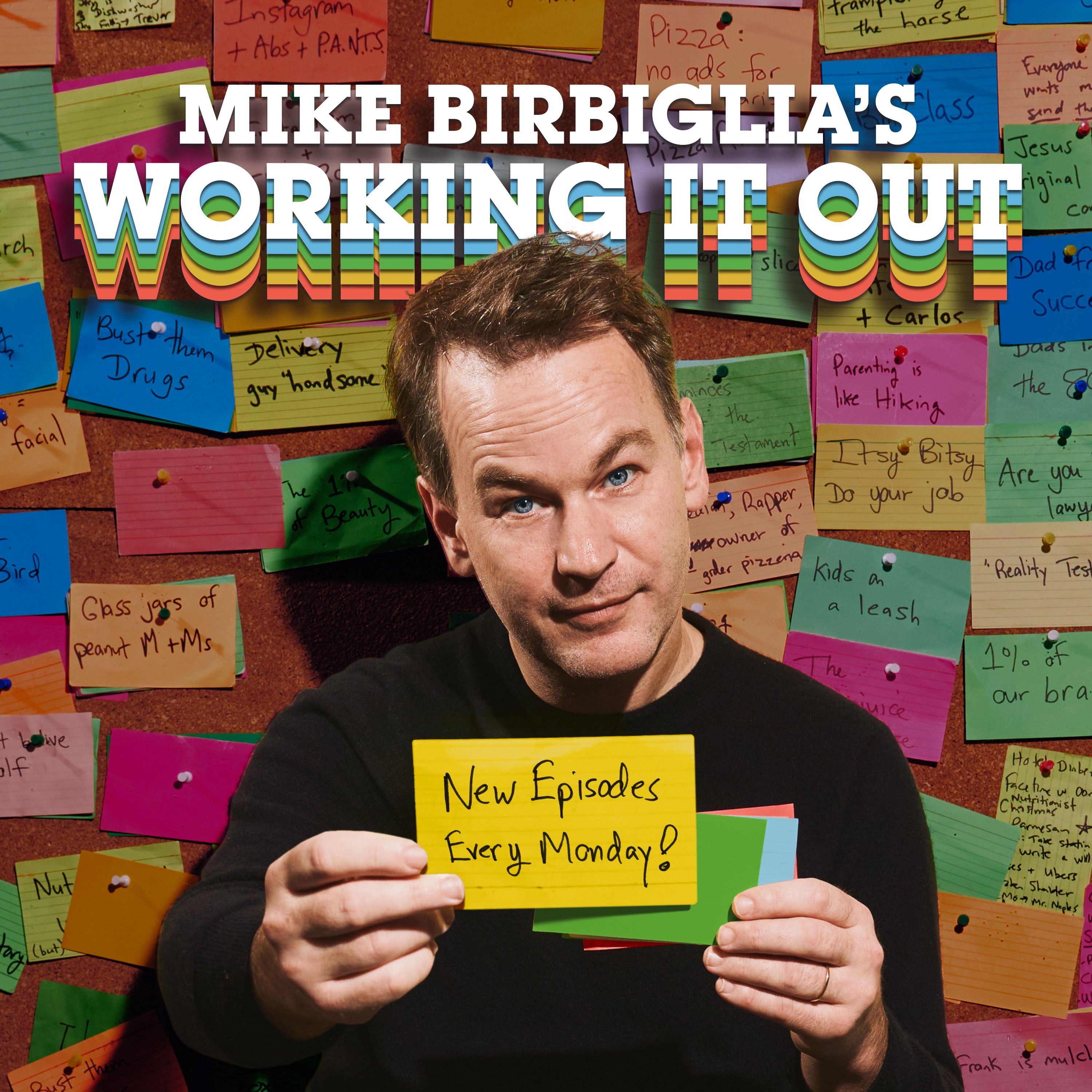
Working it Out” is Birbiglia’s podcast. As you might expect from a comedian’s podcast, there are plenty of popular comedian guests, from John Mulaney and Hannah Gadsby to Jimmy Kimmel and Frank Oz. But rather than being a simple excuse to joke with friends and acquaintances, Mike makes it something halfway between an interview show and a critique circle. It turns out he is deeply studious when it comes to the craft of telling jokes, and the craft of storytelling.

The through-line of the 40 episodes that have been released so far is the new show that Birbiglia is developing. It started with the title “The YMCA Pool,” but he now calls it “The Old Man and the Pool.” It’s a comedy show about getting older and coming to grips with your own mortality.

In the first episode, Mike tries out some of the material he’s working on with his friend and “This American Life” luminary, Ira Glass. Ira gives him advice that involves significant rewriting, and he accepts it graciously. By episode 25, when Ira returns, Mike has done his rewrite. They run through it again, and discuss it in depth. Mike jokingly asks, after half a year of revisions, how close his story is to being worthy of “This American Life.” And Ira deadpans, “halfway there.”

The Vulnerability of Revision

What makes Birbiglia’s comedy work so well, and the knife-twist that makes it hit so hard, is his vulnerability on stage. The podcast is different from a stage show, of course, but it still works because he’s willing to be vulnerable in front of an audience.

It’s clear that Mike doesn’t shy away from the hard work of revision. Guests bring their work in progress, and he brings his, and they hash it out, every episode. Some of the guests are clearly less into the workshopping aspect than others, but Birbiglia’s enthusiasm shows through.

If you’ve read any of my writing development journals, you can probably see why this appeals to me. There’s something raw and awkward about a rough draft. It’s hard enough to be confident about work that’s polished to a mirror shine, and it can outright hurt to reveal the grotesque early versions of the art we’re passionately trying to create, in the midst of its creation. But it’s immensely reassuring to be reminded that it’s like that for everyone! Art doesn’t spring fully formed from our minds, like Athena from the head of Zeus. It has to be shaped and reshaped. Bits added on, and bits sanded off. The slow, steady grind of progress.

Of course, it helps to have a few jokes to lighten the mood, even if they are jokes about death.

Stephen Colbert: A Gift from the Comedy Gods Mike Birbiglia's Working It Out

Best of WIO: Stephen Colbert (Recorded January 2025)This week the legendary Stephen Colbert returns to the podcast. Mike and Stephen discuss the behind-the-scenes of Stephen’s Late Night job as well as his Chicago improv days. Stephen talks wisdom passed down to him by David Letterman, Del Close, and Mike Nichols, and shares what makes him cry most easily. Plus, Stephen’s thoughts on meeting George Lucas and the Pope.Please consider donating to Radio Lollipop Hosted by Simplecast, an AdsWizz company. See pcm.adswizz.com for information about our collection and use of personal data for advertising.
  1. Stephen Colbert: A Gift from the Comedy Gods
  2. Josh Johnson: Reinventing the Modern Comedy Special
  3. 197. Natalie Palamides: Wisdom from a Modern Clown
  4. 196. Michael Che: An Amateur Therapy Session
  5. 195. Arthur Brooks: The Science of Happiness and Humor