

My writing time for the past few weeks has been focused on revision. My latest story, Red Eye, has now been reworked more thoroughly than any other short story I’ve written.
Does that make it the best thing I’ve ever written? No, not necessarily. There are a million factors that determine a story’s quality. What careful revision does is help make a story the best possible version of itself.
I’ve written about revision before:
- Revising Short Stories
- Debugging Stories: How to Revise Like a Programmer
- Editing and Repetition
- A Revision Checklist
I think revision is not discussed enough. This is partly because there’s more romanticism to first drafts: the blank page, the whispers of the muse, and bringing a new piece of art into the world. The raw creative energy of a first draft.
But first drafts often aren’t that good. They can be misshapen and muddled. They may be missing pieces, or not quite sure what they want to be. Like the golem, revision takes a roughly shaped form and puts magic into it that brings it to life.
First, I’ll outline some basic principles. Then I’ll discuss how they played out in my revisions for Red Eye.
Principles of Editing
These are a few things that work for me. Use what works for you and ignore what doesn’t. I am never entirely consistent with this process. I’m always changing and trying new ways of working.
Each story also has different requirements. So even if you have a consistent general process, it may still need to adapt to each individual story’s needs.
Focus on the Core Concept
Unlike longer works, short stories don’t have much room for meandering and asides. They work best when they have a distinct core concept. This might be an idea, a plot point or twist, a character, or even the structure of how the story is told.
There are many different engines that can power a story and drive it forward. The core concept is often very close to whatever got me excited about writing the story in the first place, although some stories will turn out to have a completely different focus from what you expected when you started writing.
The core concept is the measure for everything else in the story. Anything that doesn’t strengthen, deepen, or explore the core concept should be questioned and considered for removal.
Get External Feedback
The written word is an imperfect communication channel. The author stands on one side, with an idea of the story in their head. The reader stands on the other. Between them: two cans connected with string. This is the story, and just because you think you’re sending it with perfect clarity over the wire doesn’t mean the reader is receiving it the way you want them to.
The only way to effectively reconcile the story in your head with the story the reader received is to ask them. If you aren’t used to detailed feedback, you may be surprised how many different experiences and interpretations a dozen readers can have with the exact same story.
The first challenge is finding those readers. Friends and family may be an option. Writing groups and online critiques are another. More is generally better, but the sweet spot is probably 5-15 readers. Fewer, and you’ll miss useful critique, more and it will become overwhelming.
The second challenge is parsing the feedback. Put aside ego and be as open and honest as you can be. Some feedback you will disagree with. The reader may want something that doesn’t align with your core concept. The reader may identify a valid problem, but offer a bad solution. Individual readers will inevitably miss or misinterpret things, or get confused. This isn’t necessarily a problem if it’s only one reader in fifteen. If multiple readers have the same issue, it deserves scrutiny.
The final challenge is deciding what to change. It may be helpful to start with a list of problems, and then translate those into solutions. One change may be able to fix several problems, or one problem may necessitate several changes. I like to make checklists and take many editing passes, focusing on one or two things each time.
Big to Small
Try to make big, sweeping changes before line edits and more localized changes. It’s a waste of time to polish a paragraph if you’re just going to delete or replace the whole scene later.
This is something to strive for, but editing is an iterative process, so don’t stress over it too much. Sometimes an epiphany doesn’t strike until deep into the editing process. Don’t let the sunk cost fallacy discourage changes that will make a story better.
Cut, Cut, Cut
This was a hard lesson for me to internalize. If you have a naturally flowery or verbose style, it’s perfectly fine to run wild in early drafts. However, it’s important to cut that back as much as possible in revisions. Even first drafts written in a sparse style can often be trimmed significantly.
When cutting, look at what reinforces the core concept. Compare the trimmed and untrimmed versions of a sentence or paragraph. Be honest about what is really lost when removing a word here or there. Only keep what’s valuable.
Value isn’t measured solely in understandability of the plot. It may be critical characterization, or lyricism, or structure. You should be able to articulate why a cut doesn’t work, and default to brevity.
If you’re not used to ruthless cutting, it may feel bad at first. Short stories are an inherently tight medium, and given two versions of a story, the one that can say the same things in fewer words will generally be stronger. If you’re trying to get your work published or sold, there are simply more opportunities for shorter stories than longer ones.
Take frequent breaks when trimming. Once you’ve read and tweaked the same sentence a few times, it becomes hard to look at it objectively. Time is a necessary part of the process.
Example: Red Eye
Red Eye is a sci-fi noir short story in a future where a longevity serum extends lives. In rare cases this serum makes the person a “Red Eye,” activating a latent psychic power to see the future. These visions always come to pass so long as the Red Eye is still alive, and every Red Eye sees an apocalyptic cataclysm looming in the future.
The main character is a Red Eye police detective who catches other Red Eyes so they can be given a longevity-counteracting drug, in the hope that this will stop the collective catastrophic vision from coming to pass.
Red Eye is a long story for me, generally staying in the range of 6000-7000 words through many iterations. It is also an old story that stole ideas from things I wrote in my twenties. A version of it sat in a drawer for a number of years when I wasn’t submitting my work for publication. I revived it in 2024, and that is when I began editing it in earnest.
For stories I write today, I generally let the first draft sit for a couple weeks. Red Eye was an outlier in that regard.
Initial Revisions
My first editing pass is a gut check. I try to forget everything I know and come at it as a reader. What obviously works or doesn’t work? I try to find my core concept. At first, this was the idea of the psychic who locks the future in place by seeing it.
I also noted right away that the story was long, and I wanted to trim it down significantly.
I made some initial changes, fixed obvious problems, and did my best to trim. My goal at this early stage is to have the right scenes in the right order and rough shape. (Realistically though, things can change.) Then I take a light polishing pass where I check spelling, grammar, and flow. Much of this polish will be wasted, but I do it to avoid distracting first readers with small errors.
First Feedback
My first audience is my family. They are avid readers in various genres. At face value, they are not necessarily the “perfect readers” for my work, but that’s fine. They are kind enough to give me their time and energy, and they’ll be somewhat gentle with me while pointing out any major flaws.
With their initial feedback, I hope to catch anything egregiously confusing, any plot holes, and a handful of random smaller problems. They may also bring ideas or suggestions.
For Red Eye, the feedback told me that this is a complicated plot, and it was hard to relate to the main characters. That meant I would need to make it easier to understand what was happening while simultaneously putting more of the characters’ feelings and motivations on the page. And I still wanted to make the story shorter.
I made some changes based on this feedback, and jotted a few notes for later.
Detailed Feedback
Next, I submit to Critters, which is an online writing group designed for getting feedback on works in progress. It takes a story a couple weeks to get through the queue, which provides another natural break.
If I have major concerns from my initial edits and first reader feedback, I may include a question or two along with the story. Often I do not. I find that including specific questions will cause many readers to focus solely on those concerns, and I really want this feedback to clue me into any problems that I’m completely unaware of.
The Critters critiques will dribble into my inbox over the course of a week. I usually read each one the day it comes in, but I do nothing about them at first.
Reading feedback from strangers can be emotional, depending on how effective they are at constructive criticism. I have received a good amount of critique and I like to think I’m even-keeled about it. I still think it’s normal and expected to feel good when a reader compliments your story, and bad when they dislike it or are confused by it. Reading feedback as soon as it comes in gives me space to feel any of those things without the need to take any action. It lets some of that feedback lodge in my brain and start to marinate.
When all the critiques are in, I go through them again, systematically. Any initial feelings I might have had are now blunted and I can take in the critique more honestly. I respond to everyone with a brief thank-you email. This isn’t strictly required for Critters, but it’s polite, and it forces me to consider the feedback. I’ll often write a sentence or two in my email in response to what was said.
While I’m doing this, I copy all the feedback into a single document. I may do some light organizing, like putting similar feedback together or trimming out empty pleasantries and suggestions or complaints that I’ve decided to ignore.
The feedback for Red Eye reaffirmed my concerns about plot and characterization, and provided a lot of good smaller-scale line editing suggestions. Interestingly, while I was worried about the story being too long, my readers really didn’t think it was.
The Hard Edits
This is the toughest part. I have a story and a ton of feedback. Now it’s time to make it better.
Since this story was longer than I’m used to and I received a ton of good feedback, it took me a long time to organize my document of problems, and a long time to decide how I wanted to try to solve each of them.
For this particular story, I created a reverse outline in the form of a list of scenes. I gave each scene a descriptive title and noted the pages it started and ended on. Red Eye had eleven scenes ranging from less than a page to seven pages.
I also listed all my characters. This can help to see where whole characters can be cut or combined, although I didn’t do that with Red Eye.
I then looked at my checklist of problems and solutions and placed them under the scenes where I thought they made sense. This included big things and small things, with the big things first. Some bullet points migrated between scenes as I worked.
This is the grunt work, simply going through one problem after another, sometimes finding that your idea for a fix doesn’t work and finding a new one, and rearranging, adding, deleting. This is usually where my opinion of my own writing is at its lowest, because I am working through all the worst parts of the story. It’s important to remember that the end is near, and the story that comes out of this process will be the best it has ever been.
Additional Rounds of Feedback
I will note here that you may choose to make major changes to a story, and then go back for a more rounds of feedback to get an idea of how well those changes worked.
I did not do this with Red Eye, but I certainly see stories go through Critters multiple times. It all comes down to how worried you are about the shape of the story and the changes you’ve made.
I also think that there comes a point where it becomes more valuable to move on to the next story than iterate yet again on the current one. This is just something you have to feel out and decide for yourself.
Polish and Cleanup
When the big, sweeping changes are done and I’ve addressed the major problems, I turn to polish and cleanup. The scenes, characters, and plot are solidified, and I look at the individual sentences and words. First I address small items from reader feedback. Then I read through each scene several times to find anything that sounds off.
Haruki Murakami says that you know you are nearly done with editing when you find yourself adding words or punctuation in one pass, then changing it back in the next. Some changes will come down to your current mood and the time of day.
My final step, again, is to cut, cut, cut. Tighten all the screws. Get that word count as low as it will go. For Red Eye, I allowed my word count to creep up by nearly a thousand words throughout the process of fixing all the bigger issues. Then I trimmed about the same number of words out again.
That might sound pointless at first, but it’s actually fantastic. I was able to effectively replace something like 10-20% of my words with better words! That’s what editing is all about.
Take a Victory Lap
If you get to this point, all that’s left is to put your manuscript into a word doc with standard formatting. Add the author info and title and page headers. Add the word count (and see if you can shave off another fifty or hundred).
Then stop and take in your beautiful story. Appreciate your hard work. Editing is all about finding the flaws—the negatives. Take a moment to feel the good vibes of a finished story. Be proud.
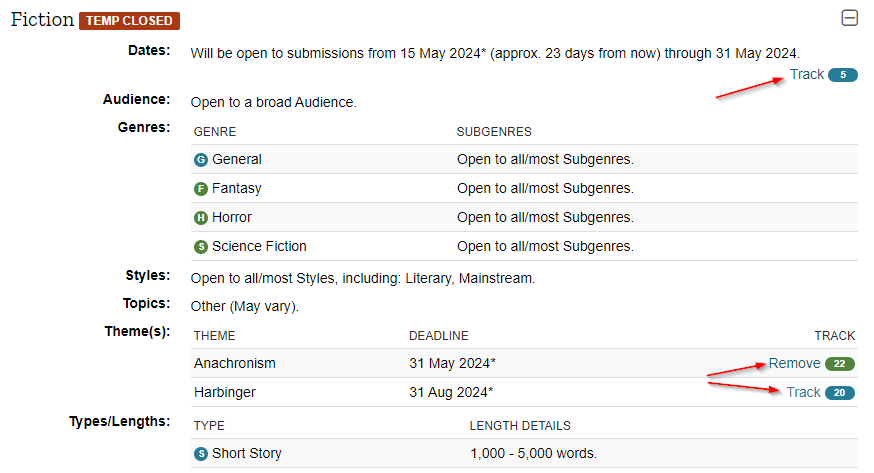
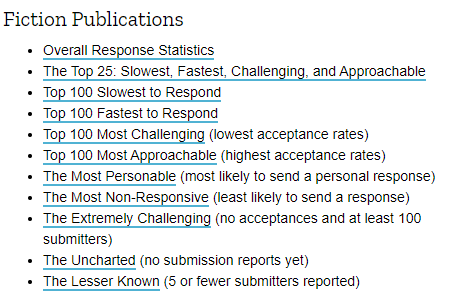
Then fire up Duotrope or Submission Grinder and find somewhere to submit that thing. And start working on the next story.






 Words Deferred