7 Duotrope Tips and Tricks

Anyone who has been keeping up with the blog lately will know that 2024 is my year of short stories. I’ve been writing short fiction and submitting it to publications. As a result, I’ve been using Duotrope quite a bit.

Duotrope includes a database of publisher information and a submission tracker for authors. (It’s not the only one: Submission Grinder and Chill Subs are out there too. Duotrope is just the tracker I’ve been using.) So, I thought I’d write about a few tips and tricks that I’ve discovered that make the submission process a little easier.

1. Search by Title

The Duotrope publisher search has a lot of options, so you might be surprised (as I was), that there is no option for the actual title of a publication.

For some reason, Duotrope decided that this belonged in its own section. The “Find by Title/Name” option in the Search menu gives you the option of inputting a partial or exact name. If you don’t quite remember the name of a publication, you can also try searching by alphabetical index.

2. Find Publishers for a Piece

Once you’ve added a story to your Duotrope submission tracker, it will show up on your “List of Pieces” page under Account -> Pieces.

When the piece is ready to be sent out, you can always search for publishers by manually entering the length, genre, and other parameters. But you don’t have to.

Instead, just click the “Publishers” link next to your story on the “List of Pieces” page. This will automatically populate a search with the information you’ve entered in the piece’s description.

3. Publishing News

The Publishing News section of the site shows publishers that have been recently added. Since brand-new publications are inherently less well-known, they may represent a good opportunity to get a story in front of editors that are hungry for content, with relatively small slush piles.

Publishing News also has a section for publishers that have recently opened to submissions, which can be another good way to find fresh options, especially when those publications are only briefly open to submissions.

4. Track Themes and Deadlines

Some publications are only open for submissions during specific windows. This is especially true for themed issues or anthologies. Duotrope can track these submission windows and deadlines.

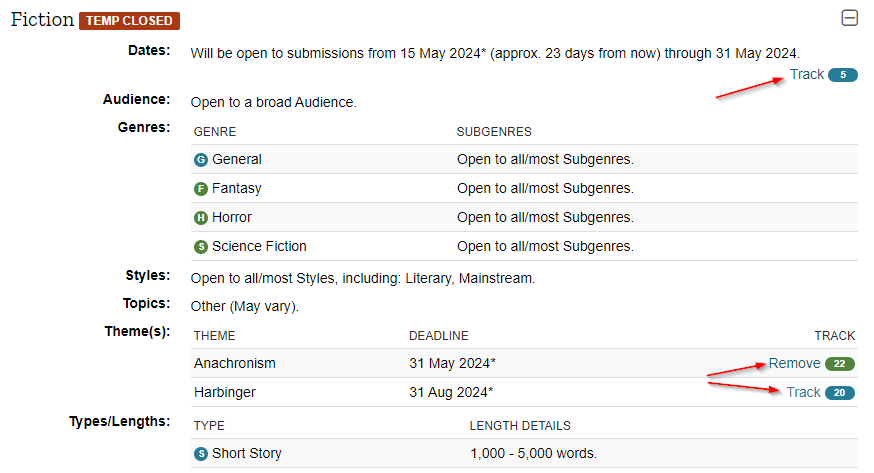
On a publisher’s detail page, general submission windows will be listed under the Dates heading, and specific themes will be listed under Theme(s). In each of these sections, there will be a Track link and a colored bubble listing the number of Duotrope users who are already tracking.

In the Account menu, you can visit “Themes and Dates” to see a convenient list of everything you’ve chosen to track.

5. Deadline Calendar

Whether or not you’re tracking any Themes or Deadlines, you can access the Theme and Deadline Calendar under the News section of the menu, or from the link at the top of the Theme tracking page.

By default, the calendar shows a list of all the themed submissions and deadlines in Duotrope, but you can filter by genre, payment, or your personal favorite publishers.

6. Overdue Responses at a Glance

Duotrope’s Submissions view shows information for all your tracked stories that are out on submission. It includes a trove of information, including some that makes it easier to decide if you need to follow up.

This view shows how many days each submission has been out, as well as the average response time reported by Duotrope users and the estimated response time provided by the publisher. But the status icon also has four different color options for pending responses.

Normally, the status is gray, but it will turn yellow if the submission has been out longer than the normal response time, and red if it exceeds the publisher’s stated response time. In some cases the publisher may state that they don’t always respond to submissions or don’t respond to status queries. In these cases, the icon will turn purple.

Of course, as with all things, you should confirm the publisher’s information on their website before blindly trusting Duotrope. It’s usually right, but occasionally there are discrepancies.

7. The Reports

Reports may sound dry and boring, but there are a few useful lists available there.

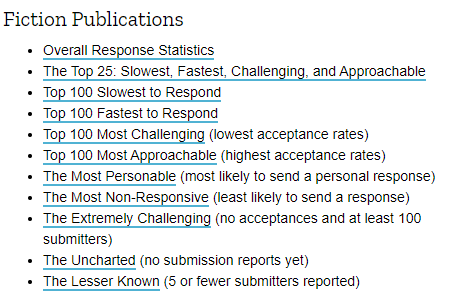
Authors who are sick of waiting for long response times can check the 100 fastest publishers to respond. Looking for feedback? Check the list of publishers most likely to send a personal response. Just trying to get a story accepted somewhere? Consider the list of publications with the highest reported acceptance rates.

What Else?

Do you use Duotrope? Are there any interesting features I missed? If you use a different tracker, I’d love to hear what they offer that Duotrope does not. Let me know in the comments.

Submission Fees for Short Fiction

There is a truism among authors that has been passed down for many years: “Money should always flow toward the writer.” In a world where many writers are desperate for recognition and the opportunity to be published and read, and where many unscrupulous people are happy to prey upon them, this is a good default attitude to have.

However, the publishing landscape has changed drastically in the decades since this truism was popularized. Traditional publishing, with its gauntlets of gatekeepers, is no longer the only path to success. Many choose to self-publish, and in self-publishing, sometimes it takes money to make money. Readers, editors, cover-artists and myriad other paid contractors are often used by successful self-published authors to polish their work and attract a wider audience.

I’ll admit that I’ve always been more focused on the traditional routes to publishing, so I was even more surprised to discover that fees paid by writers have crept into the world of short fiction as well. And this isn’t even self-publishing. It is now widely considered normal for literary magazines to charge several dollars in reading fees to authors who submit short stories for consideration, even when those journals pay little or nothing upon publication.

How Did This Happen?

In reading about this topic, I’ve come across a few explanations (or excuses) for this sea change. The audience for short fiction has been shrinking for years, stolen by games and movies and social media, so it’s harder to sell magazines. Publishing has always been a hard business, and it’s getting harder. Editors need fair compensation. Too many writers are submitting, and the slush pile is unmanageable.

There is no shortage of voices, both writers and editors, who claim that submission fees are “worth it.” Fees allow more literary journals to survive, which means more short fiction is published. These journals provide a valuable service: a place for up-and-coming writers to show off their work and grow their audience.

Publishing is not a business that moves quickly or embraces technology easily. That’s why Amazon was able to take over the ecosystem from publishers that dominated for decades. However, most of these journals have finally moved online in recent years. In fact, many no longer have any print presence whatsoever.

Many of the costs of running a journal are fixed: editors and readers are needed to trawl through the never-ending slush pile of submissions. Websites have maintenance costs. But there are also costs of printing that scale with the number of issues printed. Moving online should result in some sort of savings. So why are submission fees still becoming more popular?

There’s another reason for these fees, whispered wherever authors and editors gather: Submittable.

Fees as a Service

Submittable, according to its marketing, “streamlines workflows for publications of every kind, so you can get your content to more audiences, faster.”

Submittable is a private, VC-funded startup that provides software-as-a-service. I don’t think there are public numbers, but it’s likely that literary magazines are only a small part of their overall business.

For these journals, Submittable provides a means to accept, track, and respond to electronic submissions. No more piles of mail. No more paper manuscripts. Organize the slush pile, and send responses with a few clicks.

Sounds like a great thing. Except that Submittable makes its money by charging a fee for each submission it processes. This means that more submissions cost the journal more to process. Thanks to the pressure of these fees, Submittable’s business model often becomes the journal’s business model.

Cause and Effect

I don’t find the pleas for understanding from editors particularly sympathetic. They suggest that editors consider their own difficulties more important than any hardship their writers might face. I’ve seen more than one editor suggest that it’s unreasonable for writers to be mad. After all, don’t their staff deserve to be paid a living wage? Never mind that even full-time writers often don’t make enough to get over the poverty line.

Are these editors publishing as a side-job? It’s not uncommon. But it’s still uneven treatment to suggest that their side-gig deserves pay more than the authors that actually fill their publication.

I’m even less sympathetic toward submission fees when the journal doesn’t pay upon acceptance. What other profession requires the people producing the work to pay? This only makes sense under the assumption that art doesn’t hold any real economic value.

Is it really a valuable service to show off the work of upcoming writers while costing them money? If the publication isn’t being read enough to actually make money, how effectively is it promoting these writers? There are tons of ways authors could put their own work out into the world effectively for free, so the value of a journal must be prestige a or gatekeeper that ensures quality.

Nowhere else in publishing is this considered acceptable. Authors with a book in hand are warned never to work with an agent who requires up-front fees. Agents take a cut of the actual profit as motivation to get their clients a good deal. Book publishers who charge authors up-front fees are condescendingly referred to as “vanity presses.” So what makes short fiction (and especially short literary fiction) different?

Misaligned Incentives

Publishing works best when all the incentives align with the goal of creating a good product. A publication that relies on purchases and subscriptions from readers is incentivized to provide the most satisfying product to those readers. When less of the overall budget comes from readers, the incentives change. A hypothetical magazine that makes all its money from submission fees is incentivized to maximize the number of submissions, not the number and satisfaction of readers. It wouldn’t matter if the magazine had no readers, if they could convince authors to keep submitting.

Reading fees also skew publishing even more toward the privileged, and add yet another obstacle for struggling writers. A $2-3 fee isn’t a lot, but it is an emotional, mental, and sometimes very real financial barrier that a writer must overcome to submit. Determined writers aren’t submitting a couple times. They’re submitting dozens of times, sometimes for a single story. Fees add up.

Some publications have fee-free periods, or reduced and waived fees for specific underprivileged groups. This is a good thing, because it tries to address the problem, but it only goes so far. It’s a half measure that admits there is an issue, while only offering a partial solution.

But What Are The Alternatives?

It’s not easy to run a small publication. But that doesn’t make it ethical or justified to charge writers. Writers may seem like an infinite resource, and they are often abused because it is easy to do so.

For many writers, making a living (or something closer to a living) involves diversifying their income streams. They take writing contracts or work as journalists, copy-editors and proofreaders. To survive in challenging times, publications need to also diversify and be clever about their income streams. Luckily, we live in a time where there are a lot of ways to diversify.

Patreon, Kickstarter, and other crowd-funding platforms make it possible to build a community where the people who care about what you do can contribute directly to it. Many publications crowd-fund their regular issues and kickstart anthologies or other special editions. This requires good community engagement and providing a product that people like.

I’ve seen a few publications with optional submission fees. This is another form of patronage where authors who are well-off can offset the costs for those who aren’t. This can also take the form of payment for feedback, which is sometimes a nice option for those who are looking to improve their craft and struggling to understand why they aren’t landing more stories.

Merch, ads and sponsorships are other possible avenues for funding, all with their own upsides and downsides. With all these options, it’s easy to forget the original and simplest business model for literary journals: readers paying for stories. This can take the form of subscriptions, per-issue pricing, freemium models, and a million other variations.

Dumping Submittable

When it comes to Submittable, with its problematic fees, I think there’s a straightforward way to make things better. Just stop using it.

The speculative fiction (sci-fi/fantasy/horror) community is lucky to have an unusually high percentage of tech-savvy people working in it. There’s a reason why we have sites like Critters. Unlike other communities, spec-fic has pretty much completely eschewed Submittable. Instead, they’ve worked together and pooled resources to build tools like Moksha, or the Clarkesworld submission system. And none of them charge submission fees.

Don’t Settle

I come at this topic with a biased perspective. I’m a writer, and I don’t like paying fees to submit my work. But I don’t think it’s biased to say that submission fees for short fiction have a negative effect on readers, writers, and publishers. They might be the easiest solution to a hard problem, but that doesn’t make them the correct solution.

Writers shouldn’t excuse submission fees as a necessary evil. We should expect more from literary journals, even if that means these publications need to explore a creative mix of funding solutions to remain viable. Rather than accepting overpriced tools like Submittable, publications should work together on community tools that serve the community’s needs.

Writers and editors should be pursuing the same goals: a vibrant, healthy fiction ecosystem that not only produces great art, but also values that art and the writers producing it.

(Don’t) Write Every Day

Last week, in the second post of my series on writing short stories, I had already missed my weekly goals. Hardly the end of the world, but I was still a little disappointed in myself.

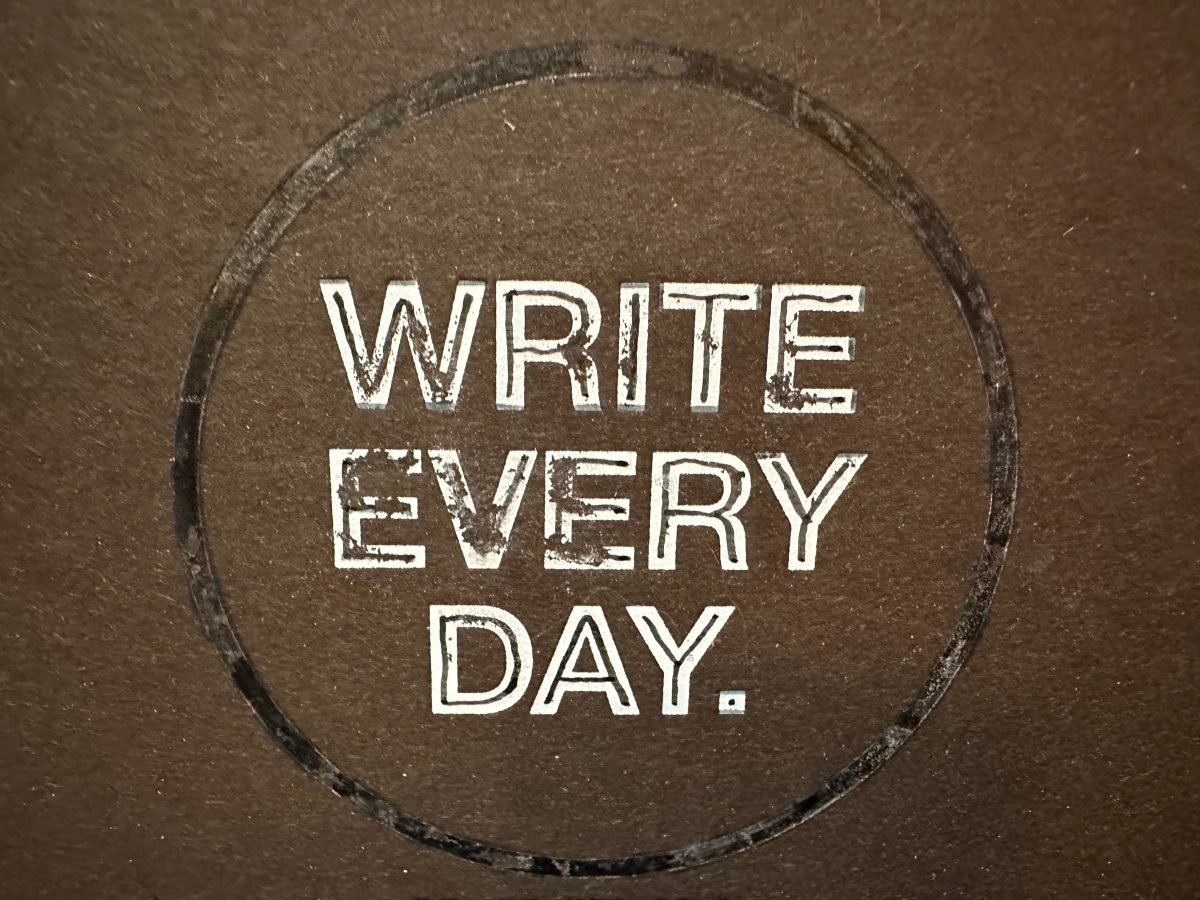
I have a notebook from NaNoWriMo that says “Write Every Day” on the cover. It’s exactly the thing that NaNoWriMo advocates. It might be the most commonly given writing advice. After all, if you want to be prolific, you’re going to need to write a lot. Right?

Well, yes and no.

The reason we have this mantra is because it’s hard. Most of us don’t write every day, even if we aspire to. However, simple aphorisms usually obscure a more complicated truth. Writing every day doesn’t guarantee success, and success doesn’t require writing every day.

The Self-Designed Job

Most of us who write fiction on spec are writing entirely on our own. There is no job description, no education or work history requirements. Nobody evaluated our resumes. We woke up one day and decided to write. Even those of us who have more formal writing jobs are often freelancers or contractors.

It can be powerful to choose your own goals and working hours. It can also be difficult. It’s not as simple as going into the office 9–5. It’s not as easy as having work handed down from a boss. Being self-directed means there are no defined boundaries to the job. You can work too little, or far too much.

I realized a few years ago that I was always setting goals for myself, and almost never satisfied with my own achievement. My performance reviews for my self-defined job were consistently bad. But this is really just my own personality issue. It doesn’t actually reflect my performance. Understanding that, I can more easily recognize that feeling and let it go.

Writing is More Than Writing

It’s not surprising how many writers hate talking about their own work, or trying to sell it. We write because we love writing, not because we want to do writing-adjacent business stuff. Unfortunately, that’s not the real world. If you want people to read what you’re writing, there’s probably some amount of business and self-promotion that needs to be done.

Beyond that, writing is more than putting words on the page. There’s work to be done before the first draft, coming up with ideas and refining them. There’s work to be done after, revising and editing. There are classes, books, and blogs about craft.

There is even the undefinable work of being out in the world, observing people and things, having the experiences that will inform the work. Fiction can only be as interesting as the inner world of the author. That stew of ideas requires ingredients and time.

I’ve even found blogging or journaling to be incredibly useful for my writing. Sometimes experience isn’t enough; it takes reflection to unlock that understanding. I can’t count the number of times that writing about my process resulted in exciting new ideas.

Moving Toward the Mountain

If you’re like me, and you have that voice in the back of your head that complains when you’re not writing “enough,” there are a few things you can do to address it. Make a list of all the things that contribute to the writing. Include things like ideation, editing, and critique. Include that fun business stuff, whether it be sending work to traditional publishers, working on self-publishing, or something as mundane as accounting for taxes. Include reflection, like blogging or journaling.

Ask yourself honestly if you’re allocating enough time to rest, recharge, and feed that stew of ideas that will, in turn, feed your stories. Don’t be afraid of taking a break, or even a vacation. If you want writing to be a “real” job, it should come with sick days and vacation time.

When pursuing goals, there are a lot of different ways to move toward the mountain. Sometimes the path isn’t straight. We have to put words to paper if we’re going to be writers. But not necessarily every day.

The Internet Archive Lawsuit

For those who aren’t aware, there is a lawsuit brought by four book publishers against the Internet Archive over their “National Emergency Library” initiative, which ran for about 3 months in 2020. During that time, the IA allowed unlimited lending of the books they had digitized. The updated program, which is still in effect, allows one person at a time to “check out” books, copies of which are supposed to be held in reserve by partner libraries.

The initial judgement was handed down recently, and it was not in favor of the IA. The judge ruled that the programs did not fall under fair use protections, and the IA would need permission from publishers to make such programs legal.

People Have Opinions About This

Author Chuck Wendig wrote a post about it—apparently he got hit by one of those social media firestorms that just keeps flaring up periodically—and says that he opposes the lawsuit. Meanwhile, Nathan Bransford (author, former agent and current freelance editor) fully supports the lawsuit, and links a Twitter thread by Nate Hoffelder explaining why the IA’s programs are bad for authors.

There are a couple reasons each camp has to support the publishers or the Internet Archive. The supporters remind us that at the beginning of the pandemic, many library systems shut down their physical buildings, and the “National Emergency Library” program was only active for a few months to help people who otherwise would have gone to those libraries. The current program is designed to limit the copies lent out in a way similar to existing libraries, so it’s less problematic. And, of course, the handful of very extreme “all-information-must-be-free” people are shouting the things they always shout, namely that most copyright and intellectual property law is bad for the human race and should be abolished.

In the opposite corner, the arguments are almost exclusively for authors’ rights. The IA ran a program that did nothing to compensate the authors of the books lent out, and was therefore pure enablement of piracy. Even the more restrictive program, while supposedly reserving library copies for each copy lent out, doesn’t have stringent controls and isn’t working with the publishers. (It’s worth noting that libraries do pay for books, and authors get a cut of that. There are systems for this that have been worked out over the years and strike a pretty good balance between compensating creators and making books available to a lot more people.)

Of Course, There Are Caveats

I do not see many people arguing in favor of the big publishers, which is telling. The truth is that authors and consumers both often feel like they’re being abused by the remaining handful of publishing conglomerates. Nobody is all that excited to go to bat for them, aside from the paid lawyers. But publishers are often the ones who end up fighting battles that benefit authors, for the simple reason that authors mostly get paid when publishers get paid.

Finally, the library systems of today have some pretty big flaws. While the advent of e-books has made it possible to borrow from libraries without getting off the couch, publishers also took the opportunity to make e-book lending far more advantageous to themselves, requiring additional payments after an amount of time or number of borrows. Plus, you have Amazon controlling a huge swath of e-books and outright refusing to lend, smaller presses being much harder to find at your local library, and a ton of people in the rural US (and certainly throughout the world) that do not have local library systems available to them.

My Thoughts

I’m somewhat inclined to forgive the IA for the brief run of the “National Emergency Library.” The beginning of the pandemic was a bad time, and nobody really knew how it was going to go. However, I have to acknowledge that I come at this argument from a place of privilege. I worried about a lot of things during the height of the pandemic, but I had a steady job.

The vast majority of authors don’t make enough money from their writing to live above the poverty line. That means they mostly aren’t wealthy and have to rely on other income streams, like spouses or other jobs. It also means that many authors work hard and struggle to eke every dime out of their work. Authors went through the pandemic just like readers, but the IA’s arguments don’t seem to worry about how authors might have been affected by the uncompensated lending of their work.

In terms of actual law, it seems pretty likely that the IA will lose their appeals. To win, they would need to carve out some new territory under fair use, and this doesn’t seem like the kind of judicial climate (especially if it gets to the Supreme Court level) where that is likely to happen. I like a lot of other things the IA does, and I hope this doesn’t hurt them too badly.

While I feel strongly for fellow authors, I don’t have much sympathy for the big publishers. They’ve made e-book lending worse than it could be, in misguided attempts to crank up profits. This would be a great opportunity to reevaluate and improve the relationships between publishers and libraries.

E-book lending theoretically solves a lot of the problems of locality that physical libraries have. It would be great if libraries had a little more legal authority to force reasonable deals with publishers for lending (and maybe even prevent companies like Amazon from locking out lenders altogether).

If we’ve learned anything from the digitization of movies and music, it’s that you can’t eradicate piracy. From Napster to Kazaa to BitTorrent, fighting pirates is like playing whack-a-mole. Some people are determined not to pay, and digital goods are just too easy to copy. The way to fight back is to make your legally-sold digital product as cheap, easy-to-use, and high-quality as possible.

My Writing Process — 2022

One of the goals of Words Deferred has always been to open up my writing process for everyone to see. I don’t claim to have the perfect process, and I think the best way to write will ultimately be different for each writer. However, there’s surprisingly little talk among writers about the day-to-day details of what writing is like, and I want to do my small part to change that.

As the end of the year approaches, I thought it would be interesting to look at the writing I’m doing and the tools I’m using in 2022. Then I can look back on this next year and see how things have changed, or if they’ve stayed the same.

Ideation

Writers are known for carrying little notebooks and jotting down ideas whenever and wherever they appear. In the past, I’ve carried pocket-sized notebooks, but I went entirely digital several years ago.

My digital notebook of choice is Microsoft OneNote. I have separate tabs for general brainstorms and ideas, short stories, novels, blog posts, lists of books I might eventually read, and more. When I need to take notes on the go, I just jot them down on my phone. OneNote synchronizes automatically between phone and laptop, with only occasional weird formatting issues.

My OneNote. There are a lot of pages hidden under those headings…

Novel Writing

For novels, when I’m ready to go beyond the idea-gathering stage, I move all my notes from OneNote into Scrivener.

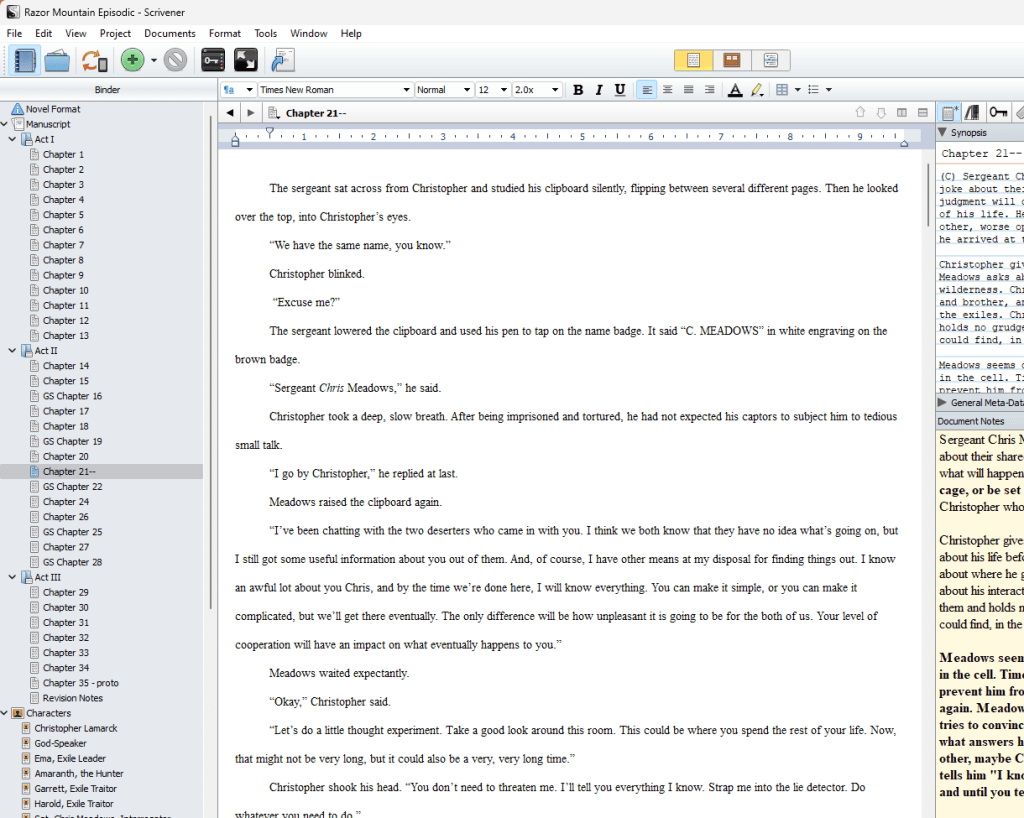
As far as I am concerned, Scrivener is the best novel-writing application out there. Where it really shines is in the way it lets me split a big project into nested parts. I split Razor Mountain into folders for each act, then split out each chapter into its own document under those folders. I have separate sections for major characters, locations and other research notes.

With a click of a button, I can look at the chapter summaries on a cork-board view, and I can drag-and-drop chapters in the document tree to rearrange them, something that has been really convenient as I’ve merged and moved chapters in Act II. Scrivener also has built-in support for “snapshots,” which I use to save each revision of each chapter. I typically save at least a rough draft, a second draft after some editing, and a third draft once I’ve gotten reader feedback.

To ensure that my work is fully backed up, I save my Scrivener files to Dropbox, which copies them across my computers and my phone for safe-keeping. I do have the mobile version of Scrivener, but I almost never use it. I love taking notes on my phone, but I do not enjoy long-form writing on that tiny keyboard.

Serial Publishing

I’m publishing Razor Mountain as a serial in three places: here on the blog, on Wattpad, and on Tapas. I chose to do this so that I could get a feel for the different platforms, and to try to increase the visibility. However, I haven’t done much to promote the Tapas or Wattpad versions, so pretty much all of my regular readership is on WordPress. I keep telling myself that I’ll eventually put some love into Tapas and Wattpad, and that may actually happen at some point. Either way, I’ll continue on all three until Razor Mountain is finished.

Because I’m posting to three platforms, my process for this is a little bit insane. It goes something like:

  1. Write the first draft and first round of edits in Scrivener.
  2. Copy it to Google Docs for easy beta reader feedback. Fix the formatting that doesn’t transfer nicely.
  3. Make changes based on feedback in Scrivener, and decide how to split the chapter into multiple posts.
  4. Copy it to a OneNote template with the brief description at the top and links to previous/home/next at the bottom.
  5. Copy from OneNote to WordPress. Schedule the posts.
  6. Copy from OneNote to Wattpad. Fix all the formatting that doesn’t transfer nicely. (Wattpad has no way to schedule posts.)
  7. Copy from OneNote to Tapas. Fix the formatting that doesn’t transfer nicely. Schedule the posts.
  8. On the scheduled day, chapter parts automatically post to WordPress and Tapas.
  9. I have to manually post the saved draft to Wattpad. I also have to update the previous/next links in the WordPress post, and I need to add links to the Razor Mountain home page. Depending on how busy I am, I sometimes forget to do these things, and I typically don’t catch it until I start posting the next chapter.

Some of this complexity comes from posting in three places, each with their own idiosyncrasies. It’s obnoxious how often copy/pasting between tools and websites causes the formatting to be lost. It’s doubly obnoxious that Wattpad doesn’t let me schedule posts.

I suspect there is probably a way to add WordPress links (previous/next and home page) that point to a scheduled post and only work once the post is “live.” I haven’t spent the time to figure it out though.

Short Stories

The majority of my writing time this year went toward Razor Mountain and the blog, but I have managed to sneak in a few short stories.

For microfiction, drabbles, and flash fiction, I often just work in OneNote. Unlike novel writing, I sometimes do work on short short stories on my phone, and I typically do not need organizing features or formatting more complex than italics and bold.

For longer stories, I usually use Microsoft Word on the laptop. Oddly, I copy to Google Docs for easy beta reader feedback, but I never really write in it. I’ve been using Word for years and I’m comfortable with it.

For all of my stories, I save everything to Dropbox to make sure it’s backed up. When it comes time to find places to submit stories, I use Duotrope.

Blogging

My blogging schedule has fluctuated over time, but these days I try to post Razor Mountain chapters every other week.

Unless a chapter is around a thousand words or less, I will break it into 2-3 parts of about a thousand words each. I’ve read that 500-1000 words is the sweet spot for keeping readers’ attention for blogs, and a slim majority of my WordPress readers are on mobile, where a post of that size feels bigger on the page than it does on a full-size monitor or tablet. Tapas and Wattpad don’t have that kind of detailed dashboard for writers, but they do say that most of their readers are also on mobile.

Along with the chapters themselves, I write a development journal for each Razor Mountain chapter. Sometimes I post the chapter parts earlier in a week (e.g. Wednesday and Thursday), and the development journal on Friday. If I have three parts in a chapter or get a little behind, I will sometimes post the development journal the following Monday. I used to worry about maintaining an exact schedule, but nowadays I just aim for a schedule and adjust as needed.

I write blog posts unrelated to Razor Mountain on the “off” weeks, and sometimes for the Monday of Razor Mountain weeks as well. I’ve been blogging long enough now that I have a few ongoing series of posts, so I will often mix one of those posts with something stand-alone in a given week.

I’ve gotten in the habit of posting reblogs every other Wednesday. Writing three blog posts in a week is too much for me, and reblogs are low-effort (while hopefully still interesting content). They occasionally result in some cross-pollination with the other blog’s readership. Their main purpose is to serve as a good motivation for me to regularly read other writing blogs. I maintain a list of interesting articles and blog posts in my OneNote, and trawl through them for these reblogs.

For the header images on my posts, I use Pexels. I don’t usually do any picture editing apart from cropping. If I have a really difficult time finding an image that I’m happy with, I will occasionally check Unsplash. Both of these sites offer pictures that are free to use and do not require specific license language to be displayed.

(If you’re blogging, please do yourself a favor and always check the licensing and make sure you’re attributing correctly. There are trolls out there who will sue you for hundreds of dollars, even for such non-crimes as using the incorrect version of Creative Commons. And if the image isn’t licensed for your use, don’t use it!)

I make it easy on myself and always use the same cover image for Razor Mountain chapters, and pictures of mountains for development journals. For all other posts, I just search for terms vaguely related to the content.

I always write my blog posts in OneNote, do an editing pass, and then copy/paste them into WordPress. I almost never publish a post immediately. Instead, I schedule them for 7:00am CST on a subsequent day—usually Monday, Wednesday or Friday.

Tracking

My latest endeavor is to try to get a better understanding of how I’m using my writing time. Lately, I’ve been using ClickUp. I like it for charting “deadlines,” even if they’re entirely self-imposed, and laying out a schedule of things I intend to write.

And even though I’ve explicitly said in the past that I don’t want to end up tracking things in Microsoft Excel, I’ve been doing a little bit of tracking in Excel. I haven’t found a great way to roll up the time spent on different projects in ClickUp in a way I like. Excel makes it dead simple to make a few columns and track days, projects and half-hour increments. It’s all compact and easy to eyeball, and there’s always an easily searched website that will tell you how to translate a few columns into an interesting graph, even if Excel formulas make me feel a little dirty.

This tracking stuff is still in flux, and I expect it to change. In every other respect I am an old man, set in my ways. It’ll be interesting to check back in next year, and see if anything is different.

This post is already much longer than I planned, so I’ll end it here. Hopefully it was interesting to see how another writer works. If you’re an author who writes about your own process, I’d love to read about how you’re working. Leave a comment or a link to a post of your own.

Reference Desk #16 — ClickUp

This series is all about tools and resources that are useful for writers. It’s been a while since I added a new entry, because I’ve written about pretty much every tool I use for my writing. However, I recently added a new one to my arsenal: a web-app called ClickUp.

Time Tracking for Writers

Part of the reason I started this blog was to get better at writing frequently and consistently. In that, it has been a success. I don’t write every day, but I do write several times a week. Between my job and family and everything we have going on, I’ve reached the point where I’m mostly happy with the amount of time I’m putting into my writing, and I’m balanced with the rest of my life.

However, ramping up my weekly writing time was an easy way to improve. If I assume that I’m going to maintain my current cadence, I have to find other avenues to increase the quantity or quality of my writing. My next step is to more closely track my writing time and how much of it I spend on different projects. If I can’t spend more time on writing, I have to get more efficient with how I use that time. I read some blog posts by writers who track their writing time, and it seemed like something that might be worthwhile.

If you think tracking your writing time sounds like an awful thing to inflict on yourself, I don’t blame you. It’s a little tedious, and it’s a distraction from the “real” work of actually getting words on the page. However, if you’re the sort of writer that wants to make writing into a full-time job, you might want to consider actually treating it like a job, even if only for a few hours a week—and that may include things like figuring out just how well you’re spending your time.

Even for those who aren’t interested in writing as a job, it can be a valuable exercise to actually track what you’re getting done. In my day job, this kind of tracking has opened my eyes to cases where I was spending much more or less time on certain things than my “gut feel” told me I was.

In any case, I decided it would be worth at least trying to track my writing time as an experiment. If I learned something useful, great. If I didn’t, then at least I tried. Thus began the long and painful search for decent project tracking software.

The Nightmare Hellscape of Business Software

Managing projects is big business, and selling software that supposedly makes those projects run more smoothly is therefore big business too. The Google results are packed with ads, and there are literally dozens of different applications that guarantee they will make your job infinitely better.

I’m sure this is obnoxious enough when you’re some middle manager at a Fortune 500 company, but it’s even worse if you’re just a freelancer or individual who just wants a basic solution for personal use. I’m not going to bore you with the list of products I tried. If you do a web search for project management or time tracking web applications, you’ll find them all.

I had a short list of features I wanted:

  • A list view of projects and categories
  • A way to track time spent on each project
  • A Gantt chart that understands dependencies between projects
  • A low price point – preferably free or a one-time charge

That last point, price, is a tough one. Almost all of these products are trying to sell to big business, and they want that recurring revenue stream. After all, they have to maintain their web infrastructure and all of those collaboration tools…that I don’t plan on using.

I was more surprised at how few tools make it easy to attach dates to projects and then see them all lined up on a schedule. This seems like pretty core functionality to me, but a lot of these products just show projects as line items or colorful squares, and don’t seem to understand scheduling. If all I wanted was a Kanban board, I’d just use Trello.

ClickUp

ClickUp ended up being the first tool I tried that actually did what I was looking for and didn’t try to lock me into a monthly contract after a brief trial.

The two views I’ve been using so far are the list and Gantt views. The list provides a set of category buckets that projects can be dropped into. You can set due dates, a priority flag, make comments, and track time. It’s possible to add more columns here, but I haven’t played with any others so I can’t comment on usefulness.

There is also a nice feature that allows association of sub-projects with a parent. I’ve used this to track things like the individual blog posts and development journals for my serial novel, Razor Mountain, or different drafts of a short story.

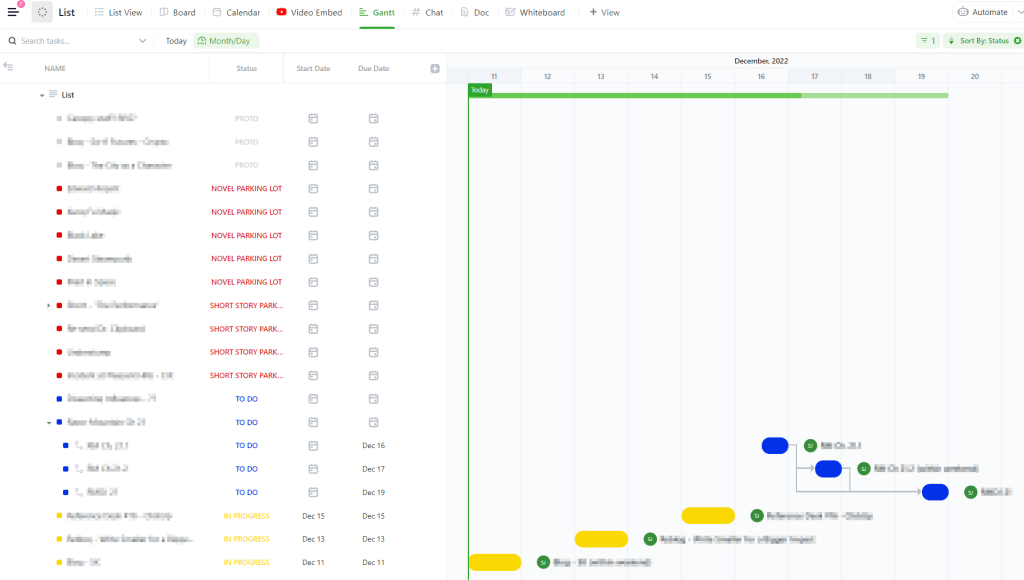
The Gantt view puts the list on the left side, and a scheduling view on the right. From here, tasks are placed according to their due dates, but the time range is easily adjustable. It is also possible to add dependencies between tasks in the task details and see them as little arrows on the chart. This is a little bit clunky, and I haven’t used it much.

ClickUp list view. (Project names blurred to protect the innocent)
ClickUp Gantt view.

There are a number of other features that I haven’t really used. ClickUp has several views of the same information, including a calendar and Kanban board. It has a chat feature, video embedding, and a document storage/wiki feature as well. The documents might be useful for some writers, but these are features that will eventually fill up the limited storage available to free accounts.

On that note…

Pricing

One of the key features of ClickUp that makes it work for me is a perpetually free account tier with a reasonable feature set. The only significant limitation is 100MB of storage, which is a good amount, but certainly possible to use up if you start attaching images or video to your projects.

There are several paid plans with various features, but they’re all targeting businesses, and I haven’t felt the need to dig into them. The free tier gives me what I need for my individual tracking.

But is it Useful?

I don’t really know yet. Although I’ve played around in ClickUp enough to decide it’s the tool I want to use for my time tracking experiment, I haven’t been consistently tracking my projects yet. I’ll need to spend some time figuring out my workflow and the features I want to use.

Once I’ve had some time to track my projects and decide if it’s valuable, I’ll write a follow-up post to tell you how it went.

Reblog: Get the Big Things Right — Nathan Bransford

Today’s reblog comes from Nathan Bransford, who has worked as an agent, author, and now freelance editor and consultant. He knows that there is a lot of side-work that comes with publishing—from query letters and synopses to promotion and marketing. It’s easy to get overwhelmed by all the things that come with writing, but aren’t actually writing.

He gives us a reasonably-sized list of things to focus on when writing and selling a book:

Particularly in this day and age when so many authors are lost in the weeds of Amazon algorithms and marketing strategies and social media and querying etiquette, it’s shocking to me how many people forget this: it all starts by writing a book that people want to read.

And not just want to read: writing a book that makes other people press it into other people’s hands so they’ll read it too.

That’s it. That’s by far (BY FAR) the most important thing.

Unfortunately, it’s also really, really, really hard to do, which is why it’s tempting to focus on things that are easier and feel more in your control.

Read the rest over at Nathan Bransford’s Blog…

Reference Desk #15 — Duotrope vs. Submission Grinder

The Short Story Series

It’s the ultimate crossover event! Today we have a continuation of my short story series, as well as my Reference Desk series detailing useful tools for writers. Get ready for a battle of publication catalogues and a submission tracker showdown!

Finding the right place to submit your short fiction isn’t trivial. Back in the olden days, you might have to subscribe to an actual dead-tree trade journal just to have a somewhat up-to-date list of publications. These days, the internet gives us some easier options.

The two most popular submission tools for short fiction writers are Duotrope and Submission Grinder. Both of them are designed to help you find markets for your stories and track your submissions. Today, I’ll be comparing some of the different features between these two tools to give you a better idea of which one you might want to use.

Price

Let’s get this out of the way up front. Duotrope is a paid service. After a 7-day free trial, it costs $5/month or $50/year. Submission Grinder is completely free to use, although they have numerous options to donate.

If you don’t want to pay or can’t afford it, Submission Grinder is the tool for you.

Listings

Duotrope maintains listings of publishers of fiction, non-fiction, poetry and visual art. It also lists literary agents for fiction writers. Submission Grinder maintains fiction and poetry listings.

At the time of writing, Duotrope lists 5,027 fiction markets. They claim that they keep their listings accurate and up-to-date by checking each active listing for changes about once a month. They also run more thorough check twice a year, contacting the editors or agents if anything appears to be inaccurate or if there are signs that the market may be dead or on hiatus. (Websites not being updated is honestly a pretty big problem with small markets.)

At the time of writing, the Submission Grinder has 2,669 listings for fiction and poetry. It’s not entirely clear from the webpage how the listings are kept updated, although there are links for users to suggest a new market listing or suggest a correction, so it seems to be mostly crowdsourced.

Submission Tracking

Both tools let you

  • Add stories to your tracker
  • Add submissions for a story
  • Mark a submission as accepted, rejected, or no response
  • Track and search personal statistics
  • Track deadlines

Both tools also aggregate the statistics across their user base. This allows them to show information like what percentage of submissions are accepted or rejected by a specific market. They both have anonymized feeds of recent activity.

Duotrope has a plethora of statistics*, including the markets that are fastest and slowest to respond, and those that are most or least likely to accept (or even respond!)

*Note: you can see the list, but not the actual statistics, without a subscription

Additional Features

  • Both tools have an optional newsletter with new listings and other publishing news.
  • Duotrope has transcripts from hundreds of editor and literary agent interviews—possibly useful for getting a better idea of what your favorite market is looking for, or just general good practices.
  • Duotrope has some basic guides for writers, especially around submitting your work. It also has guides to using their various tools.

Takeaways

Honestly, both of these tools get the job done. They make it easy to search a lot of different markets, and to track your submissions as you send them out.

Overall, I do find Duotrope to be a little bit nicer. It has a few more features and a little more polish, but that’s to be expected when they have a subscription fee. If you don’t mind spending the money, I think Duotrope is good value for the cost.

Submission Grinder feels a little more like a community project, crowdsourcing market info and relying on donations. Maintaining a popular tool site takes work, and based on their Patreon, I think Submission Grinder is powered more by love than money.

If you have a story or two that you’re looking to send out, you should definitely try out one of these services. It will make it a lot easier to find ideal markets and keep track of what gets sent where.

Reblog — How to Be a Professional Author… — Chuck Wendig

Alright, the full title of today’s reblog is “How to Be a Professional Author and Not Die Screaming and Starving in a Lightless Abyss.” Hyperbole is Wendig’s brand. This is also a two-for-one deal, because Chuck takes as his inspiration Heather Demetrios’ Medium post, “How to Lose a Third of a Million Dollars Without Even Trying.”

Heather was a debut author who had some success early on, and made the mistake of assuming that would equate to the authorial equivalent of a steady paycheck. She found out the hard way that one or two big advances do not necessarily mean that subsequent novels will fetch the same amount of money, especially for new authors.

Most authors write for the joy of the art. Unfortunately, if you also want to make a living with your art, business savvy becomes a significant concern. Most professional authors make a fairly modest income, and it doesn’t come in the form of twice-monthly paychecks or health insurance.

Demetrios advice comes in the form of a list of regrets, in the hopes that other authors won’t make the same mistakes she did. Wendig adds his own rambling advice as a successful professional writer with quite a few years’ experience.

I feel deeply for the writer, because this shit we do comes with no real map. No creative map, no story map, no industry map, no money map. “HERE IS A BUNCH OF MONEY,” a sinister shadowy figure says in an alley. “IN SIX MONTHS, WE WILL EXTRACT FROM YOU A BOOK, AND THEN THE DEAL IS COMPLETE.” And then the shadowy figure is gone, and all you’re left with is the crisp smell of burning paper and a mysterious whisper in the well of your ear that says, “deckle edge.”

But, the good news is, there exist answers to a lot of these conundrums, and so I’m going to do some painting-with-shotguns here and try to broad-stroke some thoughts and answers about the challenges this writer faced in her Authorial Journey.

Read the rest over at Wendig’s blog, TerribleMinds…

Submitting Short Stories

The Short Story Series

Make Sure It’s Ready

Writing a brilliant short story isn’t enough. When it comes time to submit, you’re in a competition with every other author who’s submitting to the same magazine, anthology or contest. And often, that’s hundreds of other people—hundreds of other stories—you’re going up against. Make sure to seek out critique and make revisions. Polish that story until it shines.

If your story is accepted, an editor may certainly ask for changes, but you still need to show your very best work up front if you want to get that far. Editors and readers are looking for any excuse to reject your story to whittle down that huge pile of submissions. Don’t give them an easy excuse like typos or sloppy grammar.

Where to Submit

The first thing you need when submitting a short story is someplace to submit to. Hopefully you’ve been reading short stories, because this is a great way to do field research on publications in your chosen genre(s). The publishing landscape is ever-shifting, but it’s a good idea to read widely to get a sense of who the heavy hitters are.

For example, as someone who writes a lot of sci-fi and fantasy, I know that The Magazine of Fantasy and Science Fiction, Analog Science Fiction And Fact, and Asimov’s Science Fiction are three of the biggest speculative fiction magazines. They’ve been around for decades and pay professional rates for short stories. There is a prestige to getting published by them. However, there are a number of other magazines and websites that are popular and pay well, and an even larger number of smaller magazines and websites that often fill specific niches and tend to pay less.

Ultimately, what you want to do is understand your options and match your story to the places with the best chance of accepting it. The best way to do that is to read some sample stories and look at the submission guidelines.

Submission Guidelines

Most actively publishing magazines, open contests, and anthologies with open submissions will post submission guidelines on their website. Submission guidelines are just the publisher’s description of what kinds of submissions they want, and how they want to receive them.

Tools like Duotrope and Submission Grinder collect the submission guidelines of many different publications and make them easier to search, so these can be a real boon. However, they sometimes take a while to add new publications, remove defunct ones, or update guidelines that have changed. Always, always, always double-check the publication’s website, and follow those guidelines if there’s any discrepancy.

Submission guidelines typically have some subset of the following:

  • Genres, Subgenres or Topics – A description of the kind of stories the editors like. This can be very broad (“hard science fiction”) or considerably more specific (“steampunk,” “stories related to climate change”). Contests and anthologies often have a theme, and even big magazines will sometimes have “theme issues.”
  • Word Count – Most publications have hard limits on the size of story they will accept. They might also note the size of story that they prefer, even if they occasionally accept larger submissions.
  • Submission Windows – Anthologies and contests always have cutoffs, because they eventually have to publish or judge. Some magazines only accept submissions at certain times.
  • Pay Rate – Legitimate publishers say up-front how much they will pay. This is often a rate like X cents per word, although you will sometimes see a flat payment per story/poem. What counts as a “professional rate” is often decided by your genre’s professional organization. For example, the SFWA currently considers 8¢/word to be the minimum for sci-fi and fantasy.
  • Form and Formatting – Some publications only accept stories sent as Word documents to an email address. Others have a form directly on their website for submission. They may specify a specific font, font size, or line spacing. These may sound pedantic, but they’re designed to make it as easy as possible for the editors to wade through a sea of submissions. You do not want to be the person who makes an editor’s life a little more difficult.
  • Response Time – Submitting stories is slow! Most publishers take weeks or months to respond to a submission. Patience is a virtue, but if you wait for the specified response time and don’t get anything, you should feel free to reach out to the publisher, or move on and submit that story somewhere else.
  • Other Stuff – Submission guidelines may also say whether a publication accepts simultaneous submissions (sending one story to multiple publications at the same time), multiple submissions (sending several stories to the same publication at the same time) or reprints and translations. As a rule, don’t send any of these things unless it’s explicitly allowed.

Formatting

There is a standard format for short stories, and the incredibly detailed visual guides on William Shunn’s website have become the go-to place for writers to find them. Remember, the specific instructions within a publication’s submission guidelines should always be followed first. If the instructions aren’t specific on a particular point or leave something out, you can default to Shunn’s recommendations.

Submission Considerations

When you first finish a short story, there will probably be a number of publications that fit your story. The next step is to decide which of them to submit to first.

Consider starting with the best pay or highest prestige. Sure, I’m less likely to have my story accepted by Analog than a smaller magazine, but if they do accept it, I’m getting an excellent pay rate, and a really nice publication credit. If they reject it, I can always send it out to another.

There are other approaches, however. If you’ve found several potential publishers who accept simultaneous submissions, you can send your story to all of them at once. Simultaneous submission can really speed up the submission process, where you’re often waiting weeks or even months for a reply.

If one or more of your potential publishers has a submission window, you may want to submit to them while it’s open. If they reject it, you can submit to the others at any time.

Tracking Submissions

When you’re submitting your first short story, it may seem silly to talk about tracking your submissions. After all, it’s your baby, your pride and joy, and that publisher will surely love it. And even if it gets rejected, it’s not that hard to keep track of one story.

The truth is that writing and submitting short stories is a grind. Statistically, most publishers don’t take simultaneous submissions, it usually takes weeks to get a response, and most stories don’t find a home on their first submission. If you’re going to write short stories, you’re likely to end up with multiple short stories out for submission at once. Possibly a lot of them. You’re going to get rejections. And you’re going to have to keep writing.

Tracking your submissions ensures you know what stories are currently out, who has already looked at them, and who’s looking at them now. You’ll want to track the expected response time so you know when to check your spam folder, send a query, or give up and send to another publisher. You may want to make a list of the publications you’re interested in sending a particular story. You might also find it a useful place to track acceptances and payments (don’t forget those taxes!)

If you want to do your own tracking, Excel spreadsheets and Google Docs are infinitely flexible, and as long as you’re willing to put in the effort, you can craft exactly what you want. Alternatively, both Duotrope and the Submission Grinder have built-in submission tracking, and tracking your statistics in those systems helps to build statistics that can be useful to everyone.

Rejection

The hard part of the short story grind is the rejection. Nobody likes pouring their heart and soul into a story, only to be told that it’s not good enough. Unfortunately, the simple math of publishing is that there are far more stories being submitted than there are slots for publication. The majority of stories are never published.

The way to fight that math is to craft the best story you can, and then submit as much as you can. More (good) stories and more submissions raise your odds. You will need to build up the fortitude to be rejected over and over again and keep on going.

It’s also important to note that not all rejections are created equal. There are a few different kinds:

  • Form rejections – These are most common. The story didn’t pique the interest of the publication.
  • Higher-tier rejections – These may still be form rejections, but they usually mention that the editors were interested, or that they considered the story but ultimately didn’t find a spot for it. Some publications have multiple tiers of readers, and the story didn’t get all the way to the top.
  • Personalized rejections – These are rare and valuable. They are specific to you and your story, and explain in more detail why the story didn’t quite make the cut. If you’re lucky, they may suggest improvements or invite you to submit more work to this publisher.

While all rejection may seem bad, it’s a great sign to receive any personalized feedback from a publication. These people are constantly wading through the slush pile of submissions and working on tight deadlines, so they only spend time on a personalized response when they really like something. Unfortunately, due to the complexities of publishing, they may really like your story and still not be able to publish it. Take it as a win, and move on.

More Advice

Finally, I’m going to point you to Aeryn Rudel’s new author starter kit.

Rudel is an incredibly prolific short story writer who tries to make 100 short story submissions every year. His blog is a great general resource when it comes to writing and submitting stories, and his monthly recaps show just how much rejection even a successful author has to power through.

Submit!

At this point in the Short Story Series, we’ve been through all the basics of writing short stories. I’ll probably still have one or two more articles, but you know enough to get started. If you haven’t done it before, it may seem daunting to write a short story and send it off to a publisher. Great! The best way to gain experience is to try it.

Once your story is submitted you can forget about it for a few weeks and write something new. It’s the authorial circle of life. Don’t give up, and keep writing.