It’s a common misconception that a great idea makes a great story. The truth is that most great stories come down to execution. A great idea with poor execution rarely works, but a great writer can breathe new life into even the most tired tropes.
Like any writer, I have my own treasure trove of ideas that might end up in a story…someday. But why horde them? Instead, I’m opening the vault and setting them free.
Use these ideas as a writing prompt, or come up with your own twist and reply in the comments.
Computational Literature
Early on, computer programming was valued for its practical uses. It overturned industry and transformed society. It was deemed a science, even if computer science wasn’t as rigorous as physics or chemistry.
There were always those who saw the artistry in programming, the code golfers, makers of esoteric languages, and high-minded software architects. But what does artistry matter in the face of trillion-dollar industries and socioeconomic upheaval?
That was before Gustav Nacht, classical painter turned web designer. In retrospect, it’s clear that his genius was on par with greats like Mozart, Nabokov, or Van Gogh. At the time, nobody took his School for Computational Literature seriously.
Nacht pioneered programming languages that were as expressive for humans as they were for computers. Ernest was a language as terse and evocative as the writing of Hemingway, while Faulkner was a language as verbose, complex, and non-linear as the stories of its namesake.
It took decades, but by the time of Nacht’s death, non-programmers reading computational literature had become commonplace, and the ability to program finally seemed destined to become ubiquitous, as more and more people discovered these accessible gateways into the practice.
Nacht’s best students carried on his work, and while some fans might suggest that nobody would ever attain the same artistic heights as Nacht himself, most readers found subsequent generations even more enjoyable.
2026 is another year of short stories. In this weekly series, I talk about short story writing, from idea and draft to submission.
This is week four: Jan. 24 – Jan. 30
Stats
Stories Finished: 0
Submissions Currently Out: 2
Submissions Total: 1
Rejections: 2
Acceptances: 0
Goals and Results
The goals I set for this week were:
Clean up another story (F-TIB) for Critters
Revise a story (Red Eyes)
Do just enough new writing to meet my self-imposed quota
My first goal went very smoothly. I usually don’t do a lot of heavy editing on a story initially, unless I get seriously negative feedback from my first readers or I feel like it has big structural problems. This particular story is fairly short—about 2300 words—and feels pretty good after some light cleanup.
My biggest concern isn’t a story structure thing, it’s the fact that one of the two main characters is trans, and their transition is an important plot point. I’m not trans, and I want to do right by the character and by that community. I haven’t worked with a sensitivity reader (formal or informal), but that’s something I might explore for this piece.
Goal number two is a work in progress. I won’t talk too much more about it. I’ve already mentioned that Red Eyes is a fairly long story (6600 words) that does need some structural adjustments, and that’s ongoing. I think this is an interesting example of the editorial process, so I may publish a longer post-mortem when I’m done.
Goal three was an abject failure. I barely wrote anything new this week. That doesn’t bother me, since I’m making progress on my revisions and that’s what I need to do to get more stories ready for submission. My word count goals are very reasonable, and I can still easily make up those words in a few hours of solid work.
Looking Back on the First Month
It’s hard to believe that January is over. One month down, eleven to go. I’m happy to report that I feel like I’ve struck a good equilibrium with my goals. I don’t feel overwhelmed, but I am getting things done.
So far, that isn’t reflected much in the stats at the top of these posts. I’ve been working on several stories, but haven’t yet pushed one over the line to be ready for submission. If we go by my goals for the year, I should be finishing one story per month. So I will necessarily have to ramp that up.
The number of submissions is also slightly low, if we go by the raw math of splitting 50 submissions over 12 months. This flows from completing stories, so it makes sense. Naturally, as I finish more stories I will be able to submit more, so I expect this to ramp up throughout the year.
My final goal for the year was orthogonal to writing short fiction: essentially keeping the blog active by posting 100 times. Conveniently, this works out to roughly two posts per week. So far I’ve remained comfortably on track.
I was struck by multiple ideas for the blog this week, which was a small distraction from writing fiction, but a welcome one. I was able to build up a small backlog of posts over my holiday vacation, and I’m happy to be able to maintain a healthy buffer for those inevitable times when the well of ideas runs dry. It’s a nice way to keep the writing muscles in shape while taking a break from fiction, and a good excuse to think about and discuss process.
Next Week
For the upcoming week, my goals are:
Finish or get close to finishing Red Eyes revisions.
Catch up on writing word count.
Taco Cat Employee Manual still has roughly two weeks in the Critters queue before I start to get feedback, and I now have F-TIB ready to submit for critique immediately after that. Red Eyes progress has been slow, so I’m mostly clearing my week to work on that. I’d really like to have it done by the time the critiques start rolling in so I can move on to addressing those.
Catching up on word count is a secondary goal, and one that will be fairly easy to achieve if I get in the right mood for it, but I’ll be happy to let it slide if I can make significant progress on revisions instead.
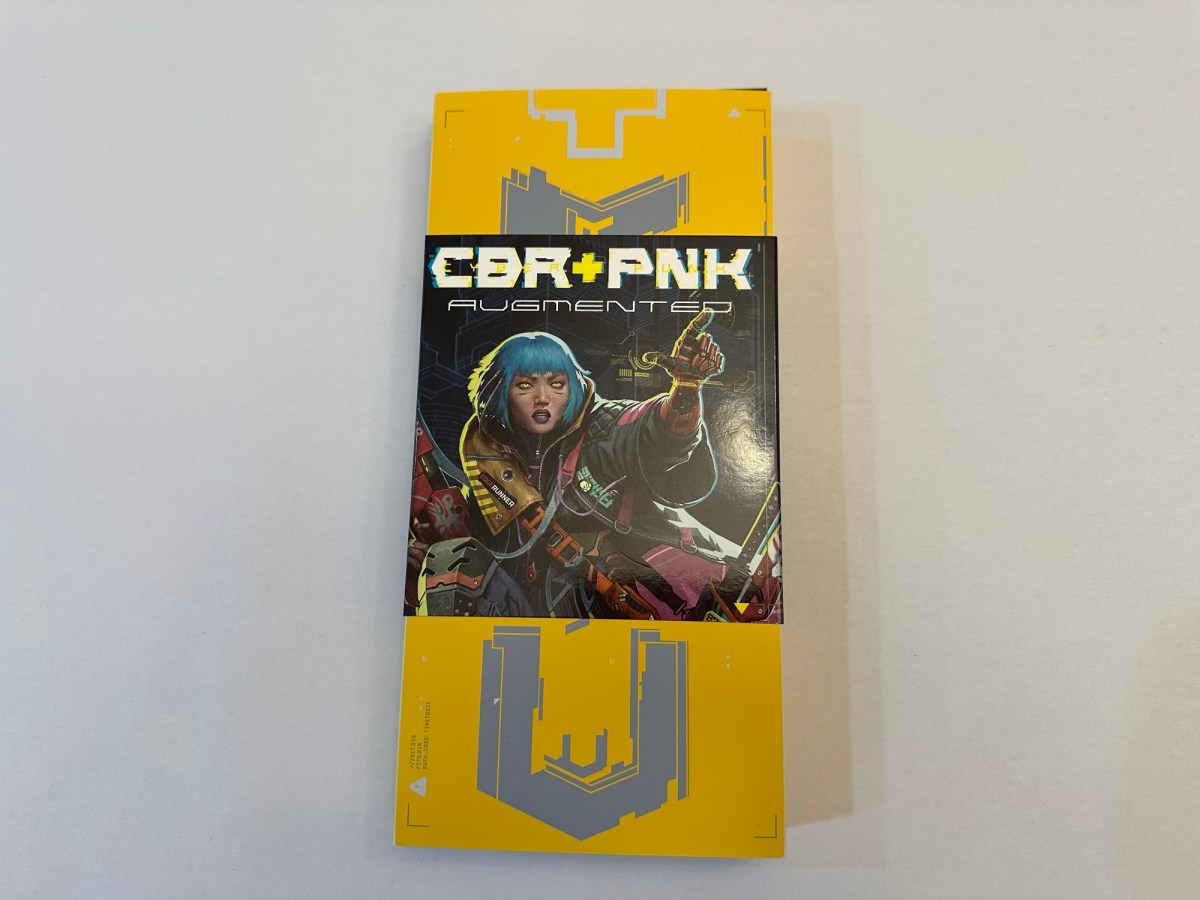
I received CBR+PNK (“cyber plus punk”) as a holiday gift, and while I haven’t had a chance to play it yet, half the fun of TTRPGs is in leafing through the materials, enjoying the art, and trying to figure out how the rules fit together and how it will actually play.
CBR+PNK bills itself as “Cyberpunk one-shots forged in the dark.” It gets its story DNA from its namesake, Cyberpunk, the gritty dystopic future setting that has recently found fresh life in the popular Cyberpunk 2077 video game and Cyberpunk RED core rules update. However, its rules are based on a stripped-down version of Blades in the Dark, a fiction-first, fast and simple ruleset with a core mechanic of rolling d6 pools.
The Package
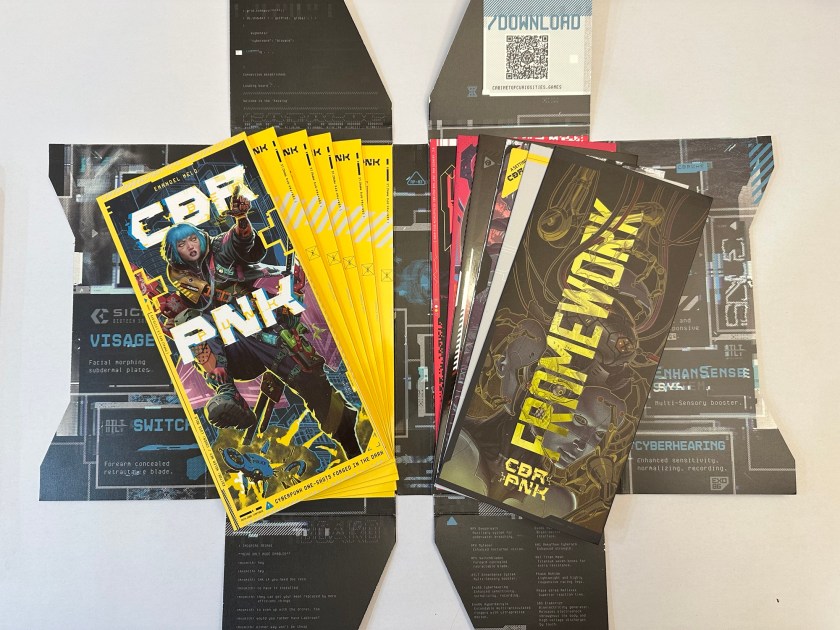
CBR+PNK is clearly broadcasting its goal of being a light, low-prep, pick-up-and-go game. The form factor is less than half the bulk of a typical core rule book; a slick little fold-out box filled with laminated pamphlets, all held together by a sturdy sleeve.
The lamination means these should stand up well to the typical abuses of game nights, including spilled drinks. It also allows players and GM to mark up their pamphlets with whiteboard markers and reuse them across sessions.
The left fold of the packet contains includes a “GM protocols” pamphlet and 5x player “runner files”—a combination character sheet and mini instruction manual. The right half contains a variety of odds and ends: optional mechanics, settings and runs.
The Framework
The players play as criminal or semi-criminal agents, mercenaries with specialized skill sets who might come together for assassinations, heists, sabotage, or other high-stakes operations at the behest of shadowy contacts promising huge payouts.
Unlike games that cater more to long campaigns where player characters can grow over months or years, the characters in CBR+PNK are veterans on their last mission, hoping to finish the run and get out of the game alive.
There are some optional rules for running CBR+PNK campaigns over multiple sessions (and supplements to that effect on Itch.io), but it’s tailored for one-shots, and I suspect the rules might feel thin in places for a long story across many missions.
As part of initial setup, each character has an “angle.” Are they out for revenge? Trying to buy a luxury flat to get their family out of the slums? Paying off a bookie? Searching for a missing friend?
At the end of the run, each player decides how they will leverage the results of the mission to try to satisfy this broader character goal, then rolls a special skill check with various bonuses. This is the final payoff or disaster.
Setup
The game is designed to be low-stress for the GM. That’s achieved in three ways—few rules, spreading some load to players, and minimizing prep.
It’s suggested that the GM figure out the mission objective, a couple locations and assets (people, data, vehicles, etc.), and 3-6 obstacles that players may have to overcome.
Players come up with their character’s name, look and “angle,” then assign points to the four “approaches” (broad attributes like Aggressive and Smart) and the 11 “skills” (narrow attributes like Close Combat and Coding). All of these attributes max out at 2, keeping bookkeeping simple.
Players also pick a cybernetic augmentation and a Load of Small (3), Medium (5), or Heavy (7), which impacts how much they can carry, but also how fast, conspicuous, and stealthy they are.
That’s about all that’s needed to start the game.
Play
Play revolves around three primary mechanics: Action Rolls, Stress, and Harm.
When a player tries to do something risky or difficult, they make an action roll. The GM decides the threat (risk) level, consequences of failure, and effect of success. Players can try to shift this equation to their advantage with gear or tactics, and the GM can increase the difficulty by doing the same for the bad guys. The player can also choose to simultaneously boost both risk and reward.
The roll uses a pool of d6s based on the sum of the Approach and Skill used and takes the highest roll(s). Rolling multiple 6s is a critical success, a single 6 is regular success, 4-5 is partial success with negative consequences, and 1-3 is outright failure. This basic system should feel very familiar to anyone who has played Forged in the Dark or Powered by the Apocalypse games.
Stress is a penalty pool that players can fill (up to 7) to get a variety of benefits. They can Push their own action or Assist another player’s action to add dice for an action or improve the effect. They can activate a cybernetic augmentation. Or they can perform a Flashback.
Flashbacks are a fun mechanism for coming up with new fiction on the spot. The player gets to describe something that happened before the mission that impacts the current action or predicament (and presumably helps them). The GM decides the Stress cost based on how outlandish this gamified retcon is.
Gear works similarly, but without the stress cost. Players decide they packed an item when they need it. The only caveat is that you can’t produce more gear from your pack than your Load number allows.
Harm is what often (but not always) happens when the characters fail an action, and it’s a replacement for more common hit point systems in other games. It’s a three-level system where L1 is superficial damage, L2 is serious injury, and L3 is severe. Stacking multiple lower-level harms results in an injury the next level up. L4 kills the character.
The Extras
The FRAMEWORK pamphlet is an odd combination of rules clarifications, quick lists for GMs, and rules for an odd campaign mode built around a series of session-long flashbacks. It feels like this really wanted to be part of the GM pamphlet and ran into the limitations of the form factor.
The HUNTERS pamphlet provides optional mechanics for what amounts to boss enemies, and seems like a pretty cool thing to add to a run once you’ve got the hang of the basics.
The +WEIRD pamphlet is a build-your-own Shadowrun, adding some light fiction to bring magic into the world, meta-human backgrounds, and magical abilities that slot into the character sheet just like cybernetic augments. It’s another set of optional rules, but trying to do a lot more than HUNTERS. It feels a little slim for what it’s trying to do, which is a lot.
The PRDTR pamphlet provides a setting—a base on Ganymede where a worker insurgency fights against corporate overlords. The colony is falling apart, infested with out-of-control mutant jungle and an engineered living weapon (definitely not the trademarked alien from Predator). It includes several starting points and missions, NPCs, a simple graph-map of locations on the base, and random events. All in all, a nice selection of components to build a mission from. A team synergy mechanic is also included, but this didn’t seem to add much, and I’d consider not bothering if I was running it.
The Mona Rise Megalopolis pamphlet is a very different take on a setting, with random tables for just about everything randomizable in this simple game, packed with what I assume are references to characters and locations from William Gibson’s Sprawl trilogy. Unfortunately I haven’t read those books, and this falls pretty flat as a stand-alone artifact without that context.
Finally, the Mind the Gap pamphlet is a complete example run, with a fun bubble-story setting, a simple three-act structure, and a twist. My biggest pet peeve for TTRPGs is when they don’t provide examples of play to help understand the game flow and rules, and this goes a long way in that regard.
Final Thoughts
This package is cool and slick, but also limiting. They’ve crammed every millimeter of these quad-fold pamphlets with text, and in some cases it feels like another page or two would have been beneficial.
As a prospective GM, I had to jump between all the pamphlets and do some internet searching to understand threat/effect and harm. Harm is the one case where the game makes a choice that I think adds significant complexity over other common mechanics like HP and well-defined status effects.
Like many, I cut my teeth on D&D. These days, I really like the FitD/PbtA style of fast, low-rules, fiction-first play. It’s so much less intimidating than running something like a D&D campaign whether that be from a book or homebrew.
That said, they also have limitations. I haven’t run a longer campaign in one of these systems, but I expect it would feel very different from something crunchier.
I’ve been looking for something relatively easy to play with the kids, so I expect I’ll find time to play this sometime in 2026. I’ll post a follow-up when I do.
2026 is another year of short stories. In this weekly series, I talk about short story writing, from idea and draft to submission.
This is week three: Jan. 17 – Jan. 23.
Stats
Stories Finished: 0
Submissions Currently Out: 2
Submissions Total: 1
Rejections: 2
Acceptances: 0
Keeping up the Pace
These first few weeks of the year have been about setting up a scaffold for the work yet to come. I’m now feeling like I’m in a comfortable place.
Each week I have some “standard” work: completing a Critters critique, meeting my first draft writing quota and my revision quota, and writing something for the blog. I like having some checklist items that I can work on without too much thought at the end of a long day. Beyond that, I can choose my own adventure.
I’m also getting back into the habit of scouring Duotrope’s upcoming themed submissions calendar. This is something I like to do pretty regularly when I’m writing short stories. Occasionally, a theme will inspire an idea for a new story, and if I already happen to have a story that fits a theme, those are great places to submit.
I didn’t find anything in the near future, but there were a couple themes opening in the next month or two that fit the stories I’m already shopping around.
Goals and Results
My goals from last week were to submit a story to Critters, revise another story, and keep up with my self-imposed quotas.
First, I spent some time cleaning up my newest and shortest story in progress, Taco Cat Employee Manual v7.1. As is typical, these are pretty light revisions based on feedback from my in-house beta readers (my wife and daughter) and anything that stands out to me after letting the story sit for a week or two. With that done, I sent it off to the Critters queue, and it should go out for feedback in early February. I’ll be curious to see how many responses it gets as a flash fiction piece that will only count for half credit.
In addition to those revisions, I dug into Red Eyes, a much longer story with a laundry list of improvements that need to be made. I made some progress, but there’s a long way to go.
The work I put into those two stories just about got me caught up on my revisions quota. Most of my writing quota was knocked out by working on a little horror story I’m calling Estate Sale, which I did partly while waiting at the DMV on a Friday afternoon. Once again, having a story in progress on my phone has paid off, even if I have to type with my thumbs. (Yeah, I probably could have brought the laptop. But I didn’t want to.)
Next Week
My first goal for next week is to work on Red Eyes revisions. I’m going to try to get the story done in the next two weeks. My second goal is to do some light cleanup on one of my stories that’s still in need of critique. That way, I will have Red Eyes ready to submit to publications by the time the Critters feedback for Taco Cat comes rolling in. I can immediately submit the next piece to Critters and work on the Taco Cat revisions while it works its way through the queue. Like a short story assembly line.
With any multi-author work like that, I always wonder how I’ll feel about the things that come later. Much like a great song with a featured artist, you never quite know if it’s the band, the guest, or some unreproducible magic in the collaboration itself.
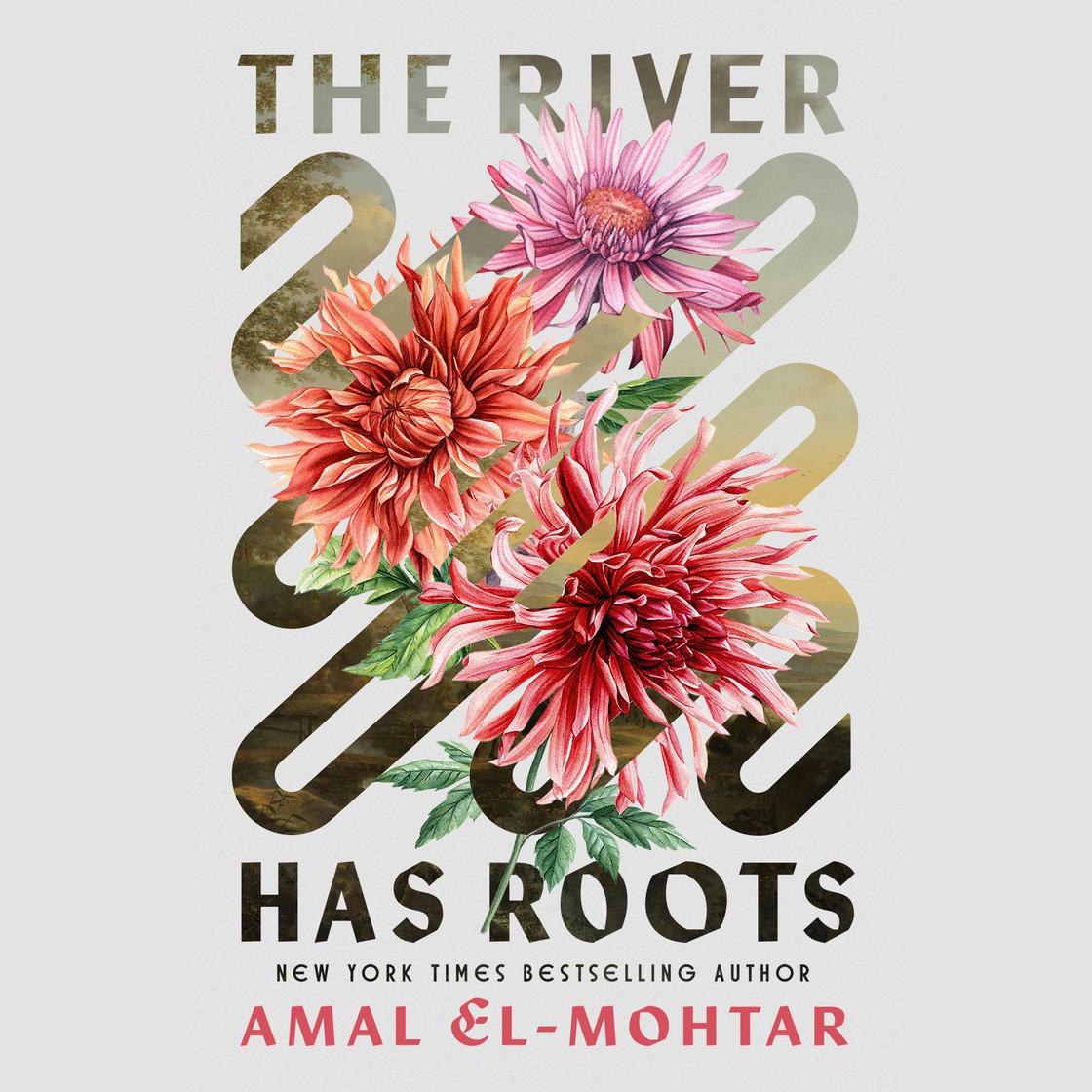
However, I’m pleased to report that even though it is very different, I enjoyed El-Mohtar’s The River Has Roots just as much as that previous book.
Audio Considerations
There’s no question that different formats can have an impact on the experience of a book. I first “read” Jeff Vandermeer’s Area X trilogy as an audiobook, and recently re-read the first book, Annihilation, in paper. It’s a dense and challenging book in places, and I found the ability to easily re-read and compare previous pages allowed me to take in more of the information on the page. On the other hand, the audiobook forced my attention and lent a certain claustrophobic feeling to parts of the story that was in many ways complimentary to the text.
I also “read” The River Has Roots as an audiobook. It’s worth noting that this audiobook includes set-dressing in the form of gentle background noise: a burbling river, a bustling market, a whispering forest. This background audio is done well, and suits the story nicely. After my initial surprise, I never found it overbearing or distracting.
Songs are an important theme of the story, and these are fully sung. I was delighted to find out after the fact that the music was actually performed by the author and her sister, including harp and flute parts. These elements put it somewhere between audiobook and radio play.
Finally, I’ll note that the narrator has a strong accent — my uninformed guess was Irish, although one of the book’s blurbs suggests that it’s “rural English.” As an American, I found myself needing to pay a little more attention than usual at the beginning of the story. By the end, I had no problem following whatsoever. The narrator, Gem Carmella, convinced me that the audiobook wouldn’t have been quite so effective without her voice.
The River Has Roots isn’t a long book. It’s listed at 144 pages. My audio edition claims a length of 3:53, but a full hour of that is actually a preview of El-Mohtar’s upcoming book of short stories.
I’ve said before that I appreciate the trend toward more acceptance of novellas in recent years, although I’d confess that I have a tough time justifying the purchase of a hardback book of that length for the $24 list price. Luckily, the audiobook was a steal on end-of-year holiday sales, and is still less than half the price of the hardcover.
A Modern Fairy Tale
The fantasy genre has come a long way. Even for those who still ape Tolkien, a significant amount of codification and shorthanding has occurred. And in backlash against that, all sorts of sub-genres and new offshoots have emerged. For the most part, modern fantasy feels quite different from ancient myths and folk stories that have been handed down more or less intact across centuries. Even if they do share certain key features.
The River Has Roots is very much trying to evoke the feeling of fairy stories, and I think it succeeds. Part of that is having the right kinds of imagery and road markers: a world just like our world, where magic is accepted as real. Sisters living in close proximity to a Faerie land. Songs with power. Witches and secret lovers and villainous suitors who are really just after the family fortune.
Beyond those many surface-level things that are easily recognizable as “things that fit into fairy stories,” there is a certain mode of speech, a certain way of unfurling the story that also contributes to this feeling. In The River Has Roots, magic is called grammar, and wizards are grammarians. El-Mohtar has found the magical grammar of the fairy story and deployed it perfectly here.
It is a common trope to suggest that fairy stories are required to have a happy ending where all the wrongs are put to rights. It’s one of those truisms we accept without thought, and it’s also not true. It’s well-known that many of the Disney versions of classic stories were changed, their dark and horrible endings often considered too depressing or gruesome. I won’t spoil the ending here, except to say that it treads that knife edge well, and could perhaps be best described as melancholic.
If you’re in the mood for something short and sweet, modern and well-crafted with the feel of something older and wiser, The River Has Roots is an excellent choice.
2026 is another year of short stories. In this weekly series, I talk about the stories I’m working on, from idea and draft to submission.
This is week two: Jan. 10 – Jan. 16.
Stats
Stories Finished: 0
Submissions Currently Out: 2
Submissions Total: 0
Rejections: 2
Acceptances: 0
Finding a Groove
I’m still getting back into the rhythm of short story writing, but it’s less daunting than it was in 2024. I’ve done this before, and now it’s just a matter of doing it better.
I’m going to have a standard block of stats at the top of these posts. I haven’t decided exactly what those will be yet. I’ll finalize it when I feel more settled into a process.
Last week, I thought about splitting out the weekly stats from the yearly stats, but now I’m second-guessing that. The numbers just don’t change very much from week to week, and I don’t think it would be very interesting. Last week I also included a “stories in progress” count, but it’s hard to decide what that means. I have quite a few half-finished stories and first drafts in need of revision. Whether a story is “in progress” mostly comes down to whether I’m spending time thinking about it or actively rearranging the words.
What really matters is stories that are done done, and stories submitted to publishers. So I’m sticking to that for now.
This is also an appropriate time to note that for some people (like myself), there’s an allure to this kind of unnecessary bookkeeping. It can make you feel productive. It can also be an excuse to procrastinate by poking around the outskirts of writing-related activities without getting the core work done.
Goals and Results
Last week, I said that I had three goals.
#1 – The Rewrite
One of my stories had come back from the publisher with a rewrite request. The story centers on two characters who are friends, and it lightly hints at a bit more than that. The problem was that I submitted to a themed issue around relationships. The rewrite request, logically enough, suggested that I put the hinted relationship clearly on the page.
I have to admit, I had a hard time getting started on that rewrite. I’m not sure if it was because I had to dive back into a story that I’ve considered “done” for a while, or some other mental block. However, when I actually sat down to do it, the rewrite was fairly straightforward. It was easy to identify a handful of places that needed to change.
The story is better now. It makes sense: the characters have stronger feelings toward each other, and that only increases the tension when they find themselves at odds. Even if the publisher ends up rejecting the rewritten story, this is a good result. Their suggestion helped me improve it in a way that I wouldn’t have gotten to on my own.
#2 – Critiques
I knew going into the new year that I was going to be doing another year of short stories. While I continued doing some writing in 2025, I had not done any critiques on Critters. So I reset my count around the start of the year, but I had to complete three critiques to get caught up to the point where I could submit my own work to the queue.
I completed my three critiques across two weekly batches—Critters runs on a Wednesday to Wednesday schedule—and then discovered that I only got 2.5 credits. Now half-credits are normal for critiques of stories under 2000 words, as a way to encourage people to look at the longer stories. But the story was well over 2000. So I completed one more just to ensure I was fully caught up, and sent a message to Andrew Burt, who runs the site.
Burt responded very quickly and fixed the issue. So now I’ve got credit to spare. (That guy should be canonized a Saint of the Writing Internet for the time, energy, and money he has dedicated to that site over the years!)
Critters is a standard part of my process when I’m writing short stories. Now that I’m caught up, I’ll be doing roughly a critique per week for the rest of the year, and I always run my stories through Critters in the rewrite process.
#3 – More Revision
My final goal was to find more time for revisions. At the end of 2025 I found myself in the unusual (for me) position of having three short story first drafts written and waiting for edits. I want to start the year by polishing up those stories. If I’m going to hit my goal of 50 submissions this year, I need more stories to submit.
So far, I’m finding the writing spreadsheet helpful for this. My writing goal is an average of 100 words of new writing per day, and 10 minutes of revision time. The spreadsheet tracks that and tells me how ahead or behind I am for the year so far. As of Week 2, I’m about an hour and a half behind on my revisions, but seeing that number does actually work as a motivator, and I’m catching up.
Thanks to that rewrite request and Critters critiques, I found myself naturally in a revising state of mind. However, I didn’t revise one of those 2025 stories. I revised a completely new story. Which brings me to…
Taco Cat
I wrote yet another story. I exacerbated my too-many-first-drafts problem. But it’s okay. I’m pretty happy about it.
I mentioned in Week 1 that I was going to keep a story in progress stashed on my phone, so I could write in little bits of down time throughout the day. The result was that I wrote an 1100-word flash fiction piece over the course of the week. It’s currently titled Taco Cat Employee Manual 7.1, and it’s a strange little story in the form of a hacked fast food employee manual from a cyberpunk dystopian future.
So even though it still feels a little weird to write fiction on my phone, it feels like a resounding success two weeks in. It’s a great alternative to social media or mindless mobile games. I’ve already started a new phone story and put a few hundred words into that one.
Revising on the tiny screen, however, does not feel so good. My revision process involves copying and pasting, making notes and referring back to those notes repeatedly. I end up changing things that can thread throughout a story. None of this works very well on the small screen. I’m going to keep trying to figure out ways to make it work, even if that ends up being something like jotting ideas and notes during the day and doing the brunt of the editing work in front of the computer at night and on the weekends.
Goals for Next Week
Submit a story to Critters
Revise a story—Red Eyes
Do just enough new writing
Critters limits the number of stories that go out to the group each week, to ensure that they all get a decent number of critiques. Usually, it takes a couple of weeks for a story to percolate up through the queue. So this week I want to do some cursory cleanup on one of my stories—probably Taco Cat—and submit it to Critters for additional feedback. It’ll likely go out in early February.
Next, I’m going to work on revisions for a story that went through Critters over a year ago: Red Eyes. Unfortunately, I think these edits are going to be significant and complicated, and it’s a long story.
Finally, I plan to do just enough new writing to keep up with the very modest quota I set for myself in my spreadsheet. The bottleneck in my process is clearly revision at this point, but hey, writing new things is fun.
It’s a common misconception that a great idea makes a great story. The truth is that most great stories come down to execution. A great idea with poor execution rarely works, but a great writer can breathe new life into even the most tired tropes.
Like any writer, I have my own treasure trove of ideas that might end up in a story…someday. But why horde them? Instead, I’m opening the vault and setting them free.
Use these ideas as a writing prompt, or come up with your own twist and reply in the comments.
The Thing and the Voice
I never see either of them. Thank God.
The Voice wants to help. It knows how to survive. It whispers, always in my right ear. The Voice gives me warnings. It protects me from the Thing.
The Thing is terrible. It is sound and stench. It can come at any time. When it comes, I crouch down in a corner, as low as I can, and I stay very still so I can’t be seen.
The Voice tells me what to do. Stare at the corner, the place where three edges come together. The triune shape. Holy. Safe.
Today, the Thing comes when I’m in the shower. It sounds like construction machinery tearing through the roof of the apartment. A crunch in the hallway, the sound of wood and plaster shattering, clear even against the wash of water and the muffling steam. The crunch of bathroom tile. The tub has no corners. I have to make do with the grouted tile wall.
The creak of metal and glass, the explosion of the shower doors. The safety glass cascades harmlessly over me as clear pebbles. The water is scorching hot. The Thing is pressing on me. Its presence like a doubling of gravity. Tripling, quadrupling. I’m on Venus or Jupiter. The atmosphere is hot poison, unbreathable. Heavy, indistinct pressure.
“Lower, lower,” the Voice whispers. The pressure on my back increases. I stare at the corner of the shower. I do everything right. I listen to the Voice. The Voice protects me. The Thing always goes away. Everything returns to the way it was before. Always.
2026 is another year of short stories. In this weekly series, I talk about the stories I’m working on, from idea and draft to submission.
Jan. 1 – Jan. 9
Due to the new year, I had to incorporate a partial week here at the start. This “week” was nine days.
Stories in Progress – 2
Submissions This Week – 0
Submissions Currently Out – 3
Yearly Totals
Submissions: 0
Rejections: 1
Acceptances: 0
Starting the Year
It’s always hard to get back into the swing of things after a vacation. Tacking on some New Year’s resolutions doesn’t help. Just when I would prefer to slow-roll into the new year, I’ve got to do all that stuff 2025-me promised? What a drag.
Firstly, I set up a writing spreadsheet. It’s not as detailed as some I’ve tried in the past, which will hopefully make it easier to keep up to date. For now, I’m tracking my daily words and rough minutes of revision time, aiming to write a minimum of about 100 words per day on average. I know that’s not a lot, but it’s a minimum, and at this point I’m just getting in my reps.
To aid in this, I made a plan to always have a short story in progress on my phone. This gives me the opportunity to jot down a few words when I might otherwise waste time. I’d guess writing on a phone sounds awful to most authors, but I’ve found that e-books and audio-books on my phone have greatly increased my capacity for reading. Why not try the same thing with my writing? There are usually a few times during the day when I have a spare few minutes, and the phone is always in my pocket. Besides, it’s not too onerous when I’m only jotting down a hundred words at a time.
Secondly, I reset my critique ratio on Critters. For those who aren’t familiar, Critters has a system that requires submitting about three critiques a month to be allowed to submit your own stories for critique. I haven’t done any critiques for the better part of a year, so I requested a reset. This wipes out my deeply negative ratio, putting my count at only -1. I plan to submit a couple critiques this upcoming week so I can put a story written in 2025 into the queue for feedback.
Submissions and Responses
I have a few submissions still out from late 2025. One of those came back this week as the first form rejection of 2026. Nothing too exciting there.
I also got something of a soft rejection. I had submitted a story with admittedly very light romance elements to a themed contest, and they responded with the suggestion that I resubmit with the relationship angle more front-and-center. The wording was ambiguous as to whether that was just politeness or significant interest, but I’ll likely give it a shot and resend.
Goals for Next Week
My to-do list is already longer than I’d like, and I’m working on being realistic about the time I have and what I can get done. It’s a balancing act between self-honesty and pushing myself to be a little more productive.
Top of the list is that story rewrite, since that’s the most time-sensitive. Next is catching up on critiques, as that will facilitate revisions. Getting “finished” stories polished is my fastest track to having more to submit, and that’s key if I want to meet my goals for the year. Lastly, I’d like to work on ways to fit more revision time into my week. This might mean putting some new story writing time on the back-burner, so I’m not simply wracking up more and more stories that aren’t ready for submission.
In 2026, I’m once again focusing on short stories, so this seems like a perfect time to revive a series of six posts I did in 2024, all focused on short stories.
In this series, I cover why short stories are important to read and write, how they’re generally categorized by publishers, and how to revise and submit for publication. Finally, I wrapped it all up with a comparison of the two most popular websites for tracking your submissions: Duotrope and Submission Grinder.
I recently crossed the threshold of 50 short story submissions, and I’ve decided to celebrate that milestone by talking about rejections! For most writers, rejections are a natural part of the submission process, and it’s expected for a short story to rack up at least a few before finding a publishing home.
Why Bother?
For most writers, feedback on a story comes through beta readers, critiques, or a writer’s group or workshop. The feedback found in rejection letters is usually paltry in comparison.
The one advantage of this feedback is that it comes directly from the editors and readers that you are selling to. Hopefully you submit to editors and publications you believe have good artistic taste, but if nothing else, these are the opinions that matter for getting a story to print (and money in the writer’s bank account).
Occasionally, this feedback might expose a flaw in the story, or in your submission process. I have a story that I submitted to fantasy publications, but it has only a single fantastic element and could be seen more as magical realism or slipstream. A helpful editor explained in a rejection, “your story has some interesting concepts, but on evaluation, it doesn’t fit well in our definition of the fantasy genre.”
This let me know that I needed to be more careful in submitting this story to publications that have a more “traditional” view of fantasy. It also gave me a better idea of what that particular publication was looking for. And since they finished the rejection with a positive note and a suggestion to submit again, I did exactly that—with a story that was a better fit—and got an acceptance.
Not every rejection will work out so well, but it’s still valuable to read the tea leaves of your rejections.
Form Rejections
These are the lowest tier of rejection, but by the probabilities of the slush pile, they are also the most common by far. Most publications (especially those that pay) receive dozens or hundreds of submissions for each one they publish, and they simply don’t have the time to give personalized feedback to each.
Unfortunately, form rejections differ slightly between publications. They typically follow a format like this:
Dear Author,
Thank you for sending us Story Name. Unfortunately the piece is not right for us at the moment. [Possibly additional sentences about how it’s not you, it’s us.] Good luck placing it elsewhere.
Sincerely,
Editors
A typical form rejection politely states that the piece is not accepted, and doesn’t offer any specific notes or ask you to submit again. However, I have occasionally received what appears to be a straight form rejection that encourages the writer to submit other work to the publication, so that shouldn’t necessarily be taken too seriously.
Some form rejections say something to the effect of “sorry for sending a form letter, we’re really busy,” which I actually quite like, because it removes any ambiguity.
Tiered Rejections
Some publications (usually bigger and more successful markets) have a tiered reading or evaluation process. They may pass each story to multiple readers, or have slush pile readers who recommend their favorites to editors for additional scrutiny. If you’re lucky, they will describe this process on their submissions page, and if you’re doubly lucky they will explain what kind of rejection a piece receives based on the “tier” where it was removed from contention.
Getting to any tier beyond the first reader already marks the story as highly-regarded by the publication. Usually the significant majority of stories get an immediate, first-tier form rejection. Since far fewer stories make it to the subsequent tiers, a rejection at this stage is much more likely to have a small, personalized note to explain why it was rejected.
In my experience, this type of rejection will almost always ask you to submit more work. Take note of this! If you get to this stage, you likely have storytelling sensibilities that align with the editors. There is no small amount of subjectivity when evaluating fiction, and for a story to get published it has to not only be well-written, but also match the vibes of the publication.
Personalized Rejections
If your story makes it into higher tiers of editorial evaluation, or you happen to submit to a rare, incredibly generous editor, you may get some personalized feedback in a rejection. This typically takes the form of a couple sentences of “what we liked and what we didn’t like,” since the story usually has some solid points that let it escape the slush pile and some weaknesses (or incompatibility with the publication’s sensibilities) that caused it to lose out to the stories that were accepted.
Some publications also offer an option to support them by paying for feedback on submissions. Use this at your own discretion. There is no guarantee that the feedback will be particularly helpful, and while most of these offers are an honestly-provided service that also helps keep the publication stay afloat financially, some less scrupulous markets don’t provide much for the fee.
I would suggest paying for a service like this only if you think highly of the publication and would be happy to support them even if you weren’t getting feedback. However, if you don’t mind dropping the money, you can always try these and see if the response feels worth it. In most cases, you’ll get considerably less than you’d get out of a writer’s circle, workshop, or critique group, so keep that in mind.
Holds
On rare occasions, you may receive a “hold” request. A hold is short fiction limbo—it’s essentially a notification that you’re going to have to wait even longer for a response.
A hold will only be issued if the publication thinks they might want to buy the story, so this is a great sign. However, it can also mean the publication is hedging their bets in case they get a submission they like more, especially if there’s a long submission window for something like an anthology.
Holds can also be a way for a publication to collect stories while trying to suss out the overall tone or theme for an issue. They may like your story, but find that it doesn’t fit well with several other stories they want to publish. As a result, a perfectly good story ends up rejected because editors have to worry about the total package of what they’re publishing.
Non-Response
If you submit enough, you’ll eventually run into a non-response. Among the hundreds of submissions publications receive every day, a few are bound to fall through the cracks. These days, many publications use submission managers like Submittable or Duosuma to help with this, but some are still working with shared email inboxes.
Firstly, if you’re submitting directly through email, it pays to whitelist the address. It’s easy to miss a response that gets caught in the spam filter, and this is much more likely to happen when the publication uses a random gmail address. It’s also worth watching your inbox and checking spam regularly, although I’ll admit I’m not very good at this.
When submitting, make sure you follow the formatting instructions provided by the publication on their submissions page. Don’t rely solely on tools like Duotrope or Submission Grinder, which can occasionally be out of date or incorrect. If you use the incorrect formatting, or ignore instructions like removing identifying information from your manuscript for blind reading, some publications will toss your submission. This may seem callous, but editors who need to weed through hundreds of submissions don’t have the time to deal with submissions that aren’t correctly formatted. Correct submission format is a basic expectation to be taken seriously as a professional writer.
Finally, pay attention to information the publication provides about its own responses. What’s their expected response time? A few publications have a policy of not responding to rejected stories, so a non-response is effectively a silent rejection. Be aware of this when submitting.
If you’re beyond the expected response time, feel free to send a short, polite query letter asking about the status of your submission. Provide your name and the title of your story. If you received an acknowledgement of the original submission, there might also be a submission number or other identifier to include.
Sometimes It’s a Mystery
While there can be valuable tidbits of information to be found in rejection letters, not every rejection will be useful. Sometimes the value is only apparent in aggregate over a number of submissions.
As a writer, I would love it if all the publishers in the world got together and organized around some standard wording for rejections so I always know exactly where I stand. However, writing (and publishing) are creative enterprises, and there are no hard and fast rules. There will always be publications that buck trends and give strange or inscrutable responses.
The best way to develop a better understanding of rejections is to submit frequently and widely. I’ve accumulated dozens of rejections, but I still have a long way to go compared to some authors who have hundreds or thousands.
Finally, it’s important to remember that a perfectly good story still needs to find the right fit to make it into print. Being patient with repeated submissions may be necessary for some stories to find an acceptance.