At 138 words, this is not quite drabble-length, so it needs to hit hard and fast. It’s a story about the loss of someone loved, with the sci-fi element being their replacement by an artificial duplicate.
The opening is a metaphor unfurling: salt as grief. The end is a callback to the title. Great structural choices for micro-fiction.
The mix of italics and quotes is something I’ve done myself, but it’s dangerously ambiguous. Is the robot speaking non-verbally? Is it the protagonist’s internal voice of their lost loved one? Any lack of clarity can be catastrophic in a story so short.
The theme is imminently relatable; we’ve all experienced loss of a loved one, by death or lesser proxy. I don’t quite get that gut-punch emotional reaction I want from a short story, but that’s always the biggest challenge of micro-fiction, where you are fighting for every word.
Children of the Mind is billed as the final book in the “Ender Quartet.” In my opinion, that quartet is really Ender’s Game standing on its own, and sequel trilogy that is in many ways tonally different and mostly disconnected in plot.
The trilogy of Speaker for the Dead, Xenocide, and Children of the Mind centers on the story of the planet Lusitania, thousands of years after Ender’s defeat of the buggers. The ticking clock of the series is the war fleet sent to destroy Lusitania. It has been delayed by the computer intelligence Jane, but now Starways Congress is aware of her presence in their computer systems, and has a plan to reset their communications network across the hundred worlds. This will not only prevent her from meddling, but effectively kill her as she’s reduced from millions of computer systems to only a handful.
The destruction of Lusitania would do more than kill the thousands of human colonists, because the planet is also home to the only other intelligent species known to humanity: the pig-like Pequeninos, whose life-cycle was heavily modified by an extra-terrestrial virus—the Descolada—and includes a worm-like larval stage and an eventual transformation into something like a psychic tree.
Ender has also brought the last of the Bugger hive-queens to Lusitania, where it is busy building enough industry to build starships and send out new queen larva to distant planets, ensuring the continuation of the species.
A final additional subplot is introduced, as if there weren’t enough. The dangerous Descolada virus has been neutralized on Lusitania, replaced with a harmless version that fills the needs of Pequenino physiology without the danger of infecting and modifying the genomes of other species. But it has become apparent that the virus is not natural. It was created, and the species that could and would send such a dangerous weapon into the universe is potentially the greatest threat humans, Pequeninos, and Buggers have ever seen.
Ender, once the titular character, has now been almost entirely sidelined in the story. As a reader, his perspective is barely present in the book, and he spends a good chunk of it effectively comatose. By the end, it’s apparent that the book is a send-off for him. His presence almost feels like an afterthought. Instead, the book focuses on Miro (his adopted son and Jane’s new favorite human), Si Wang-mu (genius emigrant from the planet of Path) and young Val and Peter, ghosts from Ender’s childhood that he made physically manifest on his brief trip outside the universe in Xenocide.
Tonal Shift
Analyzing the series as a writer, it’s interesting to see the transformation of Card’s style in the post-Ender’s Game trilogy. Ender’s Game was a relatively near-future hard SF story that focused on a single brilliant boy’s journey through military school, and the horrifying extremes the wartime government was willing to go to in order to defeat an existential threat to humanity. While there is a B-plot for Peter and Valentine, most of the story stays tight on Ender’s perspective.
The subsequent trilogy is much more scattered, and while it touches on plenty of interesting ideas, I think this lack of focus is somewhat to its detriment. The series becomes decidedly softer sci-fi, culminating in a deus ex machina mode of faster-than-light travel that also allows near-magical creation of a bespoke super-virus and several entirely new people.
My daughter and I both came to the same comparison independently—the Golden Compass series had the same seemingly tight beginning before spiraling off into odd and confusing tangents. Both feel like completely different series at the beginning and the end.
A fair amount of Ender’s Game is dedicated to his own internal angst as he undergoes indignities and abuses at the hands of the adults in positions of authority over him. The subsequent books include even more angst, spread across a large cast of characters. Long internal monologues are par for the course, and I would be hard-pressed to identify any character experiencing any kind of happiness before the final two or three chapters.
Where Ender’s frustration and eventual desperation felt appropriate to his situation, I couldn’t help but feel that this modus operandi became oppressive with so many more characters, and continuing for three books. It was unrelenting and a little exhausting.
A side-effect of this feeling was that the problems posed to the characters became so big and so multitudinous that their inevitable resolutions at the end of the series felt too trite and easy in comparison. It’s a tough balancing act to set up huge roadblocks for the characters and then resolve them in a way that feels earned.
Welcome to Ethnic Planet
I am keenly aware that I’m reading this series 30 years after its original publication. One of the strangest things about these books is the way Card has built his universe. His characters and their personalities run up against each other in a variety of interesting and well-thought-out ways, but his settings feel like cardboard cutouts in comparison.
The planet of Lusitania is the most fleshed-out setting in the series, but that’s a little deceptive because it has been engineered for simplicity. The Descolada has ravaged the ecosystem, and only a dozen species have managed to adapt. There is a single human colony city, and it is Portugese Catholic through-and-through.
The common sci-fi trope would be to construct “Star Wars” planets with a single distinguishing feature, usually an environmental biome. The ice planet. The forest planet. The desert planet. The lava planet.
Strangely, Card has managed to at least partly eschew this (though Lusitania is a uniform mix of forest and plain and Trondheim is icy). However, he has very plainly replaced these tropes with a different sequence: planets that are each a uniform human monoculture. Even more strange, in my opinion, is how these caricatures hew to a myopic 1990s American perspective. Say what you want about some of the performative multiculturalism in the still-not-very-broad-minded modern publishing industry, but I am honestly a little surprised that Card’s blatant stereotyping made it into a series that was not only mainstream, but award-worthy in its day.
Speaker for the Dead introduced Trondheim, the stoic Scandinavian planet. Xenocide introduced uniformly Chinese planet of Path, dominated by a kind of luddite, vaguely Taoist folk religion. Children of the Mind adds two more: Divine Wind and Pacifica. Divine Wind is the Japanese planet, industrious and technologically innovative much as the US saw Japan in the 70s and 80s. Pacifica is the Samoan planet, and everyone that Peter and Wang-mu encounter there seems to be built like a linebacker, living a simple tropical life, and deeply invested in ancient, polytheistic religion.
There is an argument to be made that the book explicitly says that these planets are more diverse, and there is more to them than regions depicted in the main plot. However, I think this is a weak argument. It’s textbook telling instead of showing, and it seems to admit that the cultural caricatures, which are all we’re actually shown, are shallow and problematic.
Besides, the problem is not the lack of wokeness, it’s the abject unbelievability of a universe where each planet is almost entirely populated by uniform groups of people defined by a handful of simple traits that apparently haven’t changed over thousands of years. This is as absurd as the idea of a modern Italy that has adapted to our current world, technology, and politics while remaining culturally almost identical to the early Roman empire.
Even weirder, the term “western” is explicitly used, which is nonsensical in a far-future multi-planetary society. Of course, the core power systems of the Starways Congress and the military seem to be fully controlled by these “western” cultures, because who could possibly envision a universe where the US and Europe aren’t dominant?
The Dangers of Rereading
I have to admit, part of me wishes I hadn’t revisited these books. They didn’t quite live up to my fuzzy teenage memories of them. Those memories told me that Ender’s Game was the best of the set, and I continue to feel that way. But the sequel trilogy might have been better served by being further divorced from that book and getting a little more breathing room to explore other ideas.
In the end, I found the “Ender Quartet” to be an interesting series, but ultimately flawed enough that I had a tough time enjoying all the good bits without being reminded of the things that annoyed me. My current views are certainly affected by my age, my experiences, and the many fantastic books I’ve read in the interceding decades.
On the other hand, I might have reason to worry if I felt the same way about these books today as I did in my teens. For writers, rereading our old favorites can be a fun and useful exercise, but it’s also a dangerous one. You may find that those books were more enjoyable through the lens of nostalgic memory than they are in the cold light of a fresh read.
Xenocide is the third book in the Ender series, after Ender’s Game (link) and Speaker for the Dead (link). I read the book decades ago, and remembered almost nothing about it. I’m now reading it again with my daughter.
The plot is split between two worlds and sets of characters. On the planet Lusitania, the story of Speaker for the Dead continues, with Andrew “Ender” Wiggin, his AI companion Jane, and the Ribeira family that he has now joined through his marriage to their matriarch, Novinha. Soon, Ender’s sister Valentine and her family arrive as well.
The Lusitanians, including the native Pequeninos and imported Buggers, live under the looming threat of an approaching fleet armed with the planet-destroying MD device, as well as the constantly shifting threat of the descolada virus that is integral to the Pequenino life cycle, but eventually deadly to all non-native species. The fleet is held back temporarily by Jane, who disables all their communications at the risk of revealing herself to the universe at large.
On the planet Path, we’re introduced to Han Fei-tzu, an important official, and his genius daughter, Han Qing-jao. They are members of the planet’s high caste, the godspoken, whose intelligence is linked to OCD-like compulsions that the populace believe to be the way the gods speak to mortals.
Fei-tzu is tasked by the congress of the hundred worlds to solve the riddle of the fleet near Lusitania, which seems to have suddenly disappeared. He assigns this important task to his daughter. Soon they are joined by one more character—Si Wang-mu, a servant girl who is not godspoken, but also turns out to be highly intelligent.
** More Planets, More Problems
Ender’s Game was clearly intended as a single novel that stands on its own. Speaker for the Dead was decidedly more complicated, and left a pile of unresolved plot points to pick up in Xenocide.
Despite this “head start,” the first half of Xenocide feels plodding, and it mostly involves setting up a large number of major problems that the characters are going to have to solve, along with a web of reasons why absolutely every character is going to be at odds with every other character.
Conflict can be an engine of story, but Xenocide proves to me that it can go too far. I couldn’t help feeling that the constant animosity between characters was exhausting, and when certain characters finally gave in and decided to work with others near the end of the book, it felt abrupt and somewhat unearned.
** Thinking Fast and Slow
The first half of the book is slow, and it would be easy to blame this entirely on the setup required by the huge cast of characters and the many interconnected conflicts. That is absolutely a factor, and I think this book was trying to do a few too many things at once. However, I think a lot of this is actually just Card being long-winded and having too much editorial clout at this point in his career.
There are pages of internal narration where characters muse on their feelings. These deep thoughts are sometimes interrupted by one or two lines of dialogue, only to immediately drop back into more pages of their thoughts! If there was ever an argument against a third-person omniscient perspective, this is it. A first-person narrator or even a tight third-person would have limited these long and winding detours and perhaps forced Card to show how characters feel more through their actions and words.
By contrast, the latter half of the book ramps into a much faster pace. All of those problems set up in the first half have to get resolved. Unfortunately, this leads to another problem of pacing, where everything feels like it’s happening overly fast. Again it feels like there was simply too much going on, and some plot points inevitably got short shrift.
To me, some of the resolutions felt like an abrupt tonal shift. This is a far-future series with advanced technology, but felt like hard sci-fi grounded in reality. Near the end of Xenocide, ideas are introduced that are decidedly further afield. There is a brand new kind of magical physics. When the whole plot hinges on these ideas, there’s a whiff of deus ex machina—even if they would feel perfectly reasonable in a story that plays a little looser with its sci-fi extrapolations.
It’s been long enough since I read this series that I no longer remember anything about the fourth book, Children of the Mind. Without spoiling Xenocide, I’ll say that the final bit of sci-fi magic also brings a pair of characters more or less back from the dead, further complicating an already over-complicated book, and I suspect they’ll be heavily involved in the conclusion.
This may be the first inkling of Card’s eventual obsession with rehashing his old stories. It would continue with his “Shadow Saga,” where he spends another six books rehashing plots and characters from the Ender books. I see from Wikipedia that there are at least 19 books in this same world.
** New Perspective
When I originally read these books, I was a teen. Those memories are fuzzy now, but as far as I recall, I found them to be a powerful vision of a distant future.
Re-reading now, I think that’s true of Ender’s Game. But Xenocide feels far less grounded and almost metaphorical. The conflicts, from interpersonal to intergalactic, largely boil down to people talking at cross-purposes, unable or unwilling to understand each other’s viewpoint. It’s ultimately a depressing view of the world that suggests real empathy and compromise is almost a super power, and most conflict is inevitable. It’s depressingly resonant here in 2025.
If there is a central theme across Xenocide’s many plotlines, it’s that people and cultures tend to act in ways that make them dangerous to themselves and each other. Humans are easily controlled or manipulated, and often give in to their most base instincts, even when it’s obviously bad for them.
We see evidence of that on the nightly news, but it’s far more depressing to imagine that we’ll still be so barbaric and unenlightened in three thousand years.
** Final Thoughts
In an appropriate twist, Xenocide leaves me conflicted. It does a number of things that irritate me. I’m still of the opinion that Ender’s Game was the best book in the series. But Xenocide incorporates a lot of strange and provocative ideas, and it has made me think. It comes from an era when the genre conventions of sci-fi expected intricate plotting and…less intricate characterization. So the complexities of the plot can perhaps be forgiven, and the characterization, as heavy-handed as it sometimes is, should perhaps be praised.
Once upon a time, I would likely have considered these books among my favorites. I don’t think they still hold that place. They’re by no means bad, but I do think the state of literature has changed significantly in the past 25 years, as have my own personal tastes. I’m enjoying my foray through the series, even if I do have the old man tendency to complain the whole way. And there has to be merit to any book that you find yourself thinking about well after you’re done reading it.
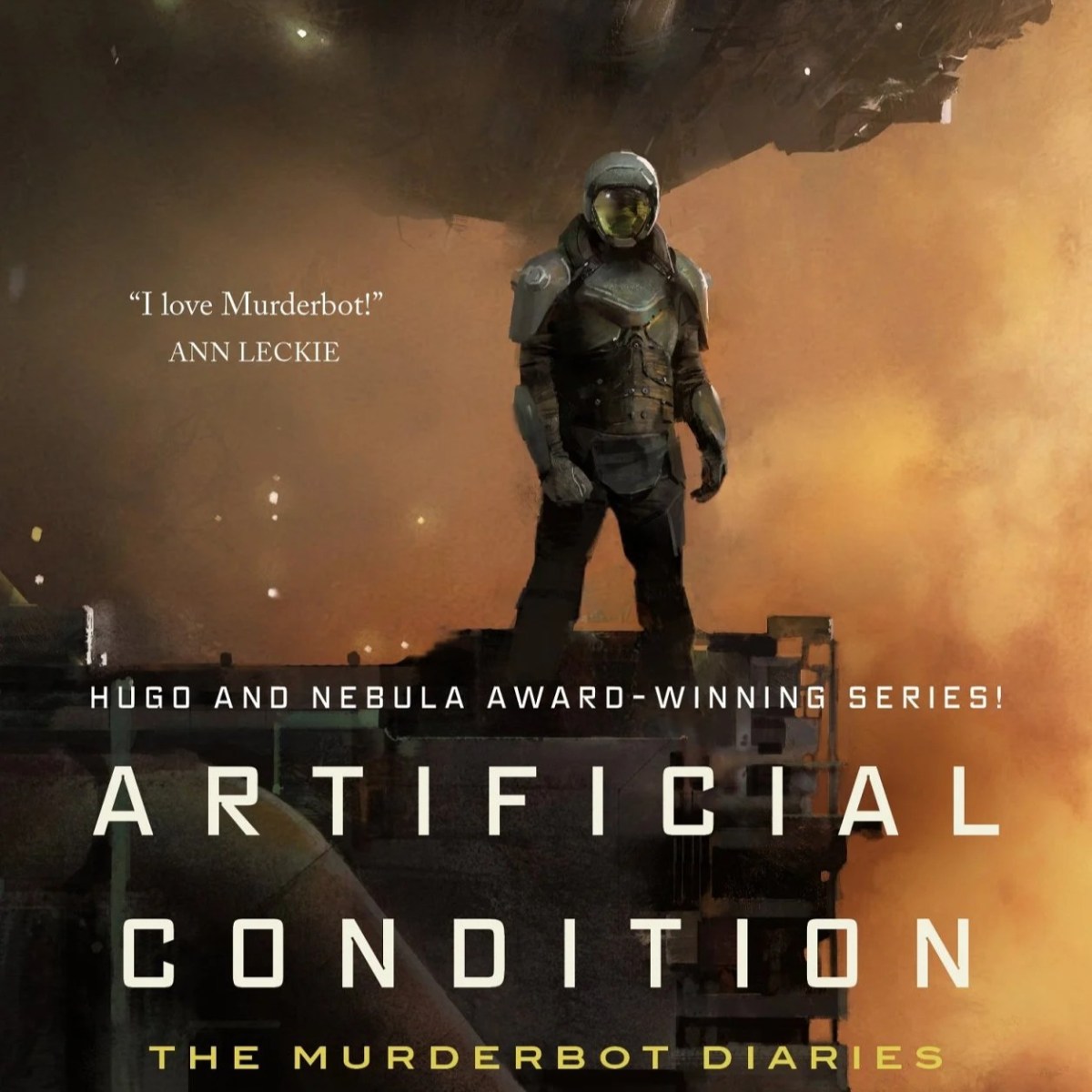
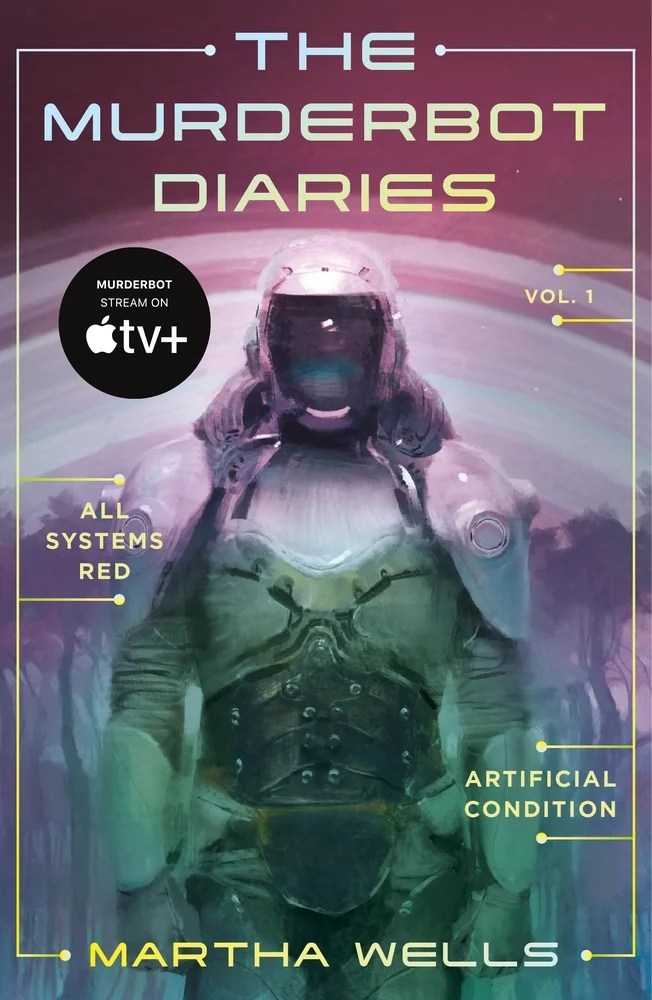
I purchased this as The Murderbot Diaries Vol. 1 double feature—which contains the first two novellas in the series—so I immediately jumped into this story after completing All Systems Red.
While the first story in a series has to introduce characters, introduce a setting, and set the tone, this is really not very different from the requirements of a stand-alone story. The only additional thing a good series-starter needs is some dangling plot threads that can be used to pull the reader into subsequent entries. As a reader, my question for a series is always, “what’s my reason for reading the next story?”
All Systems Red did this setup well, ending with Murderbot sneaking away from the new friends that had just bought its freedom from the oppressive Company. It knows that its memory was wiped after an incident at a mining colony; an incident where many people died and it was first able to override the governor module that keeps all security bots under strict control. It feels compelled to return and learn the truth about what happened.
The ART of Security Consulting
This second installment begins to set up Murderbot as the travelling tough guy in the mold of classic ronin samurai stories and westerns. Murderbot is Jack Reacher with social anxiety, 50% artificial components, and (ironically) actual emotions.
As far as we can tell, Murderbot seems to be pretty good at its job. It knows how to hack the local security systems to avoid being spotted as it makes its way through space stations. It disguises itself as an augmented human, and tries to secure passage off-the-books by finding automated transports with no human passengers to be suspicious.
Unfortunately, a deep space research vessel that Murderbot uses for transportation turns out to have an advanced artificial brain, and once he’s aboard it immediately clocks him as suspicious and forces him to reveal who he really is. What follows is a strange and decidedly awkward relationship with the ship, who Murderbot eventually dubs ART—Asshole Research Transport.
ART eventually helps Murderbot develop a cover story as a security consultant and even helps modify Murderbot’s body in its emergency surgery bay to help it avoid detection. It also ends up acting much like the classic hacker in the protagonist’s earpiece for the ensuing heist.
Murderbot, seemingly unable to avoid human entanglements, ends up taking a security job for a group of out-of-their-depth researchers trying to get their intellectual property from a shady mining corporation. This serves as cover for Murderbot’s actual goal of finding information about the mining colony massacre.
A Lack of Loose Ends
After two volumes, my impression of the Murderbot Diaries is that it’s more comfort food than high-brow sci-fi pushing the boundaries of the genre. That’s not a critique. Now seems like a time when plenty of readers could use some lighter, comforting stories.
Martha Wells has assembled a number of recognizable tropes and familiar ideas in the story so far. But they’re put together in a way that feels fresh, and mixed in with the mild goofiness of a surprisingly effective security bot who prefers to avoid human contact and binge watch its favorite shows instead.
Unfortunately, I felt that the ending of Artificial Condition didn’t quite measure up to All Systems Red. There was a whiff of deus ex machina in the sudden appearance of a character that happens to neatly resolve the concerns of Murderbot’s scientist clients. Murderbot does eventually find some information about the mining colony massacre and its own origin, but nothing is fully explained, and there are no clues as to where it could learn more. I would have liked one or two obvious threads to draw me into the third novella.
Artificial Condition expands the world, introduces new characters, and lets us get further into the head of Murderbot. It also feels like a comfortable stopping point to me, at least for now. The ending doesn’t compel me to keep reading, and maybe that’s okay. I will probably jump back in when I feel the need for some cozy, lighthearted action-adventure.
For now, this volume goes on the bookshelf, and I’ll pick up something else from my TBR list.
I suspect, in a vacuum, I would not pick up a book labeled Murderbot Diaries. It sounds like a combination of military SF parody and introspective John Green-esque YA fiction. Having read the first installment, the title comes off as tongue-in-cheek and less abrasively cheesy.
This is one of those cases where “word of mouth” unequivocally led to a sale. The book has been recommended to me by friends, acquaintances, podcasts, and blogs which would usually all have very different tastes. My interest was piqued by broad support across normally unaligned quadrants.
Who is this Killer Robot?
I can see why so many people like Murderbot. He is a protagonist for our times.
In another universe, he might have the makings of a charismatic action hero: a humanoid, partly organic robot with armor; built-in weapons; the ability to repair from near death; and extensive experience in private security.
In the universe of All Systems Red, he just wants to slack off, avoid talking to anyone, and watch his favorite shows.
Many robot narratives are either as emotionless as possible or essentially indistinguishable from a human narrative. Murderbot finds a middle-ground. He has emotions and can certainly get caught up in the moment, but he is also aware that he is more affected by the storylines of his shows than by the actual interactions between himself and the crew who has purchased his company contract for security services.
He needs his space, both physically and emotionally. He’s more comfortable talking to the crew with his opaque helmet on; more comfortable seeing them through the security cameras; and happy to spend his time alone in the tiny security room, or even tinier repair bay.
The company that owns Murderbot and sells his services to the highest bidder is an amoral edifice of shitty space capitalism. They worry about the welfare of the people Murderbot is hired to protect because they will suffer financial penalties for injuries and deaths. They care about Murderbot because he would be expensive to replace.
Murderbot himself has more theoretical autonomy than he should. He has hacked his own modules and only feigns following orders enough to not get caught. He also has actual morals, even if they often butt up against his limited emotional range and social anxiety.
Many readers identify with Murderbot because he reflects marginalized identities. He is aromantic, asexual, and exhibits behaviors and feelings familiar to many neurodivergent people. He is also a small character in a big world. He uses his very limited freedom to seek little comforts that help block out an indifferent and cruel universe, at least for a little while. He cannot possibly imagine leading a rebellion or overthrowing evil, but he appreciates when someone does it on TV.
I suspect many of us feel the same way when we flip on our favorite show these days.
Quick Hits and Remixes
I am a big fan of the return of novellas. When I was young I read huge fantasy tomes and played 100-hour JRPGs. Now that I’m older and cherish my precious free time, I quite like a book or game that I can finish comfortably in a day or two.
Novellas also lend themselves wonderfully to series like this. Much like a weekly TV show, each entry can provide a concise arc while building characterization and setting on top of the previous entries.
I’m also appreciative of the fresh familiarity of Murderbot. It’s hard to point to any particular element of the story that is a purely original take. The action-adventure, the robot learning how to be more human, and the mildly dystopic libertarian space future have all been explored elsewhere. However, Martha Wells puts those puzzle pieces together in a way that feels fun and strangely parallel to our current moment in time.
The New York Times calls Jemisin “The most celebrated science fiction and fantasy writer of her generation.” She has repeatedly won every major sci-fi/fantasy award, and when she’s not winning, she’s usually nominated. In short, I’ve heard great things about Jemisin for a while now, but I’ve never read her work. The Killing Moon was published in 2012, so I’m a couple decades late to the party.
I’ve been listening to a lot of audio books lately, and I’ve taken it as an opportunity to fill in some of these major gaps in my genre knowledge. I knew nothing about this book going in, I just saw it on Libro.fm while searching for something new to listen to on my commute.
The Killing Moon takes place in an Egyptian-inspired secondary world, a desert land with a loose pantheon of gods shared across nations. The technology is in the neighborhood of bronze or iron age, with the swords, spears, and armor a fantasy reader would expect.
There is magic in this world, specifically dream magic—narcomancy—attributed to the power of the goddess Hananja. But this is not a world where the gods are close. If they do exist, they are distant and do not meddle.
The story follows master Ehiru and apprentice Nijiri, gatherers who use narcomancy to collect magical energy from souls and guide them to the afterlife. This magical killing, sanctioned by the state of Gujaareh, is usually a gift reserved for the willing but sometimes used as a form of capital punishment for those deemed corrupt.
The pair are assigned to chase down Sunandi, a foreign ambassador accused of corruption. But they soon discover themselves embroiled in a conspiracy that goes to the highest levels of their order, and to the prince of Gujaareh himself. It threatens to reveal long-buried secrets about the near-mythological founding of their country, the religious order surrounding Hananja, and the true nature of narcomancy.
Settings and Sentiment
About a third of the way into The Killing Moon, I found myself struggling. I wasn’t feeling that compulsion to continue that usually accompanies a fantastic book. With all of the hype around Jemisin, I was expecting to be blown away, and I found myself a little disappointed.
I have a hard time pointing to any particular issue. The writing is solid. The world is well-constructed. The plot is perhaps a little slow to get going. However, I was consuming this as an audiobook, and I’m coming to realize that is not a mode of reading that makes it easy to analyze a story in detail.
One thing I can point to is the setting. I am thoroughly burnt out on the “elves and dwarves in medieval Europe” school of fantasy, so I was hoping that the Egyptian-inspired world would prove interesting. However, aside from the names and the desert, I don’t think it made much of an impact. It’s still swords and sorcery. It’s still mighty kings and high priests and big battles and political machinations.
Jade City makes for an interesting comparison. It is also a fantasy book inspired by an underused geographical region, and another one that I read as an audiobook. Jade City imagines a world that is recently industrialized and recovering from war, akin to post-WWII Asia. It eschews the kings and kingdoms so common in fantasy, and imagines a complicated web of politics, religion, and family ties that feels more modern. It limits its scope to roughly two generations of recent history and the capital city of a small island nation. The result is a setting that feels fresh and richly detailed, and I believe that’s in large part because it’s not trying to cover a thousand years and an entire world, as so many fantasy stories do.
Another frustration I noticed is that practically every character in The Killing Moon is miserable all the time. Moments of levity or happiness are brief and far between. Everything is bad, and it’s getting worse. This is certainly an engine to drive the plot, but I found that it ground me down and made it tiring to be with these characters for an extended length of time.
There are a few twists near the end that piqued my interest and substantially improved my opinion of the book overall. I was also relieved to discover that the plot wraps up nicely, because I was expecting it to end with a cliffhanger. The Killing Moon is billed as the first book in the Dreamblood duology, but they apparently only share a setting and can be read as independent books.
(A side note, as I’m reading so much fantasy lately. I sometimes find it exhausting that the norm for this genre is huge tomes and multi-book series. If I’m trying an author to see if I like their work, I don’t want to commit to a 1500 page odyssey. Just one more way it feels like we’re still slavishly copying Tolkien. Where are all the high-quality standalone fantasy books?)
It’s Not You, It’s Me
I don’t like giving negative reviews. If I don’t like a book, I’ll often just not talk about it. I’d much rather discuss what makes good things work. I can’t help but feel that I’m heaping unnecessary negativity on The Killing Moon. I don’t think it’s a bad book. To the contrary, all of the components are here for a great book. It’s well written; it just didn’t resonate for me and I don’t entirely understand why. Maybe part of that was having my expectations calibrated by all the acclaim and awards I know Jemisin has accrued.
Oddly, this only makes me want to read another book by Jemisin. Is it this particular book that doesn’t work for me? Only one way to find out.
After some searching, I see that the Broken Earth trilogy seems to be the most recommended. It made history by winning the Hugo three years in a row, for all three books in the series. Plus, it apparently uses second person POV extensively, and that’s certainly an ambitious choice. I’ll try that next.
Speaker for the Dead is the second book in the Ender’s Game series. The last time I read this, I was probably still a teen.
For Ender and Valentine, it has been two decades since the events of Ender’s Game. But much of that time has been spent on starships traveling at relativistic speeds. A thousand years have passed outside those starship hulls. Humanity has spread across the hundred worlds. Ender’s pseudonymous books, The Hive Queen and The Hegemon have convinced most humans that Ender, “the Xenocide,” was a genocidal monster, and have inspired a secular religion of “speakers for the dead,” who try to eulogize those who have passed with complete honesty.
Ender and Valentine find themselves on the icy, Scandinavian-colonized world of Trondheim, teaching and speaking for the dead, when they hear the news that the only other known sentient alien species, the Pequeninos, have brutally killed a scientist on the tiny colony of Lusitania. A call goes out for a Speaker, and Ender follows it. His sister, however, is married and expecting her first child. For the first time in twenty-two years, they part ways, fully knowing that after the lightspeed journey she will be nearly double his age.
Ender arrives at the Portugese-Catholic colony with two secrets: the egg of the last bugger hive queen, ready to revive the species he destroyed a thousand years previous, and a jewel in his ear that lets him communicate with Jane, the only sentient AI in the universe.
Ender intrudes upon a decades-long family drama. Novinha Ivanova is the colony’s xenobiologist, the orphaned daughter of the original xenobiologists, who died in the process of saving the colony from the deadly alien Descolada plague. In her youth, she was mentored by the colony’s xenologer and fell in love with his son (and apprentice). These two important men in her life, the only people allowed to interact with the Pequeninos, are the ones the aliens choose for strange, ritual murders. And Novinha is determined to keep secret any and all information that might lead others to the same fate.
Speaker for the Dead is a very different book from Ender’s Game. That book was all about Ender’s struggles to overcome adversity at the battle school. Ender is a genius with a variety of remarkable skills, but it works in that context because the challenges stacked against him are so brutal.
In Speaker for the Dead, Ender is even more of a Gary Stu. He is the legendary Xenocide. He is the accidental father of a religion. Not content to have committed genocide, he plans to revive the bugger species. Jane, the AI, chooses him as the only human she will reveal herself to. Even the Pequeninos can only be fully understood by Ender, solving mysteries in days that the xenologers couldn’t penetrate over decades. He immediately gains the trust of almost everyone he interacts with on Lusitania, with apparently little effort.
It’s a testament to the setting and the mystery-driven plot that the book is still good in spite of Ender’s nearly inhuman ability to do whatever he sets his mind to. The alien ecology of Lusitania is interesting and well-conceived, and there are fun twists along the way. The resolution of the mysteries makes perfect sense thanks to the clues peppered throughout the book.
This feels a bit like two books that only come together in the final act. Ender has his own life (and years of post-Ender’s Game history that is only alluded to) before the journey to Lusitania. And many of the important events on planet happen before he leaves or during his long lightspeed transit. Much of the remainder of the book involves teasing out this history and connecting the disparate threads, in the same way the detective pieces together clues in the drawing room at the end of a cozy murder mystery.
The main plot points of Speaker for the Dead came back to me pretty quickly as I was reading. However, I remember very little of the next book, Xenocide, and I’ll be rereading that soon. I’m curious to see if it has more in common with the first or second book in the series.
(As I mentioned in my May Read Report, I’m going to try breaking out these posts per-book instead of the monthly summary that I have been writing. That’ll mean more of these posts, but each one shorter and more focused.)
Chiang first appeared on my radar via the 2016 movie Arrival, which is based on his short story “Story of Your Life.” The film made an impression on me by the many things it was able to juggle simultaneously. It is a great first contact sci-fi story and an emotionally fraught personal story that are intimately connected. It’s a great example of Chuck Wendig’s principle from Damn Fine Story—the inner emotional story drives the external action. On top of that, it is told in a cleverly non-linear way that not only enhances the tension, but fits with the key themes of the plot. It remains one of my favorite sci-fi movies.
Exhalation is a collection of nine stories. Two of the longest, The Lifecycle of Software Objects and Anxiety is the Dizziness of Freedom account for about half of the total length, and the other seven are much shorter in comparison.
The Lifecycle of Software Objects begins with the invention of a rudimentary AI system that is designed to learn and grow. The main character is a former zookeeper turned software developer who is brought in to train and develop these AI companions for the company that hopes to sell them as an advanced Tomagatchi.
The AI companions are a success at first, enough that robot bodies are even produced to allow them to movie around in the real world, albeit a bit clumsily. However, the fad soon loses its momentum as consumers begin to realize that raising these AI is just as much work as raising a human child. They learn slowly, ask difficult questions, and show none of the super-human capabilities that sci-fi has long imagined from AI. The company goes under, but the protagonist and a dwindling group of die-hard believers in the project continue to raise their AI children with the understanding that it will be just as difficult as parenting a human child.
There are no shortage of stories out there about superintelligent AI taking over the world, but far fewer that suggest non-human lifeforms might need just as much raising and growing up as their human counterparts.
In Anxiety is the Dizziness of Freedom, a device called a “prism” can create a quantum event at the moment of initialization, with two possible outcomes. The result is two parallel realities that diverge at that exact moment, a clunky briefcase laptop linking them with text chat and video calls to its parallel-universe counterpart. Each briefcase has a limited amount of memory it can use to communicate between the two worlds before it is used up, making older or less-used machines more valuable and rare.
The story explores various ways people are affected by this tech. Some obsessively compare their own lives to those of their alternate-universe selves or use alternate realities to justify their decisions. Some use it as an opportunity to “work together” with their alternate selves, or talk with alternates of people who have died in their own world.
While the prism device is the conceit on which the story hinges, it’s really about the choices we make. Alternate realities may make some question the value of a given choice, when the exact opposite is chosen in other worlds. But each choice still has consequences in this one, and an associated moral weight. Is a person defined by the accumulation of their choices across one life, or across infinite parallel lives?
There is little “hard” sci-fi or far-future technology in Chiang’s stories. Stories like The Merchant and the Alchemist’s Gate, Dacey’s Patent Automatic Nanny, and Exhalation dip their toes in steampunk sensibilities, while The Lifecycle of Software Objects, What’s Expected of Us, and Anxiety is the Dizziness of Freedom posit worlds that could essentially be the one we live in today, but for one or two technological additions.
It’s also apparent from these stories that there are a few themes that Chiang keeps returning to, the bigger planets in his solar system, whose gravity is obvious across his work. Time travel and alternate universes are a recurring theme, but this may be because he is so intent on explorations of choice, free will, and whether our decisions have meaning.
As with any sci-fi, technology is at the heart of these stories, but they are not cold and robotic as sci-fi can sometimes be. Writers like Asimov are often critiqued for clockwork plots with flat characters who are merely parts in the machine. That’s certainly not a problem for Chiang. Most of his stories are character-forward, and are about human behavior and belief in the face of the changes wrought by technology. It’s easy to relate to these characters, because they face decidedly human problems in worlds much like ours, where technology drives change and sometimes creates new joys and new pains.
I often want to roll my eyes when speculative fiction authors escape the genre fiction ghetto and get themselves shelved under that haughty label of “literature.” It seems like a flimsy excuse by the gatekeepers to allow themselves to enjoy what they would otherwise be required to look down upon, due to the presence of spaceships or elves. For Chiang, I’ll make an exception. I think he deserves to be widely read, and I’d rather not see people put off by the time machines and intelligent robots.
Another month has passed, and I’m here to talk about books.
There are a lot of them. Really, a shocking number of books. They keep coming out!
Despite my best efforts, I haven’t read them all. But I promise, I’m working on it. Let’s talk about the ones I finished in May.
Where possible, I include Bookshop and Libro affiliate links instead of Amazon. If any of these books pique your interest, please use those links. I’ll get a small commission, and you’ll support real book stores instead of luxury ice for billionaires’ cocktails.
As I mentioned last time, I’ve been getting into audio books as a way to read more. The three-books-in-one Area X collection was my second audio book purchase, and it was a fantastic choice. I’ve loved Jeff VanderMeer’s work for years, but between the Borne books and the Southern Reach series, he might just be my favorite author.
Annihilation begins with a simple premise: there is a place somewhere in the coastal US where something supernatural or alien has taken root. (The exact location never entirely clear, but it’s in the South, and VanderMeer himself lives near Tallahassee.) This place, dubbed Area X, is surrounded by an invisible barrier that vanishes any living creature that crosses it. The only entrance or exit is a gate of scintillating light.
The government has surrounded Area X with a military blockade, created a cover story of “ecological catastrophe,” and created a clandestine organization called The Southern Reach to study it, because that’s the sort of thing governments do.
We enter into this situation with The Biologist, one of four members of the 12th expedition sent into Area X. Her fellows are The Anthropologist, The Surveyor, and The Psychologist, who also serves as the expedition’s leader. They are discouraged from knowing anything about each other, even their real names.
Within Area X they encounter mysteries and monsters, and The Biologist soon has reason to believe that the Southern Reach knows more about Area X than it has told the members of the expedition.
Annihilation was shorter than I was expecting, only six hours as an audio book, but it’s packed full. Each chapter provides new revelations about the situation or unfurls new backstory about the characters in a way that kept me constantly revising my understanding of what was going on. And even so, the central mystery of “what is Area X” kept the story moving forward.
It’s interesting to see themes from VanderMeer’s other books present here. His stories are off the map. Deep in the unknown. Places that feel alien, and characters that often feel alien despite being human.
The man is obsessed with fungus as a vector for our fear of parasites, a foreign body that brings death—or transformation. Mushrooms and mushroom-people figured heavily in the Ambergris stories. He also clearly has a deep love for ecology and nature, especially coasts and tidal pools. The Biologist, with her aquatic obsessions, mirrors the protagonists of Dead Astronauts, another book by VanderMeer.
This feels like cosmic horror, but subtle. It says the world is unknown, and unknowable. Inscrutable. It reminded me of House of Leaves. You can’t trust the laws of physics, the constancy of space and time. There is a feeling of Area X holding forbidden knowledge that will destroy anyone who comes across it.
As soon as I finished Annihilation, I jumped into Authority. I was hooked.
It starts with a twist that immediately grabbed me. One of the characters in the first book wasn’t who they pretended to be. Everything I knew from the 12th expedition was turned on its head.
This time, we follow the brand new director of the Southern Reach, a man who insists on being called Control— though it quickly becomes apparent that very little is actually in his control.
He has been brought in to replace the old director and “fix” the Southern Reach. Central, a shady government agency that may or may not be the CIA, is concerned that the organization is rotten—somehow infected or sympathetic toward Area X despite the directive to contain and control. They have become too close to the problem.
Control arrives just in time for the debriefing of the survivors of the 12th expedition, despite at least some of them appearing to be dead at the end of the first book. One of these survivors is The Biologist.
Beyond the weirdness of Area X and secret government organizations vying for power, Control has to contend with all the difficulties of being the outsider brought into a dysfunctional organization he doesn’t understand, to be in charge of people who don’t trust him and quietly resist any significant change.
As is often the case with clandestine organizations, Control soon realizes that he really doesn’t know everything going on at the Southern Reach or at Central. He is being manipulated from all sides while becoming more and more obsessed with the mysteries of Area X.
Even worse, the past has been purposely muddied. There have been far more than twelve expeditions, but the numbers are reused, the members lied to. The facts are hidden from all but the highest-ranking officials. The previous director’s notes indicate that Area X is expanding, though there seems to be no outward sign of it.
Control cannot even trust himself. The Southern Reach uses hypnosis to condition and control the members of the expeditions, and it seems increasingly likely that Central uses the same conditioning on its own people. Can he be sure of what he knows? Can he be sure of who he is?
The first book ended in personal catastrophe: death and failure for the 12th expedition. The second book ends in what appears to be a global catastrophe as Area X suddenly and rapidly expands, not only extending its border, but surpassing it, spreading its seeds out into the wider world. Control flees, but like everyone who spends time at the Southern Reach, he can’t really get away, and he finds himself returning to Area X.
If Authority has a hypothesis, it’s that nobody is truly in control. You can take a name or a title, you can construct borders to protect yourself, you can perform as much rigorous, scientific categorization and classification as you’d like. It won’t stand up in the face of the unknown.
Annihilation and Authority mostly follow linear narratives, even if information about the past is revealed in bits and pieces throughout. Acceptance is decidedly non-linear. It intermingles three stories.
The time before the border fell over the Forgotten Coast is told by Saul Evans, lighthouse keeper and former preacher. He encounters the Séance and Science (S&S) Brigade, a weird collection of locals who investigate strange phenomena from scientific and paranormal angles, and somehow seem to be intimately involved in the eventual advent of Area X.
The time after Area X appeared is told by the director of the Southern Reach who preceded Control. She reveals the origin of the organization, some of its ties to Central, and what really happened across the many expeditions and years of investigation.
The present, then, is told by Control and The Biologist—or at least something that looks like The Biologist, but calls herself Ghost Bird. Control is drawn to Area X, repulsed by it, obsessed with it and terrified of it. Ghost Bird has a connection to Area X that she does not completely understand. They both suspect she is the only one who can stop it.
In the aftermath of the border’s expansion, the pair trek through the pristine wilderness of Area X, to the island off the coast. They meet an old friend and formulate a desperate plan to return to the buried tower that forms the heart of Area X, to stop the threat it poses to all of humanity.
The trilogy is built as something of a mystery box, with the ultimate question for readers being the cause and purpose of Area X. Is it supernatural? Alien?
I’d argue that VanderMeer is better than most at constructing this kind of mysterious narrative while still giving up big, exciting revelations along the way, but there are plenty of questions left to answer going into book three. To his credit, most of the questions are answered by the last page.
There are revelations about the origin and purpose of Area X, but they are oblique. Some readers will be satisfied with that, either constructing their own head-canon from the pieces, or accepting that there will always be a little uncertainty. On the other hand, I’ve seen plenty of folks online still looking for more clarity.
Personally, I came well-prepared, having read another VanderMeer series first — the not-quite trilogy of Borne, The Strange Bird, and Dead Astronauts. Those books are delightful explorations of language in a post-apocalyptic future, but they’re challenging and they leave a lot of questions unresolved. In comparison, the Southern Reach trilogy is practically overflowing with answers.
And luckily, there may be more. After ten years away, VanderMeer recently released a fourth Southern Reach book: Absolution. (Of course it has to start with A.)
What I’m Reading in June
When do you know you’re reading too many books at the same time? Right now, I’m halfway through an audio book that I listen to in the car. I’m also halfway through an e-book that I can read in spare minutes on my phone. And I’m halfway through a physical book that I keep next to my bed.
Next month, expect to hear about some sci-fi short stories, one of the most award-winning fantasy authors of recent times, and yet more from Jeff VanderMeer.
I’m also considering a change in format. I originally started these Read Reports as a way to combine my thoughts on a few books into a single post, but now I’m finding that it ends up being an awfully long post when I write about a month’s-worth of books.
So let me know in the comments — do you like these consolidated Read Reports, or would you rather have bite-sized posts on one book at a time?
It’s Spring. Here in Minnesota it may be 40 or 80 degrees on any given day. The animals have that springtime energy. The kids can sense that summer is almost in spitting distance. But there are also those notorious April showers, and some cooler days, and plenty of reasons to curl up inside with a good book. Let’s talk about some of them.
Where possible, I include Bookshop affiliate links instead of Amazon. If any of these books pique your interest, please use those links. I’ll get a tiny commission, and you’ll support real book stores instead of scalp polish for Jeff Bezos.
Audio Books and Libro.fm
I recently decided to try audio books as a way to “read” more while I’m driving, folding laundry, or performing other mundane tasks. I was excited to discover Libro.fm, an audio book alternative to Amazon’s Audible, much like Bookshop.org has become my default option for buying paper books.
While Bookshop is a B Corp and Libro is a Social Purpose Corporation, both share profits with local bookstores and seem to have a moral framework beyond simple money-making. While the moral aspects of my purchases have become increasingly important to me, I’ll also note that both of these websites (and in Libro’s case, their mobile app) are well-constructed and easy to use, and the buying experience is very good. So I don’t feel like I’m missing out or working harder for the same product.
The first audio book I purchased through Libro was Jade City, by Fonda Lee.
I could tell immediately that Jade City fits my fantasy sensibilities perfectly. There are no elves or dragons to be seen, no medieval castles. Yes, the story takes place in a secondary world, and yes, there is magic in that world, but it feels grounded and real. High fantasy this is not.
The story takes place in the small, Asian-inspired island nation of Kekon, and almost entirely in the capital city of Janloon. The country is in a transitional period in the decades following the Many Nations War, a world war which distracted colonial overlords long enough for native, magic-imbued freedom fighters to drive them out.
As is often the case, without a shared enemy to fight the guerrilla army fractures into feuding clans. While there is an official, somewhat clan-neutral government over Kekon, these clans have an effective monopoly on magic and exercise significant power. They operate like mafia houses with spiritual, commercial, and governmental components, controlling and battling over territory. The fight to free the country from outsiders is still within living memory, but that memory is fading.
Although the world of Jade City is in the early stages of industrial revolution, with cars being commonplace and guns only slightly less so, the magic is decidedly wuxia, focusing on close-range martial arts fighting with knives and swords. Even then, the magic serves to move the plot as a political and social element, and only occasionally comes to the fore in tense life-or-death battles.
Magic is derived from bio-reactive jade, and this jade is only to be found in Kekon. Moreover, not everyone can use jade. It requires a genetic component, luck, and training.
However, there is a loophole. A drug has recently been invented—SN1 or “shine”—that allows those without aptitude and genetics to use jade. It threatens both the political order of Kekon and the Kekonese control of jade. Larger powers out in the world are eager to get their hands on both jade and the means to use it, and most of them are indifferent towards Kekon.
Within this complex historical and geopolitical backdrop, the story follows a single family: the Kauls, leaders of the No Peak clan. They are one of the largest clans, second only to the Mountain clan. But the longstanding equilibrium is broken as the Mountain makes moves to consolidate power inside and outside the island, no longer following the codes of honor that have long bound the actions of jaded “greenbones.”
Jade City is a family drama, as well as a political and crime drama. It’s Wuxia Godfather. It’s a fantastic first entry for a fantasy trilogy, and I’ll definitely pick up the sequels.
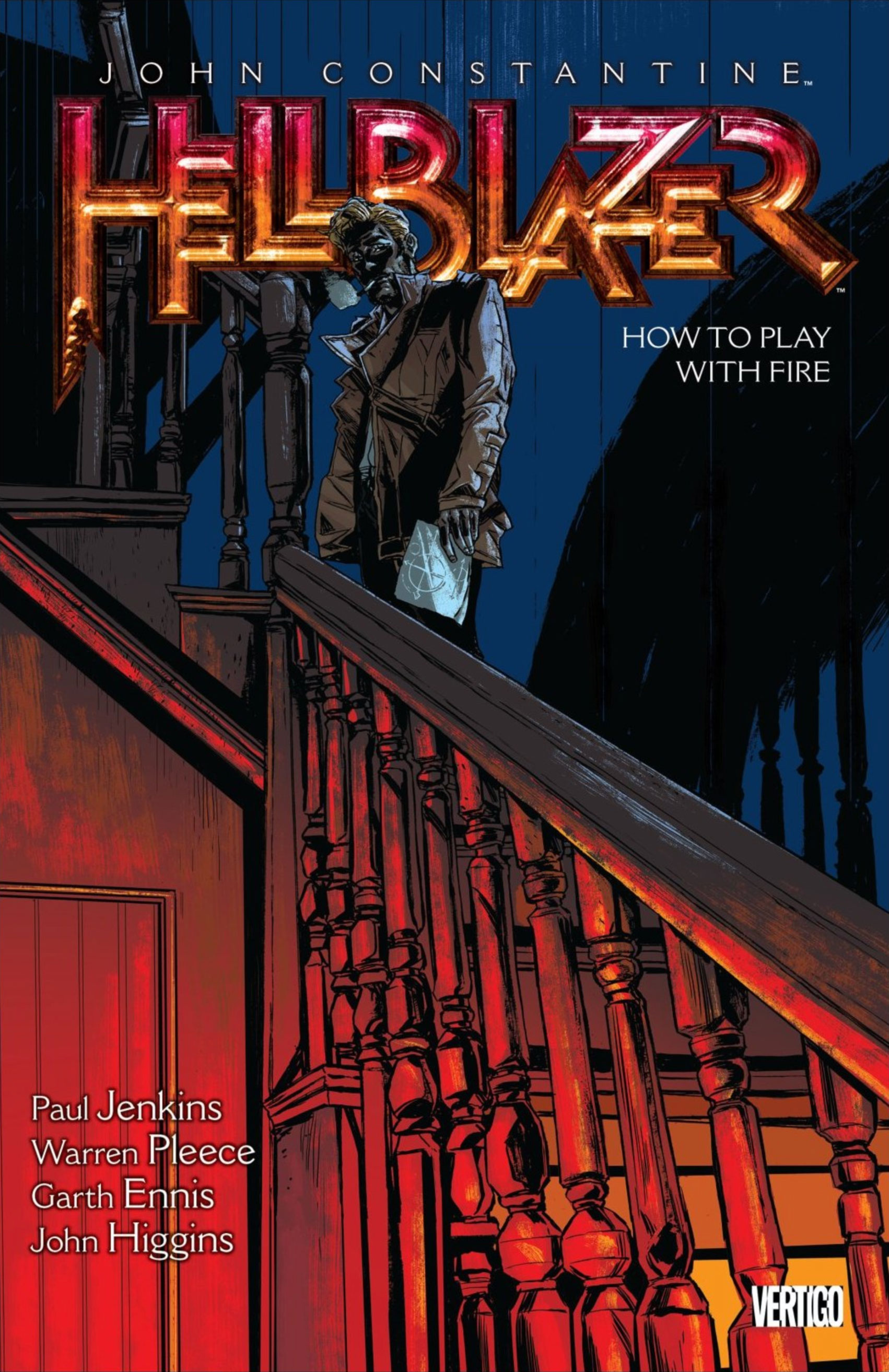
Hellblazer Vol. 12 – How to Play With Fire
By Paul Jenkins, Warren Pleece, Garth Ennis, John Higgins
There are questions you ask at the start of any Constantine story arc. Which old enemy is going to show up? Which estranged friends? What terrible thing is going to happen to this girlfriend? Does the big bad evil plan to wreck up the entire planet, or only London?
This trade paperback collects three story arcs, four issues each. In the first, Constantine is in New York to meet the latest girlfriend’s family. And for some reason, he’s up against that classic villain, Satan. But the devil isn’t raining down fire and brimstone, he’s unleashing some kind of overly-vague psychic malaise on New York, the girlfriend’s family included. Of course, John manages to save the day with the help of the girlfriend’s grandpa and a psychic he happens to know. Or at least he clears off the bad mojo from her family. Everyone else is on their own.
This arc really felt like filler to me. The actual danger is described in such vague terms, and the solution is just as unclear. I don’t need every story to conclude with a beatdown of the villain, but I do need to actually understand what’s going on, and as far as I can tell the plot of these issues seems to be that America is psychically sick, and the only cure is to share memories with boomers who know what it means to really live.
The second storyline is classic Hellblazer, with old friends turned to enemies and demonic forces desperate to get even with Constantine. As usual, everything in John’s life begins to fall apart. His buddies are estranged and his girlfriend leaves him. But all it takes to fix it is making a deal with the devil.
The final arc is the best of the bunch. John’s friend Chas gets accidentally mixed up in some gangster business and hopes that Constantine can get him out of it. Unfortunately, John has history with these gangsters too—he once did them a dangerous favor that ended in a little bit of demonic possession. This one does end in a proper showdown with a big nasty demon. So maybe that is something I need in a Hellblazer story to really enjoy it.
I last read American Gods about two decades ago. It holds up pretty well, all things considered.
It is a love letter to America and especially the Midwest, a novel whose story runs across rural highways and through chintzy roadside attractions. It looks on America kindly, but also observes our weaknesses and foibles as only an outsider can.
In American Gods, there is a spiritual void in modern America, and the gods are dying. They are being forgotten, their worshipers dwindling. In their place, new concepts ascend: media, the internet, and mysterious three-letter government organizations. And yet, for some, the transition can’t happen soon enough. Among the new gods, there are those who aren’t content to let the old gods fade. They want blood.
Meanwhile, Shadow is getting out of prison. He’s served his time and he’s going home to his wife. He has a job lined up. Then, right before release, he finds out that his wife is dead, and everything falls apart. That’s when he meets an old man who calls himself Mr. Wednesday, and Shadow is pulled into the war among the gods.
The end hinges on several surprise twists, which are nicely telegraphed, but not obvious. The final chapters are satisfying without being glib or wrapping things up too cleanly.
Acknowledging Monsters
I would be remiss to write up this book without acknowledging the recent accusations against Gaiman. His stories never shied away from dark topics like sexual assault—which once seemed like a clear-eyed view of an often terrible world. Now, it comes across as something more personal and disturbing.
I won’t argue for or against the death of the author. I can understand appreciating a piece of work, even while disagreeing with or hating the author. I’ve certainly enjoyed stories by authors like Card or Heinlein while vehemently disagreeing with their politics and social views. I also can’t blame anyone who can’t (or doesn’t want to) separate the author and the story.
There are things I love in many of Gaiman’s works. I would have called myself a fan of his not so long ago. It’s unfortunate that those stories will now be tainted. They will always have that dark coda attached.
What I’m Reading in April
Hey, it turns out audiobooks are pretty cool. I can turn a lot more of my mundane task time into listening time. And what I’m listening to next is the Area X trilogy by one of my favorite literary SFF authors: Jeff VanderMeer. I’ve also got short fiction by Ted Chiang, and maybe a couple other things from the TBR pile. See you next month.