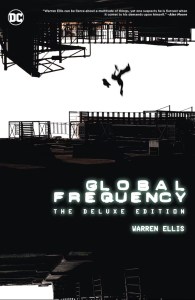
Global Frequency — Read Report

(Global Frequency Deluxe Edition at DC.com)

The version from my local library is the Deluxe Edition, containing all 12 original issues from the 2002-2004 run. As an early 2000s title, I’d say this is on the tail end of non-superhero books working their way into mainstream culture. So there is no spandex and no superpowers (at least by that parlance), but Global Frequency does dabble in super-villain sci-fi and supernatural stuff on roughly the believability level of The X-Files.

The Global Frequency is a semi-secret, global and unaffiliated spy organization, 1001 specialized experts recruited by a woman who calls herself Miranda Zero. They live in a heightened version of the real world at the turn of the millennium, and they find solutions for crises big and small.

Each issue is a self-contained story, “monster of the week” style. There is no broader arc or big bad pulling all the strings, and no significant final wrap-up for the series. Miranda Zero and her central radio operator Aleph are the only recurring characters. Everyone else is a day player, and therefore sometimes expendable.

Each issue sets up a high stakes problem with many lives on the line, then places Global Frequency members with interesting skills nearby to solve that problem. Sometimes “interesting skills” means hacking into anything and everything. Sometimes it just means a lot of punching and shooting. Sometimes it’s being a super-detective or having a bionic arm or being a magician or building your own civilian space agency.

Some of the impending catastrophes are varied, like a memetic alien mind virus or an apparent angelic visitation that drives a whole town insane. Unfortunately, about half of them boil down to a big bomb. And by big, I mean at least three separate instances of nuclear weapons, and one orbital railgun that would only be similar in effect to an atomic bomb.

2000s Edgy

The series is very of-its-time, on the bleeding edge of what was cool in 2002: parkour and UAVs and satellite imagery. The Matrix was only a couple years earlier, and the Internet still felt new. I don’t begrudge the high tech that seems mundane from a 2020s perspective, or the hackers that get into any computer in five seconds flat. Some of the early web slang, spoken aloud by serious characters, is a little harder to forgive.

The biggest problem, however, is classic Warren Ellis: the series seems to want to play with the literary big boys, but it comes off as adolescent a little too often. It’s William Gibson by way of Hot Topic.

Oh, there are cultists with a bomb and hostages? And the bomb is connected to their heart rate monitors? And they took a slow-acting poison? It’s a delicate situation. Better send in a pair of action heroes to shoot them all, and shoot the remote before the leader can push the button. Good thing the heart monitor bit was a bluff.

Then, of course, the action heroes who have been at each others’ throats the whole time can immediately go offscreen to get it on. Its violent and sexy and there are naughty words, and that makes it adult.

I don’t mind these kinds of shenanigans. They’re why people still love over-the-top 90s action flicks. Heck, Netflix is still making a few of those movies per year, with big actors and eye-watering budgets. It works when the story doesn’t take itself too seriously. But Global Frequency sometimes feels like it’s trying a little too hard to be cool.

Missed Opportunities

That said, the series could have really benefitted from another 12 issues, and I would have been happy to read them. The run is short and it sticks to the anthology- style disconnected stories a little too much for my tastes. There are two things that more issues could have given breathing room for: a multi-issue arc, and an opportunity for failure.

The Global Frequency is a sort of an organizational Mary Sue. Their funding and equipment is never really explained. All their members are experts in their field, and everyone is fully aligned with the mission, whatever that might be. There are no moles and no traitors, despite their many enemies. In a spy series!

I would love to have gotten a little more background, and that could have very easily played into some kind of SPECTRE counter-spy organization or villain with a bone to pick. It would also have allowed for the Global Frequency to fail. Because they never really do. Individual members may die in the line of duty, but they always save the day.

Art and Extras

The art is solid and varied. Each issue has a different artist, so there’s always something new to look at. The angles, panels, and framing are occasionally unexpected, but there’s nothing especially crazy or unusual going on for this era of DC. There were a few places where the action was muddied, mostly in a specific issue that is almost entirely taken up by a big one-on-one brawl.

The book ends with two Deluxe Edition extra features: the original proposal for the series as submitted to DC, and a script for one issue. These are interesting for those who want to work in comics, and those who just like to see how the sausage gets made.
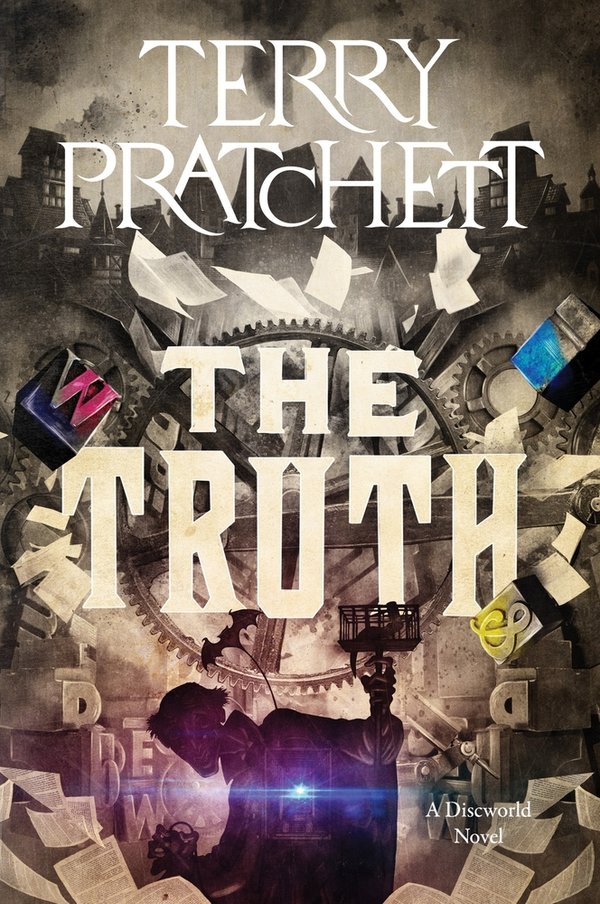
The Truth—Read Report

Book | Ebook | Audiobook (affiliate links)

There aren’t many authors who put out 40 books in the same world. It requires not only an audience that maintains interest in that world, but also an author who is both prolific and continues to find that world worth writing about.

Discworld is an interesting case because it is a comedic fantasy world, which allows it to be big and complicated and strange, but also do some occasional hand-waving when Pratchett wants to do things without the sort of rigorous justifications that a more “serious” world might need to appease its audience.

Of the 41 Discworld novels, I’ve read roughly half, and I haven’t gone in any particular order. However, there are still some clear trends in the topics and characters Pratchett chooses to focus on over the years. There are seasons of Discworld.

The Witches and Wizards show up frequently early on, and topics are fairly typical for fantasy: magic and royal lineages and the occasional dragon or world-threatening calamity. The season of Death and his family goes deep into folklore and myths, the nature of what people believe in and how that shapes the world.

It’s pretty clear that at a certain point Pratchett lands in the city of Ankh Morpork, a fantasy London analogue, and decides to spend most of his time there. There is still room here for Wizards at the Unseen University and twisted plots—usually involving the perspicacious Lord Vetinari, the Patrician who rules the city. These also frequently involve the steadily growing cast of the City Watch and their leader, Sam Vimes.

However, the stories set in the city soon start to feel more modern. This world is undergoing something of an industrial revolution, and the cultural revolutions that come along with it. The Watch becomes less medieval guards and more a police force, while reckoning with multiculturalism through the lens of dwarfs and werewolves. The semaphore “clacks” tower network jumps from telegraph to pseudo-internet in the span of a single book. Photography and rock music come to Ankh Morpork.

Through these real-world-adjacent changes to Discworld and Ankh Morpork, Pratchett finds back doors for critique and commentary that feel applicable to the everyday mundane world without ever coming across as overly political or preachy.

The new technology at the heart of The Truth is movable type and the printing press. In classic Discworld historical compression, the idea of the newspaper and the investigative journalist follow mere hours behind. The reporter is William de Word, who accidentally falls into the job when his monthly paid newsletter for royals quickly morphs into a daily broadsheet read across the city. William is the youngest son of a nobleman with very particular ideas about how society should be structured. William disagrees and has chosen estrangement and a life of poverty rather than compromising his principles.

The city’s ruler, Lord Vetinari, is accused of attempted murder under strange circumstances that look suspiciously like a frame-up. Unlike a typical fantasy tyrant, this is actually a problem for him in the semi-democratic system of modern Ankh Morpork. The mysterious cabal behind the plot want Vetinari out because he’s allowing the modernization of the city. Technological and cultural. These shadowy plotters want a return to traditional values. They want less immigration. They couch it in polite language. They stink of old money. It’s all very familiar.

The printing press itself is the work of a group of dwarven immigrants. The paper soon employs a troll for security and a vampire as their photographer. William has the luxury of slumming it, choosing a pauper’s life with the knowledge that there are mansions and titles waiting, should he have need. But his friends and coworkers are legitimately poor, and members of groups that many in the city look down upon. The stakes are real for them.

While the big bad lurks in the shadows, ground-level villain duty falls to a pair of thugs, Mr. Pin and Mr. Tulip, who collectively call themselves The New Firm. One of Pratchett’s under-appreciated skills is crafting exceptional villains, and these two are no exception.

Mr. Tulip is the muscle-bound brute. He wants to have a drug problem, but doesn’t know anything about drugs, so he spends the book snorting all sorts of innocuous white powders. What he does know about is fine art, and he waxes loquacious about paintings, sculptures, and candelabras.

Mr. Pin is the brains of the operation, cold and calculating and quick with a knife. He’s haunted by demons that progressively strip him of his sanity as events unfold.

The Truth is not my favorite Discworld book, but it’s a solid entry in the series. As usual, there were several places where I was delighted by Pratchett’s use of language. Comedy writing is rarely taken seriously, and Pratchett’s pure writing chops deserve more praise than they get.

If the book has a weakness, it’s that it underuses its recurring characters. Were used to seeing Vetinari and Sam Vimes chewing up the scenery when they’re on-stage. Here, they sit in the background, prevented from doing anything interesting because this is William’s story. I would have loved for each of them to have more clear and interesting roadblocks to justify the space William is given to swoop in and save the day.

William himself has a nice arc as the unassuming lesser son of a noble family who hates all his relatives and wants to make his own way in the world. The interesting twist is that he ends up embracing the noble haughtiness that his birthright, but deploying it for the good of the city, his friends, and his fledgling newspaper.

If you’re just starting on Discworld, this wouldn’t be my recommended entry point, but if you enjoy Pratchett and his fantasy-comedy shenanigans, The Truth will give you everything you’re looking for.

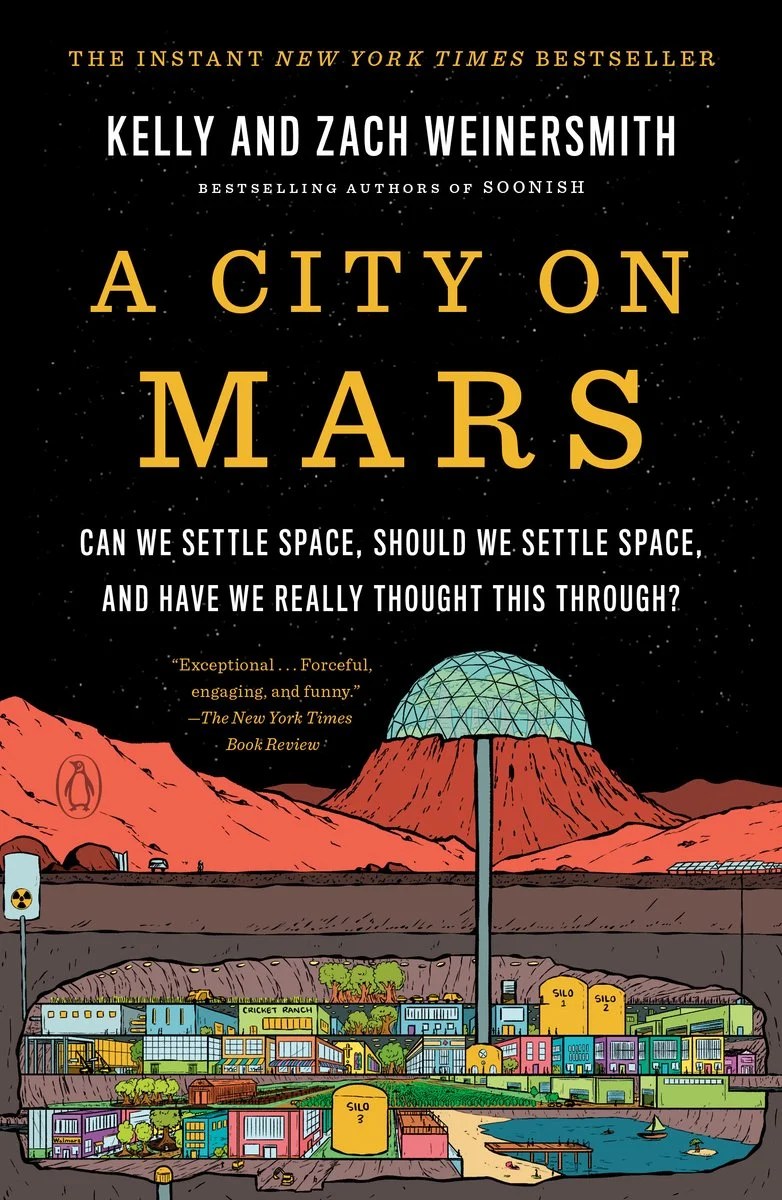
A City on Mars — Read Report

Book | E-book | Audiobook (affiliate links)

A City on Mars is the perfect kind of pop-science non-fiction for science fiction writers. It’s no surprise they got blurbs from the likes of Mary Robbinette Kowal and Andy Weir. It’s easy reading, comedic without being too jokey, and well-illustrated (Zach is author of Saturday Morning Breakfast Cereal). It delves into a subject that’s core to science fiction, one we’re all familiar with, and makes it feel new and interesting.

This is a book about space colonization, but with a few unexpected twists. “Can we settle space, should we settle space, and have we really thought this through?” asks the subtitle. Those might seem like silly questions when so much engineering and money have gone into space exploration over the last 75 years. And yet, the authors make a fairly convincing case that in some really important ways, we’ve only scratched the surface.

The Weinersmiths note that we seem to be at the beginning of a new age of space exploration. Unlike the Apollo era, there are more countries in the space game. There are private companies managing flights. And there is an awful lot of supposedly serious talk about space colonization, or at least space capitalism.

A City on Mars explores space colonization on multiple axes: not only engineering and tech, but biology, law, economics, and politics.

The Technology of Colonization

We have rockets. We have space stations. Space suits and space toilets. All sorts of advanced space technology. Hundreds of people have been to space, including Katy Perry. How hard could it be?

Of course, simply going into space is fraught with danger and wildly expensive, and this is easy to forget after watching a blockbuster movie or two. Living in space (or on other planets) is more expensive, harder, and more dangerous than living at the bottom of the sea or Antarctica. Orders of magnitude worse. And yet, those harshest of terrestrial environments often seem more fraught in our imaginations than the cold, airless, heavily irradiated void of space.

We have surprisingly little understanding of living in space—really living for years, or lifetimes—not just visiting and doing a little science. Practically everyone in space has been a well-trained, psychologically stable adult, in the prime of life and in incredible physical shape. The longest contiguous period ever spent in space is 437 days. Nobody has built anything approaching a self-sustaining environment in space. Nobody (that we know of) has ever conceived, been pregnant, or given birth in space. No children have grown up, way up there.

Despite all these unknowns, all these open questions and possible things that could go wrong, there are plenty of high-profile calls for “space colonization.” We could solve Earth’s population crisis. We could make trillions of dollars mining asteroids. We could make humanity a multi-planetary species, robust against catastrophe.

Don’t get me wrong, there have long been space nerds with dreams like this. I’m one of them, and so are the Weinersmiths. But now, space nerdery has been infected by the same Silicon Valley ethos that captured tech, finance, a lot of government, and seems to be rapidly becoming the villain of modern life. Its core tenet says that if we understand computer programming we can understand and solve any problems, probably very easily. It’s good to remember that is often not the case.

A City on Mars is in many ways a litany of all the problems that need to be solved to make space colonization a reality. It’s a long list, but also an interesting one.

More than Tech

The intersection of tech and law is rarely something that catches the zeitgeist. Where Silicon Valley interacts with the law, it often seems to be working under the famous adage of “move fast and break things.” And by pretty much any measure, it turns out that space colonization would be breaking our current space laws.

International space law is unsurprisingly limited. A handful of documents from 50+ years ago comprise all of it. That hasn’t been much of an issue while you can count all the space-faring governments on one accident-prone sawmill worker’s hand. It might become more of a problem when a dozen space programs and an equal number of private corporations are racing into space. Especially if they’re led by libertarian billionaires with certain ideas about manifest destiny.

The Weinersmiths look at the existing laws, where they are likely to be inadequate, and some international frameworks that might make good templates for new laws, including those that govern the deep sea and Antarctica.

They also look at the economic drivers for space exploration and colonization, or the lack thereof. Even with drastic improvements to the tech, the likelihood of making money in space seems slim. It’s so hard and expensive and slow to do anything in space that the payoffs would have to be outright astronomical to develop any kind of self-sustaining industry.

Space Livin’ Ain’t Easy

If there’s a broad takeaway from A City on Mars, it’s that space colonization is still a lot harder than it’s often assumed to be, and that it would be a good idea to take it slow and act thoughtfully rather than jumping in with half a plan and dealing with the consequences. It’s not a sexy position for a book aimed at space nerds to take, and the Weinersmiths are keenly aware of this.

They make their case well, and it’s hard to argue against it. This doesn’t mean space colonization is doomed, but it does probably mean that it’s a very long-term project, and one whose parameters may not jive with a lot of the current discourse. It means there are a lot of problems still to solve, and that throwing money at them won’t be enough.

Science has proven pretty good at solving some of these problems, given enough public support. That’s half the battle. The other half is purely social: can we work together and get along, as individuals and nations? The technology may be the easier lift.

Pessimism for Writers?

So why would a book that catalogues all the barriers to space colonization be good for science fiction writers? Simple: we need tension and conflict in our stories.

Practically every page of A City on Mars is a story waiting to happen. Every challenge, every difficulty or unsolved problem is just another seed for an interesting new plot.

Sci-fi can  get bogged down in the land of technobabble solutions to technobabble problems. It’s not always satisfying when your dilithium crystals break and you solve it by reversing the polarity on the tractor beam to push your ship out of the neutral zone. A City on Mars offers a wealth of potentially fun challenges for characters to overcome: problems of technology and biology, but also of politics, law, and economics. If you want to write about near-future space colonization, it’s a fantastic place to start.

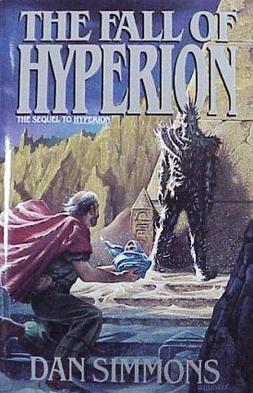
The Fall of Hyperion — Read Report

Book | E-book (affiliate links)

The Fall of Hyperion is the second book in the Hyperion Cantos. It is the sequel to Hyperion, and although the two Endemion books pick up a related story in the future of the same universe, the two Hyperion books really form a complete pair.

They are an interesting duo of books to compare. Hyperion has only a few long chapters, each a self-contained story. As the first half of a series, it makes little attempt to resolve loose ends. The Fall of Hyperion has a very large number of short chapters and has many mysteries to wrap up and plot points to resolve.

Severn, Gladstone, and the Pilgrims

Hyperion followed the stories of the seven Shrike Pilgrims, who make their way to the so-called Time Tombs, finding themselves alone in a dire situation as the galaxy sits on the brink of war. The Ousters, humans who long ago committed to life in wandering deep space colonies, face off against the Hegemony, a culture stradles hundreds of planets with instant-travel “farcaster” portals and a central government.

The Fall of Hyperion introduces the character of Joseph Severn, who takes his name from a friend of the ancient poet, John Keats. Severn is a “cybrid”—a hybrid of human biology and an AI personality, with the artificial memories of John Keats embedded in his mind. As if that weren’t enough, Severn is in some ways the twin of Johnny, the dead cybrid lover of one of the Shrike Pilgrims.

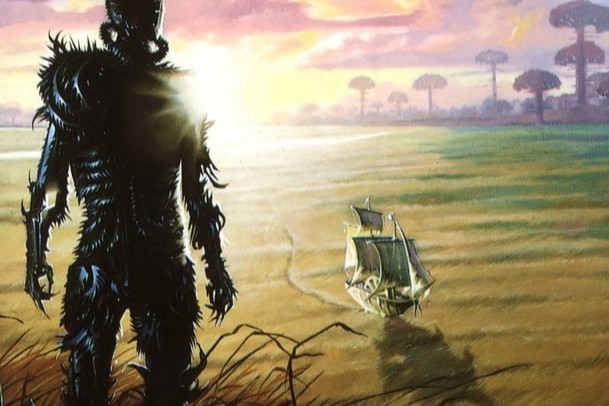
Severn is hired by Hegemony CEO Meina Gladstone, ostensibly to draw her portraiture in what is expected to become a defining moment of the Hegemony’s history. For most of the book, chapters alternate between Severn and the Shrike Pilgrims. The Pilgrims work to discover the mysteries of the Time Tombs and how they relate to the Shrike, a four-armed, semi-mythic, razor-covered metallic monstrosity that seems inextricably linked to the tombs and a far-future war where humankind fights for its existence.

It eventually becomes apparent that the chapters alternate because Severn has the unique ability to “see” the pilgrims’ activities in real time through his dreams, and it is because of this that Gladstone wants to keep him close.

The Hegemony’s war with the Ousters heats up and threatens to spill out of the Hyperion system, into the web of farcaster-linked worlds. But the pilgrims and Severn soon learn that the Ousters may not be the biggest threat. The Core of hyper-intelligent AIs, inventors of the farcasters and aloof patrons of the Hegemony, are revealed to be split into three competing factions. At least one of these is Hell-bent on creating a machine god and wiping out humanity.

The Challenges of Mythic Sci-Fi

The greatest strength of Hyperion becomes the main weakness of The Fall of Hyperion. The first book manages to build an epic space-opera universe and populates it with characters and stories pulled from other genres. The overall effect of the Pilgrims’ quest and their adventures is a mythical-feeling quest in a far-future setting.

Hyperion gets away with this partly because it only dips its toes into galactic politics and space wars and AI metaverses. But the sequel has to gather the loose ends into a somewhat logical and satisfying conclusion. As a result, it digs deeper into many of the sci-fi elements and strips away some of the hand-wavy magic of the universe by explaining how it all works. Of course, the AIs and quantum physics of eight centuries in the future are still magic, just with a technobabble vocabulary.

I do appreciate that the resolution really resolves the story (even if it does leave one very specific opening for the sequels). The two books make a satisfying series. But the second book feels more like “standard” space opera and doesn’t quite achieve the same highs of the first book.

That said, my favorite chapter across both books comes from The Fall of Hyperion, and follows Meina Gladstone as she traverses many worlds by farcaster on the eve of war. Rarely does sci-fi achieve such a sense long history in its setting or capture so well the feeling of insignificance in the face of a vast universe.

Is Dan Simmons Problematic?

Coincidentally, as I was re-reading these books, Dan Simmons passed away. I clicked through a few articles and quickly learned that he is widely considered problematic. I hadn’t come across much in these books that raised my hackles, so I ventured down the Internet rabbit hole to see what random strangers found objectionable.

The answer was mostly in his other books. It turns out historical and alt-history fiction is a more fertile ground for outright racist tropes. However, I did find some specific complaints with the Hyperion books, and I thought they offered interesting insights into modern readers.

Firstly, some people are just excited to pile on. Hating things online has long been a popular pastime, and hating on awful people has the added bonus of letting the hater feel superior and righteous.

A notable number of criticisms come from “readers” who pretty clearly haven’t read the material. They complain about unreasonable interpretations of the material, or complain about something insignificant when there are clearly better examples for their argument elsewhere in the books. At best, these are readers who quit after the first few chapters.

One critic took offense at the use of the r-slur by one of the characters, in reference to a tribe of people with a parasite that revives them whenever they die, but degrades their mental faculties each time. This is an interesting case, because the first book was published in 1989.

For younger readers unfamiliar with the history, I suspect it comes across as weirdly blatant use of a nasty slur. These readers seem unaware of the shifting moral terrain of scientific terms around mental disabilities over the course of the 20th century. I think it’s fair to assume that this particular usage of the r-word was considered relatively innocuous in ’89. The modern, offensive, and derogatory usage of the word (and pushback against it) came mostly in the following two or three decades. Similarly, the word “oriental” is used once or twice. That might have been a bit dated in ’89, but I don’t think it would have seemed nearly as off-color as it does today.

These books are “only” 40 years old, but that is enough time for the language and the culture to change. I may be the old man yelling at clouds, but this shallow maligning of the author’s intent and tone strikes me as willful disinterest in any non-negative interpretation.

That said, there are parts of these particular stories that don’t hold up well to modern sensibilities. Simmons indulges in a few Star Wars-style monolithic planets, including a Catholic planet, a Jewish planet, and an Islamic planet. None of these are explored in great detail, but the Islamic planet is suggested to be a place where holy war and fanatic religious hatred are normalized.

There’s also no question that the book embodies a full-on male gaze. It definitely doesn’t pass the Bechdel test. On a list of important characters, the top fifteen contains—at most—three women. Only two of them meaningfully impact the plot. And yet there are a number of sex scenes focusing almost exclusively on female anatomy.

Of course, sex in sci-fi is hardly a big deal, especially in a world where romantasy is a wildly popular genre. I’d also argue that the most gratuitous examples in these two books come from the story of the meathead action hero, whose focus on sex and violence make some sense for his character.

I don’t defend Simmons’s character. It certainly sounds like some of the books I haven’t read contain more racist and questionable material. For what it’s worth, the first two Hyperion books mostly avoid it.

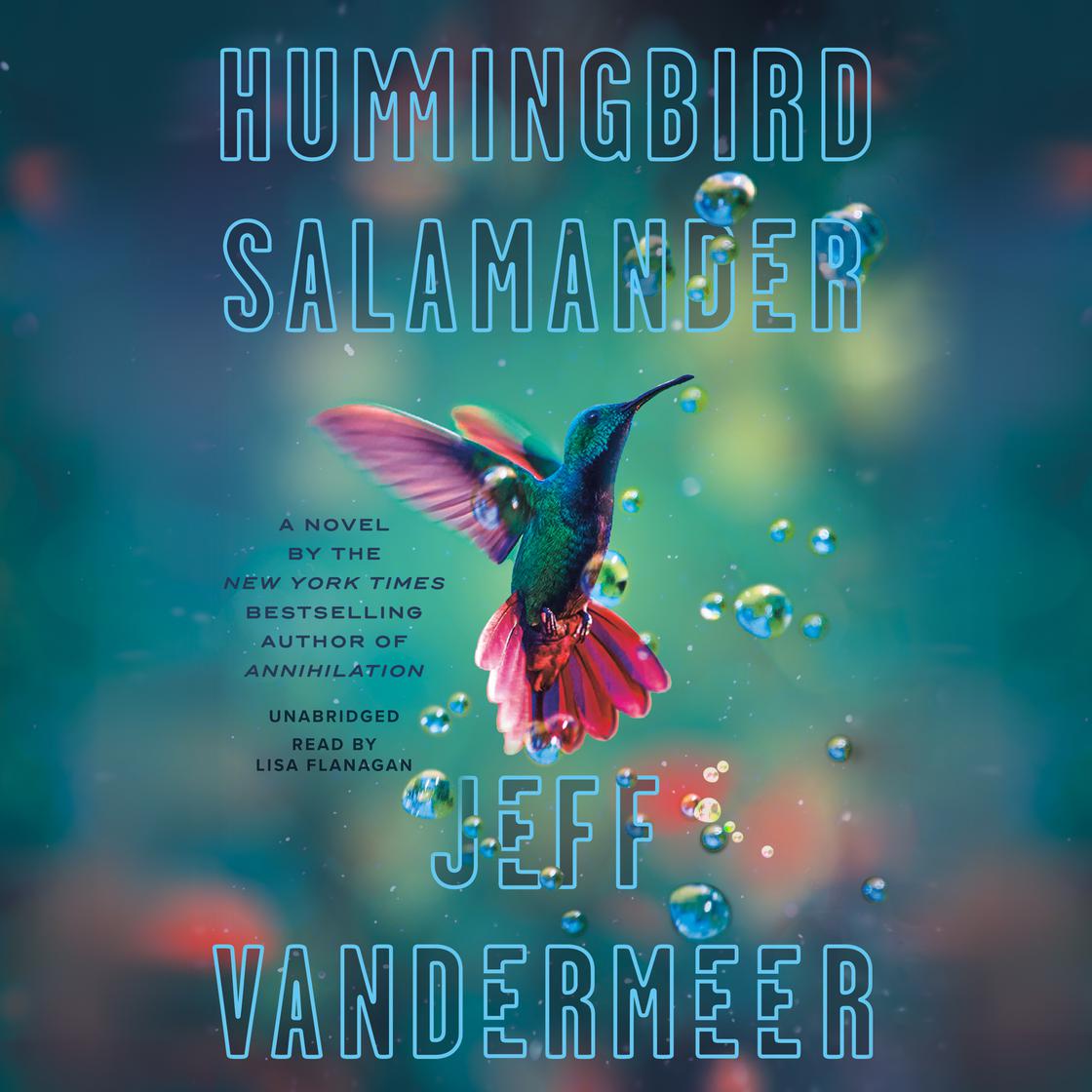
Hummingbird Salamander — Read Report

Book | E-book | Audiobook (affiliate links)

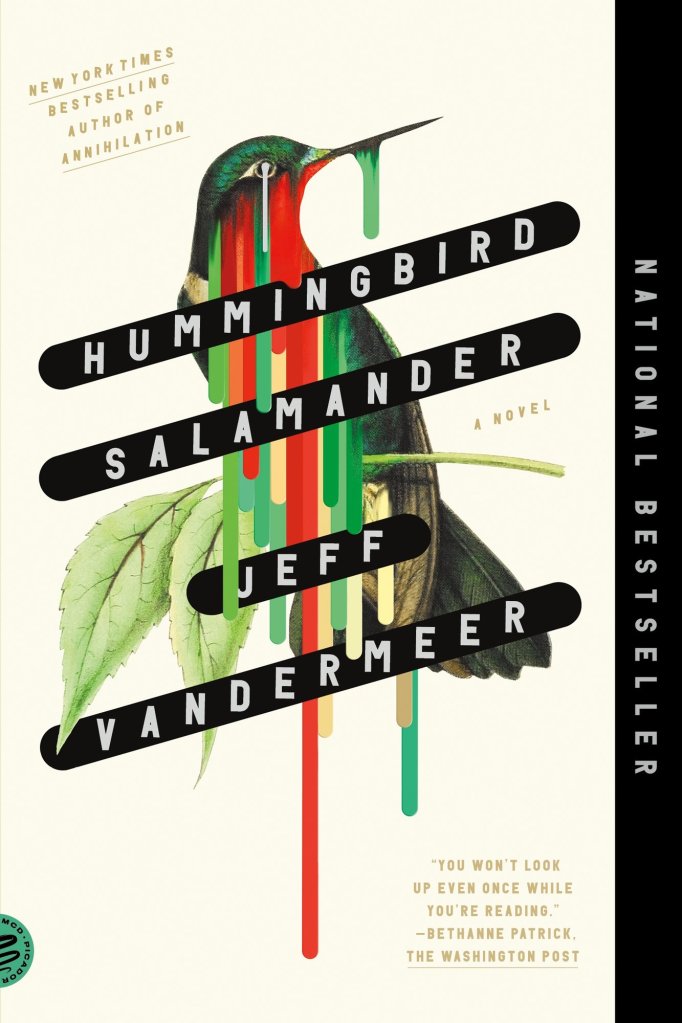
Jeff VanderMeer has hovered at the top of my favorite authors list since I read Borne and Dead Astronauts. The Area X trilogy only cemented that position. I had understandably high hopes for his latest book, Hummingbird Salamander.

Hummingbird Salamander stays close to the modern day in a way that will feel familiar to William Gibson fans. There are science fiction elements, but they are very restrained compared to VanderMeer’s previous work.

Borne was almost Joycean in a way that made it a challenging read. Hummingbird Salamander is much more straightforward, even if VanderMeer can’t stop himself from adding literary flourishes. It comes across as more of a suspense/thriller story than anything he has written in recent years.

Eco-Terrorism and Generational Trauma

It’s not particularly hard to pick out the bigger themes running through VanderMeer’s work. Ecology is the most obvious. His stories explore the ways humans interact with the world around them, and how social and technological factors intertwine with the natural world. Area X seems to exist in a relatively near future where climate change continues apace and a mysterious section of coastline is hidden behind government claims of a localized ecological catastrophe. The Borne stories describe a far-flung future city where most of what survives is the result of extreme genetic manipulation.

In Hummingbird Salamander, humankind’s fraught relationship with nature is again front and center. The story begins with a note that leads the protagonist, Jane, to a storage unit. The note contains the words “Hummingbird” and “Salamander,” with some mysterious dots in between. The storage unit contains an actual, taxidermied hummingbird of a variety that turns out to be extinct. These clues lead Jane into a deadly mystery that involves poaching and the illegal wildlife trade, as well as eco-terrorism and organized crime.

Jane lives in an America that is on the brink. Extreme weather is normalized. Ecological collapse is commonplace. Pandemics are perpetually imminent. It turns out that society fails in more of a whimper than a bang, and most things in life are getting slowly, steadily worse. But people still have jobs, family, and lives. Jane has all of these things. She’s a private security analyst, a mother, and a wife. She stands out as an unusually tall, strong woman who has excelled at weight lifting and body building, but has an otherwise normal, middle-class existence.

Another common theme among VanderMeer books is generational trauma, and in some ways this is just ecology at an individual level. A family is an environment, and as our current world is shaped by the mistakes made by our forefathers and ancestors, our personal hangups and dysfunctions are shaped by those who raised us, and those who raised them.

Jane’s dysfunctions are revealed slowly in fragments and flashbacks, only becoming fully apparent in the final third of the book. In many ways, this is the story of everything she does wrong, and why.

Where it All Breaks Down

Hummingbird Salamander is a well-written book. It has rich and detailed characters, an interesting setting, and touches on timely topics. And after some consideration, I have to admit that it is the most unenjoyable VanderMeer book I have read. This book and I have irreconcilable differences, and they are, unfortunately, at the very heart of the story.

From the first chapters, Jane is obsessed with the hummingbird and the mystery it represents. And sure, there is a reason for why the two words on the note would be important to her. But even with all the answers that are eventually revealed, I can’t help but feel that her obsession is unreasonable.

I might be able to overlook that questionable motivation if I had some sympathy for Jane. But in spite of her horrible upbringing, I find it hard to root for her. There are a handful of moments in the book where Jane shows affection for her teenage daughter and long-suffering husband, but these seem like afterthoughts. These people are hindrances, distractions from her obsessive pursuit of the central mystery. When it becomes apparent that unraveling the mystery might be dangerous, she barely spares a thought about how that could impact her “loved” ones.

In the end, she makes choices that destroy her family and ruin their lives, but she can barely muster a moment of self-reflection or regret. Her coworkers are caught up in the maelstrom. Strangers are hurt and killed because of her. She simply doesn’t care. She gets tougher and meaner as the book goes on, but she was cold and indifferent to begin with.

I will admit, as a husband and father of a teenage daughter I may be especially well-positioned to dislike Jane and her choices. Other readers with different backgrounds might have an easier time identifying with her and sympathizing. I enjoy flawed characters. I just need them to have enough redeeming qualities to get me on their side.

All Cloud, no Silver Lining

I think you’d be hard-pressed to find anyone who’d say VanderMeer’s work shows a positive attitude or hope for the future, but the pessimism has never been as apparent as it is here. A straightforward reading suggests that we might have to hit rock-bottom (as individuals and as a species) before things will get better. And even then, they might not.

Jeff’s other work balances that dark and dismal worldview with genuine strangeness and wonder. There’s a reason he was one of the leading voices of the New Weird/Slipstream movement. His worlds are shadowy and unfamiliar, but also unexpectedly delightful. Nobody loves a tidal pool the way this man loves a tidal pool. He describes coastlines like French poets describe their lovers. Hell, in Borne, the post-apocalyptic city is effectively ruled by a kaiju-sized, magically levitating super-bear, and the scariest villain is a regular-sized (but very menacing) duck.

There’s almost none of that here. The drones have gotten a little fancier and the world’s gone to shit. No impossible sci-fi. No crazy weirdness. Just a mysterious note in a grim world that eventually leads to violence and heartbreak.

The Missed Twist

I don’t want to be too down on this book, and I’ve already gotten more negative than I really like. The fact is, I plowed through it, and I did want to know the answer to the mystery. I wanted to know how it all turned out. But the entire time I was reading, I kept waiting for the twist that would help me finally understand Jane and why she was doing all this.

That twist never came.

Rod String Nail Cloth: An Afrofuturist Mixtape — Read Report

Buy on Bookshop (affiliate links)

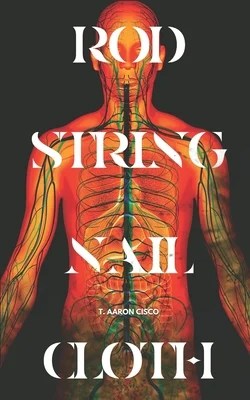
Rod String Nail Cloth was a random library pick containing six stories and a poem. It’s slim enough that I read it in the span of a Saturday afternoon. When I grabbed it I didn’t know anything apart from the title, but I’ve been meaning to investigate Afrofuturism for a while, and a short anthology seemed like a good place to start.

As it turns out, T. Aaron Cisco was born and raised in Chicago, but now lives in Minneapolis, so there’s a hometown connection for me. It also turns out that this is self-pub, and has a whiff of punk-rock “zine” to it. Unfortunately, it also has something like 20-30 typos and formatting errors across its 150-odd pages.

These stories revolve around themes of time travel, racial injustice, environmental catastrophe, and transhumanism. There are some interesting ideas in here, and some sentences and paragraphs that really pop. However, I found some of the writing straying too far into the literary style that I most struggle with: pages spent on a character’s languid internal thoughts without giving me enough plot or setting to latch onto.

The first story, “Now, Justice,” is the biggest offender in this regard. It follows a Black inventor who creates a machine that manipulates people’s perceptions. He uses it to take vengeance on a policeman who shot an unarmed Black kid and dodged the consequences. However, we don’t get to the first mention of the machine until page 17.

The subsequent stories were tighter, in my opinion. “Thursday Addison” is a Shonen anime of a story where a cybernetically enhanced enforcer is sent into a violent, futuristic battle that she barely survives.

“The Hesitant Envoy” is a tongue-in-cheek tale where an advanced civilization pulls aside one human to ask him to justify the continued existence of the species. He has a hard time coming up with a good argument, and isn’t particularly inclined to try.

 “Lydian Mode” is about a down-on-his-luck Black musician who travels back in time to 1960s Chicago. Despite the dangers of life at the height of the civil rights movement, he discovers that there are also opportunities.

“Captain Michaela” is a poem about the titular character (maybe?) saving the universe. I’m just the wrong audience for this. While I have my favorite poets and poems, I’ve never felt drawn to sci-fi poetry.

“Rod String Nail Cloth” is the stand-out story of the book for me, an epistolary story about a person sent far back in time to fix a broken world.

In “They Burn So Easily,” an apocalyptic virus turns people into still-thinking vampire/zombie creatures called Chalkies, more strongly affecting those with paler, less pigmented skin. It’s a story about choosing forgiveness and humanity even when it may be undeserved. The conflict in this one felt a bit rushed, and I would have been interested in a longer exploration of the setting, the premise, and the relationships between the characters.

Rod String Nail Cloth is, in parts: intriguing, goofy, and a little rough around the edges. It’s not going on my favorites list, but I’m happy to have read it, and I’ll keep an eye out for Cisco’s work in the future.

It also whet my appetite for more Afrofuturism, especially in short fiction. If you have any good recommendations, leave them in the comments.

Hyperion — Read Report

Book | E-book (affiliate links)

Reading the four-part Ender’s saga left me feeling skeptical of big, philosophical, late-80s sci-fi books.  Now I’m going back to that well with Hyperion.

I’ll be honest, Hyperion feels clever and stylish after Children of the Mind. Then again, Ender’s Game was the first and best book in the series. Hyperion is also the first book in a four-book series. So maybe I’m setting myself up for heartbreak all over again.

Canterbury Tales, in Space!

Hyperion opens with a frame story. A man we know only as the Consul is given instructions to go to the planet of Hyperion along with six others, on a mysterious pilgrimage. He goes, and meets his compatriots:

  • Het Masteen, captain of the spaceship that will transport them, which just so happens to be a giant tree.
  • Father Lenar Hoyt, a Catholic priest in a galaxy where Catholicism is nearly extinct
  • Colonel Fedmahn Kassad, a soldier of the galaxy-spanning Hegemony’s military
  • Martin Silenus, a centuries-old poet who has journeyed between stars and across time via relativistic space travel
  • Sol Weintraub, a scholar, who brings his baby daughter Rachel
  • Brawne Lamia, a hard-boiled private detective

When the pilgrims arrive at Hyperion and introductions are made, they come to an agreement: they will each tell the story of why they came as they make the long journey from the spaceport to their final destination, the Time Tombs. There, they expect to find the Shrike, a mythic creature made entirely of razor-sharp blades. Supposedly, he will choose one of them to grant a boon, and the others will be sacrificed.

As the journey gets underway, each pilgrim tells their story in turn. Between the stories, they travel across the planet toward their destination. It’s a bad time to return to Hyperion. The planet is poised to be the first front in the largest war humanity has ever seen, between the Hegemony and the long-exiled Ousters, who live strange lives in their deep-space ships. The Time Tombs—in what cannot be coincidence—appear to be opening, and nobody knows what will come out.

A Slowly Woven Tapestry

The structure of the book allows Simmons to expand the scope of ideas slowly. The unexplained and confusing in one story is addressed and answered in another. It allows the reader to assemble these small pieces into a detailed and rich setting.

Through the pilgrims’ stories, we begin to understand the galaxy they inhabit and the ways their paths have crossed Hyperion and the Shrike to bring them to the current moment. From Silenus we learn about Old Earth and the Big Mistake, a man-made black hole that slowly (and then quickly) devoured the planet, forcing the Hegira to many worlds. From Father Hoyt and Saul, we learn about Hyperion, it’s inhabitants, and the Time Tombs. From Kassad and the Consul, we learn about the armies of the Hegemony; the many rebellions quashed and small wars fought by a supposedly peaceful and democratic government. From Brawne, we come to understand the vast web of farcaster portals that allow instantaneous travel between Hegemony worlds, and the mysterious society of AIs who control them and remain apart from humanity while ostensibly guiding and helping them.

The book paints rich portraits of a handful of specific worlds. Dan Simmons manages to make almost every setting in the book genuinely strange and interesting. A planet wracked with storms, a sea of grass navigated by gyroscopic sailing ship, a 1.3g planet where the people live in vast arcology-like “hives,” a bus-sized cable-car over snowy mountains, an ocean world where people live on island-sized migratory creatures, and a vast capital city where the rich live in houses where every room is a portal to a different planet.

This feels like a universe with a history, a big universe populated by billions of people across dozens of worlds, and all the diversity that represents. It’s full of beauty and weirdness. And yet, the same human sins and weaknesses are still there, still causing problems.

Each pilgrim brings a different perspective to their story, which allows Dan Simmons to shift style and tone throughout. Kassad’s story is full of sex and violence, a pastiche of military sci-fi, while the Consul’s story is more of a historical documentary. Brawne’s story is a cyberpunk noir where the detective inevitably falls in love with her dangerous client. Sol’s story is that of a father desperately trying to save his sick child. These different styles help to keep the book constantly fresh, and each reveals new pieces in the puzzle of what’s really happening on Hyperion.

In the Ender Saga books, the relativistic effects of space travel were a promise that never really delivered. Nobody apart from the main characters traveled between worlds, and it seemed that nobody could even imagine that someone might live for hundreds of years by traveling between stars while time passes by.

In Hyperion, relativistic space travel is a part of life. The Web of Hegemony worlds are connected instantaneously via farcasters, but each world starts as a colony whose inhabitants took a many years to arrive, and even longer to build their first farcasters. Conflicts often arise between the original settlers, or indiginies, and the flood of tourists that inevitably come with joining the web.

Style Plus Substance

Ultimately, I think a lot of what I enjoy about Hyperion comes down to Dan Simmons’s writing style. It incorporates literary flashes and delightfully crafted language, while maintaining the workmanlike plotting and characterization that a mainstream science-fiction audience would expect…especially in the late 1980s.

For a thirty-five year old novel, Hyperion still feels fresh and interesting. It’s doing a lot, and doing most of it well. If there’s anything to critique, it’s that the book sets up some big mysteries and leaves the biggest ones unresolved. I believe the four books in the series are really a pair of duologies, so I expect to get most of the answers in the sequel, The Fall of Hyperion.

The River Has Roots — Read Report

Book | E-book | Audiobook (affiliate links)

I first discovered Amal El-Mohtar as the co-author of This is How You Lose the Time War with Max Gladstone. (I’ll even take the hipster cred of loving that book years before it was cool.)

With any multi-author work like that, I always wonder how I’ll feel about the things that come later. Much like a great song with a featured artist, you never quite know if it’s the band, the guest, or some unreproducible magic in the collaboration itself.

However, I’m pleased to report that even though it is very different, I enjoyed El-Mohtar’s The River Has Roots just as much as that previous book.

Audio Considerations

There’s no question that different formats can have an impact on the experience of a book. I first “read” Jeff Vandermeer’s Area X trilogy as an audiobook, and recently re-read the first book, Annihilation, in paper. It’s a dense and challenging book in places, and I found the ability to easily re-read and compare previous pages allowed me to take in more of the information on the page. On the other hand, the audiobook forced my attention and lent a certain claustrophobic feeling to parts of the story that was in many ways complimentary to the text.

I also “read” The River Has Roots as an audiobook. It’s worth noting that this audiobook includes set-dressing in the form of gentle background noise: a burbling river, a bustling market, a whispering forest. This background audio is done well, and suits the story nicely. After my initial surprise, I never found it overbearing or distracting.

Songs are an important theme of the story, and these are fully sung. I was delighted to find out after the fact that the music was actually performed by the author and her sister, including harp and flute parts. These elements put it somewhere between audiobook and radio play.

Finally, I’ll note that the narrator has a strong accent — my uninformed guess was Irish, although one of the book’s blurbs suggests that it’s “rural English.” As an American, I found myself needing to pay a little more attention than usual at the beginning of the story. By the end, I had no problem following whatsoever. The narrator, Gem Carmella, convinced me that the audiobook wouldn’t have been quite so effective without her voice.

The River Has Roots isn’t a long book. It’s listed at 144 pages. My audio edition claims a length of 3:53, but a full hour of that is actually a preview of El-Mohtar’s upcoming book of short stories.

I’ve said before that I appreciate the trend toward more acceptance of novellas in recent years, although I’d confess that I have a tough time justifying the purchase of a hardback book of that length for the $24 list price. Luckily, the audiobook was a steal on end-of-year holiday sales, and is still less than half the price of the hardcover.

A Modern Fairy Tale

The fantasy genre has come a long way. Even for those who still ape Tolkien, a significant amount of codification and shorthanding has occurred. And in backlash against that, all sorts of sub-genres and new offshoots have emerged. For the most part, modern fantasy feels quite different from ancient myths and folk stories that have been handed down more or less intact across centuries. Even if they do share certain key features.

The River Has Roots is very much trying to evoke the feeling of fairy stories, and I think it succeeds. Part of that is having the right kinds of imagery and road markers: a world just like our world, where magic is accepted as real. Sisters living in close proximity to a Faerie land. Songs with power. Witches and secret lovers and villainous suitors who are really just after the family fortune.

Beyond those many surface-level things that are easily recognizable as “things that fit into fairy stories,” there is a certain mode of speech, a certain way of unfurling the story that also contributes to this feeling. In The River Has Roots, magic is called grammar, and wizards are grammarians. El-Mohtar has found the magical grammar of the fairy story and deployed it perfectly here.

It is a common trope to suggest that fairy stories are required to have a happy ending where all the wrongs are put to rights. It’s one of those truisms we accept without thought, and it’s also not true. It’s well-known that many of the Disney versions of classic stories were changed, their dark and horrible endings often considered too depressing or gruesome. I won’t spoil the ending here, except to say that it treads that knife edge well, and could perhaps be best described as melancholic.

If you’re in the mood for something short and sweet, modern and well-crafted with the feel of something older and wiser, The River Has Roots is an excellent choice.

The Voice I Kept, by Juno Guadalupe — Short Report

Short Reports are a miniature version of my Read Reports: brief thoughts about small—often tiny—stories.


The Voice I Kept
by Juno Guadalupe
(Anomaly SF)

At 138 words, this is not quite drabble-length, so it needs to hit hard and fast. It’s a story about the loss of someone loved, with the sci-fi element being their replacement by an artificial duplicate.

The opening is a metaphor unfurling: salt as grief. The end is a callback to the title. Great structural choices for micro-fiction.

The mix of italics and quotes is something I’ve done myself, but it’s dangerously ambiguous. Is the robot speaking non-verbally? Is it the protagonist’s internal voice of their lost loved one? Any lack of clarity can be catastrophic in a story so short.

The theme is imminently relatable; we’ve all experienced loss of a loved one, by death or lesser proxy. I don’t quite get that gut-punch emotional reaction I want from a short story, but that’s always the biggest challenge of micro-fiction, where you are fighting for every word.

Children of the Mind — Read Report

Book | E-book | Audiobook (affiliate links)

Children of the Mind is billed as the final book in the “Ender Quartet.” In my opinion, that quartet is really Ender’s Game standing on its own, and sequel trilogy that is in many ways tonally different and mostly disconnected in plot.

The trilogy of Speaker for the Dead, Xenocide, and Children of the Mind centers on the story of the planet Lusitania, thousands of years after Ender’s defeat of the buggers. The ticking clock of the series is the war fleet sent to destroy Lusitania. It has been delayed by the computer intelligence Jane, but now Starways Congress is aware of her presence in their computer systems, and has a plan to reset their communications network across the hundred worlds. This will not only prevent her from meddling, but effectively kill her as she’s reduced from millions of computer systems to only a handful.

The destruction of Lusitania would do more than kill the thousands of human colonists, because the planet is also home to the only other intelligent species known to humanity: the pig-like Pequeninos, whose life-cycle was heavily modified by an extra-terrestrial virus—the Descolada—and includes a worm-like larval stage and an eventual transformation into something like a psychic tree.

Ender has also brought the last of the Bugger hive-queens to Lusitania, where it is busy building enough industry to build starships and send out new queen larva to distant planets, ensuring the continuation of the species.

A final additional subplot is introduced, as if there weren’t enough. The dangerous Descolada virus has been neutralized on Lusitania, replaced with a harmless version that fills the needs of Pequenino physiology without the danger of infecting and modifying the genomes of other species. But it has become apparent that the virus is not natural. It was created, and the species that could and would send such a dangerous weapon into the universe is potentially the greatest threat humans, Pequeninos, and Buggers have ever seen.

Ender, once the titular character, has now been almost entirely sidelined in the story. As a reader, his perspective is barely present in the book, and he spends a good chunk of it effectively comatose. By the end, it’s apparent that the book is a send-off for him. His presence almost feels like an afterthought. Instead, the book focuses on Miro (his adopted son and Jane’s new favorite human), Si Wang-mu (genius emigrant from the planet of Path) and young Val and Peter, ghosts from Ender’s childhood that he made physically manifest on his brief trip outside the universe in Xenocide.

Tonal Shift

Analyzing the series as a writer, it’s interesting to see the transformation of Card’s style in the post-Ender’s Game trilogy. Ender’s Game was a relatively near-future hard SF story that focused on a single brilliant boy’s journey through military school, and the horrifying extremes the wartime government was willing to go to in order to defeat an existential threat to humanity. While there is a B-plot for Peter and Valentine, most of the story stays tight on Ender’s perspective.

The subsequent trilogy is much more scattered, and while it touches on plenty of interesting ideas, I think this lack of focus is somewhat to its detriment. The series becomes decidedly softer sci-fi, culminating in a deus ex machina mode of faster-than-light travel that also allows near-magical creation of a bespoke super-virus and several entirely new people.

My daughter and I both came to the same comparison independently—the Golden Compass series had the same seemingly tight beginning before spiraling off into odd and confusing tangents. Both feel like completely different series at the beginning and the end.

A fair amount of Ender’s Game is dedicated to his own internal angst as he undergoes indignities and abuses at the hands of the adults in positions of authority over him. The subsequent books include even more angst, spread across a large cast of characters. Long internal monologues are par for the course, and I would be hard-pressed to identify any character experiencing any kind of happiness before the final two or three chapters.

Where Ender’s frustration and eventual desperation felt appropriate to his situation, I couldn’t help but feel that this modus operandi became oppressive with so many more characters, and continuing for three books. It was unrelenting and a little exhausting.

A side-effect of this feeling was that the problems posed to the characters became so big and so multitudinous that their inevitable resolutions at the end of the series felt too trite and easy in comparison. It’s a tough balancing act to set up huge roadblocks for the characters and then resolve them in a way that feels earned.

Welcome to Ethnic Planet

I am keenly aware that I’m reading this series 30 years after its original publication. One of the strangest things about these books is the way Card has built his universe. His characters and their personalities run up against each other in a variety of interesting and well-thought-out ways, but his settings feel like cardboard cutouts in comparison.

The planet of Lusitania is the most fleshed-out setting in the series, but that’s a little deceptive because it has been engineered for simplicity. The Descolada has ravaged the ecosystem, and only a dozen species have managed to adapt. There is a single human colony city, and it is Portugese Catholic through-and-through.

The common sci-fi trope would be to construct “Star Wars” planets with a single distinguishing feature, usually an environmental biome. The ice planet. The forest planet. The desert planet. The lava planet.

Strangely, Card has managed to at least partly eschew this (though Lusitania is a uniform mix of forest and plain and Trondheim is icy). However, he has very plainly replaced these tropes with a different sequence: planets that are each a uniform human monoculture. Even more strange, in my opinion, is how these caricatures hew to a myopic 1990s American perspective. Say what you want about some of the performative multiculturalism in the still-not-very-broad-minded modern publishing industry, but I am honestly a little surprised that Card’s blatant stereotyping made it into a series that was not only mainstream, but award-worthy in its day.

Speaker for the Dead introduced Trondheim, the stoic Scandinavian planet. Xenocide introduced uniformly Chinese planet of Path, dominated by a kind of luddite, vaguely Taoist folk religion. Children of the Mind adds two more:  Divine Wind and Pacifica. Divine Wind is the Japanese planet, industrious and technologically innovative much as the US saw Japan in the 70s and 80s. Pacifica is the Samoan planet, and everyone that Peter and Wang-mu encounter there seems to be built like a linebacker, living a simple tropical life, and deeply invested in ancient, polytheistic religion.

There is an argument to be made that the book explicitly says that these planets are more diverse, and there is more to them than regions depicted in the main plot. However, I think this is a weak argument. It’s textbook telling instead of showing, and it seems to admit that the cultural caricatures, which are all we’re actually shown, are shallow and problematic.

Besides, the problem is not the lack of wokeness, it’s the abject unbelievability of a universe where each planet is almost entirely populated by uniform groups of people defined by a handful of simple traits that apparently haven’t changed over thousands of years. This is as absurd as the idea of a modern Italy that has adapted to our current world, technology, and politics while remaining culturally almost identical to the early Roman empire.

Even weirder, the term “western” is explicitly used, which is nonsensical in a far-future multi-planetary society. Of course, the core power systems of the Starways Congress and the military seem to be fully controlled by these “western” cultures, because who could possibly envision a universe where the US and Europe aren’t dominant?

The Dangers of Rereading

I have to admit, part of me wishes I hadn’t revisited these books. They didn’t quite live up to my fuzzy teenage memories of them. Those memories told me that Ender’s Game was the best of the set, and I continue to feel that way. But the sequel trilogy might have been better served by being further divorced from that book and getting a little more breathing room to explore other ideas.

In the end, I found the “Ender Quartet” to be an interesting series, but ultimately flawed enough that I had a tough time enjoying all the good bits without being reminded of the things that annoyed me. My current views are certainly affected by my age, my experiences, and the many fantastic books I’ve read in the interceding decades.

On the other hand, I might have reason to worry if I felt the same way about these books today as I did in my teens. For writers, rereading our old favorites can be a fun and useful exercise, but it’s also a dangerous one. You may find that those books were more enjoyable through the lens of nostalgic memory than they are in the cold light of a fresh read.