
Book | Ebook | Audiobook (affiliate links)
There aren’t many authors who put out 40 books in the same world. It requires not only an audience that maintains interest in that world, but also an author who is both prolific and continues to find that world worth writing about.
Discworld is an interesting case because it is a comedic fantasy world, which allows it to be big and complicated and strange, but also do some occasional hand-waving when Pratchett wants to do things without the sort of rigorous justifications that a more “serious” world might need to appease its audience.
Of the 41 Discworld novels, I’ve read roughly half, and I haven’t gone in any particular order. However, there are still some clear trends in the topics and characters Pratchett chooses to focus on over the years. There are seasons of Discworld.
The Witches and Wizards show up frequently early on, and topics are fairly typical for fantasy: magic and royal lineages and the occasional dragon or world-threatening calamity. The season of Death and his family goes deep into folklore and myths, the nature of what people believe in and how that shapes the world.
It’s pretty clear that at a certain point Pratchett lands in the city of Ankh Morpork, a fantasy London analogue, and decides to spend most of his time there. There is still room here for Wizards at the Unseen University and twisted plots—usually involving the perspicacious Lord Vetinari, the Patrician who rules the city. These also frequently involve the steadily growing cast of the City Watch and their leader, Sam Vimes.
However, the stories set in the city soon start to feel more modern. This world is undergoing something of an industrial revolution, and the cultural revolutions that come along with it. The Watch becomes less medieval guards and more a police force, while reckoning with multiculturalism through the lens of dwarfs and werewolves. The semaphore “clacks” tower network jumps from telegraph to pseudo-internet in the span of a single book. Photography and rock music come to Ankh Morpork.
Through these real-world-adjacent changes to Discworld and Ankh Morpork, Pratchett finds back doors for critique and commentary that feel applicable to the everyday mundane world without ever coming across as overly political or preachy.
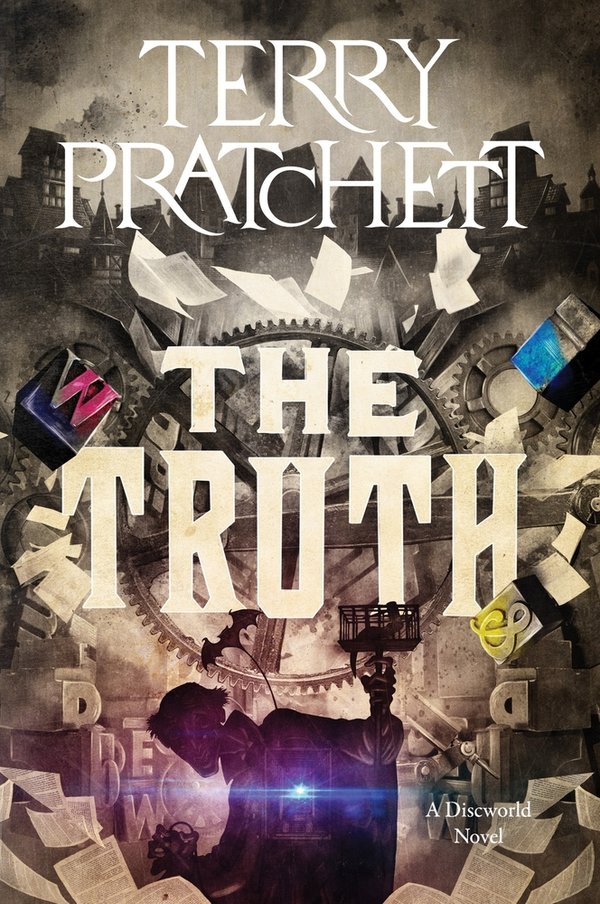
The new technology at the heart of The Truth is movable type and the printing press. In classic Discworld historical compression, the idea of the newspaper and the investigative journalist follow mere hours behind. The reporter is William de Word, who accidentally falls into the job when his monthly paid newsletter for royals quickly morphs into a daily broadsheet read across the city. William is the youngest son of a nobleman with very particular ideas about how society should be structured. William disagrees and has chosen estrangement and a life of poverty rather than compromising his principles.
The city’s ruler, Lord Vetinari, is accused of attempted murder under strange circumstances that look suspiciously like a frame-up. Unlike a typical fantasy tyrant, this is actually a problem for him in the semi-democratic system of modern Ankh Morpork. The mysterious cabal behind the plot want Vetinari out because he’s allowing the modernization of the city. Technological and cultural. These shadowy plotters want a return to traditional values. They want less immigration. They couch it in polite language. They stink of old money. It’s all very familiar.
The printing press itself is the work of a group of dwarven immigrants. The paper soon employs a troll for security and a vampire as their photographer. William has the luxury of slumming it, choosing a pauper’s life with the knowledge that there are mansions and titles waiting, should he have need. But his friends and coworkers are legitimately poor, and members of groups that many in the city look down upon. The stakes are real for them.
While the big bad lurks in the shadows, ground-level villain duty falls to a pair of thugs, Mr. Pin and Mr. Tulip, who collectively call themselves The New Firm. One of Pratchett’s under-appreciated skills is crafting exceptional villains, and these two are no exception.
Mr. Tulip is the muscle-bound brute. He wants to have a drug problem, but doesn’t know anything about drugs, so he spends the book snorting all sorts of innocuous white powders. What he does know about is fine art, and he waxes loquacious about paintings, sculptures, and candelabras.
Mr. Pin is the brains of the operation, cold and calculating and quick with a knife. He’s haunted by demons that progressively strip him of his sanity as events unfold.
The Truth is not my favorite Discworld book, but it’s a solid entry in the series. As usual, there were several places where I was delighted by Pratchett’s use of language. Comedy writing is rarely taken seriously, and Pratchett’s pure writing chops deserve more praise than they get.
If the book has a weakness, it’s that it underuses its recurring characters. Were used to seeing Vetinari and Sam Vimes chewing up the scenery when they’re on-stage. Here, they sit in the background, prevented from doing anything interesting because this is William’s story. I would have loved for each of them to have more clear and interesting roadblocks to justify the space William is given to swoop in and save the day.
William himself has a nice arc as the unassuming lesser son of a noble family who hates all his relatives and wants to make his own way in the world. The interesting twist is that he ends up embracing the noble haughtiness that his birthright, but deploying it for the good of the city, his friends, and his fledgling newspaper.
If you’re just starting on Discworld, this wouldn’t be my recommended entry point, but if you enjoy Pratchett and his fantasy-comedy shenanigans, The Truth will give you everything you’re looking for.

