
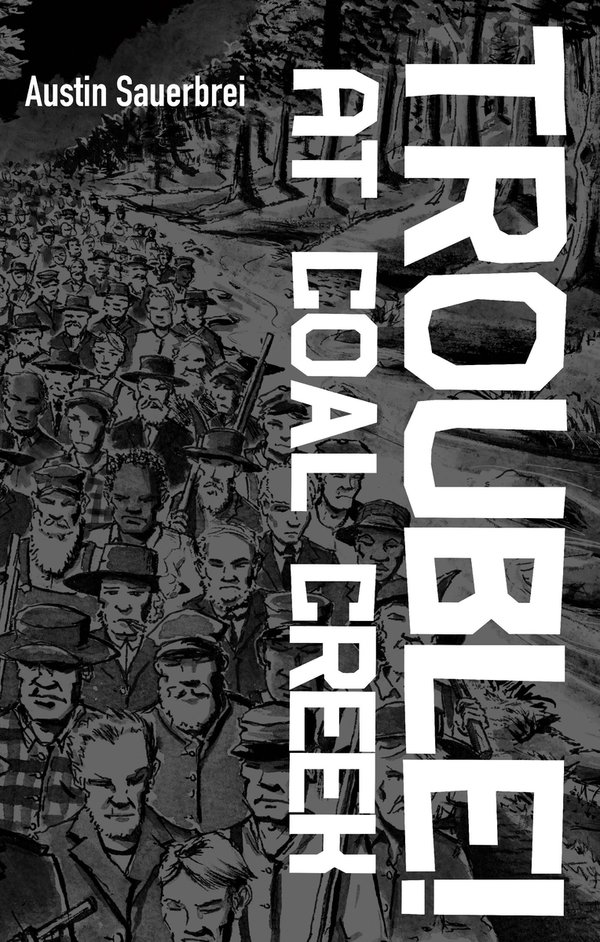
Trouble! At Coal Creek is a historical fiction graphic novel that tells the story of the 1891 “Coal Creek War” through the eyes of a mining family. It follows in the tradition of books like Maus and They Called Us Enemy.
At this point, I would almost classify this style of book as its own sub-genre, fairly distinct from both mainstream graphic novels and traditional historical fiction, with its own style and tropes. Weirdly, after decades of comics being snubbed by the mainstream as childish, the books that managed to cross over have lent a patina of prestige to this particular combination of format and subject matter.
Trouble! was published with grants from no less than three art and education foundations and funds. The author, Austin Saurbrei’s bio describes him as a community organizer with strong union ties. My own political leanings are pretty pro-labor, but I think it’s fair to say that the book is happy to take sides and isn’t trying for a neutral viewpoint. On the other hand, the maltreatment of coal miners in the 1800s was so incredibly nasty that I hope most people with modern sensibilities would find it hard to side with the coal barons.
The story is told by an unnamed narrator whose parents emigrated from Wales to eastern Tennessee, hoping to use Pa’s experience as a miner to build a better life. Ma, Pa, narrator and Sis are sucked into the biscuits cycle of work and debt that mining towns and “the company store” have become synonymous with.
When Ma and a third child die in childbirth, Pa gives up hope of a better life, spending his paltry pocket money and free hours drinking. Sis escapes via marriage into another mining family. The narrator—forbidden from the mines by Pa—gets a job at a local general store. The store happens to be run by a local member of the Knights of Labor, one of the earliest precursors to modern labor unions in America.
The rest of the book chronicles the escalating dispute between coal miners and mine owners. A labor strike is countered by bringing in (largely black, questionably prosecuted) prisoner labor. Miners riot and force out prison labor, only for the Tennessee government to bring it back it through new laws and militia protection. The conflict is shown through the narrator’s family as he and his sister fight for the miners, while their father, oddly, stays loyal to the company.
The book ends on a positive note, the rebellious miners using dynamite to crack open the stockade and free the prisoner-laborers. But the page-long afterword makes it ring hollow, describing how the fights of 1891-1892 weren’t enough to stop convict labor, which continued in some form for another 75 years.
The black and white art is often moody, alternating white and black framing. Recreations of maps, telegrams, posters and newspapers are interspersed with the illustrations to lend verisimilitude. However, despite the often violent subject matter, the book shies away from grit and gore. I suspect it was kept in the PG range to make it an easier sell for classrooms and school libraries.
There is little dialogue in the book. Most of the story is told through voice-over narration, even when the narrator is in the illustrated scene. This, along with the minimal characterization (none of the family have names), gives the story a little too much distance from the fictional characters.
They are there to add some pathos and personal stakes to the historical story. However, that distance makes it hard to be too invested in their plight. Since the rebellion is largely successful in the time period covered, it never really feels like they are in life-threatening danger.
Still, the book is a very easy way into an interesting period of American history; events that I didn’t know in detail, and I expect most Americans aren’t familiar with. The topic is especially salient now, when wealth disparities and the rights of labor are once again a major issue in our politics.
Then again, maybe that could be said for every decade between the Coal Creek War and today.

