
By Manuele Fior (Translated by Matt Madden)
Buy (affiliate link)
Hypericum is one of two graphic novels by Italian authors that I picked up in my recent library excursion. Both involve Italians traveling overseas in the ’90s. Obviously Italy has artistic traditions spanning millennia, but Italian comics are a complete blind spot for me. After these two examples, I’m inclined to seek out more.
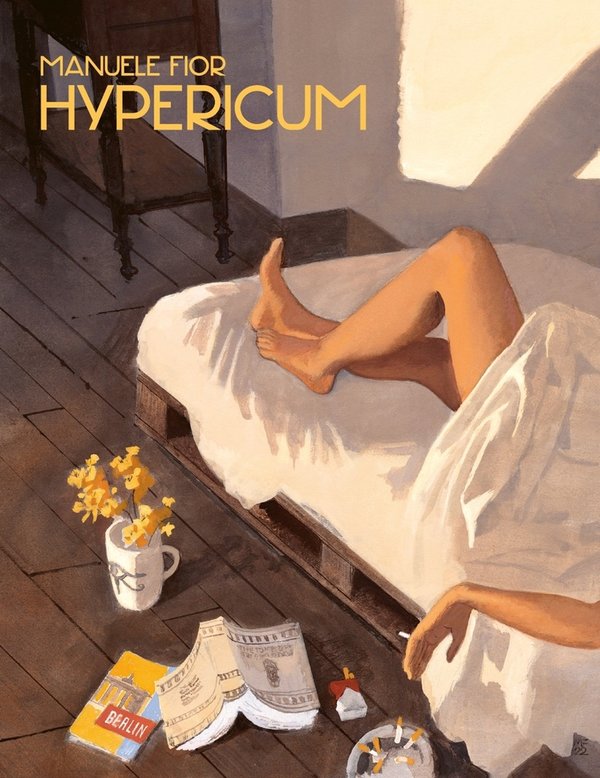
Manuele Fior tells the story of Teresa Guerrero, an Italian student who has come to Berlin in the late ’90s to intern as a scientific assistant preparing an exhibit on king tut’s treasure. Teresa leads a charmed life, one where each event seems inevitable, running, as she says, in “a straight line.”
A chance meeting with fellow Italian expat Ruben breaks that straight line. Teresa thinks a day of exploring the sights of the city is just a dalliance, but she soon discovers that a mix-up has left her without living arrangements. With no other place to turn, she calls Ruben.
Ruben turns out to be a carefree punk, squatting in a building with other like-minded young people. Teresa moves in, thinking it will only be temporary. Instead, things get physical, and they enter a relationship that Teresa finds exhilarating and frustrating in turns.
Teresa has a dark side. She suffers from chronic insomnia. By day, she walks through life like a waking dream, working on Egyptology and her exhibit. At night, awake and exhausted while everyone else is recuperating and peaceful, she becomes depressed and miserable.
Ruben’s glib attitude frustrates her, especially when she discovers that his counterculture lifestyle is actually funded by the family he is constantly complaining about.
The story culminates in a reckoning over their relationship and Teresa’s successful exhibit, which comes with a full-time job offer and a choice about whether to stay in Berlin or to abandon her life in Germany and go home.
Hypericum is informed by Fior’s own time in Berlin, and the backdrop of a freshly reintegrated Germany is rendered as drab and dark or bright and sexy in turns. The characters are slightly stylized, skewing ever so slightly toward cartoony, but never childish.
Alternating chapters follow Howard Carter and the original excavation of Tutankhamen’s tomb, desert scenes blown out with bright sun, underground scenes saturated in darkness.
Teresa’s connection to the excavation goes beyond the exhibit. Within the tomb, Carter finds traces of small yellow flowers that once adorned the king. Called Hypericum by the ancient Greeks and St. John’s Wort in modern day, they turn out to be the one form of medication that may actually help Teresa’s insomnia.
Hypericum is a little bit of history, a little romance, and not quite a fictionalized travelogue. It makes great use of the medium of comics for a story that feels like it wouldn’t be quite the same as a traditional novel or something made for the screen. It’s a great showcase of what modern comics can be.

