
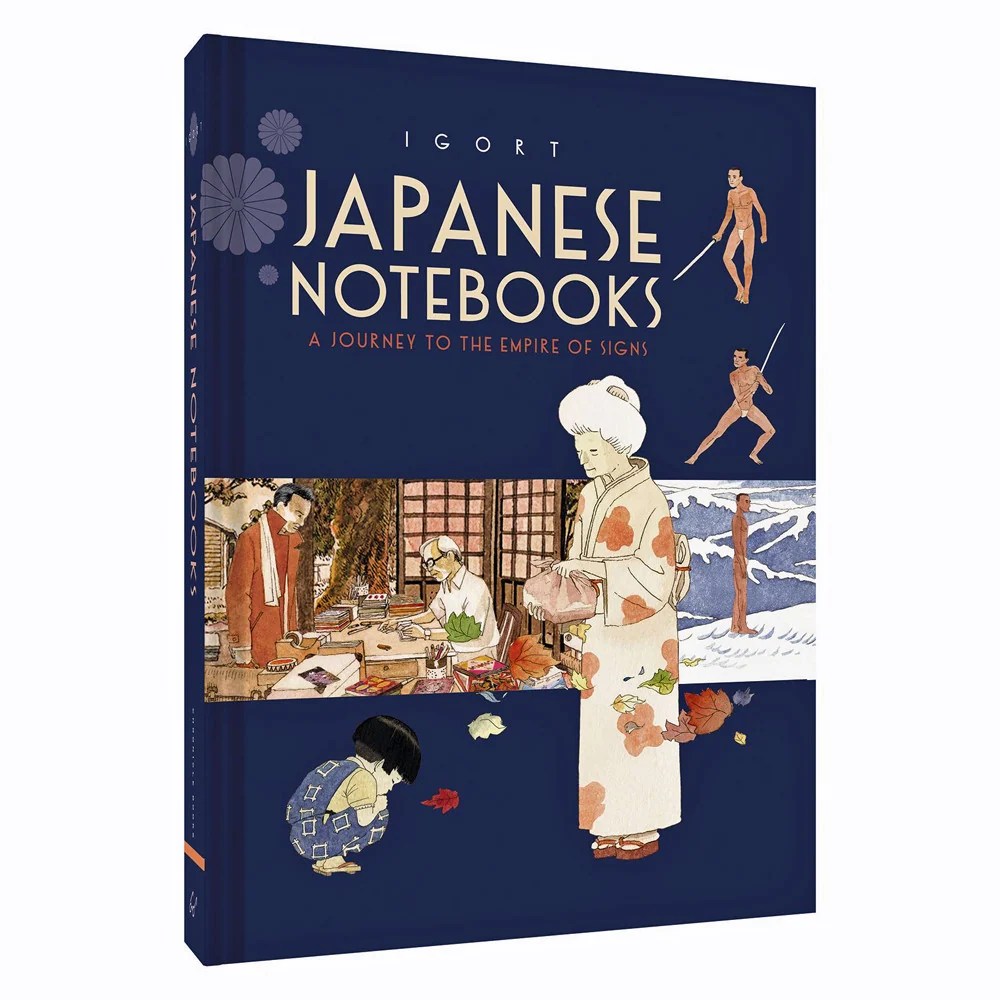

A Journey to the Empire of Signs
By lgort (Igor Tuveri)
Translation by Jamie Richards
This is the second of the Italian-authored comics I picked up recently, after Hypericum.
Part travelogue, part autobiography, Japanese Notebooks documents Igort’s decades-long fascination with Japan, a country he clearly loves. While he found success there, he also experienced deep frustrations with certain aspects of the culture, and seems to have never been able to fully escape the feeling of being an outsider.
As an American, I enjoyed the twice-removed perspective of an Italian in Japan (just as I enjoyed the Italian perspective on post-unification Berlin in Hypericum). Igort also brings the expertise of a prolific professional illustrator to Japan, the country with perhaps the biggest comics culture in the world. There is no attempt to be an objective or impartial observer: this is purely Japan through Igort’s eyes.
The book takes the form of a series of vignettes that span many trips across the years, focused primarily on Igort’s work for manga studio Kodansha. Between these stories are interludes on such varied topics as chrysanthemums, Japanese erotic traditions, Japanese movies, kawaii war propaganda, Burakumin (Japan’s untouchable caste), and Igort’s meeting with legendary Ghibli boss Hayao Miyazaki.
The default style of the illustration is clean and sharp-edged, often with a two-point perspective that puts me in mind of architectural drawings (and in one place, Igort uses this to great effect when illustrating his tiny accommodations). Soft watercolors bring these drawings to life, but also give them a distance that suggests we’re peering into the past.
Across the many vignettes, Igort switches styles as needed to illustrate the topic at hand, including expert imitation of several Japanese styles. It’s a beautiful portfolio, and shows that if the man chooses to stick to a particular style, it’s purely a matter of choice.
The book itself is a very nice form-factor that I wish we saw more in comics. It’s a hard-cover, 7″ x 9.5″, with unusually heavy paper. A little smaller than standard American comics, with a matte finish that suits the watercolors and stands in stark contrast to typical glossy superhero pages.
If you’re one of the many Westerners who finds some fascination in Japan in general or Japanese illustration in particular, this is a fantastic book. Even if you’re not a Nipponophile or otaku, you’ll likely find something interesting here.

