2024 is my year of short stories. In this weekly series, I talk about the stories I’m working on, from idea and draft to submission.
Stories in Progress – 2
Submissions Past Two Weeks – 1
Submissions Currently Out – 5
Rejections This Year – 11 (4 personalized)
This week is the last week of school, so my kids are keeping me busy with concerts and events. I’m also packing and getting everything set up to move house next week. Once again I’ve been slacking on my short story reports, so we’re doubling up this week and last.
Submissions
My first submission for The Bluefinch and the Chipmunk came back with a rejection, so I sent it back out. This was my only submission for the week, although a few other stories should be coming back soon, if the duotrope estimates are anything to go by.
Writing
I finally completed a draft of Red Eyes, a story that I revived from the trunk, although it’s still a pretty big mess. This pass was mostly to find the core of the story and assess what the big, structural problems are. Now I need to take some time to decide how those things should be fixed. I also need to make it shorter, because this story is awfully long.
I’ve been doing a lot of revision lately. This is a good thing, because it’s one of my weaker points and I want to get better. However, too much revision makes me feel like I’m churning on the same stories, so I’m planning to shift focus to fresh stories for a week or two. The first of these will be Portrait of the Artist in Wartime, which I’ve been talking about for a while, but not really working on.
I intend to knock out a half-assed draft just to get a feel for where I want to go with it. Hopefully that will leave me feeling refreshed and ready to tackle more revisions.
2024 is my year of short stories. In this weekly series, I talk about the stories I’m working on, from idea and draft to submission.
Stories in Progress – 2
Submissions This Past Two Weeks – 3
Submissions Currently Out – 5
Rejections This Year – 10 (4 personalized)
Moving
Well, I missed my usual Monday post last week, and as soon as I did, I lost all my blogging ambition. So this week will be a double-whammy and include the stats for last week too.
In exciting non-writing news, I’ll be moving house in about a month. We’re just getting all the paperwork sorted and starting on the packing, but I have no doubt it’ll be a big time suck. We’ve had more than a decade at the current house, and boy oh boy, stuff accumulates. At least it gives us an opportunity to go through everything and do some Spring cleaning. It’ll be a good thing, but it may eat into my writing time in the next few weeks.
Submissions
Luckily, the Year of Short Stories continues full-bore. With more than a quarter of a year under my belt, I’m up to five short stories currently out for submission, and feeling like a proper short story writer.
I finally finished The Bluefinch and the Chipmunk and sent it out. I also found a good themed anthology that accepts reprints, and submitted an old drabble, Haunted, under a new name: Renter’s Dilemma. I also got a rejection on Dr. Clipboard’s Miracle Wonder Drug and sent it out again. I’ve just about exhausted the professional-paying options for this story, so I’m moving on to the semi-pro publications.
New Stories
I’ve noticed that I tend to slow down when I’m working on a single story, so I’ve decided that it makes sense to have a couple irons in the fire. Now that Bluefinch is done, I’m going back to Red Eyes, another story from the trunk that I’m in the process of revising. I’m also working on a fresh story, Portrait of the Artist in Wartime, in the hopes that if I don’t feel like working on one of these stories, I can make progress on the other.
2024 is my year of short stories. In this weekly series, I talk about the stories I’m working on, from idea and draft to submission.
Stories in Progress – 2
Submissions This Week – 0
Submissions Currently Out – 3
Rejections This Year – 9 (4 personalized)
Finishing “The Bluefinch and the Chipmunk”
This week was less stressful than the past few, and I found myself with more time and energy. None of my submissions came back, which meant I could focus entirely on getting The Bluefinch and the Chipmunk done.
I did some more cleanup based on critiques, trimmed it down, and tightened up the new ending. This story has felt close to done for a few weeks, so I was very excited to finally get it finished and ready to send out.
The Joys of Multi-Tasking
Until recently, my plan was to work on Red Eyes after I finished with Bluefinch, since I already have a draft. Then I had a flash of inspiration about a story idea I’ve been calling Portrait of the Artist in Wartime.
I had been struggling with the structure of that story because I wanted to write it as an interview with the main character, but I needed to reveal past events that the character wouldn’t want to talk about.
Now I’m thinking that I’ll alternate between the interview and flashbacks. That will give me a way to access those scenes outside the interview, and allow for some interesting juxtaposition between what the character is saying and what the reader sees actually happening.
So, now I’m planning to work on a rough draft of Portrait. When I’ve had enough, I’ll switch to Red Eyes revisions again. It can be nice to have a few different stories at different stages of completion, to switch back and forth when one feels blocked.
2024 is my year of short stories. In this weekly series, I talk about the stories I’m working on, from idea and draft to submission.
Stories in Progress – 2
Submissions This Week – 1
Submissions Currently Out – 3
Rejections This Year – 9 (4 personalized)
Quick Update
I don’t have much in short story news this week. It turned out to be busy, so I got little writing done. Bluefinch remains just shy of fully revised.
I was excited to discover a brand new, pro-rate-paying magazine that specializes in speculative fiction drabbles: 100-Foot Crow. In fact, it’s so new that it hasn’t actually published yet. The timing is perfect, since I got a quick, personalized rejection for Tom, Dick, and Derek a few days ago.
That’s all for now. I hope to have more news next week.
Anyone who has been keeping up with the blog lately will know that 2024 is my year of short stories. I’ve been writing short fiction and submitting it to publications. As a result, I’ve been using Duotrope quite a bit.
Duotrope includes a database of publisher information and a submission tracker for authors. (It’s not the only one: Submission Grinder and Chill Subs are out there too. Duotrope is just the tracker I’ve been using.) So, I thought I’d write about a few tips and tricks that I’ve discovered that make the submission process a little easier.
1. Search by Title
The Duotrope publisher search has a lot of options, so you might be surprised (as I was), that there is no option for the actual title of a publication.
For some reason, Duotrope decided that this belonged in its own section. The “Find by Title/Name” option in the Search menu gives you the option of inputting a partial or exact name. If you don’t quite remember the name of a publication, you can also try searching by alphabetical index.
2. Find Publishers for a Piece
Once you’ve added a story to your Duotrope submission tracker, it will show up on your “List of Pieces” page under Account -> Pieces.
When the piece is ready to be sent out, you can always search for publishers by manually entering the length, genre, and other parameters. But you don’t have to.
Instead, just click the “Publishers” link next to your story on the “List of Pieces” page. This will automatically populate a search with the information you’ve entered in the piece’s description.
3. Publishing News
The Publishing News section of the site shows publishers that have been recently added. Since brand-new publications are inherently less well-known, they may represent a good opportunity to get a story in front of editors that are hungry for content, with relatively small slush piles.
Publishing News also has a section for publishers that have recently opened to submissions, which can be another good way to find fresh options, especially when those publications are only briefly open to submissions.
4. Track Themes and Deadlines
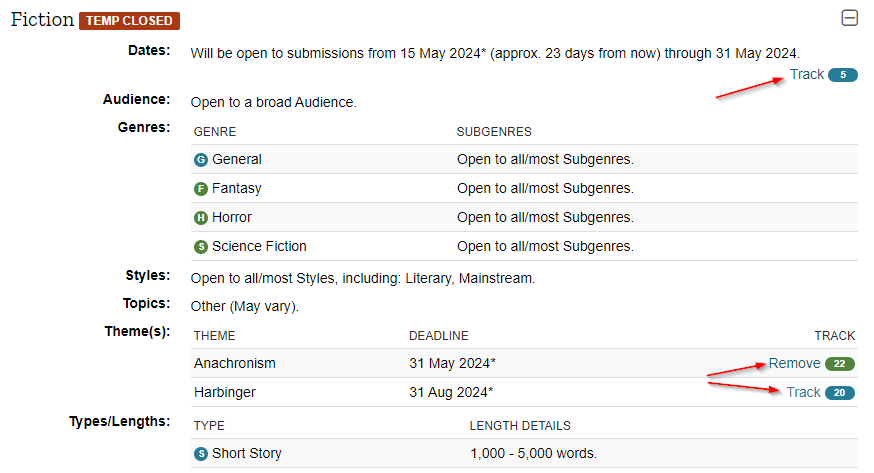
Some publications are only open for submissions during specific windows. This is especially true for themed issues or anthologies. Duotrope can track these submission windows and deadlines.
On a publisher’s detail page, general submission windows will be listed under the Dates heading, and specific themes will be listed under Theme(s). In each of these sections, there will be a Track link and a colored bubble listing the number of Duotrope users who are already tracking.
In the Account menu, you can visit “Themes and Dates” to see a convenient list of everything you’ve chosen to track.
5. Deadline Calendar
Whether or not you’re tracking any Themes or Deadlines, you can access the Theme and Deadline Calendar under the News section of the menu, or from the link at the top of the Theme tracking page.
By default, the calendar shows a list of all the themed submissions and deadlines in Duotrope, but you can filter by genre, payment, or your personal favorite publishers.
6. Overdue Responses at a Glance
Duotrope’s Submissions view shows information for all your tracked stories that are out on submission. It includes a trove of information, including some that makes it easier to decide if you need to follow up.
This view shows how many days each submission has been out, as well as the average response time reported by Duotrope users and the estimated response time provided by the publisher. But the status icon also has four different color options for pending responses.
Normally, the status is gray, but it will turn yellow if the submission has been out longer than the normal response time, and red if it exceeds the publisher’s stated response time. In some cases the publisher may state that they don’t always respond to submissions or don’t respond to status queries. In these cases, the icon will turn purple.
Of course, as with all things, you should confirm the publisher’s information on their website before blindly trusting Duotrope. It’s usually right, but occasionally there are discrepancies.
7. The Reports
Reports may sound dry and boring, but there are a few useful lists available there.
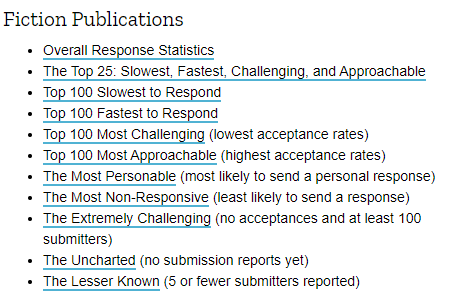
Authors who are sick of waiting for long response times can check the 100 fastest publishers to respond. Looking for feedback? Check the list of publishers most likely to send a personal response. Just trying to get a story accepted somewhere? Consider the list of publications with the highest reported acceptance rates.
What Else?
Do you use Duotrope? Are there any interesting features I missed? If you use a different tracker, I’d love to hear what they offer that Duotrope does not. Let me know in the comments.
2024 is my year of short stories. In this weekly series, I talk about the stories I’m working on, from idea and draft to submission.
Stories in Progress – 2
Submissions This Week – 2
Submissions Currently Out – 3
Rejections This Year – 8 (3 personalized)
Critiques and Rejections
This week, I finished what I started last week and caught up on my Critters critiques.
While not as exciting as an acceptance, I did receive two more personalized rejections in the past two weeks—one from a bigger publication, and one somewhat smaller. Still, it’s always nice when an editor says they want to see more of your work.
Finishing the Finch
I continued to edit “The Bluefinch and the Chipmunk” this week, incorporating all the feedback. I initially thought these would be relatively small, but in the end I found a few bigger changes to make, including a new ending.
For the third week in a row, I think I’m almost done. I’m going to let the story sit for a few days and come back to it with fresh eyes before doing the (hopefully) final cleanup.
2024 is my year of short stories. In this weekly series, I talk about the stories I’m working on, from idea and draft to submission.
Stories in Progress – 2
Submissions This Week – 0
Submissions Currently Out – 2
Rejections This Year – 7 (2 personal)
Critique Week
I received great feedback on The Bluefinch and the Chipmunk, but I always under-estimate how long it will take to incorporate so much feedback. There won’t be any major changes, but I haven’t gotten through all the edits yet.
Once again, it’s clear that stories just over 2000 words get the best response on Critters. Anything shorter only counts for half credit, and people are naturally drawn to shorter stories because it’s the least amount of effort. It’s unfortunate for longer stories, but longer stories are also a lot tougher to sell, so it makes sense to subtly encourage tight word counts.
I’m still surprised, when I receive critiques, to see just how differently people can read the same short story. There’s always at least one response that completely misses a major plot point that everyone else got, and this time, I also got another response saying that the exact same plot point was too obvious.
As mentioned last week, I also submitted a lot of critiques. I didn’t quite get my ratio back up to 100%, but I’m very close.
My 100-word mini-story, Tom, Dick, and Derek came back to me again, with a personalized rejection. I suppose one nice thing about markets that specialize in microfiction is that they can churn through the slush pile relatively fast.
I’ll be sending it out again in the upcoming week, although I’m a little less sure about how well it fits the next couple of publications on my list.
2024 is my year of short stories. In this weekly series, I talk about the stories I’m working on, from idea and draft to submission.
Stories in Progress – 2
Submissions This Week – 1
Submissions Currently Out – 3
Rejections This Year – 6 (1 personal)
Are Drabbles a Long Shot?
I got a rejection and re-sent “Tom, Dick, and Derek” this week. It’s a drabble, and I’m still unsure whether it really has a chance at any publications that don’t specialize in super-short fiction. There are still a couple paying markets that I have lined up for it. If none of those pan out, I’ll see if there are any good non-paying drabble markets out there.
Critique Catch-Up
Critters has a policy requiring members to submit a critique approximately three out of every four weeks—a participation ratio of 75%—to ensure that each submitted story gets a good amount of feedback. I’ve been slacking lately, and my participation ratio has fallen to about 85%. Not a big deal, but I like to stay around 100% so I have a nice buffer.
I decided this week was as good a time as any to catch back up. As an added bonus, Critters offers one “Most Valuable Critter” token to the person who does the most critiquing in a week, so if I write several, I have a chance of getting that. The MVC token is used to send a story straight to the front of the queue (which normally takes 2-3 weeks).
Finishing “Bluefinch”
Speaking of the Critters queue, my story “The Bluefinch and the Chipmunk” reached the top and was sent out this week. I’ve already received a good number of critiques, and I expect a few more to trickle in by Wednesday, when the Critters week ends.
I’ve already begun synthesizing that feedback into changes I plan to make, so hopefully I can finish those final edits and send it out by the end of the week. Unfortunately, between extra critiques and these edits, I have good reasons to put off “Red Eyes” for the week. I’ll get back to it next week.
2024 is my year of short stories. In this weekly series, I talk about the stories I’m working on, from idea and draft to submission.
Stories in Progress – 2
Submissions This Week – 0
Submissions Currently Out – 3
Rejections This Year – 4 (1 personal)
A Little Bit of Burnout
The past two weeks were a one-two punch of stress in my day job and things going on in my personal life, leaving me with less time and energy for writing. While I initially coped with this in the usual way (mild self-recrimination), I decided that I’d try to be a bit healthier and just cut back on writing time until everything leveled out.
Helpfully, all of my stories that were out on submission have remained out, so I was able to spend all of my limited writing time on editing Red Eyes. As expected, it’s going to be a good amount of work to fix it up.
My other work in progress, “The Bluefinch and the Chipmunk,” is working its way through the Critters queue and should go out for critiques in the middle of next week. When I get that feedback, I’ll probably switch over to that story again. It’ll give me a nice break, and once I’ve incorporated reader feedback I’ll have another story ready to submit. Then I can go back to finish up “Red Eyes.”
2024 is my year of short stories. In this weekly series, I talk about the stories I’m working on, from idea and draft to submission.
Stories in Progress – 2
Submissions This Week – 1
Submissions Currently Out – 3
Rejections This Year – 5 (1 personal)
Stories in Progress
This week, I had a single incredibly fast rejection—coming back in less than two days. This is not a small publication either, so that’s quite impressive. It’s interesting how much variation there is—some places ask you to give them 90 days to respond!
I edited “The Bluefinch and the Chipmunk,” which was a fairly quick process. Now it’s in the Critters queue for critique (and on my kitchen counter for my in-house readers). I’ll come back to it later in the month, when I have all that feedback in hand.
Unfortunately, the next old story I’m working on is considerably larger and rougher around the edges. It’s almost 7,000 words, which is getting into territory that will limit the places I can submit it. If possible, I’d like to chop it down to less than 5,000, but I’m not yet sure if that’s something I can manage. It may require some architectural changes.
I’ve got a busy few days coming up, so I fully expect that those edits will take up my writing time for the next two weeks.
Goals for Next Week
Major reconstructive surgery on the story tentatively titled “Red Eyes.”