The Read Report — August 2023

This is the monthly post where I talk about what I’ve been reading. As usual, if you’re interested in any of these books, please use the included Bookshop.org links instead of Amazon. It helps independent bookstores, and I get a small affiliate commission.

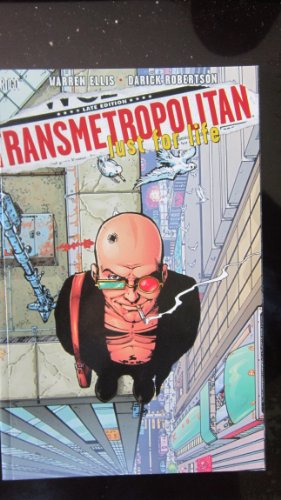
Transmetropolitan (Vol. 1)

Written By Warren Ellis, Illustrated by Derick Robertson

Transmetropolitan has been on my radar for some time, even though I knew almost nothing about it. It was lodged in my brain alongside a bunch of other 90s-2000s non-superhero comics. I’ve recently discovered just how cheaply you can snag slightly beat-up trade paperbacks of old series at places like ThriftBooks, so I went ahead and purchased the first two volumes of the series just to see if I had any interest.

My feeling coming away from the first volume is that Transmetropolitan is weird for the sake of weird, and that particular brand of “edgy” that was popular in this era, but a little silly in retrospect. It is a depiction of the kind of cultural and technological singularity where almost everything is possible and is probably happening just down the street, but the absolutely schizophrenic nature of that kind of chaos doesn’t really jive with telling a deep or particularly coherent story.

The book begins with former journalist Spider Jerusalem living like a wild-man in a mountain-top cabin surrounded by booby-traps. He is naked, heavily tattooed, and clearly hasn’t gotten a shave or a haircut in a few years. We learn that he was the most famous journalist in a nearby city (simply known as The City), and he gave it all up to move out here. Unfortunately, he signed a contract for a book deal, overdue by five years, and now his publisher is threatening to take the money back. So off he goes, back to The City.

Spider breaks into the offices of his old newsfeed, secures a job and an apartment, removes all his hair with a chemical shower, and gets his trademark glasses out of the totally-not-a-Star-Trek-replicator in his kitchen. Then he turns on the news. There are cryogenic defrostees, people uploaded into nanite clouds, and humans surgically turning themselves into aliens and trying to succeed from The City and create their own colony. As it turns out, these will all be plots for subsequent issues.

The first volume didn’t wow me as an introduction. The chaos of The City struck me as an excuse to just throw any sort of futuristic spaghetti at the wall and see what sticks. The characters all range from unpleasant to outright awful, and I have a hard time taking it seriously when the city is called The City and the protagonist has a name like Spider Jerusalem. But hey, it’s the first volume, and a lot of series don’t find their feet right away, so I started in on the next one…

Transmetropolitan (vol. 2)

Written By Warren Ellis, Illustrated by Derick Robertson
I realized partway through this volume that the post-facts world of Transmetropolitan probably seemed more science-fictiony around the year 2000. Nowadays, it’s hardly any different than world outside my window. This certainly isn’t the first piece of sci-fi to satirize politics and religion, only to find that the future went and outdid them. Being subversive and edgy is not a good way to last—yesterday’s shocks are boring to tomorrow’s audience.

I also came to the conclusion that a lot of what rubs me the wrong way about the series is that it’s packed with big, obnoxious allegory. It’s constantly winking and nudging you.

Transmetropolitan doesn’t have an ongoing arc in these first couple volumes. It’s just a series of unrelated stories. This time, we get one about Spider’s assistant’s boyfriend, who decides to download himself into a cloud of nanites. After that, it’s a cryogenically frozen woman who wakes up and discovers that the future is impossible to acclimate to, and that nobody much cares to try and help her. Then there’s Spider’s tour of the “reservations,” hermetically sealed places throughout The City that are built to preserve different cultures and ways of life. Each of these works pretty well as a stand-alone short story, but it didn’t feel like it was building to anything bigger.

Ultimately, I found that Spider Jerusalem was one of the least interesting characters in his own book. It’s possible that some of these disparate threads will eventually weave back together into a larger story, but I wasn’t feeling it after two volumes. I don’t think I’ll be continuing this series.

The Witcher: Sword of Destiny

By Andrzej Sapkowski

This is the second Witcher book that’s billed as a short story collection. And it is, but they end up feeling like more than the sum of their parts. There are bigger arcs happening across these stories, continuing the events from the first book.

In addition to the titular Witcher, Dandelion the bard and the sorceress Yennifer are the other main characters. If there is an overall theme across the book, it’s the angst between Geralt and Yennefer, who are both outcasts and troublemakers in their own ways. They each think they can’t make the other person happy, while also being unable to permanently break things off.

There is also a great deal more world-building happening here, including the first mentions of the Wild Hunt, a mysterious recurring event where ghostly warriors cross the sky and portend disaster and war. These stories are still “low to the ground,” but they incorporate a bit more about the nations and politics of the northern kingdoms.

Of course, it wouldn’t be the Witcher without stories about the interactions between humans and magical creatures, whether that be a shapeshifter stealing friends’ identities or a pompous town mayor in love with a mermaid. It also sets up the series of books to follow, as Geralt meets Ciri, the kid princess whose destiny he inadvertently entwined with his own.

The Sandman: Fables and Reflections (Vol. 6)

Written By Neil Gaiman, Illustrated by P. Craig Russell

Much like Volume 3, Dream Country, this is a set of mostly stand-alone tales where Dream takes on a minor role. There’s a story about Emperor Norton, the real person who declared himself Emperor of the United States of America, a fable about a clan of eastern European werewolves, a tale of young Marco Polo getting lost (and eventually found) in the desert, and story of a spectacular Baghdad, greater than we ever knew it because it was traded into dreams so it might stay perfect forever.

Unlike Dream Country, there are a few things of note that tie back into the broader ongoing plot. For the first time in the series, we actually see “the prodigal,” Destruction, the one member of the Endless who has abdicated his position. We witness a retelling of the ancient Greek tragedy of Orpheus, who is an oracle, and Dream’s son. We see why Orpheus lives eternally as a severed head, and the cause of the rift between him and his father.

These events lead directly into Volume 7, and it really feels like the meandering main story is picking up steam.

The Sandman: Brief Lives (Vol. 7)

Written by Neil Gaiman, Illustrated by Jill Thompson

The issues of this arc are labeled as “chapters,” and this is probably the most linear and focused volume since the first. The beginning pulls together several threads from earlier stories, and the end implies a whole lot of bad things are in store for Dream.

Each chapter begins with a sequence of cryptic phrases, like this for chapter one:

Blossom for a lady

Want/not want

The view from the backs of mirrors

Not her sister

Rain in the doorway

The number you have dialed…

They turn out to be little landmarks in the story, a game where the reader can try to guess what might happen from these tidbits, and then check items off the list as they come to pass. It got me thinking how excellent the whole series is at these little things. From the surreal Dave McKean covers and interstitial art to the introductory quotes to the entertainingly themed credits, the Sandman books feel like absolutely every single element was labored over more than was really reasonable. All the little things add up.

The story of this volume centers around the duo of Dream and his youngest sister, Delirium (who used to be Delight). Delirium’s personality is somewhere between a young child and a lunatic, and you get the feeling that the rest of the oh-so-serious Endless family is perpetually humoring her. She decides to go looking for Destruction, the brother that abandoned the rest of the Endless and made it clear that he doesn’t want to be found. Delirium asks her siblings to help her, but one by one they brush her off. When she comes to Dream, the most serious of them all, it’s a surprise that he agrees to go with her. So the pair set off to find Destruction.

Eventually, we learn that Dream had ulterior motives, and never really expected to find Destruction. But he takes his responsibilities seriously, and since he promised to help Delirium, he turns to the one person who has the power to find the Endless, even when they do not want to be found: his own son, Orpheus. For this favor, Orpheus (a severed head who cannot die) asks his father to end his suffering.

The book ends with foreboding. They find Destruction, only to have him leave again. Morpheus returns to his realm, everything neatly wrapped up, and then reveals his chalk-white hands stained with his son’s blood. It’s made clear that there are consequences for the Endless when they spill family blood. The only question is what those consequences will be…

Small Gods

By Terry Pratchett

Sometimes I look at the Hitchhikers’ Guide omnibus on my shelf and I think sadly about how I’ll never be able to read another Douglas Adams story for the first time. But if there’s anyone who can compare to Adams, it has to be Terry Pratchett. I’m grateful that unlike Adams, he wrote so prolifically.

There are 41 books in the Discworld series, and I’ve been slowly going through them, picking up new ones at Half Price Books whenever I see them. I’m savoring them, because I know eventually I’ll run out.

Small Gods is about an accidental prophet named Brutha, in the desert land of Omnia, where the people worship the god Om. Omnia is a strict theocracy where the church is the central pillar of life, and it’s not uncommon for supposed sinners to have the badness tortured out of them. Faith is of the utmost importance in Omnia, so it’s especially awkward when Brutha discovers that Om is trapped in the form of a turtle with hardly any godlike powers at all, and this is because nobody besides Brutha actually believes in him anymore.

Brutha goes on a hero’s journey, and despite his best efforts he manages to overthrow the Omnian order, restore (real) belief in Om, and generally start making the country a place where people can live their lives without worrying about being randomly tortured.

Small Gods isn’t my favorite Discworld book, but it’s a parody with plenty of laughs and a few sideways glances toward our world. As usual, an average book by Terry Pratchett is quite good by anyone else’s standards.

Harry Potter and the Sorcerer’s Stone

By J. K. Rowling

One of the joys of being a parent is getting to share things you enjoy with your kids. One of the strange things about being a parent of several children (with a few years in-between) is that I’ve shared a bunch of those things with my eldest kids, and my youngest knows nothing about them. So, although I read the Harry Potter books to my eldest son—and my daughter was sometimes in the general vicinity of the reading—I was told that we should read them again. And now we are.

I’ll say here that I don’t agree with Rowling and the garbage she is now known for spewing on social media. I also think it’s fashionable to criticize books by authors who are deemed terrible people. Despite Rowling acting out, I think the Harry Potter books are perfectly enjoyable.

A lot of the complaints about this series are about all the unbelievable aspects of the world-building. There are a lot of problems with the Wizarding World and its interactions with the regular world that just aren’t addressed. And that’s completely true. But I also think it doesn’t really matter.

The odd thing about this series is that it grew up along with its readership. The first book is very much a children’s story, in its form and in the language it uses. It’s not worried about perfectly consistent world-building, any more than Little Red Riding Hood or Goldilocks is, because the shape of the story still works. Part of that is because it borrows from fairy tales, starting with the classic evil step parents (or in this case, aunt and uncle), and the orphan boy who is destined to save the world.

So shockingly, my takeaway is that a super-bestselling book that started a huge pop-culture craze and made more money than some small countries does, in fact, do a lot of things well.

What I’m Reading in September

I’ll continue working my way through the Sandman and Witcher series. I might go for a couple brand-new books about writing that I just got. I also recently compiled a list of highly-rated comics from the last 20 years, and I might start working through some of those.

See you at the end of September.

The Inevitable Fall of the Superhero Movie

I would describe myself as a mid-level comics nerd. I’ve subscribed to comics. I worked at a comics store in high school. I still read comics in trade paperbacks, but rarely the ones with superheroes. I’ve seen at least half of the Marvel movies, although I’ve really cut back in recent years. The last DC movies I saw were the Christopher Nolan Batman trilogy. (But honestly, I’ve never been that into classic DC characters.)

In short, I come at this topic as someone at least reasonably informed, but not quite a super-fan. Unfortunately, from this point of view, I think superhero movies as they currently exist are doomed.

The Structures of Comics

For many years, comics have been primarily periodicals. They exist somewhere in the universe of magazines and newspapers, traditionally printed on cheap paper and published in monthly 30-page installments. You can find many examples of other form factors, but this is the standard, and this has had a strong influence on the structures of the comics industry and the stories comics tell.

Comics follow a structure I call “endless episodic.” There may be arcs to the story, but the overall goal is to keep publishing issues, month after month, year after year. If the story ends, it stops making money. “Endless episodic” naturally trends toward a steady state, a cartoon-like existence where the world and the characters are more or less the same at the end of the story as they were at the beginning.

This steady state is death for good storytelling. If nothing changes, there are no stakes. There is no satisfying resolution. The ending is what provides meaning.

This is one of the reasons why origin stories are so important to superheroes. Often, they are the best story about that character, the only one a non-comics-nerd is likely to know. If the average normie knows anything about Superman, it’s probably that he comes from the planet Krypton, that it blew up, and he was adopted by farmers. If they know anything about Spiderman, it’s probably that he was bitten by a radioactive spider, and that “with great power comes great responsibility.” That’s because the origin story is allowed to have an actual character arc. At the beginning, the hero is just some person, and by the end, they are a superhero. They’ve changed. They’ve learned things. They’ve experienced loss.

Of course, comics writers have long understood this limitation of the form, and they’ve come up with many solutions and band-aids. They’ve ramped up the stakes in each subsequent story arc, saving the city, the country, the world and the universe. They’ve written tie-ins that pull in other, unfamiliar characters to provide novelty and sell more books. They’ve killed off the main character and put a replacement in the same old super-suit. They’ve explored alternate realities.

All of these are ways to create an arc while keeping the endless episodic story going, but you can only squeeze so much juice out of each of these techniques. Readers might get excited by the first or second jaunt into alternate realities, but eventually they’ll get bored. Everybody can only get worked up about the death of Superman so many times when you know he’ll be back in a couple months.

Comics will even go so far as to completely reboot their entire lineup and shared universe, and it’s all because they’re fighting against the intractable problem of endless episodic stories.

The State of Movies

The pandemic had a profound effect on movie theaters and theatrical releases, but the truth is that it only accelerated processes that were already in motion.

Movies today are a luxury item. Theaters have more screens, reserved seating, big fat recliner seats, restaurant food and a full bar. Taking my family of five to a movie is a significant outlay even if we only buy the tickets, and it’s very easy to spend over a hundred dollars on two hours of entertainment. Small, discount, and second-run theaters are essentially extinct.

The big studios are bigger than ever, and they’re putting more money into fewer movies. These bigger tentpole movies are designed to be as safe as possible, and are engineered by committee to appeal to a maximally broad audience.

It is in this environment that the superhero movie has ascended. I don’t necessarily think this environment boosted superheroes into pop culture. It may just be coincidence. However, superhero movies are the flavor du jour, and the current environment has resulted in maximum saturation. Disney spent billions to acquire Marvel and has continued to pour billions into it, and Disney will get its money’s worth. Same goes for DC and Warner, although they’re not quite as good at the money extraction process.

The State of Streaming

It’s easy to forget how young the streaming industry is. Netflix started streaming in 2007, and it didn’t really take off until 2010. The industry rode a decade of steady growth and market expansion into the pandemic boom, and now it’s quite possible that we have just entered the era of flat growth that will become the norm going forward. Prices are rising, everyone is adding commercials, and all of this looks awfully familiar to anyone who saw the rise of cable TV. Nobody knows yet how much people are willing to pay (in cash or commercial attention) or how many different services can coexist.

Early in Marvel’s meteoric rise, they released a few limited series on Netflix. These featured characters ranging from moderately popular (Daredevil) to almost unknown (Jessica Jones). These initial forays into superhero TV were largely self-contained, with real character arcs—although the origin story is always a bit of a freebie. The series were popular enough to warrant second seasons in a couple cases, and eventually a tie-in series that featured the whole Netflix superhero crew.

When the contracts between Disney and Netflix ran out, the new home of Marvel streaming became Disney+, and with this, they doubled-down on integrated stories. The movies told an ongoing, interwoven story, so why not include TV series in that and sell some subscriptions? Just as comics love crossovers to sell more issues across different lines, comics movies love crossovers to sell more tickets and subscriptions.

However, this also begs the question of just how many people are willing to see that many movies per year, and subscribe to the streaming service just to get the “whole story.”

The Present Moment

When the movie studios bought Marvel and DC, they bought a massive back-catalog of superhero stories. Decades of content, some of which is effectively modern mythology, it has so permeated modern society. From this huge backlog, they can pick and choose the best stories…for a while.

The studios wanted a return on their investments, and they have kept their foot on the gas for years now. They have burned through some of the biggest classic comics stories. Eventually they will have to look to more and more obscure and mediocre storylines, all that filler that kept those “endless episodic” stories going. Of course, they could take a chance on a brand new story, but big studios don’t like to take chances.

It seems inevitable that comics movies will fall into the same patterns as comics, only faster. The same forces are shaping them. The more history the movie universes accrue, the more is expected of new viewers to “catch up.” Big, integrated universes become weighed down by their history. The temptations of reboots and alternate universes grow ever stronger. Hell, we’ve already had multiple movies featuring multiple alternate-universe Spidermen.

The flavor du jour of movies will change. Just like Westerns, superhero movies will eventually discover that they can’t command the same budgets they once had. There will be less room for incredible effects and star-studded casts, and these are integral parts of the modern superhero movie formula.

There are even signs that the super-fans are tiring. I wasn’t even aware that there was a Secret War series on Disney+, until a wave of nerd-rage and complaining washed over Twitter. As someone who hasn’t watched these series, it was quite the contrast to the excitement that followed Wandavision or Loki. And even if you ignore bombs like Morbius, people just don’t seem to be talking as much about the current crop of movies as they did in the era of Endgame (or even Justice League).

The Future

People have been debating whether big-budget superhero movies have peaked for nearly the entire time studios have been making them. We could debate whether now is an inflection point, but it doesn’t really matter. It seems inevitable to me that there will be a hard turn sooner or later, followed by a significant decline. Nothing lasts forever.

As a somewhat-invested comics fan who is burnt-out on Marvel and DC, I think I’m a reasonable bellwether for the broad audience. Super-fans might stay invested longer.

On the other hand, the genre won’t go away completely, and that’s a good thing. Projects like the Spider-verse films and “off-brands” like Umbrella Academy or Sandman show the possibilities of less-integrated properties, less focus on classic superhero archetypes, and eschewing the “endless episodic” formulas.

Superhero movies are, in some ways, burdened by the need to be the 900lb. gorilla at the top of the hill. If budgets shrink and opportunities dwindle, it will force some limitations on the genre, and limitations breed creativity. If movies and shows are given smaller budgets, the people in charge of the money may be more willing to dig into the many weird and interesting corners of comics, taking on riskier projects on the chance that they hit big.

I’m hopeful that the future of comics movies will be filled with cheaper, smaller things, and more innovation. I’d love to see more exploration of less mainstream titles. I think the massive shared universes will eventually collapse, although I doubt any media based on comics can completely escape the gravity of cross-overs, alternate universes, and reboots. Even if the number of releases and the budgets decrease, the future of superhero media is bright. In fact, it’s likely to be better than an alternate universe where they remain big-budget blockbusters forever.

What I Learned From The Unwritten (Part II)

Last time, I took some lessons from the first four volumes of The Unwritten. This time, I’m going to look at volumes 5-8. These volumes encompass some interesting turning points in the series. The heroes seem to have defeated the “bad guys,” even if it does come at a high cost. The mysteries deepen, a few new major characters are introduced, and some old characters come back.

What really makes these volumes great is that they don’t just continue the story that was started in the first four. They take it in new and unexpected directions. Each question that gets answered introduces yet more questions. All in all, it sets up the last three volumes so that you really have no idea what to expect as the story comes to its conclusion.

Moving the Goalposts Can Be Exciting

The first few volumes set up a shadowy cabal as the villains who cause all sorts of trouble for the protagonists, especially their chief henchman, Pullman. All of the bigwigs in the cabal are largely interchangeable and never characterized in much detail. It’s Pullman who is causing trouble on the ground for the heroes while the leaders of the cabal are safely hidden, and he’s the one they have to worry about. But Pullman is also the one villain who is given a back-story, revealed in drips and drops.

When the heroes actually have some success bringing the fight to the shadowy cabal, it might seem obvious that Pullman is just a Man in Front of the Man trope. But his motives turn out to be quite different from a “standard” villain. Almost exactly halfway through the story, the entire direction of the plot turns in a new direction.

Tropes are dangerous. If the reader thinks you’re just retelling a story they’ve heard before, they’ll quickly lose interest. However, tropes can be useful building blocks if you want to subvert expectations.

Tropes are just story elements that show up over and over again. They’re the canyons gouged by the flow of stories over the centuries, the comfortable shapes that stories like to fall into. A savvy reader will see parts of a trope and anticipate that the rest is forthcoming. However, you can make them a little less certain by including some elements that break the trope. Eventually, you can tear the trope apart in some unexpected plot twist, and it can be immensely satisfying. 

Sometimes these twists seem obvious in hindsight, but as a reader it’s very easy to get pulled into those deep currents that tropes provide. It’s a great way to disguise where the story is going.

Exposition Can Be a Reward

The Unwritten is great at introducing characters right in the middle of something. Tom Taylor’s dull life is turned upside down within the first few pages of the first volume. Lizzie sets those events in motion, but not in the way that she hoped. And Ritchie meets Tom in a French prison right before it explodes into chaos. The story forces the reader to hit the ground running. First, it shows you who the characters are and makes you care about them. Only then, and slowly, does it start to reveal their back-stories and the paths they took to get here.

By making you care about the characters first, the story makes exposition exciting. We want to know more about these people. How the heck did they get in these situations?

If these parts of the story were told in sequential order, they would be less interesting. They’re the lead-up to the exciting action that makes up the bulk of the story. But by withholding them for a while, they become a reward for the reader. Even better, they offer an opportunity to understand why the characters are the way they are. Learning about the events that shaped them provides new context to everything they’ve done so far in the story.

Epilogues Can Be Prologues Too

Almost every volume of The Unwritten, each major story arc, ends with a seemingly unrelated episode. After seeing the latest exploits of Tom, Lizzie and Ritchie, we might be transported to the Winnie-the-Pooh-inspired Willowbank Wood, to meet Pauly the lovable rabbit, who sounds a lot like a New Jersey mob thug and seems a bit out of place. We might be taken back a century or three to see the exploits of various famous storytellers and how they became entangled with the cabal. Or we might meet Daniel, a directionless young man with a degree in literature who finds himself taking a job that involves reading books all day with hundreds of other people in a featureless underground bunker.

Each of these little stories is an abrupt jump to a new time and place, with new characters. Each one eventually ties in to the main plot, but when the reader first encounters them, they seem like non-sequiturs. In this quiet lull at the end of an arc, when the story has just answered some questions and provided a small, satisfying conclusion, a brand-new big mystery is introduced. Namely, “who are these people and what the heck is going on?”

The next volume invariably jumps right back into the story of Tom et al., leaving these epilogues hanging unresolved for a while. Later on, when they tie back into the main story, there’s an “aha!” moment. These parts of the story are made more exciting simply by being told out of order. They’re also a great way of keeping up the tension in the parts of an episodic narrative where tension has just been relieved (at the end of an arc).

But Wait, There’s More…

The Unwritten is a big series, and I have one more post in me before we get to the end. Next time I’ll be covering the last few things I learned from the final volumes: 9-11. See you then.

What I Learned From The Unwritten (Part I)

The Unwritten is a Vertigo comics series published from 2009 to 2015, written by Mike Carey. I picked up the first few trade paperbacks by sheer chance, when my wife found them at a garage sale and thought they looked interesting. After devouring those four, I bought the remaining seven books in the series.

The Unwritten takes place in a world similar to ours, and follows Tom Taylor, whose father published a massively best-selling series of books starring a boy wizard named Tommy Taylor. Tom makes a meager living on the convention circuit by virtue of being the character’s namesake. Early in the story he becomes the target of a secret society that uses stories to manipulate and control the world, and finds out that his father was somehow involved with them as well.

The Unwritten is a modern comics masterpiece that intertwines its own original story with real history and dozens of famous works of fiction. It starts with the classic idea that stories have the power to change the world, and then asks what would happen if that were literally true.

This is a big series of books, so I’m going to cover it in a couple posts. First, volumes 1–4.

Everything is a Gun on the Mantle

Callbacks are powerful, and The Unwritten makes liberal use of them. Characters  are often introduced in short scenes where it’s not entirely clear what’s going on. The story steps away, only to revisit them later and explore them more deeply. Scenes from the Tommy Taylor novels and from other works of fiction are shown early in an episode and become relevant later on. And some ideas keep coming back again and again, like the vampire, Ambrosio, never quite being dead for good.

These callbacks use the principle of minimum necessary information to pull the reader along without bogging down the story. But they’re not just one-and-done. In Damn Fine Story, Chuck Wendig calls this “echoing.” The gun on the mantle need not be thrown away as soon as it’s fired. It can be fired again and again. It can turn out to have historical significance and emotional significance. This layering of narrative makes the reader feel rewarded for simply paying attention, seeing these through-lines keep building and building.

The Unwritten covers a lot of history, back to the very first stories and ahead to the end of the world. But that history is doled out carefully, in small helpings. It takes most of the series for the reader to finally see the whole picture. Each new plot twist seems inevitable, because the groundwork was laid for it by the elements that came before.

Leave Breadcrumbs

I skimmed through the books again as I was writing this, and I immediately discovered several tiny references that I had missed the first time around. These were little clues about what was going on, and which mysteries would become important later. Missing them didn’t hurt my enjoyment of my first read-through, although I’m sure they’d add to the experience of a reader who caught them. Perhaps it’s even better to catch them on a re-read, and discover that I can still find new things in a story whose shape I already know.

Breadcrumbs like these also give the reader an important sense that the author knows where the story is going, which is particularly relevant in episodic media like TV and comics. Many of us have been burned by stories like Game of Thrones or LOST where the authors threw down exciting mysteries and conflicts, but couldn’t come up with commensurate payoffs because they didn’t have a clear plan for the end. Breadcrumbs and callbacks let the reader know that the author is leading them somewhere. It’s hard to enjoy a story until you trust that the author is going to bring you somewhere interesting.

Form Follows Function

The Unwritten plays with a variety of different forms. News broadcasts show up in several places as a series of small TV stills with a ticker along the bottom of the “screen” and the voice-over text just below. There are also times when the characters are browsing the web, and pages of various sizes and shapes are shown shuffled and overlapping, to give the sense of time passing in a jumble of scattered information.

Stories from ancient and recent times are interwoven into the narrative, and are illustrated in different ways. The medieval Song of Roland has washed-out colors and heavier line work. The Tommy Taylor books-within-the-book are slightly more cartoony. Dickens looks like woodcut. The Winnie-the-Pooh-inspired fictitious Willowbank Wood is all pastel watercolors. The Nazi propaganda Jud Süß is black and white, with the red of swastikas providing the only color.

Beyond the visual style, the prose itself changes between these different types of stories. Even more interesting are narrative jaunts, like the issue that reveals Lizzie Hexam’s past. Rather than give the reader a definitive version of events, we get a choose-your-own-adventure story, and different branches paint the characters as sinister or sympathetic, in their own control or manipulated by others. The result is a character whose back-story exists in a quantum superposition of different states.

Sometimes, the way the story is told is what makes the story worth listening to. Memento just isn’t a very interesting story if it’s told linearly. House of Leaves would lose its punch without the multiple frame stories and the parts where the text starts wandering around the page and turning back on itself. The ordering of the narrative and the presentation are the layers of the story that the reader directly interacts with. Even if they aren’t the “meat” of the story, they are responsible for a lot of the flavor.

More to Come

Next time, I’ll dig into volumes 5–8.

Reference Desk #11 —Writing Comics

I recently read two of Scott McCloud’s lauded books about comics: Understanding Comics and Making Comics. These books have been around for decades, but they hold up well. And when comics treatises are praised by the likes of Art Spiegelman, Jeff Smith, and Neil Gaiman, you can be pretty sure there’s something good in there.

I wouldn’t say I’m a full-on comics nerd, but I did work at a comics shop in high school, and I have a respectable number of comics on my bookshelf and e-reader. I know what I like and dislike. And while I occasionally dabble in visual arts like drawing and painting, I’m happy to be a semi-competent amateur when it comes to producing visuals. As a writer, I’m much more interested in the craft of writing for comics. That’s the perspective I brought to reading these books.

Understanding Comics

This book is, first and foremost, a comic. McCloud understands that the best way to describe the medium of comics is within the pages of a comic. He is an adept artist and writer, rendering his ideas clearly and gracefully, with a dash of silliness here and there.

McCloud has a style that appeals to my personal tastes — he loves to define and categorize. He describes the medium of comics by breaking it down into bite-sized pieces, then showing how those pieces can be combined to build new and interesting things.

First, he goes through pages of effort to justify his chosen definition of comics: “Sequential Art,” or more precisely, “Juxtaposed pictorial and other images in deliberate sequence, intended to convey information and/or to produce an aesthetic response in the viewer.” He gives a brief history of art that fits this description, from native Mesoamerican codices to the Bayeux Tapestry to Egyptian tomb paintings, and on into more modern examples. This may sound like dry academics, but it’s much more palatable in comic book form.

Next, he discusses iconography and the complex spectrum between words and pictures; how symbols can be more relatable than realism. He categorizes the ways that a reader infers movement across time and space between the juxtaposed images of a comic, in the “gutters.” He shows the ways that words and pictures can interact together to create unique effects within comics.

Finally, he finishes the book with a broad manifesto describing all art as a series of layers, with some art at the shallow surface level, and some digging deep into other layers. This ties into the comics stuff, but it’s more like his ideas of how to make great art.

McCloud is a great observer of comics. He describes many techniques that I’ve seen before, but his categorization and explanation allowed me to understand how they work, and what they’re good at. This book is not prescriptive, it’s descriptive: it’s a fantastic description of comics from his vantage point as an articulate insider.

Even though this book doesn’t describe comics in a “how to do it” manner, it’s incredibly useful for aspiring creators. It provides framework and language for understanding the medium. These are vital tools in the creator’s toolbox.

Besides, when it comes to creation, there’s a related book called…

Making Comics

Making Comics is another comic about comics. It takes many of the concepts from Understanding Comics and uses them as a foundation. This is much more of a how-to manual, split pretty evenly between visuals, words, and general storytelling principles.

Since my interest is in writing, not art, I skimmed some of the more technical parts related to drawing recognizable expressions and body language. I focused on the parts relating to writing, storytelling, and the way the words and pictures work together.

This book will be most useful to the indie comic artist, who wants to draw and write everything themselves, or perhaps writer-artist duos. McCloud does everything, so that’s the perspective he writes from.

There is a bit less in here for someone like me, who is only interested in the writing, despite it being a thicker volume than Understanding Comics. Still, Making Comics is a valuable book, worth reading if you’re interested in any aspect of comic creation. It solidifies some of the abstract concepts of the first book in more hands-on examples.

Am I an Expert Yet?

Reading these books didn’t make me want to immediately write a comic. But that’s a good thing. They do a great job showing how deep comics can go as an art form, and that’s a little intimidating. They showed me enough to realize I’d need to put in more effort before I think about starting a comics project.

I think my next step will be to re-read some of my favorite comics and analyze what makes them great. McCloud’s books have given me the tools to do that analysis. I know I like the stories, but how are they using the medium, the “juxtaposed images in sequence,” to tell those stories so effectively?

I also want to look for good examples of comics scripts, just to learn the ins and outs of formatting. I know there’s an annotated Neil Gaiman Sandman script in some edition or another of those books, and I’m sure there are other examples floating around. I get the impression that comics script format is a bit less rigid than TV and movie scripts.

As I continue to dig into writing for comics, I’ll come back and post more updates. If you have any interest, these two books are a great starting point. And if you’ve come across any other great resources for comics writing, let me know in the comments.